- English
- ePUB (mobile friendly)
- Available on iOS & Android
eBook - ePub
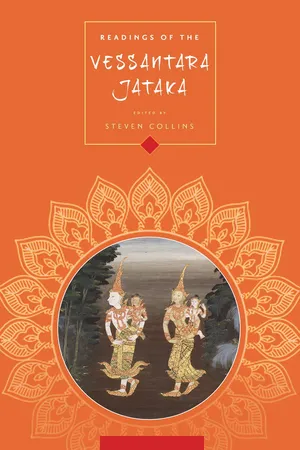
Readings of the Vessantara Jātaka
About this book
The Vessantara Jataka tells the story of Prince Vessantara, who attained the Perfection of Generosity by giving away his fortune, his children, and his wife. Vessantara was the penultimate rebirth as a human of the future Gotama Buddha, and his extreme charity has been represented and reinterpreted in texts, sermons, rituals, and art throughout South and Southeast Asia and beyond. This anthology features well-respected anthropologists, textual scholars in religious and Buddhist studies, and art historians, who engage in sophisticated readings of the text and its ethics of giving, understanding of attachment and nonattachment, depiction of the trickster, and unique performative qualities. They reveal the story to be as brilliantly layered as a Homeric epic or Shakespearean play, with aspects of tragedy, comedy, melodrama, and utopian fantasy intertwined to problematize and scrutinize Theravada Buddhism's cherished virtues.
Information
Subtopic
Art asiatique

READERS IN THE MAZE
MODERN DEBATES ABOUT THE VESSANTARA STORY IN THAILAND
Louis Gabaude
THE MAZE is a universal symbol of initiation and spiritual quest. In the Middle Ages, Christians could trace their way into salvation through a labyrinth engraved on the pavement of European cathedrals. Now, the Shan of northern Thailand walk into their future through a wooden or bamboo maze they have built in their temple, trying their best to get to the central point, an image or a miniature replica of an ashram. Some monks explain the game as an exercise reflecting the hits and misses of life one has to experience before the final liberation from desires. A more down-to-earth belief promises success in this life to whoever manages to reach the center.
The maze set up by the Shan people is no ordinary maze. It has a precise location and reference in the Buddhist literature and worldview, right at the core of the last previous life of the Buddha, simply because it is called Mangkapa in Shan1 and Wongkot in Thai—the very name of the Vaṅkatapabbata Mountain2 where Prince Vessantara took refuge and where the old Jūjaka wandered before finding the two children as servants for his young wife. The central point is supposed to be Vessantara’s ashram, and sometimes there is a second one for Maddī and the children. Other ashrams may be found too, in sets of five named according to the five buddhas of the present cosmic eon.
Today, like Jūjaka, modern Thai listeners and readers of the Vessantara Jātaka (hereafter VJ) still do wander, and sometimes feverishly, but in a forest of symbols and a maze of meanings, searching for a Vessantara they will naturally pretend in the end to be the real one. The questions asked in the introduction by Steven Collins about the possibly excessive moral code of Vessantara are not simply Western theoretical inquiries concocted in a distant ivory tower. The fact is that the story has confused and disoriented the East too, from at least the time of King Milinda and Nāgasena. In Thailand, it has generated hot debates among elite as well as common voices. All have found and painted our hero together with his foils under various lights, shades, and colors, depending on their quest for formal, social, or spiritual interests.
In addition to innumerable expressions in iconography, the tale is known through hundreds of literary versions in the Buddhist Asian world, both scholarly and popular. It is also known, as a number of contributors to this volume attest, in rituals, whose climax is the recital of the story, often acted out as a form of theater. This ritual celebration was justified and popularized, perhaps even created, by the story of the monk Māleyya, who came back from his journey in hell and heaven to report that whoever listened to a reading of the entire VJ during less than twenty-four hours would be reborn in the world at the time of the next Metteyya Buddha.3 Such an aspiration was made more urgent by the prediction that, during the gradual disappearance of Buddha Gotama’s teaching, this tale would be the first within the book of the jātakas to vanish. Often at the very beginning of the celebration, people try to propitiate natural forces by inviting Upagupta, the exemplary disciple of the Buddha whom Māra was not able to vanquish, to participate.4
This chapter will examine two kinds of modern reaction to VJ. The first attacks it in the name of modern values, the second vindicates it in the name of “eternal” values.
CRITICISM OF THE
VESSANTARA JĀTAKA
VESSANTARA JĀTAKA
Certainly, the extreme generosity of Vessantara’s behavior did not start to shock readers only in the twentieth century. But the controversy was before that time the main reason people were interested in the tale, since it increased the dramatic intensity of the realization of the Perfection of Generosity. However, during the past 150 years criticisms have developed that have questioned either the historical accuracy of the previous lives or their exemplary moral value, their political neutrality, or the very religious system they convey.
Critique of Authenticity
While opening to the “scientific” ideas of the Western world, Thailand received, among other things, its critical theories of religious texts, which were used, sparingly but significantly, by Prince and then King Mongkut.5 At the end of the nineteenth century, Gerini saw that members of the royalist and reformist sect of the Thammayut generally did not organize recitations of VJ since they considered it not to be the “Buddha’s word.”6 The king at the time, Chulalongkorn, actually thought that the jātaka-s were popular fables that the Buddha had simply reused for giving moral lessons, and that it was only later that he had been turned into this “Great Being,” the hero of each tale, to strengthen their authority. Even later, he thought, correspondences between the characters of the jātaka-s and those surrounding the Buddha were added to vindicate even more the theory of the ripening of action, kamma, by claiming that the fable was history.7
Put into play by royal and religious authorities, this first critique of the historical value of the previous lives of the Buddha was soon controlled, channeled, and balanced by the later hermeneutical theory of Bhikkhu Buddhadasa, which was actually traditional; it permitted the literal content of the tales written in “personal” language (puggalādhiṭṭhāna) while interpreting them according to their “doctrinal” meaning (dhammādhiṭṭhāna). This kind of criticism of authenticity intended no more than to salvage the essential, the original, the genuine.
Moral and Economic Critique
A second wave of challenges appeared, especially in the 1960s and 1970s, that radicalized the internal criticisms of Vessantara’s behavior already found within the tale. However, it was further based on the requirements a “developing country” was supposed to follow. This kind of criticism is illustrated by the reply Kukrit Pramoj wrote to a letter from a reader. (Kukrit, at that time already the director of a newspaper and a successful literary author, had not yet grown into a full political figure: he was to be appointed Prime Minister in 1974.) Like his Thammayut masters, Kukrit asserts first that the story of Vessantara is not to be found in the canon and that he himself believes “in the Buddha, but not in Vessantara”! The most problematic issue, for him, is not authenticity, but rather the corrupted lesson that the tale claims to give. Vessantara cultivates the virtue of generosity, disregarding ordinary morality. Imitating him without understanding would end up ruining the basic principles of contemporary society.
Vessantara first cultivates generosity at the expense of general welfare: he gives disproportionate alms from the state revenue, and during his exile society still needs to pay a hunter to protect him against people who might ask him for money. Vessantara is “a king who fails to keep the morality of kings”; in other words, he fails to obey the national interest: he knows that his rain-bringing white elephant is an important element in the natural, seasonal balance and that it guarantees the prosperity and happiness of his people. He nevertheless gives it away, knowing that the people will have to suffer the consequences: “it is absolutely normal that the people got rid of him.” Vessantara is “a husband who fails to keep the morality of husbands”: far from protecting his wife, Maddì, making her happy, and being lavish with her according to their social status, he lets her slip into poverty and even gives her away to another man “as if she were not a human being.” Vessantara is a “father who fails to keep the morality of fathers”: he does not protect his children or make them happy. He accepts seeing them beaten in front of him by Jūjaka.
The writer finally attacks what he sees as two “flaws” of contemporary Thai society: corruption and the inability to develop economically. One must first cultivate generosity in a moral fashion, and not steal or cheat in one place and then be generous in another by funding new hospitals. The budget of a university should not be used to show off with a major gift when the king comes to visit. It is necessary, during this phase of economic development, to “teach Buddhism with intelligence by examining the ins and outs of it so that it does not impede development: if the government supports rural development with millions of dollars but farmers then use all their revenue to build pagodas so that they can acquire merit, they will continue to live in huts for a long time and the development will have been worth nothing.”
Appearing in his newspaper as a guru who gives advice about everything, particularly about Buddhism, Kukrit does not challenge the religion from the outside; nor is he a royal figure whose opinions cannot be challenged. He already belonged to the Thai political world and was neither external nor supposedly neutral to political institutions. To put it simply, he was a conservative who, cherishing both Buddhist and monarchical traditional institutions, allowed himself to give his opinion regarding how Buddhism should be taught so that civil society and economic society would not be threatened. The criticisms he voiced against VJ on the one hand, and against the teaching of Buddhadasa about the empty mind on the other hand,8 follow the same logic.
It is probably difficult for a non-Thai to imagine the scandal that such a statement could cause for the dominant religious ideology, which considered the existence of Vessantara to be the culmination of all the previous lives of the bodhisatta, and hence to offer an individual and social model that all beings and society are supposed to emulate. We will measure a little the extent of this scandal by investigating below the responses that Kukrit’s criticism provoked. But we first need to pay attention to a new kind of challenge faced by the Vessantara.
Political Critique
The challenges examined so far all came from people who presented themselves as Buddhist and claimed to provide the most genuinely Buddhist interpretation of VJ. Nevertheless, each criticism necessarily presupposed a dividing line between itself and the traditionally received interpretation, in terms of historical or moral authenticity. But this dividing line never set the critics at a distance from the Buddhist institution as a whole. This is, however, the case with a position held by university professors or scholars that challenged the exclusively religious nature of VJ, i.e., its political neutrality. Even if he doubted the political common sense of the hero of the fable, Kukrit could hardly imagine that the kings of Thailand, whom he generally held in high regard, would have wanted to use the popularity of VJ for Machiavellian purposes. This is what was claimed by some university professors in the 1970s, whose main opinions I will now present in a general way, drawing on a book by two such scholars, Sombat Chantornvong and Chaiʻanan Samutwānit.9
They highlighted first of all the constant collusion between political and religious authorities in Buddhist countries and illustrated this fact with the political intentions behind the composition of a version of VJ called “Mahachat Kham Luang” ordered by King Trailokanat of Ayuthaya in 1482. Trailokanat was a clever political leader who succeeded in unifying the two kingdoms of Sukhothai and Ayuthaya. To this end, he highlighted as much as possible his religious identity, in two ways: he built and restored pagodas in both kingdoms and had himself ordained as a monk, following the example of the kings of Sukhothai.
Sombat and Chaiʻanan point out that for some people this version was perhaps the first to include, besides the Pali text, a poetical translation in vernacular language. While they recognize that the text could not have had much influence over the reign of Trailokanat, since it was written at the end of it, they consider that it was a key instrument in spreading the ideology of merit during the next centuries. For them, it is an obviou...
Table of contents
- Cover
- Series Page
- Title Page
- Copyright
- Contents
- Preface
- Introduction, Dramatis Personae, and Chapters in the Vessantara Jātaka
- 1. Readers in the Maze: Modern Debates About the Vessantara Story in Thailand
- 2. Emotions and Narrative: Excessive Giving and Ethical Ambivalence in the Lao Vessantara Jātaka
- 3. Blissfully Buddhist and Betrothed: Marriage in the Vessantara Jātaka and Other South and Southeast Asian Buddhist Narratives
- 4. Jūjaka as Trickster: The Comedic Monks of Northern Thailand
- 5. Narration in the Vessantara Painted Scrolls of Northeast Thailand and Laos
- 6. A Man for All Seasons: Three Vessantaras in Premodern Myanmar
- 7. Vessantara Opts Out: Newar Versions of the Tale of the Generous Prince
- Index
Trusted by 375,005 students
Access to over 1.5 million titles for a fair monthly price.
Study more efficiently using our study tools.
Frequently asked questions
Yes, you can cancel anytime from the Subscription tab in your account settings on the Perlego website. Your subscription will stay active until the end of your current billing period. Learn how to cancel your subscription
No, books cannot be downloaded as external files, such as PDFs, for use outside of Perlego. However, you can download books within the Perlego app for offline reading on mobile or tablet. Learn how to download books offline
Perlego offers two plans: Essential and Complete
- Essential is ideal for learners and professionals who enjoy exploring a wide range of subjects. Access the Essential Library with 800,000+ trusted titles and best-sellers across business, personal growth, and the humanities. Includes unlimited reading time and Standard Read Aloud voice.
- Complete: Perfect for advanced learners and researchers needing full, unrestricted access. Unlock 1.5M+ books across hundreds of subjects, including academic and specialized titles. The Complete Plan also includes advanced features like Premium Read Aloud and Research Assistant.
We are an online textbook subscription service, where you can get access to an entire online library for less than the price of a single book per month. With over 1.5 million books across 990+ topics, we’ve got you covered! Learn about our mission
Look out for the read-aloud symbol on your next book to see if you can listen to it. The read-aloud tool reads text aloud for you, highlighting the text as it is being read. You can pause it, speed it up and slow it down. Learn more about Read Aloud
Yes! You can use the Perlego app on both iOS and Android devices to read anytime, anywhere — even offline. Perfect for commutes or when you’re on the go.
Please note we cannot support devices running on iOS 13 and Android 7 or earlier. Learn more about using the app
Please note we cannot support devices running on iOS 13 and Android 7 or earlier. Learn more about using the app
Yes, you can access Readings of the Vessantara Jātaka by Steven Collins in PDF and/or ePUB format, as well as other popular books in Théologie et religion & Art asiatique. We have over 1.5 million books available in our catalogue for you to explore.