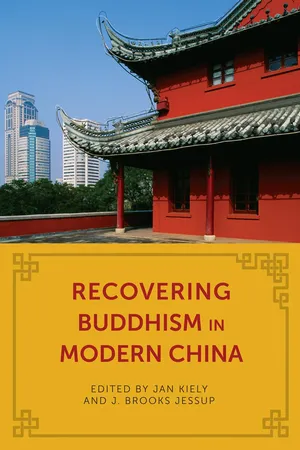
Modern Chinese history told from a Buddhist perspective restores the vibrant, creative role of religion in postimperial China. It shows how urban Buddhist elites jockeyed for cultural dominance in the early Republican era, how Buddhist intellectuals reckoned with science, and how Buddhist media contributed to modern print cultures. It recognizes the political importance of sacred Buddhist relics and the complex processes through which Buddhists both participated in and experienced religious suppression under Communist rule. Today, urban and rural communities alike engage with Buddhist practices to renegotiate class, gender, and kinship relations in post-Mao China.
This volume vividly portrays these events and more, recasting Buddhism as a critical factor in China's twentieth-century development. Each chapter connects a moment in Buddhist history to a significant theme in Chinese history, creating new narratives of Buddhism's involvement in the emergence of urban modernity, the practice of international diplomacy, the mobilization for total war, and other transformations of state, society, and culture. Working across an extraordinary thematic range, this book reincorporates Buddhism into the formative processes and distinctive character of Chinese history.
eBook - ePub
Recovering Buddhism in Modern China
- English
- ePUB (mobile friendly)
- Available on iOS & Android
eBook - ePub
Recovering Buddhism in Modern China
About this book
Information
Subtopic
Chinese HistoryIndex
HistoryPART I
REPUBLICAN-ERA MODERNITY

1
BUDDHIST ACTIVISM, URBAN SPACE, AND AMBIVALENT MODERNITY IN 1920s SHANGHAI

I still remember this great ten-mile-foreign-place [Shanghai] as it was a decade ago, with its unending flood of horses and cars and its rampant competition for ostentatious display. There was no evil it did not possess, no curiosity it did not have. Deceitful and dishonest, demolishing principle and damaging ethics, it was truly a den of worldly evils. It was a most imposing site in the landscape of humanity, a so-called living hell before one’s very eyes. At that time, where was there such a sanctified ritual space [daochang 道場] for buddhacization? With hardly anyone who could recognize, understand, or believe in even the character for “Buddha,” how could the Buddha’s radiance be expected to bestow its protection?
Suddenly, from amid this jungle of ten thousand evils, numerous householders [jushi 居士] appeared, riding their vows as they came. In this place where the filthiest elements of society gather, they have broadly promoted buddhacization, and everywhere invigorated the lotus school.
—MASTER YANSHENG1
In the early twentieth century, an impressive cross-section of urban elites in Shanghai turned to Buddhism. They were drawn from the ranks of the most prominent and wealthy figures in China’s premier modern metropolis: bankers, doctors, lawyers, judges, government officials, intellectuals, educators, and, above all, capitalists. Over the course of the Republican era (1912–1949), this burgeoning community of Buddhist elites established an array of new organizations for the collective practice and promotion of the faith in Shanghai, extended their influence throughout the country and abroad through the creation of a modern Buddhist publishing industry, and played a central role in the national movement to protect Buddhist temples from state secularization programs and win recognition for Buddhism as the very model of legitimate Chinese religion in the twentieth century.2 These urban elites identified themselves as “householders” (jushi 居士). Although the term “householder” had a long history of usage in the Chinese lexicon as a general appellation for a lay Buddhist,3 it took on new meanings when used by modern elites as a marker of identity in the specific context of early twentieth-century Shanghai.
Shanghai during the Republican era was China’s largest and most dazzlingly modern metropolis. Ever since the mid-nineteenth century, when it acquired its status as a premier treaty port with sizable British and French foreign settlements, the city had been transformed by Western influence and international commerce. To the many Chinese who either fled to the safety of the city from disturbances in nearby provinces or were attracted by its business opportunities, treaty-port Shanghai confronted them as a strange, almost foreign, place. A new urban elite had emerged as Chinese entrepreneurs acquired vast fortunes through trade and industry and often adopted not only the business techniques but also the cultural styles of their Western counterparts. The city’s transformation was reflected perhaps most saliently in the urban landscape and infrastructure of the foreign settlements, which boasted neoclassical Western architecture, broad French-style tree-lined avenues, electricity, running water, automobiles, trams, and other such amenities of modern life. This became the setting for the proliferation of such new urban spaces as coffee shops, dance halls, department stores, amusement parks, and movie theaters, in which Chinese residents could engage in new types of sociability and cultural activity. Early twentieth-century Shanghai’s urban culture became known above all for its opportunities for novel cosmopolitan forms of leisure, entertainment, and conspicuous consumption.4 However, such urban cultural trends were by no means universally celebrated. Indeed, there was a pervasive ambivalence expressed toward Shanghai’s cosmopolitan commercial culture, particularly among the residents of the city itself. Hanchao Lu has pointed to two general views of the city as “a symbol of economic opportunities to be seized, or … a trap of moral degeneration … to be shunned and condemned.”5 As the “dystopic” quote at the beginning of this chapter suggests, it was this deep, pervasive ambivalence toward the moral effects of Shanghai’s cosmopolitan commercial culture that fired urban elite engagement with Buddhism as “householders” in a modern metropolis.6
This chapter explores how urban elites gave meaning to their identity as householders by constructing new urban religious spaces in Shanghai’s physical and cultural landscape. I focus here on one particular space, the World Buddhist Householder Grove (WBHG, shijie Fojiao jushilin 世界佛教居士林). Along with Enlightenment Garden and the Merit Grove vegetarian restaurant,7 the WBHG was one of three newly constructed sites in the mid-1920s that became the primary spaces within which the city’s householder community would carry out its social practices throughout the remainder of the Republican era and beyond.8 On the one hand, these practices unmistakably associated each of the three sites with particular aspects of Shanghai’s self-consciously “modern” urban culture—voluntary associations for collective representation and activism, public parks for leisure and assembly, and fashionable restaurants for entertainment and social events, respectively. Therefore, these newly constructed religious spaces were not, in either fact or presentation, merely anachronistic remnants of the city’s past holding on as isolated pockets of tradition in the modern metropolis. On the other, however, householder spaces were also unmistakably differentiated from other modern voluntary associations, public parks, and restaurants by a distinctive moral orientation derived from the shared Buddhist soteriology to which the householders committed themselves as a community. The morally infused social practices carried out in these spaces went beyond merely marking householder spaces as distinctive alternatives to their competitors in the urban cultural marketplace; they proclaimed an ethical, and thus political, critique of those competitors. It was therefore through the unique combination of cultural associations and distinctions established by their social practices in newly constructed spaces that urban elites gave meaning to their identity as householders in the specific context of Republican Shanghai.
There are two reasons that the spatial construction of householder identity in Shanghai deserves our attention, both of which I will return to in the conclusion. First, the WBHG, Enlightenment Garden, and the Merit Grove vegetarian restaurant were each a new type of urban religious space that, after first appearing in Shanghai, was replicated in numerous other cities across China throughout the Republican era and to the present day. Therefore, simply by virtue of being a fixture of Chinese urban culture since the 1920s, householder spaces and identity are deserving of our attention. The second reason is both broader ...
Table of contents
- Cover
- Series Page
- Title Page
- Copyright
- Contents
- Acknowledgments
- Introduction
- Part I: Republican-Era Modernity
- Part II: Midcentury War and Revolution
- Part III: Contemporary Social Practice
- Bibliography
- List of Contributors
- Index
Trusted by 375,005 students
Access to over 1.5 million titles for a fair monthly price.
Study more efficiently using our study tools.
Frequently asked questions
Yes, you can cancel anytime from the Subscription tab in your account settings on the Perlego website. Your subscription will stay active until the end of your current billing period. Learn how to cancel your subscription
No, books cannot be downloaded as external files, such as PDFs, for use outside of Perlego. However, you can download books within the Perlego app for offline reading on mobile or tablet. Learn how to download books offline
Perlego offers two plans: Essential and Complete
- Essential is ideal for learners and professionals who enjoy exploring a wide range of subjects. Access the Essential Library with 800,000+ trusted titles and best-sellers across business, personal growth, and the humanities. Includes unlimited reading time and Standard Read Aloud voice.
- Complete: Perfect for advanced learners and researchers needing full, unrestricted access. Unlock 1.5M+ books across hundreds of subjects, including academic and specialized titles. The Complete Plan also includes advanced features like Premium Read Aloud and Research Assistant.
We are an online textbook subscription service, where you can get access to an entire online library for less than the price of a single book per month. With over 1.5 million books across 990+ topics, we’ve got you covered! Learn about our mission
Look out for the read-aloud symbol on your next book to see if you can listen to it. The read-aloud tool reads text aloud for you, highlighting the text as it is being read. You can pause it, speed it up and slow it down. Learn more about Read Aloud
Yes! You can use the Perlego app on both iOS and Android devices to read anytime, anywhere — even offline. Perfect for commutes or when you’re on the go.
Please note we cannot support devices running on iOS 13 and Android 7 or earlier. Learn more about using the app
Please note we cannot support devices running on iOS 13 and Android 7 or earlier. Learn more about using the app
Yes, you can access Recovering Buddhism in Modern China by Jan Kiely,J. Brooks Jessup, Jan Kiely, J. Brooks Jessup in PDF and/or ePUB format, as well as other popular books in History & Chinese History. We have over 1.5 million books available in our catalogue for you to explore.