- English
- ePUB (mobile friendly)
- Available on iOS & Android
eBook - ePub
Sugawara and the Secrets of Calligraphy
About this book
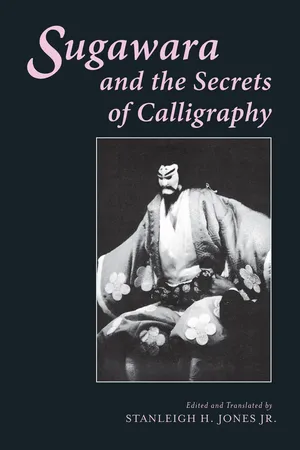
Sugawara and the Secrets of Calligraphy is a classic play from Japan's golden age of puppet theater. Written in the eighteenth century, it tells the tale of Sugawara no Michizane, a wronged scholar-official who, in death, joins the Shinto pantheon as a nurturer of scholarship and calligraphy. The story recounts Sugawara's entanglement with the powerful Fujiwara family, who accuse Sugawara of plotting against the emperor, resulting in his exile and death in 903. After a series of misfortunes befall those who conspired against him, Sugawara's enemies appease his spirit through deification. Sugawara and the Secrets of Calligraphy centers on three archetypical brothers and their wives. Their fates unfold against the intrigues surrounding Sugawara and his foes, which reflect the cultural values of the Edo period woven into a stylized past. This annotated translation by Stanleigh H. Jones Jr. replicates the play's poetic and idiomatic language and its original mix of register while also clarifying the drama's complex story and dialogue for students of Japanese literature and drama. An introduction situates the play within its eighteenth-century context and ninth-century setting and describes the relationship between bunraku puppet theater and kabuki. A unique illustrated appendix delves into the construction of puppets and the art of puppetry.
Information
Subtopic
Ancient & Classical DramaIndex
LiteratureACT II
Scene 1. The Journey—Sweet Words Exchanged
(Rolling green hills appear in the distant background, with yellow rice fields and green dikes in the closer background. A river winds through the landscape at SR off toward a cluster of thatched farm houses. In the immediate foreground at both SR and SL small stands or blossoming cherry trees mingle with pines. On stage is Sakuramaru, disguised as a traveling seller of sweets. His stock of sweets is contained in two unpainted boxes attached to a pole he carries across his shoulder. A pale violet paper parasol is fixed to one of the boxes. The boxes are in reality the hiding places of Prince Tokiyo and Lady Kariya.)1
SAKURAMARU: Here here, come children,
Come and buy, come and buy.
Candy birds have I,
Sweet birds made of candy.
And if that suits you not,
Then try rock candy, hard
And cracked off by the chisel.
Or sesame drops
To stop the mouths of crying children.
But, lo, there’s more: Hirano sweets,
And katsurame, the candy of Katsura Village,
Money candy from Nishinomiya.2
For these, go buy them where they’re made.
But as for me, come buy
The sugarplums of which I boast,
My round cherry sweets,
Cherry candy, sakura candy.
NARRATOR: Though to his wares he gives his name,
His face he hides with a scarf.
His clothing—cap and pants and sleeveless coat—
Are slight in weight, as slight his rank in life;
But loyalty lies heavy in the heart
Of this groomsman Sakuramaru.
Following what came to pass
Beside the Kamo River’s dancing wavelets,
Prince Tokiyo and Lady Kariya
Have been obliged to flee;
At length has Sakuramaru
Happened upon them.
For a day or two they may
Conceal themselves from their homes,
“But then what?” have they wondered.
Now have they set their minds
To seek aid from Lord Sugawara’s aunt.
No longer as a carriage groom
Does Sakuramaru attend them;
Now does he hide the noble pair,
One in each of the candy chests
He carries on a shoulder pole.
Shunning the eyes of an inconstant world,
The trio make their way to Haji village,
Hawking candy as they go.
Yet Sakuramaru’s care-worn heart
Is deeply troubled.
In the depths of night they leave the Capital,
And though they reach Fukakusa,
The inky road is hard to see.
At Gokō Shrine the day dawns,
And they hurry on their way,
Through Serikawa, on past Yodo.
Each time they pass beyond a town
They breathe more easily,
Feel free of prying eyes and wagging tongues.
At Iwashimizu3
Sakuramaru lowers his burden.
“Come out,” he says, and as he opens the cases,
The stately form of Lady Kariya
Comes forth. For a moment
In the morning sun,
She gazes about with rapture;
But around her, only unfamiliar peaks,
Obscure and unknown hamlets.
KARIYA: When I see such vistas as these, it is as though I have no cares at all. And you, my prince?
TOKIYO: I was just thinking the same thing. It was after we left the Capital that your father, Lord Sugawara, through some misunderstanding, was confined to his home. So, while I can’t be certain, I do feel that the time will come when you are forgiven. But me, I feel like the candy we sell: as the sweets are shielded by a parasol from the sun, so must I, an outcast, hide my face in a rush hat. Oh, will my fears all someday melt away and let me know peace?
SAKURAMARU: Things are not as bad as you may think. Your very concealment, with candy on top and my lord hiding beneath, is a lucky sign that you will soon rule this land.4
NARRATOR: Yet even more the Prince shrinks back, downcast.
Slowly they make their way
Along the slippery roads,
Across the ricefield footpaths.
The bracken along the way
Thrusts its stems beneath the hem
Of Lady Kariya’s robe,
Turning it outward to display
The pattern of its lining.
In the spring fields,
Now sweet scented by fragrance
From the noble lady’s gown,
Throng hosts of butterflies.
Should on her sleeve they light,
Dust from their wings might form
A powder for the lady’s face,
So long deprived of a mirror.
Here is the village of Kariya,5
The place perhaps from whence
Her name was drawn.
Now is the time for planting rice
In the seedling beds.
How rare to see for endless vistas
The handiwork of farmers.
Hearing the call of the cranes—
Those emblems of long life—
Returning to their nesting places,
The lovers recall the vows
Made in their sleeping chamber,
Vows their tender passions
Would for a thousand years
Remain unchanged.
From evening had they lain together,
Locked away from others,
Locked in each other’s embrace,
Sleeping through the night,
Unmindful that the moon might shine
Or that the sky be cast with clouds.
With the hand that grabs the pillow
I sleep, my sash undone.
I stand so deeply in your trust,
So deeply in your trust.
With the hand that g...
Table of contents
- Cover
- Title Page
- Copyright
- Dedication
- Contents
- Acknowledgments
- Introduction
- Dramatic Personae
- Prologue
- Act I
- Act II
- Act III
- Act IV
- Act V
- A Note on the Puppets
- Bibliography
- Illustrations
Trusted by 375,005 students
Access to over 1.5 million titles for a fair monthly price.
Study more efficiently using our study tools.
Frequently asked questions
Yes, you can cancel anytime from the Subscription tab in your account settings on the Perlego website. Your subscription will stay active until the end of your current billing period. Learn how to cancel your subscription
No, books cannot be downloaded as external files, such as PDFs, for use outside of Perlego. However, you can download books within the Perlego app for offline reading on mobile or tablet. Learn how to download books offline
Perlego offers two plans: Essential and Complete
- Essential is ideal for learners and professionals who enjoy exploring a wide range of subjects. Access the Essential Library with 800,000+ trusted titles and best-sellers across business, personal growth, and the humanities. Includes unlimited reading time and Standard Read Aloud voice.
- Complete: Perfect for advanced learners and researchers needing full, unrestricted access. Unlock 1.5M+ books across hundreds of subjects, including academic and specialized titles. The Complete Plan also includes advanced features like Premium Read Aloud and Research Assistant.
We are an online textbook subscription service, where you can get access to an entire online library for less than the price of a single book per month. With over 1.5 million books across 990+ topics, we’ve got you covered! Learn about our mission
Look out for the read-aloud symbol on your next book to see if you can listen to it. The read-aloud tool reads text aloud for you, highlighting the text as it is being read. You can pause it, speed it up and slow it down. Learn more about Read Aloud
Yes! You can use the Perlego app on both iOS and Android devices to read anytime, anywhere — even offline. Perfect for commutes or when you’re on the go.
Please note we cannot support devices running on iOS 13 and Android 7 or earlier. Learn more about using the app
Please note we cannot support devices running on iOS 13 and Android 7 or earlier. Learn more about using the app
Yes, you can access Sugawara and the Secrets of Calligraphy by Stanleigh Jones Jr., Stanleigh H. Jones Jr. in PDF and/or ePUB format, as well as other popular books in Literature & Ancient & Classical Drama. We have over 1.5 million books available in our catalogue for you to explore.