The Imjin War (1592–1598) was a grueling conflict that wreaked havoc on the towns and villages of the Korean Peninsula. The involvement of Chinese, Japanese, and Korean forces, not to mention the regional scope of the war, was the largest the world had seen, and the memory dominated East Asian memory until World War II. Despite massive regional realignments, Korea's Chosôn Dynasty endured, but within its polity a new, national discourse began to emerge. Meant to inspire civilians to rise up against the Japanese army, this potent rhetoric conjured a unified Korea and intensified after the Manchu invasions of 1627 and 1636.
By documenting this phenomenon, JaHyun Kim Haboush offers a compelling counternarrative to Western historiography, which ties Korea's idea of nation to the imported ideologies of modern colonialism. She instead elevates the formative role of the conflicts that defined the second half of the Chosôn Dynasty, which had transfigured the geopolitics of East Asia and introduced a national narrative key to Korea's survival. Re-creating the cultural and political passions that bound Chosôn society together during this period, Haboush reclaims the root story of solidarity that helped Korea thrive well into the modern era.
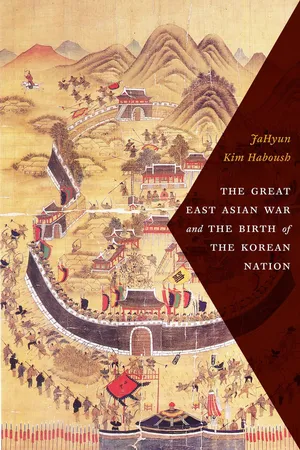
eBook - ePub
The Great East Asian War and the Birth of the Korean Nation
- English
- ePUB (mobile friendly)
- Available on iOS & Android
eBook - ePub
The Great East Asian War and the Birth of the Korean Nation
About this book
Information
Subtopic
Early Modern HistoryIndex
History1. The Volunteer Army and the Discourse of Nation
The Imjin War was an epochal event in which hundreds of thousands participated directly. Three states fought, each closely directed by its respective head, assisted by ministers, staff, and advisors for the course of war. There were thus three armies and three navies deployed, commanded by generals and admirals, some of whom acquired immortal fame. In Korea, where the battles were waged, there were also thousands of volunteer army members, moving amid a population of millions suffering the ravages of war, not to mention the hundreds of thousands killed or taken prisoner. The Imjin War was to be writ large in tales of heroes and victims. The three states entwined in battle each had its own unique perspectives, with separate legends and corresponding hagiographies and canons of heroes and victims. As befits a war that occupies a central place in their defining imaginings, Koreans canonized and deployed a huge number of heroes in the aftermath of the Imjin War, the most honored among them arguably being Admiral Yi Sunsin (1545–1598) and a number of volunteer army leaders. Non’gae, a courtesan who threw herself into a river, bringing a Japanese general with her, also earned legendary status.1 I will argue that the Imjin War became the war that defined or redefined “Korea” as an imagined community in Korean historical discourse, so that these heroes became the patriotic faces of Korea.
Yi Sunsin was a state military officer. His famous admiralship qualities—a superb strategist who never lost a battle, an inventor of the famous battleships known as turtle ships (kŏbuksŏn), and a fearless soldier who, when felled in the final battle as the Japanese retreated from Korea, ordered that his death be kept secret until the fighting was over—achieved near mythic status, and he became the hero of popular Korean history and the exemplar of patriotic virtue in contemporary South Korean elementary textbooks. But Yi’s special place in Korean history does not rest only on his being a superior admiral. More important still to his heroism and his status as a “sage-hero” (sŏng’ung) (as the popular 2004–2005 television drama, Pulmyŏl ŭi Yi Sunsin,2 refers to him) was his unwavering loyalty to the very throne that rejected and humiliated him. Indeed, the Chosŏn state had not always appreciated or valued him. Despite the early victories he earned for Korea, Yi Sunsin was recalled in the midst of the war and demoted to the lowest soldier rank (paegŭi chonggun). It was only after his successor, the infamous Wŏn Kyun (?–1597), suffered a drastic defeat in which the entire fleet was destroyed and he himself was killed that Yi was reappointed as commander of the navy. Though his disgrace and fall lent humanity to this seemingly perfect man, Yi Sunsin’s story is after all that of a soldier.
What of the volunteer army? Known as the Righteous Army (Ŭibyŏng), it consisted of countryside civilians who formed volunteer army units and waged guerilla warfare against the Japanese Army of 158,000 after it landed and swept across Korea.3 Benedict Anderson has argued that “the idea of the ultimate sacrifice comes only with an idea of purity, through fatality.” He elaborates that “dying for one’s country, which usually one does not choose, assumes a moral grandeur” because of “an aura of purity and disinterestedness.”4 In this vein, the leaders of the volunteer army, despite their civilian status and the absence of any obligation to fight, felt compelled to rise for their country. Although none of the members of this army have achieved the instant name recognition of Admiral Yi Sunsin in the popular media, arguably they achieved an even greater moral grandeur precisely because of their “aura of purity and disinterestedness.” Collectively they occupy a place of honor in the Korean historical imagination that is no less revered than that of the great naval hero.
Not surprisingly, the volunteer army movement has received a great deal of attention from historians in contemporary Korea. There are innumerable studies on different aspects of the army. Some consider the movement on a local or national scale and evaluate its effectiveness as an army; others discuss its relations with the state, focusing on the social and political constraints under which the volunteer army operated; and some examine its effects on the socioeconomic positions of the local elites before and after the war. By far the greatest number of studies detail the deeds of individual leaders, most often in a timeless heroic narrative mode well-suited to biographies of national heroes highlighting selfless acts of courageous devotion to the country in the face of impossible odds.5
Despite the enormous attention devoted to the volunteer army, I believe that the army’s political and historical significations have yet to be properly examined. Issues such as the texture of the political culture from which the movement emerged and the changes wrought have not been adequately addressed. For example, while the missives of exhortation the leaders of the volunteer army sent out are casually quoted in the secondary literature, they have not been properly appreciated as an integral component of the movement. I believe these missives to be foundational communiqués from which discourse of nation emerged. Still unexamined are the process and political meaning of the immortalization of volunteer army leaders as patriotic symbols in postwar Chosŏn.
Thus missing in modern scholarship is proper recognition of the exceptional nature of the volunteer army. We can perhaps attribute this oversight to a primordialist vision of the nation as timeless, so that patriotic uprisings in the face of foreign invasion can be seen as natural. In this view, the rise of the volunteer army was an admirable venture worthy of endless encomium but not a remarkable historical phenomenon deserving to be studied for its origin, impact, and meaning. It is also possible that centuries of adulation may have turned these figures into familiar images, depriving them of the aura of wonderment with which they were viewed by their contemporaries and by postwar Chosŏn society.
This primordialist view, however, flies in the face of history. Just as the Japanese invasion was unanticipated, so too the volunteer army was unimagined. The Chosŏn was a state that fit Max Weber’s definition of a state: it possessed a monopoly on legitimate violence. Private armies and private possession of arms had been outlawed since 1400. Local elites, who were a majority of the leaders of the volunteer army, were scholars not warriors. Thus when the civilian-volunteer army first appeared it was greeted with bewilderment and awe. The volunteer army had to get state permission to organize and bear arms and, at some point, to be made a part of the royal army. Although it is disputed whether government encouragement or the appearance of the volunteer army came first, and it is known that the relationship between the government and the volunteer army often was complex and even tense, nonetheless the government encouraged and supported the movement. Awe and wonderment at the appearance of the volunteer army lasted for centuries, and these “structures of feeling,” to borrow Raymond Williams’s phrase, lay at the heart of their becoming national heroes.6 This was true during the war and remained so through centuries afterward, as various agencies competed to appropriate and honor volunteer army fighters and leaders. Eventually, it is hardly an exaggeration to say, nearly every family scrambled to claim an ancestor who had been active in the volunteer army. Posthumous honors were showered on them, shrines were built in their name, and their resistance activities were researched, revealed, narrated, and even published—an industry that continues to this day in Korea.
The volunteer army is hard to characterize. On the one hand locally based, on the other hand it grew into a nationwide force as well as a national movement. Then again it was a military movement, but its growth was inextricably intertwined with the emergence and expansion of the communicative space that connected Koreans to one another, and in which they exchanged discourse on an imagined community of Chosŏn. It was at this moment of crisis—when the Chosŏn community seemed to be irrevocably torn asunder—that Koreans fashioned an alternative communicative space through which a nation emerged. In this and the subsequent chapter, I am foremost interested in the local and national components of the army and in the way its activities were subsumed into a national movement. I will argue that a vision of national community emerged between the space of action and the space of communication. I will concentrate on what I call the horizontal space of communication that was created by volunteer army leaders, and on the way in which the discourse on the Chosŏn community evolved from one limited by social status and region to one that extended to all inhabitants of Korea.
Prelude
I have already mentioned that on the eve of the Imjin War, the identity and aspirations of Japan and Korea were nearly opposite: Korea, having enjoyed two hundred years of uninterrupted peace, aspired to be a society of civil culture, while Japan, having just been unified under Hideyoshi after many years of civil strife, was intent on building a huge Asian empire through invasion, with Korea as its first target. The irregular and inadequate communication that existed between Korea and Japan for decades prior to the war also contributed to their mutual incomprehension. The ambassadorial mission of investigation that Korea sent to Japan in 1590 amply displays this. The Korean court dispatched the embassy to investigate whether Hideyoshi genuinely intended to invade Korea as he had threatened in his missives. The embassy, headed by Hwang Yun’gil (1536–?) and Kim Sŏng’il (1538–1593) as ambassador and deputy ambassador, respectively, the first since 1443, left in April 1590 and returned a year later. This ill-fated mission would become notorious in the narration of Korean history. In their audience with the king upon return, the two were queried for their views as to whether Hideyoshi was planning an attack. Hwang replied affirmatively; Kim negatively. Later historians often attributed their conflicting views to their differing factional affiliations and cite the incident to refer to the sorry factionalism of the Chosŏn bureaucracy.7
Perhaps the greater misfortune of the embassy was that it inadvertently conveyed the wrong message to Hideyoshi. When the Korean investigative embassy arrived, the official mediator between the two countries, the Sō feudal house of Tsushima, led Hideyoshi to believe that the Korean envoys had come as tributaries and that Korea accepted his demand for cooperation in the invasion of China.8 Thus he ordered his own envoys, Keitetsu Genso and Sō Yoshitoshi, to accompany the Korean embassy on its return to Seoul to present his letter to the Korean king. This letter invited Koreans to join in his planned campaign against China. After describing his pacification and unification of Japan, he announced his dream of building a greater Asian empire:
A man born on this earth, though he might live to a ripe old age, will not, as a rule, reach a hundred years. Why then should I rest grumbling in frustration where I am? Disregarding the distance across the sea and across the mountain reaches that lie between us, I shall in one fell swoop invade Great Ming. I have it in mind to introduce Japanese customs and values to the four hundred and more provinces of that country and to bestow upon it the benefits of imperial rule and the culture of the coming hundred million years.
He then gave an ultimatum:
Your esteemed country has done well to make haste in attending our court. To the farsighted, grief does not approach. Those who lag [in offering homage], however, will not be granted pardon, even if this is a distant land of little islands lying in the sea. When the day of my invasion of Great Ming arrives and I lead my troops to the staging area, that will be the time to make our neighborly relations flourish all the more. I have no other desire but to spread my fame throughout the three countries, this and no more.9
This letter left no doubt as to Hideyoshi’s intention to invade.10 From this point on, the Korean government made some attempt to devise defense plans: it chose and placed talented men in charge of crucial military posts, fortified the fortresses of walled towns, and streamlined weapons.11 These measures were half-hearted and were rebuffed and resented by local residents.12 The Chinese scholar Li Guangtao justifiably characterized the confused manner in which Koreans approached the Japanese this way: “Korea adopted a policy of trying to hide its mistakes by going to sleep and ignoring the threat as if hoping the Japanese would be gone when they woke up.”13 No one seems to have believed or wanted to believe in the likelihood of an imminent invasion. This would perhaps have required too large a leap of both imagination and disposition.
Even taking into consideration Chosŏn incredulity and unpreparedness for the war, Korea fared miserably, especially in the early phase of the war. Though the navy continued to function, the Chosŏn Royal Army could offer no resistance to the invaders. Narrative after narrative, private or official, portrays this period as one of unmitigated doom. The Japanese vanguard army landed in Pusan on May 23, 1592, and the first battles fought in Pusan and Tongnae set the stage for what was to come. On May 24 a Japanese army of 18,700 led by Sō Yoshitoshi and Konishi Yukinaga encircled the port town of Pusan, despite Korean resistance led by Chŏng Pal, the commander of the navy of Pusan, and entered the town.14 On May 25 the Japanese Army attacked Tongnae and overcame fierce resistance led by the magistrate, Song Sanghyŏn, within a day. Both Chŏng Pal and Song Sanghyŏn were killed, and Song, because of the dignified manner in which he met his death, became one of the heroes of the war. Other government offi...
Table of contents
- Cover
- Title Page
- Copyright
- Contents
- Foreword
- Map of Chosŏn Korea
- Introduction
- 1. The Volunteer Army and the Discourse of Nation
- 2. The Volunteer Army and the Emergence of Imagined Community
- 3. War of Words: The Changing Nature of Literary Chinese in the Japanese Occupation
- 4. Language Strategy: The Emergence of a Vernacular National Space
- 5. The Aftermath: Dream Journeys and the Culture of Commemoration
- Publications
- Notes
- Bibliography
- Index
Trusted by 375,005 students
Access to over 1.5 million titles for a fair monthly price.
Study more efficiently using our study tools.
Frequently asked questions
Yes, you can cancel anytime from the Subscription tab in your account settings on the Perlego website. Your subscription will stay active until the end of your current billing period. Learn how to cancel your subscription
No, books cannot be downloaded as external files, such as PDFs, for use outside of Perlego. However, you can download books within the Perlego app for offline reading on mobile or tablet. Learn how to download books offline
Perlego offers two plans: Essential and Complete
- Essential is ideal for learners and professionals who enjoy exploring a wide range of subjects. Access the Essential Library with 800,000+ trusted titles and best-sellers across business, personal growth, and the humanities. Includes unlimited reading time and Standard Read Aloud voice.
- Complete: Perfect for advanced learners and researchers needing full, unrestricted access. Unlock 1.5M+ books across hundreds of subjects, including academic and specialized titles. The Complete Plan also includes advanced features like Premium Read Aloud and Research Assistant.
We are an online textbook subscription service, where you can get access to an entire online library for less than the price of a single book per month. With over 1.5 million books across 990+ topics, we’ve got you covered! Learn about our mission
Look out for the read-aloud symbol on your next book to see if you can listen to it. The read-aloud tool reads text aloud for you, highlighting the text as it is being read. You can pause it, speed it up and slow it down. Learn more about Read Aloud
Yes! You can use the Perlego app on both iOS and Android devices to read anytime, anywhere — even offline. Perfect for commutes or when you’re on the go.
Please note we cannot support devices running on iOS 13 and Android 7 or earlier. Learn more about using the app
Please note we cannot support devices running on iOS 13 and Android 7 or earlier. Learn more about using the app
Yes, you can access The Great East Asian War and the Birth of the Korean Nation by JaHyun Kim Haboush, William J. Haboush,Jisoo Kim, William Haboush, Jisoo Kim in PDF and/or ePUB format, as well as other popular books in History & Early Modern History. We have over 1.5 million books available in our catalogue for you to explore.