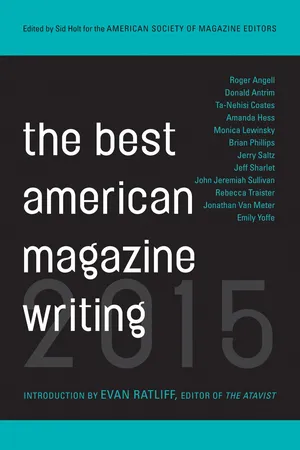
This year's Best American Magazine Writing features articles on politics, culture, sports, sex, race, celebrity, and more. Selections include Ta-Nehisi Coates's intensely debated "The Case For Reparations" (The Atlantic) and Monica Lewinsky's reflections on the public-humiliation complex and how the rules of the game have (and have not) changed (Vanity Fair). Amanda Hess recounts her chilling encounter with Internet sexual harassment (Pacific Standard) and John Jeremiah Sullivan shares his investigation into one of American music's greatest mysteries (New York Times Magazine).
The anthology also presents Rebecca Traister's acerbic musings on gender politics (The New Republic) and Jerry Saltz's fearless art criticism (New York). James Verini reconstructs an eccentric love affair against the slow deterioration of Afghanistan in the twentieth century (The Atavist); Roger Angell offers affecting yet humorous reflections on life at ninety-three (The New Yorker); Tiffany Stanley recounts her poignant experience caring for a loved one with Alzheimer's (National Journal); and Jonathan Van Meter takes an entertaining look at fashion's obsession with being a social-media somebody (Vogue). Brian Phillips describes his surreal adventures in the world of Japanese ritual and culture (Grantland), and Emily Yoffe reveals the unforeseen casualties in the effort to address the college rape crisis (Slate). The collection concludes with a work of fiction by Donald Antrim, exploring the geography of loss. (The New Yorker).
eBook - ePub
The Best American Magazine Writing 2015
- English
- ePUB (mobile friendly)
- Available on iOS & Android
eBook - ePub
The Best American Magazine Writing 2015
About this book
Information
Subtopic
JournalismChicago
FINALIST—REPORTING
This, said the Ellie judges, is “old-fashioned, idealistic reporting at its best: a piece of journalism that exposes clear and consequential wrongdoing by public officials”—the underreporting of murder and other crimes by the Chicago Police Department. Chicago was also nominated for the Reporting Ellie two years ago for another story—“Lawbreakers, Lawmakers,” about the sordid relationship between street gangs and Chicago pols—by the same team. David Bernstein is the features editor at Chicago; Noah Isackson a contributing editor. Chicago, like many city magazines, is largely devoted to service journalism but also has a distinguished record of Ellie nominations in literary-journalism categories such as Feature Writing, Essays and Criticism, and Fiction.
David Bernstein and Noah Isackson
The Truth About Chicago’s Crime Rates
I. Dead Wrong
It was a balmy afternoon last July when the call came in: Dead body found inside empty warehouse on the West Side.
Chicago police officers drove through an industrial stretch of the hardscrabble Austin neighborhood and pulled up to the 4600 block of West Arthington Street. The warehouse in question was an unremarkable-looking red-brick single-story building with a tall barbed-wire fence. Vacant for six years, it had been visited that day by its owner and a real-estate agent—the person who had called 911.
The place lacked electricity, so crime scene technicians set up generators and portable lights. The power flickered on to reveal a grisly sight. In a small office, on soggy carpeting covered in broken ceiling tiles, lay a naked, lifeless woman. She had long red-streaked black hair and purple glitter nail polish on her left toenails (her right ones were gone), but beyond that it was hard to discern much. Her face and body were bloated and badly decomposed, her hands ash colored. Maggots feasted on her flesh.
At the woman’s feet, detectives found a curled strand of telephone wire. Draped over her right hand was a different kind of wire: thin and brown. The same brown wire was wrapped around each armrest of a wooden chair next to her.
The following day, July 24, a pathologist in the Cook County medical examiner’s office noticed something else that had been obscured by rotting skin: a thin gag tied around the corpse’s mouth.
Thanks to some still-visible tattoos, detectives soon identified this unfortunate woman: Tiara Groves, a twenty-year-old from Austin. She was last seen walking alone in the wee hours of Sunday, July 14, near a liquor store two miles from the warehouse. At least eight witnesses who saw her that night told police a similar story: She appeared drunk and was upset—one man said that she was crying so hard she couldn’t catch her breath—but refused offers of help. A man who talked to her outside the liquor store said that Groves warned him, excitedly and incoherently, that he should stay away from her or else somebody (she didn’t say who) would kill him too.
Toxicology tests showed she had heroin and alcohol in her system, but not enough to kill her. All signs pointed to foul play. According to the young woman’s mother, who had filed a missing-person report, the police had no doubt. “When this detective came to my house, he said, ‘We found your daughter.… Your daughter has been murdered,’” Alice Groves recalls. “He told me they’re going to get the one that did it.”
On October 28, a pathologist ruled the death of Tiara Groves a homicide by “unspecified means.” This rare ruling means yes, somebody had killed Groves, but the pathologist couldn’t pinpoint the exact cause of death.
Given the finding of homicide—and the corroborating evidence at the crime scene—the Chicago Police Department should have counted Groves’s death as a murder. And it did. Until December 18. On that day, the police report indicates, a lieutenant overseeing the Groves case reclassified the homicide investigation as a noncriminal death investigation. In his write-up, he cited the medical examiner’s “inability to determine a cause of death.”
That lieutenant was Denis Walsh—the same cop who had played a crucial role in the alleged cover-up in the 2004 killing of David Koschman, the twenty-one-year-old who died after being punched by a nephew of former mayor Richard M. Daley. Walsh allegedly took the Koschman file home. For years, police officials said that it was lost. After the Sun-Times reported it missing, the file mysteriously reappeared.
But back to Tiara Groves. With the stroke of a computer key, she was airbrushed out of Chicago’s homicide statistics.
The change stunned officers. Current and former veteran detectives who reviewed the Groves case at Chicago’s request were just as incredulous. Says a retired high-level detective, “How can you be tied to a chair and gagged, with no clothes on, and that’s a [noncriminal] death investigation?” (He, like most of the nearly forty police sources interviewed for this story, declined to be identified by name, citing fears of disciplinary action or other retribution.)
Was it just a coincidence, some wondered, that the reclassification occurred less than two weeks before the end of the year, when the city of Chicago’s final homicide numbers for 2013 would be tallied? “They essentially wiped away one of the murders in the city, which is crazy,” says a police insider. “But that’s the kind of shit that’s going on.”

For the case of Tiara Groves is not an isolated one. Chicago conducted a twelve-month examination of the Chicago Police Department’s crime statistics going back several years, poring through public and internal police records and interviewing crime victims, criminologists, and police sources of various ranks. We identified ten people, including Groves, who were beaten, burned, suffocated, or shot to death in 2013 and whose cases were reclassified as death investigations, downgraded to more minor crimes, or even closed as noncriminal incidents—all for illogical or, at best, unclear reasons.
This troubling practice goes far beyond murders, documents and interviews reveal. Chicago found dozens of other crimes, including serious felonies such as robberies, burglaries, and assaults, that were misclassified, downgraded to wrist-slap offenses, or made to vanish altogether. (We’ll examine those next month in part 2 of this special report.)
Many officers of different ranks and from different parts of the city recounted instances in which they were asked or pressured by their superiors to reclassify their incident reports or in which their reports were changed by some invisible hand. One detective refers to the “magic ink”: the power to make a case disappear. Says another: “The rank and file don’t agree with what’s going on. The powers that be are making the changes.”
Granted, a few dozen crimes constitute a tiny percentage of the more than 300,000 reported in Chicago last year. But sources describe a practice that has become widespread at the same time that top police brass have become fixated on demonstrating improvement in Chicago’s woeful crime statistics.
And has there ever been improvement. Aside from homicides, which soared in 2012, the drop in crime since Police Superintendent Garry McCarthy arrived in May 2011 is unprecedented—and, some of his detractors say, unbelievable. Crime hasn’t just fallen, it has free-fallen: across the city and across all major categories.
Take “index crimes”: the eight violent and property crimes that virtually all U.S. cities supply to the Federal Bureau of Investigation for its Uniform Crime Report. According to police figures, the number of these crimes plunged by 56 percent citywide from 2010 to 2013—an average of nearly 19 percent per year—a reduction that borders on the miraculous. To put these numbers in perspective: From 1993, when index crimes peaked, to 2010, the last full year under McCarthy’s predecessor, Jody Weis, the average annual decline was less than 4 percent.
This dramatic crime reduction has been happening even as the department has been bleeding officers. (A recent Tribune analysis listed 7,078 beat cops on the streets, 10 percent fewer than in 2011.) Given these facts, the crime reduction “makes no sense,” says one veteran sergeant. “And it makes absolutely no sense that people believe it. Yet people believe it.”
The city’s inspector general, Joseph Ferguson, may not. Chicago has learned that his office has questioned the accuracy of the police department’s crime statistics. A spokeswoman confirmed that the office recently finalized an audit of the police department’s 2012 crime data—though only for assault-related crimes so far—“to determine if CPD accurately classified [these categories of] crimes under its written guidelines and if it reported related crime statistics correctly.” (The audit found, among other things, that the department undercounted aggravated assaults and batteries by more than 24 percent, based on the sample cases reviewed.)
Meanwhile, the see-no-evil, hear-no-evil pols on Chicago’s City Council have mostly accepted the police department’s crime numbers at face value. So have most in the media. You can hardly turn on the news without hearing McCarthy or Mayor Rahm Emanuel proclaiming unquestioned: Murders down 18 percent in 2013! Overall crime down 23 percent! Twelve thousand fewer crime victims! “These days, everything is about media and public opinion,” says one longtime officer. “If a number makes people feel safe, then why not give it to them?”
If you want proof of the police department’s obsession with crime statistics, look no further than the last few days of 2012. On the night of December 27, a forty-year-old alleged gang member named Nathaniel Jackson was shot in the head and killed in Austin. The next morning, newscasters proclaimed that Chicago’s murder toll for the year had hit 500—a grim milestone last reached in 2008, during the Great Recession.
By lunchtime, the police department’s spinmeisters at Thirty-Fifth and Michigan had challenged the reports. The actual total, they said, was 499. A murder case earlier in the year had just been reclassified as a death investigation.
Critics howled. The bloggers behind Second City Cop declared: “It’s a miracle! The dead have risen!!!”
By late afternoon, police had backed down; Jackson was, indeed, the 500th homicide of 2012. Chicago would end the year with 507 recorded murders, more than in any other city in the nation.
Many inside the police force, as well as many outside criminologists, saw the spike in violence in 2012 as a statistical anomaly. Crime tends to go in cycles, they pointed out; the city topped 500 killings not only in 2008 but also in 2003, 2002, and 2001, to name a few.
Still, it looked bad for Mayor Emanuel. His disapproval rating in the polls was rising sharply, particularly among black voters. Behind closed doors, according to a City Hall insider, Emanuel told his police chief that the department had better not allow a repeat performance of 2012 or McCarthy’s days in Chicago would be numbered. (Through a spokeswoman, the mayor declined to comment for this article.)
McCarthy called 2012’s homicide total a “tragic number” and vowed that things would be different in 2013. The mindset inside police headquarters, recalls one officer: “Whatever you gotta do, this can’t happen again.”
The chief felt even more pressure than his rank and file may have realized. For the former New Yorker to prove that his policing strategies worked in Chicago, he would need to keep the number of murders not just below 2012’s total but also below 2011’s: 435.
To do so, McCarthy leaned even more heavily on a tool that has proved wildly successful in his hometown: CompStat. Borrowing performance-management principles from the business world, CompStat collects, analyzes, and maps a city’s crime data in real time. These statistics help police track trouble spots more accurately and pinpoint where officers are needed most. The department’s number crunchers can slice and dice the stats all sorts of ways, spitting out reports showing percentage changes in various crimes by neighborhood over different time frames, for example: month to month, week to week—heck, hour to hour.
Armed with those statistics, the police brass turn up the pressure in weekly meetings, grilling field commanders about crime in their areas. The statistics are widely said to make or break a career. “The only evaluation is the numbers,” says a veteran sergeant. “God forbid your crime is up. If you have a 20 percent reduction this month, you’d better have a 21 percent reduction the next month.”
The homicide numbers are especially important, says one cop: “You should see these supervisors, like cats in a room filled with rocking chairs, afraid to classify a murder because of all the screaming they will hear downtown.”
If the numbers are bad, the district commanders and officers get reamed out by McCarthy and the other bosses at headquarters. These targets frequently leave the meetings seething. Even McCarthy concedes that such meetings can get ugly. “When I was a commander in New York, it was full contact,” he told Chicago in 2012. “And if you weren’t careful, you could lose an eye.”
Unfortunately for all concerned, January 2013 could not have started out worse. Five people were murdered in Chicago on New Year’s Day. The number hit seventeen by the end of the first full week. “This is too much,” Al Wysinger, the police department’s first deputy superintendent, told the crowd in the January 17 CompStat meeting, according to a memo summarizing it. “Last October and November, I kept saying we have to start 2013 off on the right foot. Wrong foot! We can’t reiterate this much clearer.”
As the month wore on, the death toll kept rising. Among the victims were headline grabbers Ronnie Chambers, thirty-three, the last of his mother’s four children to die from gun violence, and Hadiya Pendleton, fifteen, the honor student who was shot in a park about a mile from President Obama’s house.
And then there was twenty-something Tiffany Jones from the South Side. (To protect the identity of her family, we have given her a pseudonym.)
In January, Jones got into an argument with a male relative that turned into a “serious physical fight,” according to the police report. Her sister later told police that she saw the enraged man punch Jones in the head. Police and paramedics arrived to find Jones’s siblings struggling to keep him out of the family’s apartment.
Inside, Jones was sitting on the couch, gasping for breath. When officers asked her if she wanted to press battery charges, she could only nod yes, the police report shows. She tried to stand but collapsed to the floor, no longer breathing. Rushed to the hospital, Jones was soon pronounced dead.
The attending doctor noted head trauma and bleeding behind Jones’s left eye. Seeing fresh bruises on her left cheek, left eye, and both arms, the investigating officers were leaning toward recommending a first-degree murder charge against the male relative, according to the police report. First-degree murder—willfully killing or committing an act that creates a “strong probability of death or great bodily harm”—carries more severe penalties than any other homicide charge.
The next day, however, a pathologist with the Cook County medical examiner’s office came to the surprising conclusion that Jones had died from a blood clot that was unrelated to the fight. “Because of the embolism,” the pathologist noted to detectives, according to the police report, Jones “would have died ‘from just walking down the street.’”
Disagreements between police and medical examiners are rare but not unheard of. When they do occur, the rule for police is clear. The FBI’s Uniform Crime Reporting Handbook expressly states that a police department’s classification of a homicide should be based solely on a police investigation, not on the determination of a medical examiner or prosecutor’s office.
But the officers did not ask for a lesser homicide charge, such as involuntary manslaughter, against Jones’s relative. Nor did they even charge him with battery. The reason, the report states: “the lack of any complaining victim or witness to the domestic battery incident.” Never mind that a dead victim cannot complain.
Police sent the man on his way. And that was that. Search for this case in the police department’s public database of 2013 crimes and you won’t find it. It’s as if it never happened.
By the end of January, forty-four people had been murdered in Chicago, more than in any first month since 2002. That big number—and the national attention brought by Pendleton’s killing—set off more public furor about the inability of McCarthy ...
Table of contents
- Cover
- Title Page
- Copyright
- Contents
- Introduction
- Acknowledgments
- The Case for Reparations
- Women Aren’t Welcome Here
- The College Rape Overcorrection
- When Michael Dunn Compared Himself to a Rape Victim, He Was Following an Old, Racist Script and I Don’t Care If You Like It and The Slenderman Stabbing Shows Girls Will Be Girls, Too
- Shame and Survival
- Inside the Iron Closet: What It’s Like to Be Gay in Putin’s Russia
- Love and Ruin
- The Ballad of Geeshie and Elvie
- The Truth About Chicago’s Crime Rates
- The Sea of Crises
- Zombies on the Walls: Why Does So Much New Abstraction Look the Same? and Taking in Jeff Koons, Creator and Destroyer of Worlds and Post-Macho God: Matisse’s Cut-Outs Are World-Historically Gorgeous
- Follow Me: Kate Upton Leads the Charge of Models Who’ve Gone Crazy for Social Media
- Jackie’s Goodbye
- This Old Man
- The Emerald Light in the Air
- Permissions
- List of Contributors
Trusted by 375,005 students
Access to over 1.5 million titles for a fair monthly price.
Study more efficiently using our study tools.
Frequently asked questions
Yes, you can cancel anytime from the Subscription tab in your account settings on the Perlego website. Your subscription will stay active until the end of your current billing period. Learn how to cancel your subscription
No, books cannot be downloaded as external files, such as PDFs, for use outside of Perlego. However, you can download books within the Perlego app for offline reading on mobile or tablet. Learn how to download books offline
Perlego offers two plans: Essential and Complete
- Essential is ideal for learners and professionals who enjoy exploring a wide range of subjects. Access the Essential Library with 800,000+ trusted titles and best-sellers across business, personal growth, and the humanities. Includes unlimited reading time and Standard Read Aloud voice.
- Complete: Perfect for advanced learners and researchers needing full, unrestricted access. Unlock 1.5M+ books across hundreds of subjects, including academic and specialized titles. The Complete Plan also includes advanced features like Premium Read Aloud and Research Assistant.
We are an online textbook subscription service, where you can get access to an entire online library for less than the price of a single book per month. With over 1.5 million books across 990+ topics, we’ve got you covered! Learn about our mission
Look out for the read-aloud symbol on your next book to see if you can listen to it. The read-aloud tool reads text aloud for you, highlighting the text as it is being read. You can pause it, speed it up and slow it down. Learn more about Read Aloud
Yes! You can use the Perlego app on both iOS and Android devices to read anytime, anywhere — even offline. Perfect for commutes or when you’re on the go.
Please note we cannot support devices running on iOS 13 and Android 7 or earlier. Learn more about using the app
Please note we cannot support devices running on iOS 13 and Android 7 or earlier. Learn more about using the app
Yes, you can access The Best American Magazine Writing 2015 by Sid Holt,The American Society of Magazine Editors, Sid Holt, The American Society of Magazine Editors in PDF and/or ePUB format, as well as other popular books in Languages & Linguistics & Journalism. We have over 1.5 million books available in our catalogue for you to explore.