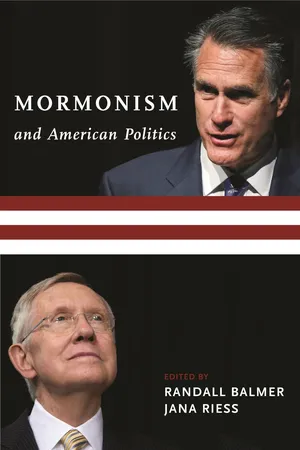
When Joseph Smith ran for president as a radical protest candidate in 1844, Mormons were a deeply distrusted group in American society, and their efforts to enter public life were met with derision. When Mitt Romney ran for president as a Republican in 2008 and 2012, the public had come to regard Mormons as consummate Americans: patriotic, family-oriented, and conservative. How did this shift occur?
In this collection, prominent scholars of Mormonism, including Claudia L. Bushman, Richard Lyman Bushman, Jan Shipps, and Philip L. Barlow, follow the religion's quest for legitimacy in the United States and its intersection with American politics. From Brigham Young's skirmishes with the federal government over polygamy to the Mormon involvement in California's Proposition 8, contributors combine sociology, political science, race and gender studies, and popular culture to track Mormonism's rapid integration into American life. The book takes a broad view of the religion's history, considering its treatment of women and African Americans and its portrayal in popular culture and the media. With essays from both Mormon and non-Mormon scholars, this anthology tells a big-picture story of a small sect that became a major player in American politics.
- English
- ePUB (mobile friendly)
- Available on iOS & Android
eBook - ePub
Mormonism and American Politics
About this book
Information
Topic
Theology & ReligionSubtopic
North American HistoryPART I
Origins and Tensions
| 1 | Joseph Smith’s Presidential Ambitions |
| Richard Lyman Bushman |
On May 17, 1844, the Democratic Party met in Baltimore to select James K. Polk as their presidential candidate. It featured the usual hullabaloo of nineteenth-century party politics. The same day in Nauvoo, Illinois, another convention met in the office of Joseph Smith to nominate the Mormon prophet for the presidency as an independent candidate. The formalities were followed by a scaled-down version of the Baltimore festivities. That night Smith’s friends lit a barrel of tar in front of his house and twice carried him around the fire while a band filled the air with music.
The miniature convention and tar-burning ceremony publicized a campaign that had been moving forward for four months. The Twelve Apostles, the church’s highest governing body after Smith and his two counselors, had first nominated him on January 29 after a frustrating autumn when the five prospective candidates of both parties had refused to promise the Mormons protection from their enemies. In November of 1843, Smith had posed the question to each of them: “What will be your rule of action, relative to us as a people?” None of them had answered satisfactorily. Henry Clay said he could not bind himself to any constituency in advance of the election. John C. Calhoun said typically “the case does not come within the Jurisdiction of the Federal Government,” igniting an explosion of vexation from Smith: “The States rights doctrines are what feeds mobs.… They are a dead carcass, a stink.”
The Mormon newspaper, the Times and Seasons, accounted for Smith’s candidacy by explaining that “under existing circumstances we have no other alternative, and if we can accomplish our object well, if not we shall have the satisfaction of knowing that we have acted conscientiously.” Smith himself said he would never have allowed his friends to nominate him if the Saints “could have had the privilege of enjoying our religious & civel [sic] rights.” He presented himself as a protest candidate.1
The sequence of events in 1843 and 1844 can be seen as an encapsulated version of the overall trajectory of Smith’s political career. Reluctance followed by involvement was the pattern he followed throughout his life. He did not want to get mixed up in politics in 1830, the year the church was organized, any more than he did in 1844, but was drawn in by the needs of the church. He had begun his religious career as a millenarian with no interest in America as a nation. When the Church of Christ was organized in 1830, the expectation of an immediate return of Christ made man-made governments irrelevant. All of them would be erased when the Savior installed the millennial order. “Ye will have no laws but my laws when I come,” one revelation informed the Saints.2
Change came because of the Saints’ need for government protection. In 1831 they had laid the foundation for a new Zion in Jackson County, Missouri, on the edge of American settlement. Two years later they were expelled and forced to move north where they began again in Caldwell and Daviess Counties. In 1838 they were dislodged once more. The Missouri governor, Lilburn Boggs, led to believe the Mormons had attacked the state militia, issued his infamous “Extermination Order,” forcing the Mormons to move once more, this time to Illinois where they began again in Nauvoo.
This recurring hostility convinced Smith that he could not build his Zion without state protection. His tiny band of Saints could not stand alone against attacks from the communities where they lived. Without the intervention of the state militia or federal troops, Mormons would be at the mercy of their persecutors. Almost immediately after news of the 1833 expulsion, Smith had appealed to the Governor of Missouri, and when no aid was forthcoming, he petitioned President Andrew Jackson. With locals as his enemies, the higher levels of government were his only hope. Again in 1839 he appealed to President Martin Van Buren for succor, and in 1844, as pressures built up in Illinois, his first instinct was to call upon Washington.
Smith’s revelations sustained his growing conviction that the only hope for peace lay with the federal government. One said that the principles of the Constitution in protecting people in their rights came from heaven: “That law of the land which is constitutional, supporting that principle of freedom in maintaining rights and privileges, belongs to all mankind, and is justifiable before me.”3 From an irrelevance at the beginning of Smith’s prophetic career, government became a necessity after 1833. He saw in the constitutional guarantee of freedom of worship the ideological grounds for demanding federal protection. He valued the founding document almost entirely for its role in protecting personal rights such as freedom of worship. He threw himself into the presidential race determined to protect all abused minorities, such as slaves and prisoners, but with the needs of his own people foremost in his mind.
Indifference followed by involvement, then, appears to have been the trajectory of Joseph Smith’s overall political career. His interest appears to have been spurred almost entirely by his need to protect the church. He was a political innocent with little interest in politics until the attacks on his people required government help. That conclusion seems to follow from his history between 1830 and 1844, but it is not the whole story. When we bring the Book of Mormon into the picture, a book published in 1830 at the beginning of his political career, Smith’s later interest in national affairs appears in a new light.
Smith claimed the Book of Mormon was a translation of an ancient record that had come into his hands by divine means. It was not a modern history but one written by ancient prophets much like the Bible. It began hundreds of years before Christ and ended in 421 CE. It had no bearing on nineteenth-century American politics, but in its own terms it was a highly political book. Its prophets were deeply involved with the government, and its concerns were national more than individual. If the Book of Mormon represents Smith’s thought in 1830, he had politics and good government on his mind from the beginning.
From the opening pages, authority, rule, and power are at the forefront of Book of Mormon history. Nephi, the first prophet-recorder who left Jerusalem around 600 BCE and with his father’s family headed for a new promised land, presents himself as the mistreated younger son who suffered at the hands of his older brothers Laman and Lemuel. Their quarrels and eventual separation established a framework for the entire book. For a thousand years, the descendants of the brothers did battle with one another until in the end the Lamanites eradicated the Nephites. On one level these brotherly battles were familial; they warred as rival siblings and their descendants as antagonistic cousins. But the issue, as Laman and Lemuel saw it, was authority. Who had the right to govern the band of migrants? Nephi had taken charge when, by custom and right, Laman should have succeeded to his father’s headship. Nephi wrote his account of the family’s history to show that he was the legitimate leader despite his status as a younger brother. The older two, his account argued, had forfeited their rights of leadership by consistently resisting their father, their inspired younger brother, and God. Nephi was the obedient son blessed with visions and backed by divine power. Laman and Lemuel had opposed God’s purposes at every turn. That division set up the framework for the entire book: the wars between Nephites and Lamanites always turned on the question of Nephi’s usurpation of authority. The overarching plot of the Book of Mormon grew out of Nephi’s claim to rule.
From Nephi on, the narrative dwelt almost continuously on the interplay of prophecy and politics. Government was never very far from the action. Kings, chief judges, generals, successions of power, changes in the form of government, dissenting factions, political assassinations, civil-military relationships, and the descent into anarchy when government broke down all figure in the book. For one span, the record-keepers omitted politics from their account to concentrate on the spiritual, but the separation did not work. Without politics, the history foundered. The recorders seemed to feel superfluous and wrote less and less. The Nephite record revived only when the record-keepers began to talk again of the nation’s political life and turned the record over to a king.4 From then on, the record came back to life. For much of the time, kings and chief judges were the prophets and kept the record. When they left the judgment seat to preach, they were always in touch with the rulers and generals. Events at the center of power were never far out of the picture. The book was written from within the beltway.
Even when not in office, the prophets concerned themselves with the well-being of the nation. They were not like revivalist preachers who wanted to make a few converts and start a church. Individual conversions in the Book of Mormon usually involved kings and chief judges. More often than not, the prophets spoke to the whole nation rather than to individuals. The prophets were not always rulers themselves, but they always considered themselves the monitors of the nation’s goodness. Like the prophets in the Hebrew Bible, they thought corporately and focused on the righteousness of rulers and the people as a whole. Religion and the state were not separated; religion thoroughly infused thinking about the state. The great issue was the religious condition of the people and their rulers; if righteous, the nation flourished; when wicked, it declined. The prophets’ threats and promises dealt with the fate of the nation—its prosperity and its decline and fall. That is the way the Hebrew Bible thought, and the same outlook pervades the Book of Mormon. The word “nation” appears 744 times in the Book of Mormon; the word “people” 3,997 times. The book has a national consciousness.
With the Book of Mormon in his background, it would not be the least unnatural for Joseph Smith to think nationally and to be concerned with the righteousness of the nation and its rulers. That is the factor we must introduce into the picture as we trace Joseph Smith’s political outlook. The Book of Mormon precedent made attention to politics a natural part of his prophetic identity. In the Book of Mormon, prophets slipped in and out of political leadership as kings, chief judges, or generals; why not a modern prophet?
We get an idea of how the Book of Mormon may have shaped Smith’s political thought by examining his 1844 political platform, General Smith’s Views of the Powers and Policy of the Government of the United States (Nauvoo: John Taylor, 1844). W. W. Phelps authored the document, but Phelps probably thought as much like Joseph Smith as any of his followers. When the Prophet showed the platform to guests, he expressed pride in the document as if it were his own. The Nauvoo Press printed 1,500 copies which were mailed to President John Tyler, the Supreme Court Justices, all the members of Congress, and newspapers all over the country. The 300 missionaries who were sent out to promote Smith’s candidacy saw to printings in Pittsburgh, Philadelphia, New York, and Pontiac, Michigan. Views was the face of Smith’s campaign.5
The platform has been ransacked by modern Mormons for hints about Joseph Smith’s opinions on twenty-first-century political issues.6 Modern Mormons rejoice in his vigorous opposition to slavery and his ingenious plan to buy out slaveholders with revenues from the sale of public lands. Latter-day Saint Democrats take comfort in his phrase the “fostering care of government” applied to the encouragement of industry through tariffs and the establishment of a national bank.7 But efforts to identify Joseph Smith’s political position on contemporary issues are no more conclusive than the claims of both Democrats and Republicans to the mantle of Thomas Jefferson. Conditions in the country have altered too radically to translate political views of the 1840s to the 2010s.
It is more suitable to ask if traces of Book of Mormon prophetic politics turn up in Smith’s political platform. One possible carryover is the apparent link to the alteration in government in the middle of the book, about 92 BCE. At that point, government went from a monarchy to a government by judges chosen by “the voice of the people.” That alteration on first glance appears to constitute an obvious endorsement of American democracy, a kind of American Revolution in ancient garb with the end of monarchy and the beginning of democracy.
The parallel, however, is not as close as it first appears. While popular election of judges certainly has a democratic tone, the results were not recognizably American. To begin with, monarchy in the Book of Mormon was not overthrown by popular demand or by revolution. The sitting king relinquished the throne against the wishes of the people. They wanted a king, and he had to persuade them that rule by judges was a more secure form of government. He installed a ch...
Table of contents
- Cover
- Series Page
- Title Page
- Copyright
- Contents
- List of Illustrations
- Introduction
- Part I: Origins and Tensions
- Part II: Shifting Alliances
- Part III: Into the Twenty-first Century
- List of Contributors
- Index
Trusted by 375,005 students
Access to over 1.5 million titles for a fair monthly price.
Study more efficiently using our study tools.
Frequently asked questions
Yes, you can cancel anytime from the Subscription tab in your account settings on the Perlego website. Your subscription will stay active until the end of your current billing period. Learn how to cancel your subscription
No, books cannot be downloaded as external files, such as PDFs, for use outside of Perlego. However, you can download books within the Perlego app for offline reading on mobile or tablet. Learn how to download books offline
Perlego offers two plans: Essential and Complete
- Essential is ideal for learners and professionals who enjoy exploring a wide range of subjects. Access the Essential Library with 800,000+ trusted titles and best-sellers across business, personal growth, and the humanities. Includes unlimited reading time and Standard Read Aloud voice.
- Complete: Perfect for advanced learners and researchers needing full, unrestricted access. Unlock 1.5M+ books across hundreds of subjects, including academic and specialized titles. The Complete Plan also includes advanced features like Premium Read Aloud and Research Assistant.
We are an online textbook subscription service, where you can get access to an entire online library for less than the price of a single book per month. With over 1.5 million books across 990+ topics, we’ve got you covered! Learn about our mission
Look out for the read-aloud symbol on your next book to see if you can listen to it. The read-aloud tool reads text aloud for you, highlighting the text as it is being read. You can pause it, speed it up and slow it down. Learn more about Read Aloud
Yes! You can use the Perlego app on both iOS and Android devices to read anytime, anywhere — even offline. Perfect for commutes or when you’re on the go.
Please note we cannot support devices running on iOS 13 and Android 7 or earlier. Learn more about using the app
Please note we cannot support devices running on iOS 13 and Android 7 or earlier. Learn more about using the app
Yes, you can access Mormonism and American Politics by Randall Balmer,Jana Riess, Randall Balmer, Jana Riess in PDF and/or ePUB format, as well as other popular books in Theology & Religion & North American History. We have over 1.5 million books available in our catalogue for you to explore.