The bond siblings develop in childhood may be vastly different from the relationship that evolves in adulthood. Driven by affection but also characterized by ambivalence and ambiguity, adult sibling relationships can become hurtful, uncertain, competitive, or exhausting though the undercurrents of love and loyalty remain. An approach that recognizes the positive aspects of the changing sibling relationship, as well as those that need improvement, can restore healthy ties and rebuild family closeness.
With in-depth case studies of more than 260 siblings over the age of forty and interviews with experts on mental health and family interaction, this book offers vital direction for traversing the emotional terrain of adult sibling relations. It pursues a richer understanding of ambivalence, a normal though little explored feeling among siblings, and how ambiguity about the past or present can lead to miscommunication and estrangement. For both professionals and general readers, this book clarifies the most confounding elements of sibling relationships and provides specific suggestions for realizing new, productive avenues of friendship in middle and later life—skills that are particularly important for siblings who must cooperate to care for aging parents or give immediate emotional or financial support to other siblings or family members.
- English
- ePUB (mobile friendly)
- Available on iOS & Android
eBook - ePub
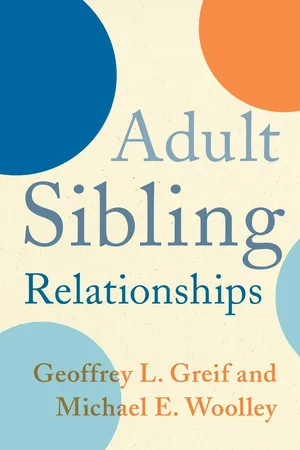
Adult Sibling Relationships
About this book
Information
Topic
PsicologiaSubtopic
PsicoterapiaPART |  |
Introduction to Adult Siblings
CHAPTER | |
The World of Adult Siblings
When I was growing up and I was starting to have new experiences—getting married, starting a family, having babies—it felt really nice to have older sisters that I could share with and get advice from and feel part of a bigger family. It felt like a safety net, and later, it felt like a safety net for my children that they had other people that loved them too.
Forty-nine-year-old white female, youngest of three sisters
Len’s living here and I was over there [an hour’s drive] for dinner one night last week, and he comes here probably once or twice a week for dinner, so we’re very close. And my sister, who lives like five miles from me, I hardly ever see. She calls me. I really have to work up the courage to call her back because it’s just an unpleasant relationship.
Fifty-nine-year-old white female, middle of three
My sister and I are polar opposites. She is a kind and loving person. I do not have any harsh things to say to describe her. However, she fails to honor the boundaries that should come with adult sibling relationships. More than I would like, we do not see eye to eye on various things that lead to patterns of harsh and disrespectful dialogues. It is common for us not to speak to each other for months following these exchanges, but we engage each other again as if nothing ever happened when there is a birthday or other family event that requires both of us to attend.
Forty-four-year-old African American male, younger of two
Well, I have [my husband] and our son, and my brother does not want children. He and his wife just have different goals for their lives. I think my family looks much more like what we had when we were kids, while I don’t know what my brother is doing half the time. The point is that it doesn’t matter; he’s still my brother.
Forty-three-year-old white female, older of two
Although it [our relationship] is fairly close and fairly frequent, it is also complicated. My brother is three years younger than me…somebody who growing up would now be diagnosed with social anxiety and maybe oppositional defiant disorder. Been treated for depression. Been treated for anxiety, so there are lots of those issues in the background, but everyone is crazy to some extent, so I am sure he has some things to say about me. He can be sort of a wild card and get angry pretty quick, and because he has social anxiety and OCD, it has really prevented him from being successful, and he is pissed about that, not all the time but a fair amount.
Fifty-nine-year-old white male, older of two
When I first agreed to do the interview, I was hoping to have a little bit of closure with that situation, but I decided just to wait and see if my brother would contact me. And he hasn’t. He travels for work and for pleasure and was recently in town twice. He had talked about us getting together—not talked so much as texted. And then never called me. So on the day that they were leaving, I didn’t realize they were leaving, I called and got their voicemail. I was really surprised; I thought it was like the next week or something.
Fifty-one-year-old white female with an older sister and younger brother
I have never been nearly as close to the others [step-, half, and adopted sibling] as I was to Donald [only full brother, who died in 1967]. I can do the dinners and all the usual stuff, but I can’t be totally honest with them. I can’t live those inner spots with any of them the way that Donald and I did it.
Seventy-one-year-old white female, oldest of six
THESE SEVEN WOMEN AND MEN speak about the loving as well as the distant and strained nature of sibling relationships. They describe appreciating the protection that siblings provide, avoiding a sister while staying close to a brother, pretending to get along at family events despite significant differences, not understanding a brother’s behavior but still accepting him, coping with a brother’s lifelong mental illness, feeling sloughed off by a brother, and mourning the loss of a cherished full-sibling while maintaining pseudo-relationships with other half, step-, and adopted siblings. To varying degrees, these relationships are marked by affection, ambivalence, and ambiguity, feelings that permeate many sibling relationships.
It may be a cliché, but we all face the reality that we can choose our friends but not our family of origin, the family into which we are born. We are forever tethered to our siblings, longer even than to our parents or children. We can drop or change our friends and our partners, but we cannot fully discard, relationally or psychologically, a brother or sister.
One of our initial premises in writing this book was to compare sibling relationships with friendships. After considering the data and reading the interviews, we determined that a friendship lens was not the correct lens to use. While siblings often are friends, the bonds that connect siblings are quite different. More family history is shared from birth and across generations. More physical space (bedroom, bathroom, dinner table) and activities (watching television, playing with toys, attending holiday rituals) are shared. Finally, family members are not chosen.
In this book, we offer an understanding of the complexity of adult sibling relationships, describing how affection is fostered, how ambivalence is a normal but little-understood feeling, and how ambiguity about the past or the present may lead to miscommunication and distancing. Based on in-depth case studies, interviews with more than 260 adult siblings forty and older, a survey of therapists, and consultations with experts, we offer ways to consider these complex and often changing connections so that they can be appreciated when going well and reconfigured and improved when needed. Even though mental health practitioners are our primary audience, what we describe will also be useful to lay readers interested in understanding and improving their relationships with their siblings.
Adult sibling relationships have been understudied in both mental health and historical research and only fairly recently have attracted attention. In both fields, the focus on the parent-child relationship has overshadowed other relationships. According to psychoanalyst Joyce Edward, the field of psychoanalysis has ignored such relationships because of its focus on the Oedipal complex and because most analysts paid little attention to it in their own analytic training.1 C. Dallett Hemphill, a history professor at Ursinus College, explained that her discipline also has been late in coming to the topic: “Despite all the attention to early modern families produced by historical baby boomers, it is curious that sibling relations, a near universal and crucial axis of family relations, have been almost totally overlooked.”2 As we will see in chapter 2, it was not until relatively recently that sibling relationships began to stimulate the interest of researchers and clinicians.
Edward argues that there is a plus/minus component to sibling relationships—a strong attachment to siblings can sustain a person and lead to a good sense of self throughout life or, conversely, can hinder individuation and growth. Competition can be healthy and foster maturity, or it can be debilitating and foster hostility. The task, according to Edward, is for the mental health profession to explore more deeply these important family relationships and then put this newfound knowledge about siblings to use in clinical practice in a world in which family forms are becoming increasingly diverse.
Another reason to look at sibling relationships is the recognition of the benefits of a robust social network in which siblings can be a critical part, particularly as people age. People with friends live longer, healthier, and happier lives. The qualities that people look for in friendships—loyalty, dependability, trustworthiness, and frequent communication have been noted as key elements of friendships between adults3—are often the bulwark of good family relationships. When sibling relationships are at their best, the connection goes beyond being merely a sibling relationship; it also can be a friendship, a perhaps higher and more satisfying order of connection. In those cases, it is not just blood that binds siblings together; instead, both siblings implicitly feel they would have chosen each other as a friend even if they were not already connected by a mutual love marked by a powerful shared history. When siblings are close, considering each other friends as well as family, they can play a key role in the social support network.
Other health and family benefits may accrue when siblings get along well. As the divorce rate among baby boomers increases,4 people are more likely to be single in later life. Many worry about aging alone and relying on strangers to take care of them. Siblings provide a trusted and reliable potential source of caregiving as we age. Our longer life spans bring siblings, as well as families in general, closer together.5 It is estimated that 80 percent of Americans have siblings.6 With increasing longevity, we will arguably need our siblings for our mutual good. Improving relations thus would seem to be imperative and might even reduce the need for government services to provide the caretaking that siblings may be able to do for one another if they are on good terms. Improving relations could also improve quality of life, which, at an advanced age, is often marked by social isolation and reclusiveness.
This is what we gain from growing up and growing old with siblings (whether they are biological, step-, half, or adoptive siblings) who can help us as we venture out into the world and build relationships with people outside our family. From siblings we learn how to
1. Cooperate and deal with competition.
2. Interact with the opposite sex (when there is an opposite-sex sibling).
3. Develop same-sex friendships (when there is a same-sex sibling).
4. Bond for protection from parents (when needed).
5. Stick up for one another to parents and peers, in school and other situations.
6. Negotiate the differences inherent in everyday life.
7. Navigate major decisions, such as taking care of aging parents.
8. Deal with the loss of parents and close relatives.
9. Maintain a lifelong relationship with a person closely matched to us in biological characteristics and family environment.
We begin with the assumption that people want a close and loving relationship with their brothers and sisters, even though they may settle for something different. We cannot escape family. It is emphasized in everyday life in the books and newspapers that we read and the television shows and movies that we watch. Work colleagues mention spending weekends with family, traveling for family reunions and vacations, and wanting to start a family. Emergency number requests ask for next of kin.
Google the word family and more than a billion hits come up. Family defines who is in and who is out of the first—and possibly only—lifelong system of which we are a part. Almost everyone wants a family, and those who don’t want one often feel they have to justify why they do not. While family does not provide the same life-and-death environment that it did in medieval times and pioneer days when, if you were thrown out of the home, you were unlikely to survive, it is still one of the most powerful forces in our lives.
Siblings are family. They may be the siblings that we “never see,” “never were close to,” “had a major falling out with,” or “stopped seeing after Mom (or Dad) died.” Notwithstanding such disclaimers, they still are related to us despite the lack of connection and strain; they remain a part of our history and our identity. Just as music is defined by the silences and art by the space on the canvas, relationships with siblings can be defined by the absence of connection.
Bad relationships with siblings can haunt us. Daniel Buccino, a Baltimore-based clinical social worker and former chair of the Maryland Board of Social Work Examiners, told us that half of his time providing psychotherapy to adults is taken up with discussing sibling relationships. “The residue of childhood often remains,” he explained. Whether someone was abused by a sibling or was treated poorly or favorably by a parent, those events have a clear impact on a person’s adult relationships with siblings and what kind of help is sought in treatment. In support of Buccino’s statement, numerous research studies have shown that sibling-to-sibling violence in childhood is a common form of family-based aggression.7
Favoritism (defined in various ways in the research to include receiving more affection, time resources, support,8 and treatment that is perceived as consistently unfair and one sided),9 as our own research found, also leaves fingerprints throughout the life span.
At their worst, sibling relationships can remain a source of stress for years, sometimes for a lifetime. They can be complicated, painful, hurtful, and conflicted. Sometimes there may be bitter fighting or simply no communication at all, which is handed down from one generation to the next. One woman whom we interviewed, who died at age eighty-five, asked her three daughters not to tell her sister when she died. She had stopped contact with her fifteen years earlier, and she wanted to maintain that separation after her death. Hence that legacy is carried to the next generation. Her daughters have no communication with their first cousins and have struggled at times with their own sister relationships, mimicking, though to a lesser degree, their mother and aunt’s relationship.
Between the siblings with wonderful, loving relationships and those with highly troubled relationships are siblings who may have settled into a valley with some, but not too much, emotional distance. These people often have ambivalent feelings about one another. A typical description of a brother or sister in such a situation might be:
“We understand each other, but we are not especially close and never have been.”
“She is my sister and I love her, but I wouldn’t choose her as a friend.”
“I will always be there for him, but he is such a pain.”
“We were close when we were young, but we have families now and don’t have time.”
“Since she moved away, we haven’t been as close.”
“His politics changed, so we avoid talking about a lot of stuff.”
The good news is that sibling relationships are not immutable. As we found in our research, some events may cause the dynamics to improve. People gain...
Table of contents
- Cover
- Title Page
- Copyright
- Contents
- Preface
- Acknowledgments
- Part One: Introduction to Adult Siblings
- Part Two: What We Learned About Siblings from Our Research
- Part Three: Case Studies
- Part Four: Therapy Approaches
- Appendix: Study Methodology and Implications for Future Research for Clinical Work
- Notes
- References
- Index
Trusted by 375,005 students
Access to over 1.5 million titles for a fair monthly price.
Study more efficiently using our study tools.
Frequently asked questions
Yes, you can cancel anytime from the Subscription tab in your account settings on the Perlego website. Your subscription will stay active until the end of your current billing period. Learn how to cancel your subscription
No, books cannot be downloaded as external files, such as PDFs, for use outside of Perlego. However, you can download books within the Perlego app for offline reading on mobile or tablet. Learn how to download books offline
We are an online textbook subscription service, where you can get access to an entire online library for less than the price of a single book per month. With over 1.5 million books across 990+ topics, we’ve got you covered! Learn about our mission
Look out for the read-aloud symbol on your next book to see if you can listen to it. The read-aloud tool reads text aloud for you, highlighting the text as it is being read. You can pause it, speed it up and slow it down. Learn more about Read Aloud
Yes! You can use the Perlego app on both iOS and Android devices to read anytime, anywhere — even offline. Perfect for commutes or when you’re on the go.
Please note we cannot support devices running on iOS 13 and Android 7 or earlier. Learn more about using the app
Please note we cannot support devices running on iOS 13 and Android 7 or earlier. Learn more about using the app
Yes, you can access Adult Sibling Relationships by Geoffrey L. Greif,Michael E. Woolley in PDF and/or ePUB format, as well as other popular books in Psicologia & Psicoterapia. We have over 1.5 million books available in our catalogue for you to explore.