eBook - ePub
Available until 27 Jan |Learn more
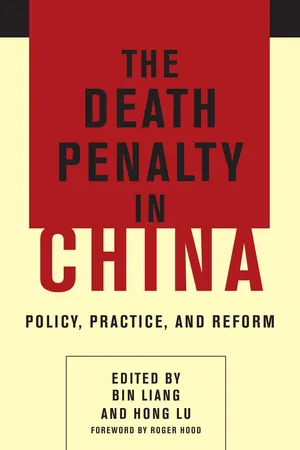
The Death Penalty in China
Policy, Practice, and Reform
This book is available to read until 27th January, 2026
- English
- ePUB (mobile friendly)
- Available on iOS & Android
eBook - ePub
Available until 27 Jan |Learn more
About this book
Featuring experts from Europe, Australia, Japan, China, and the United States, this collection of essays follows changes in the theory and policy of China's death penalty from the Mao era (1949–1979) through the Deng era (1980–1997) up to the present day. Using empirical data, such as capital offender and offense profiles, temporal and regional variations in capital punishment, and the impact of social media on public opinion and reform, contributors relay both the character of China's death penalty practices and the incremental changes that indicate reform. They then compare the Chinese experience to other countries throughout Asia and the world, showing how change can be implemented even within a non-democratic and rigid political system, but also the dangers of promoting policies that society may not be ready to embrace.
Frequently asked questions
Yes, you can cancel anytime from the Subscription tab in your account settings on the Perlego website. Your subscription will stay active until the end of your current billing period. Learn how to cancel your subscription.
No, books cannot be downloaded as external files, such as PDFs, for use outside of Perlego. However, you can download books within the Perlego app for offline reading on mobile or tablet. Learn more here.
Perlego offers two plans: Essential and Complete
- Essential is ideal for learners and professionals who enjoy exploring a wide range of subjects. Access the Essential Library with 800,000+ trusted titles and best-sellers across business, personal growth, and the humanities. Includes unlimited reading time and Standard Read Aloud voice.
- Complete: Perfect for advanced learners and researchers needing full, unrestricted access. Unlock 1.4M+ books across hundreds of subjects, including academic and specialized titles. The Complete Plan also includes advanced features like Premium Read Aloud and Research Assistant.
We are an online textbook subscription service, where you can get access to an entire online library for less than the price of a single book per month. With over 1 million books across 1000+ topics, we’ve got you covered! Learn more here.
Look out for the read-aloud symbol on your next book to see if you can listen to it. The read-aloud tool reads text aloud for you, highlighting the text as it is being read. You can pause it, speed it up and slow it down. Learn more here.
Yes! You can use the Perlego app on both iOS or Android devices to read anytime, anywhere — even offline. Perfect for commutes or when you’re on the go.
Please note we cannot support devices running on iOS 13 and Android 7 or earlier. Learn more about using the app.
Please note we cannot support devices running on iOS 13 and Android 7 or earlier. Learn more about using the app.
Yes, you can access The Death Penalty in China by Bin Liang,Hong Lu, Bin Liang, Hong Lu in PDF and/or ePUB format, as well as other popular books in Law & Chinese History. We have over one million books available in our catalogue for you to explore.
Information

China’s Death Penalty Practice
WORKING PROGRESS, STRUGGLE, AND CHALLENGES WITHIN THE GLOBAL ABOLITION MOVEMENT

FEW SOCIAL ISSUES have received more public attention and scholarly debate than the death penalty. Although the global abolitionist movement has made successful strides in recent decades, a small number of countries remain committed to the death penalty and impose it relatively frequently. In this regard, the People’s Republic of China (PRC or China hereafter) no doubt leads the world in the numbers of both death sentences and executions. Nevertheless, usually missing from public discussion (in particular among Western nations and societies) are the tremendous changes that have already occurred to China’s death penalty system. Such changes have become increasingly evident since China kicked off its legal reforms in the 1990s that aimed at building an effective Chinese legal system.
The main goal of this collection is to examine China’s death penalty practice within the dramatically changing social, political, and legal context of China and under the influence of the global abolition movement. In this introductory chapter, I would like to draw attention to China’s death penalty practice through two interrelated lenses, one domestic and the other international. The domestic lens focuses on internal changes to China’s practice, while the international lens situates China’s reforms within the context of the global abolition movement and examines whether and how China’s reform measures have addressed concerns raised by the international community.
DOMESTIC LENS: WORKING PROGRESS IN DECADES
Although studies of China’s death penalty have grown significantly in the past two decades, the world came to know about China’s practices mostly through research and media reports from Western countries, many of which portrayed China’s practices through negative or even vilified lenses (Lu & Miethe 2007:1). One major problem with such portrayals (which contain elements of truth) is that they fail to capture the complexity of China’s death penalty system as a whole and its rapid evolution and changing nature, especially in recent years (see table 1.1). To highlight and reflect on these dramatic changes, five death penalty cases in different eras are discussed in this chapter. These cases are neither comprehensive nor representative of all capital cases of their times. Rather, they collectively form a collage that gives the reader a glimpse of China’s death penalty practices at different times.
Politicized Use of Capital Punishment from the 1950s to 1970s
Zhang Zhixin was born in Tianjin in 1930, received her college education in the early 1950s, and became a member of the Chinese Communist Party (CCP) in 1955 and a cadre in the Communist Party Propaganda Department in Liaoning Province. Her fate, however, dramatically changed after the onset of the Cultural Revolution (1966–1976). In 1968, she was denounced for her critical comments about Chairman Mao and was sent to the “school for cadres” (reeducation camp) and ultimately labeled an active counterrevolutionary. Zhang was then arrested and imprisoned in 1969. In prison, she was tortured and raped, and her attempted suicide was deemed “confrontation and protest against the Party.” In 1970, Zhang was condemned to death for having opposed Mao and Jiang Qing (Mao’s wife) in favor of Liu Shaoqi (who was elected China’s chairman in 1959 but was disowned by Mao in the late 1960s as “the number one capitalist roader and a traitor”), and her case was transferred to the Liaoning High People’s Court and then to the Party Revolutionary Committee of the province for approval. Chen Xilian, then head of the province and military commander of the region, decided that Zhang be spared in order to “serve as a living (negative) example,” and Zhang’s sentence was reduced to life imprisonment. In 1973, during a meeting to criticize Lin Biao (who was named Mao’s successor after Liu Shaoqi but was labeled a counterrevolutionary after a failed coup in 1971), Zhang, then suffering from mental illness, shouted a slogan against Mao. This was judged another counterrevolutionary crime, and her case was resubmitted for death sentence approval in 1975. This time, Mao Yuanxin, Mao’s nephew and then the top person in charge, ordered her to be condemned to death with immediate execution. Zhang was executed in secret on April 4, 1975, at the age of 45. Before execution, her throat was slit, a method invented to prevent condemned prisoners from proclaiming their innocence or shouting political slogans considered unacceptable. Four years later, in the spring of 1979, her case was overturned, and Zhang was officially proclaimed a martyr.1
TABLE 1.1 Timeline of China’s Death Penalty Legal and Policy Changes
| YEAR | MAJOR CHANGE(S) |
| 1949 | The PRC was founded. |
| No formal criminal law or criminal procedure law was passed. | |
| 1954 | The NPC passed the Organic Law of the People’s Court, which stipulated that death penalty cases were to be reviewed and approved by provincial high courts and the SPC (Article 11). |
| 1958–66 | The SPC reviewed and approved death penalty cases based on a NPC decision passed in 1957. |
| 1966–76 | The SPC’s review and approval power became defunct during the Cultural Revolution period. |
| 1979 | The first Criminal Law and the first Criminal Procedure Law were passed; 28 death-eligible offenses were stipulated, and the SPC possessed the final review and approval authority for death penalty cases (Article 199). |
| The Organic Law of the People’s Court was revised: the SPC still possessed the final review and approval authority (Article 13). | |
| 1980 | The SCNPC decided to delegate the final review and approval authority from the SPC to provincial high courts. |
| 1981 | The SCNPC passed the Decision on Review and Approval of Death Penalty Cases, which (1) extended the delegation of the SPC’s final review and approval authority from 1981 to 1983 and (2) authorized that no SPC final review and approval would be needed in violent cases, such as murder, robbery, and arson. |
| The Decree on Punishing Military Personnel Who Derelict Military Duty added 13 new capital offenses. | |
| 1982 | The Decree on Severely Punishing Criminals Who Disturb National Economic Order added seven new capital offenses, including drug trafficking. |
| 1983 | The Decree on Severely Punishing Criminals Who Threaten Public Security added 10 new capital offenses. |
| The SCNPC passed On Expediting Trial Procedure Against Criminals Who Severely Threaten Public Security, under which certain cases were no longer bound by stipulations of the Criminal Procedure Law (e.g., the statute of limitations for criminal appeals was shortened from 10 to 3 days). | |
| The Organic Law of the People’s Court was revised to allow the SPC to delegate the final review and approval power (Article 13). | |
| The first strike-hard anticrime campaign kicked off; provincial high courts, instead of the SPC, exercised the final review and approval authority in certain cases (e.g., violent offenses, narcotics offenses). | |
| 1984 | Six ministries (SPC, SPP, MPS, MJ, MPH, and MCA) jointly adopted Temporary Provisions on How to Utilize Corpses or Organs of Executed Offenders. |
| 1986 | The Organic Law of the People’s Court was revised and continued to allow the SPC’s delegation of the final review and approval power (Article 13). |
| 1988 | The Supplemental Regulations on Punishing Criminals Who Leak National Secrets added one new capital offense. |
| 1990 | The NPC adopted the Decree on Drug Control, which made the death penalty applicable to all narcotics offenses. |
| 1991 | The Supplementary Regulation on Punishing Illegally Digging and Robbing Ancient Remains or Tombs added one new capital offense. |
| The Resolution on Severely Punishing Criminals Who Abduct and Sell Women and Children added three new capital offenses. | |
| The Resolution on Prohibiting Prostitution and Pimping added two new capital offenses. | |
| The SPC issued a notice to delegate the final review and approval power to the Yunnan High Court for drug cases. | |
| 1992 | The Decree on Punishing Criminals Who Hijack an Aircraft added one new capital offense. |
| 1993 | The Resolution on Punishing Criminals Who Produce and Sell Fake and Shoddy Products added two new capital offenses. |
| The SPC issued a notice to delegate the final review and approval power to the Guangdong High Court for drug cases. | |
| 1995 | The Resolution on Punishing Criminals Who Disturb the Financial Order added four new capital offenses. |
| The Resolution on Punishing Criminals Who Issue, Counterfeit, or Sell Special Value-Added Tax Invoices added two new capital offenses. | |
| 1996 | The Criminal Procedure Law was revised: (1) the final review and approval authority still resided in the SPC (Article 199); (2) legal representation was mandated in death penalty cases; and (3) legal injection became one means of official execution. |
| The SPC issued a notice to delegate the final review and approval power to the Guangxi, Sichuan, and Gansu High Courts for drug cases. | |
| 1997 | The Criminal Law was revised, with a total of 68 capital offenses. |
| The SPC’s Notice on Granting the Final Review and Approval Authority in Certain Death Penalty Cases to Provincial High Courts and Military Tribunals still allowed the decentralized practice of death penalty review and approval. | |
| 2001 | The SPC decided to implement legal injection nationwide as the means of execution. |
| 2002 | The SPC issued the Notice on Utilizing Lethal Injection in Executions to ensure standardized procedure. |
| 2005 | The SPC issued the Notice on Further Improving Appellate Trials (i.e., trials of second instance) in Death Penalty Cases, mandating an open–court appellate trial after July 2006. |
| 2006 | The Organic Law of the People’s Court was revised again and abolished the delegation of the SPC’s final review and approval authority (Article 12). |
| Over 6,000 judges received special training on death penalty trials in Beijing (National Judiciary College), the first such training ever organized by the SPC. | |
| The SPC and the SPP issued the Answers to Some Procedural Questions with Regard to Open–Court Appellate Trials in Death Penalty Cases. | |
| 2007 | The SPC took back the final review and approval power. |
| Four ministries (SPC, SPP, MPS, and MJ) jointly issued the Opinion on | |
| Further Strictly Enforcing the Law to Ensure the Quality of Death Penalty Cases, which, e.g., adopted rules against torture, demanded witness testimony in appellate trials, guaranteed lawyers’ rights, and granted visitation by family members before execution. | |
| 2008 | The SPC issued On Certain Issues with Regard to Execution Halt Procedure. |
| 2010 | The SPC issued Opinion on Certain Issues Concerning Implementing the Criminal Justice Policy of Balancing Leniency and Severity. |
| Five ministries (SPC, SPP, MPS, MNS, and MJ) jointly issued the Rules on Certain Issues Concerning Examination and Judgment of Evidence in Death Penalty Cases and Rules on Certain Issues Concerning the Exclusion of Illegal Evidence in Criminal Cases. | |
| 2011 | The Eighth Amendment of the 1997 Criminal Law was adopted: 13 previously capital offenses are no longer death eligible, but 55 death–eligible offenses remain. |
| 2012 | The Criminal Procedure Law was revised, and new measures were adopted to strengthen criminal defense: e.g., granting lawyers’ early intervention in the investigation stage (e.g., Articles 33 and 36), simplifying procedures for lawyers to meet with detained clients (e.g., Article 37), adopting exclusionary rules against evidence illegally obtained through torture (e.g., Articles 50, 53, 54), and mandating that interrogations of criminal suspects be recorded or videotaped for suspects facing a potential death sentence or life imprisonment (Article 121). |
| 2013 | The SPC held an open–court hearing in its review of a death penalty case, its first–ever open–court hearing in death penalty reviews. |
Abbreviations: MCA = Ministry of Civil Affairs; MJ = Ministry of Justice; MNS = Ministry of National Security; MPH = Ministry of Public Health; MPS = Ministry of Public Security; NPC = National People’s Congress; PRC = People’s Republic of China; SCNPC = Standing Committee of the National People’s Congress; SPC = Supreme People’s Court; SPP = Supreme People’s Procuratorate.
Zhang’s case is one of the best-known cases during this historical period. As reflected in her case, the most dominant feature of this era was the politicized use of the death penalty against counterrevolutionaries (see chapter 3). From 1949 to 1979, no formal criminal codes (e.g., criminal law, criminal proced...
Table of contents
- Cover
- Title Page
- Copyright
- Contents
- Foreword
- Preface and Acknowledgments
- Chapter One: China’s Death Penalty Practice: Working Progress, Struggle, and Challenges Within the Global Abolition Movement
- Chapter Two: The Criminal Justice System and the Death Penalty
- Chapter Three: Crimes of Counterrevolution and Politicized Use of the Death Penalty During the Mao Era
- Chapter Four: China’s Death Penalty in a State-Power-Based Society
- Chapter Five: From “Killing Many” to “Killing Fewer”
- Chapter Six: The Abolitionist and Retentionist Debate
- Chapter Seven: Guiding Cases for China’s Death Penalty: Analysis and Reflection
- Chapter Eight: The Death Penalty After the Restoration of Centralized Review: An Empirical Study of Capital Sentencing
- Chapter Nine: Public Opinion and the Death Penalty
- Chapter Ten: Between Deference and Defiance: Courts and Penal Populism in Chinese Capital Cases
- Chapter Eleven: Chinese Capital Punishment in Comparative Perspective
- Chapter Twelve: China’s Death Penalty in the Twenty-First Century
- List of Contributors
- Index