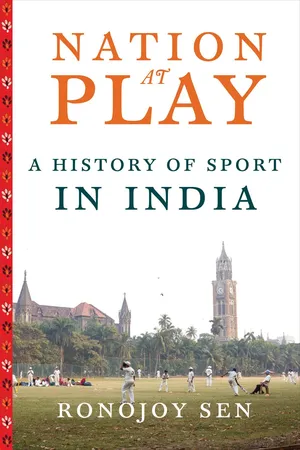
Reaching as far back as ancient times, Ronojoy Sen pairs a novel history of India's engagement with sport and a probing analysis of its cultural and political development under monarchy and colonialism, and as an independent nation. Some sports that originated in India have fallen out of favor, while others, such as cricket, have been adopted and made wholly India's own. Sen's innovative project casts sport less as a natural expression of human competition than as an instructive practice reflecting a unique play with power, morality, aesthetics, identity, and money.
Sen follows the transformation of sport from an elite, kingly pastime to a national obsession tied to colonialism, nationalism, and free market liberalization. He pays special attention to two modern phenomena: the dominance of cricket in the Indian consciousness and the chronic failure of a billion-strong nation to compete successfully in international sporting competitions, such as the Olympics. Innovatively incorporating examples from popular media and other unconventional sources, Sen not only captures the political nature of sport in India but also reveals the patterns of patronage, clientage, and institutionalization that have bound this diverse nation together for centuries.
- English
- ePUB (mobile friendly)
- Available on iOS & Android
eBook - ePub
About this book
Information
Subtopic
Indian & South Asian HistoryIndex
History1
DOWN THE AGES
SPORT IN ANCIENT AND MEDIEVAL INDIA
In the Ancient world there was nothing comparable to the Olympic Games of Greece. The games first held at Olympia in at least 776 B.C.E., if not earlier, were among at least four such competitions—the others being the Pythian, Isthimian, and Nemean Games—held in ancient Greece. But the games in Olympia were by far the most prestigious as well as the longest running, as they were held without fail every four years for an astonishing 1,200 years. Though there is a tendency to view the ancient Olympics through rose-tinted spectacles, we now know that it was often a bloody and violent business. As a scholar of the ancient Olympics explained, at both the popular and philosophical levels, it was understood that essentially “all games were war games.”1 While modern sports can, in many instances, be traced back to ancient times, the similarities should not be exaggerated. According to Norbert Elias and Eric Dunning, “Throughout antiquity the threshold of sensitivity with regard to the infliction of physical injuries and even to killing in a game-contest and, accordingly, the whole contest ethos, was very different from that represented by the type of contest which we nowadays characterize as ‘sport.’”2 This was true for ancient India as well.
Sports in the Epics
Even though mention of sports or sports competitions is pitifully scarce in standard histories of ancient India, such references, at least in the martial sense, are plentiful in the great Indian epic the Mahabharata. The Mahabharata is a complex and bloody tale of two sets of warring cousins—the five Pandavas and the one hundred Kauravas—containing 100,000 verses, or shlokas, spread over eighteen books. It was most likely composed over several hundred years between 400 B.C.E. and 400 C.E. For nearly every aspect of Indian life, we can turn to the Mahabharata, and this holds true for sports as well. Thus the author(s) of the Mahabharata could boast, “Whatever is found here may be found somewhere else, but what is not found here is found nowhere.”3
The Mahabharata does not, of course, discuss competitive sports as we understand them today, but it does describe training for the martial arts as well as physical contests within a loose framework of rules. In the stratified Indian society, the martial arts were restricted to the Kshatriya, or warrior, caste, second in the pecking order behind the Brahmins and above the Vaishyas (traders), the Sudras (the lowest caste), and the Avarna (Dalit or Scheduled Caste, formerly called “untouchables”) who fell outside the pale of the caste system. This scheme is explained in the Mahabharata itself when the Kuru patriarch Bhishma gives a lengthy sermon to the eldest Pandava, Yudhisthira, over books 12 and 13, which is commonly believed to have been added later to the text. Bhishma described the dharma of the four castes thus: “Brahmins should be self-controlled and study the Vedas. Ksatriyas should give gifts, perform sacrifices, protect people and show courage in battle. Vaisyas should tend cattle. Sudras should obey the three higher classes.”4 This division is quite apparent in the Mahabharata, in which only the princes, such as the Pandavas and Kauravas, were given training in various martial arts, though their teachers were Brahmins. The caste boundaries were rigid, and transgressions, particularly by those lower in the caste hierarchy than the Kshatriyas, were not taken lightly, as the Mahabharata chillingly makes clear. The world of sports also was overwhelmingly male. Likewise, in ancient Greece, women weren’t allowed to compete in the Olympics either, although there was a festival dedicated to Zeus’s consort Hera, in which virgin girls could take part.
Modern India’s Arjuna and Dronacharya awards, which came into being in 1961 and 1985, respectively, draw their inspiration from the teacher of the Kuru princes, Dronacharya, and his favorite pupil, the Pandava prince Arjuna. Bhima, another of the Pandavas, is regarded as a patron saint of Indian wrestlers. Dronachaya was appointed the trainer of the young princes by Bhishma, who was on the lookout for “teachers of recognized prowess who knew archery, since no man of little wit, authority, and expertise in weaponry, or of less than divine mettle, could discipline the mighty Kurus.”5 Drona instructed his wards in archery and swordsmanship and also in hand-thrown weapons like clubs, spears, javelins, and lances, as well as in the art of fighting from chariots, elephants, and horses.
Because of Drona’s great renown, young men throughout India flocked to train under him. One of them was Ekalavya, a Nisada belonging to a group of people living in the forest (those who are called Adivasis today), whom Drona refused to accept as a student. Undeterred, Ekalavya practiced his skills in the forest in front of his teacher, a clay image of Drona. But Ekalavya was discovered when the Kuru princes observed him one day displaying amazing shooting skills. When they asked his identity, Ekalavya answered that he was the son of the chieftain of the Nisadas and a pupil of Drona. When Arjuna told Drona that another archer was even better than him, Drona himself went to meet Ekalavya and demanded his reward, guru dakshina. Drona’s fee was Ekalavya’s right thumb, which Ekalavya cheerfully sliced off. Arjuna’s position thus remained secure. Among other things, the Ekalavya episode is a powerful allegory of the consequences of transgressing the closed boundaries of martial sports and, indeed, caste hierarchies in general.
With Ekalavya out of the way, Arjuna became the undisputed champion of all weapons, while both Duryodhana, the eldest of the Kauravas, and Bhima excelled in combat with clubs. Arjuna’s prowess was shown in the famous episode from the Mahabharata in which Drona tested his trainees’ skills. All his trainees were asked to take aim at a clay bird perched on a treetop and to report what they saw before letting fly the arrow. Without fail, each prince said that he saw the treetop, the bird, and his cousins. But when Arjuna was asked, he said he saw only the bird. And when he was asked to describe the bird, Arjuna replied, “I see its head, not its body.”6 On hearing this, a pleased Drona commanded Arjuna to release his arrow, which promptly knocked the bird off its perch.
A dramatic illustration of the closed circle of sport occurred during a public exhibition held by the Kuru princes once they had finished their training under Drona. The star of the show was Arjuna:
Trained to high excellence, the favourite of his guru hit and shot through fragile targets, and tiny ones, and hard ones, with different makes of arrows. While an iron boar was moved about, he loosed into its snout five continuous arrows as though they were one single one. The mighty archer buried twenty-one arrows in a cow’s hollow horn that was swaying on a rope. And in this and other fashions he gave an exhibition of his dexterity with the long sword as well as the bow and the club.7
When the rapturous crowds were about to leave the arena, Karna, a central character in the Mahabharata, strode in. Born to Kunti, mother of the three elder Pandavas—Yudhisthira, Bhima, and Arjuna—Karna was abandoned as a baby and raised by a charioteer. He threw down a challenge to Arjuna, who dismissed him as an uninvited intruder. Karna replied, “Ksatriyas excel in heroism, and dharma defers to strength; why trade in insults, the consolation of the weak? Talk with your arrows, heir of Bharata, till my arrows carry off your head while your teacher looks on!”8 As the two warriors squared off, one of the elders clearly spelled out the rules of challenge to Karna, which meant not only belonging to the right caste but also having a royal lineage:
Here stands the younger son of Kunti, son of Pandu, descendant of Kuru. He will fight you in single combat, sir. Now that you too, strong-armed hero, must announce your mother, father and the royal lineage of which you are the glory. Once this is known to Kunti’s son, he will fight you, or he will not.9
A crestfallen Karna hung his head in shame. Then the Kaurava prince Duryodhana, avowed rival of the Pandavas, immediately crowned Karna as the king of Anga to enable him to take on Arjuna. At this point, the charioteer who had raised Karna made an appearance and embraced his adopted son, prompting Bhima to taunt Karna by calling him the lowliest of men. While the drama played out, the sun set, drawing the curtain on this particular episode of an unforced entry into a competition meant only for Kshatriyas.
So much for the training of the Kshatriya princes. Essential to sports is the idea of winning, which often comes with a prize, both material and nonmaterial. Johan Huizinga noted that victory could bring with it honor, esteem, and prestige. But usually every game involved stakes that could be a “gold cup or a jewel or a king’s daughter or a shilling; the life of the player or the welfare of the whole tribe.”10 This aspect of sports was shown in the swayamvar (the practice of choosing a husband from among a list of suitors) held for the hand of Draupadi, the ravishing daughter of King Drupad. The king announced that he would give his daughter’s hand to the person who could string a very strong bow and hit a high target through a small opening. The Pandavas, who were on the run to avoid Duryodhana’s evil designs, were at the gathering disguised as mendicant Brahmins. When prince after prince failed to string the bow, Arjuna rose to take a try. This caused some consternation among the princes assembled there, who wondered how a “mere Brahmin boy, untrained in weapons and inferior in strength,”11 could string the bow in a way that so many Kshatriya princes had failed to do. Once again the hierarchies of caste came into play. But unlike Ekalavya or Karna, who were deemed to be lower in the hierarchy, Arjuna was allowed to proceed because “there is no task anywhere in the three worlds that is beyond the power of Brahmins among the three classes of men.”12 The task that had stumped so many princes was done in a trice by Arjuna: “In the time it takes to blink, he strung it; and he took up five arrows and swiftly pierced the target through the opening.”13
We find a similar episode of a hero showing his strength to win the hand of a princess in the other great Indian epic, the Ramayana. King Janaka had promised his daughter Sita in marriage to whoever could lift a celestial bow in his possession. When Rama and his brother Lakshman, accompanied by the great sage Vishvamitra, wanted to see the bow, Janaka said that he would marry his daughter to Rama if he could string the bow. Rama did so with ease, winning Sita’s hand:
Then, as though it was mere play to him, the righteous prince, the delight of the Raghus, strung the bow as thousands watched. The mighty man affixed the bowstring and, fitting an arrow to it, drew it back. But, in so doing, the best of men broke the bow in the middle. There was a tremendous noise loud as a thunderclap, and a mighty trembling shook the earth, as if a mountain had been torn asunder. Of all those men, only the great sage, the king and the two Raghavas remained standing; the rest fell, stunned by the noise.14
A greater contribution of the Ramayana to Indian sports is the character of Hanuman—the monkey god known for his immense strength as well as his loyalty to Rama—who is regarded as the patron deity of Indian wrestling and occupies pride of place in most akharas in India.
Arjuna won Draupadi’s hand, but the matter did not end there. The fact that a Brahmin had bested the cream of the Kshatriyas in a contest of physical skill did not go down well at all. They said to King Drupad, “Here we are assembled and he passes us by as though we were straw! He wants to give Draupadi, finest of women, to a Brahmin.”15 With these words, they readied to attack Drupad. The Pandavas came to his rescue and warded off the Kshatriya princes, led by such great warriors such as Karna and Salya. Soon the Kshatriya princes beat a retreat, wondering whether these Brahmins weren’t the Pandavas in disguise. They left muttering, “The arena has become dominated by the brahmins.”16
The contests in the Mahabharata were by no means restricted to prowess in archery. A central place is occupied by the gambling match—in fact, according to Huizinga, the main action of the Mahabharata hinges on this game of dice—in which Yudhisthira...
Table of contents
- Cover
- Series Page
- Title Page
- Copyright
- Dedication
- Contents
- Acknowledgments
- Introduction
- 1. Down the Ages: Sport in Ancient and Medieval India
- 2. Empire of Sport: The Early British Impact on Recreation
- 3. White Man’s Burden: Teachers, Missionaries, and Administrators
- 4. Players and Patrons: Indian Princes and Sports
- 5. The Empire Strikes Back: The 1911 IFA Shield and Football in Calcutta
- 6. Politics on the Maidan: Sport, Communalism, and Nationalism
- 7. The Early Olympics: India’s Hockey Triumphs
- 8. Lords of the Ring: Tales of Wrestlers and Boxers
- 9. Freedom Games: The First Two Decades of Independence
- 10. Domestic Sports: State, Club, Office, and Regiment (1947–1970)
- 11. 1971 and After: The Religion Called Cricket
- 12. Life Beyond Cricket
- Notes
- Index
Trusted by 375,005 students
Access to over 1.5 million titles for a fair monthly price.
Study more efficiently using our study tools.
Frequently asked questions
Yes, you can cancel anytime from the Subscription tab in your account settings on the Perlego website. Your subscription will stay active until the end of your current billing period. Learn how to cancel your subscription
No, books cannot be downloaded as external files, such as PDFs, for use outside of Perlego. However, you can download books within the Perlego app for offline reading on mobile or tablet. Learn how to download books offline
We are an online textbook subscription service, where you can get access to an entire online library for less than the price of a single book per month. With over 1.5 million books across 990+ topics, we’ve got you covered! Learn about our mission
Look out for the read-aloud symbol on your next book to see if you can listen to it. The read-aloud tool reads text aloud for you, highlighting the text as it is being read. You can pause it, speed it up and slow it down. Learn more about Read Aloud
Yes! You can use the Perlego app on both iOS and Android devices to read anytime, anywhere — even offline. Perfect for commutes or when you’re on the go.
Please note we cannot support devices running on iOS 13 and Android 7 or earlier. Learn more about using the app
Please note we cannot support devices running on iOS 13 and Android 7 or earlier. Learn more about using the app
Yes, you can access Nation at Play by Ronojoy Sen in PDF and/or ePUB format, as well as other popular books in History & Indian & South Asian History. We have over 1.5 million books available in our catalogue for you to explore.