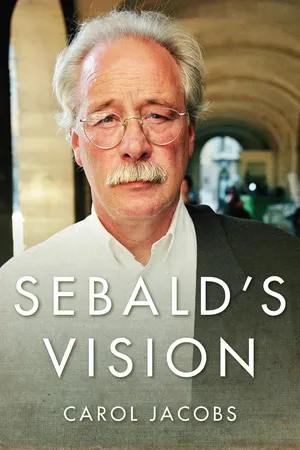
W. G. Sebald's writing has been widely recognized for its intense, nuanced engagement with the Holocaust, the Allied bombing of Germany in WWII, and other episodes of violence throughout history. Through his inventive use of narrative form and juxtaposition of image and text, Sebald's work has offered readers new ways to think about remembering and representing trauma.
In Sebald's Vision, Carol Jacobs examines the author's prose, novels, and poems, illuminating the ethical and aesthetic questions that shaped his remarkable oeuvre. Through the trope of "vision," Jacobs explores aspects of Sebald's writing and the way the author's indirect depiction of events highlights the ethical imperative of representing history while at the same time calling into question the possibility of such representation.
Jacobs's lucid readings of Sebald's work also consider his famous juxtaposition of images and use of citations to explain his interest in the vagaries of perception. Isolating different ideas of vision in some of his most noted works, including Rings of Saturn, Austerlitz, and After Nature, as well as in Sebald's interviews, poetry, art criticism, and his lecture Air War and Literature, Jacobs introduces new perspectives for understanding the distinctiveness of Sebald's work and its profound moral implications.
eBook - ePub
Sebald's Vision
About this book
Information
Subtopic
20th Century HistoryIndex
Literature1
“Like the snow on the Alps”
After Nature
CROSSING BORDERS
Whoever opens After Nature (Nach der Natur) might well be lost. The epigraph to the first of its three poems invokes a guide, but what reader would thereby be given hope?
“Now go, for a single will is in us both:
Thou guide, thou lord, thou master,”
So I said to him; and when he had set forth
I entered on the steep wild-wooded way.1
Dante, led into the Inferno by Virgil, is taken on a wooded way (which will eventually find echoes in Sebald’s poem) and follows his guide with blind abandon. That we are on the way to hell in Sebald’s first major literary publication, in the first of the three poems that comprise that work, is not immediately evident. But we might be struck from the outset by its title, which cites, not the opening phrase of the poem, the customary gesture for titling a text, but, rather, its closing words: “like the snow on the Alps” (After Nature, 37E, 33G).2 The poem, devoted to the sixteenth-century painter Matthaeus Grünewald, thus anticipates its own end, makes it foregone. With the phrase “like the snow on the Alps” it might also seem to celebrate nature, or at the very least its own capacity to paint therefrom (Nach der Natur). We will see.
Like its title, the beginning of the poem asks us to think the relation of opening and closure. It is a question of how we have access to a work of art, what kind of art that is, and how it relates to those outside it.3
Whoever closes the wings
of the altar in the Lindenhardt
parish church and locks up
the carved figures in their casing
on the left hand panel
will be met by St. George.4
(After Nature 5E)5
To be met by the work of Matthaeus Grünewald, perhaps that of Sebald as well, one must perform a certain task. We must close the door on, withdraw from sight, certain kinds of figures. Carved and three-dimensional, to them belongs a casing or housing that guarantees fixed place. We must lock these away, with their attempts at rounded replication, and give ourselves over, rather, to what comes to meet us. We are called to an encounter—if not yet to account.
Foremost at the picture’s edge he stands
above the world by a hand’s breadth
and is about to step over the frame’s
threshold. Georgius Miles. . . .
(After Nature 5E)6
Floating just slightly above the earth, nothing fixes St. George in place—much less grounds or closes him in. Poised on the border of image and world, he is about to cross the threshold between painting and beholder. This permeability of the work of art, this crossing of borders—an interchangeability of spaces, of figures, of times—will have a crucial role to play across the parts of After Nature as well as in each of the four works to follow, in The Rings of Saturn, Vertigo, The Emigrants, and Austerlitz.
On the facing panel, another wanderer: the older man, St. Dionysius, is Matthaeus Grünewald’s chosen protector:
at the centre of
the Lindenhardt altar’s right wing,
that troubled gaze upon the youth
on the other side, of the older man
whom, years ago now, on a grey
January morning I myself once
encountered in the railway station
in Bamberg. It is St. Dionysius,
his cut-off head under one arm.
(After Nature 6–7E)7
If St. George is poised to enter our space, Dionysius had already done so—jumped the frame and made it to the other side. Doubly. First with his eyes, directed toward the youth on the facing panel—but, also, crossing out of the painted surface, out of the sixteenth to the twentieth century—to the Bamberg train station where the narrator had seen him years before.8
St. George is about to step over the threshold to us, leaving his dragon yet to be slain. St. Dionysius has already, without our knowing, entered our world. “In the midst of life [Dionysius] carries his death with him” (After Nature 7E, 8G) in the form of his own severed head. Perhaps it is this one face too many (the dead one with the closed eyes) of the saint that allows him to wander out of the work of art and into the everyday life of the author. Closed eyes, a death of sorts, may be the ticket to Sebald’s many railway stations.
Saints George and Dionysius may wander among us. Access to Grünewald is another matter. “The face of the unknown / Grünewald emerges again and again in his work” (After Nature 5E, 7G) in St. George to begin with, as well as in the work of Holbein and others. In a barely disguised instance of resemblance, how can one fail to recognize also Sebald’s eyes, sliding sideways in so many photos as though burdened with grief and loneliness?
Always the same
gentleness, the same burden of grief,
the same irregularity of the eyes, veiled
and sliding sideways down into loneliness.
. . .
These were strangely disguised
instances of resemblance, wrote Fraenger
whose books were burned by the fascists.
Indeed it seemed as though in such works of art
men had revered each other like brothers, and
often made monuments in each other’s
image where their paths had crossed.
(After Nature 6)9
The staged coincidences, connections, similarities, the rupture from the image world to its apparent other, the temporal volt over a threshold of centuries that seems to divide the past from the present and death from life,10 the haunting by a Holocaust never quite absent: throughout the works of Sebald, these are defining gestures—also the irregularity of eyes that cannot be ruled.
DEPICTIONS
If his face is to be found in various forms, depicted by various hands, still: “Little is known of the life of / Matthaeus Grünewald of Aschaffenburg” (After Nature 9E, 10G). If not the life, then might we know the works? They come to us at first indirectly, if at all (in section II of the poem) by way of “The first account of the painter / in Joachim von Sandrart’s German Academy / of the year 1675” (After Nature 9E, 10G). There we read of one work, lost since the nineteenth century, and of another, looted and lost in a shipwreck, and of other paintings that Sandrart also never got to see. Nevertheless, we are asked to trust the report of Sandrart, since an image of him in the Würzburger Museum shows him at eighty-two “wide awake and with eyes uncommonly clear” (After Nature 9E, 10G). The clarity of the critic’s eyes alongside the irregularity of the painter’s: what are we to make of this?
Might we speak of the clarity of the critic’s eye in the narrative of After Nature? There are many verbal depictions of Grünewald’s images, pages on pages of them: the Lindenhardt Altar with its St. George and St. Dionysius, the fourteen auxiliary saints, Cyriax and Diocletian’s epileptic daughter, the self-portrait in the Erlangen library, the trans-figuration of Christ on Mount Tabor, the blind, murdered hermit on the Mainz cathedral altar panels, the self-portrait of Nithart in the Chicago Art Institute, the Sebastian panel, the Isenheim altar, the Basel Crucifixion of 1505, the temptation of St. Anthony in all its excruciating detail, all these are laid out before the mind’s eye. Take the following passage, a scene from the temptation of St. Anthony, but, surely, also, the fulfilled premonition of hell announced in the epigraph.
Low down in the bottom-left corner
cowers the body, covered with
syphilitic chancres, of an inmate
of the Isenheim hospital. Above it
rises a two-headed and many-
armed androgynous creature
about to finish off the saint
with a brandished jaw-bone.
On the right, a stilt-legged ...
Table of contents
- Cover
- Series Page
- Title Page
- Copyright
- Dedication
- Contents
- Preface: “Sebald’s Vision”
- Acknowledgments
- 1. “Like the Snow on the Alps”: After Nature
- 2. What Does It Mean to Count?: The Emigrants
- 3. Frames and Excursions: Rings of Saturn
- 4. Toward an Epistemology of Citation: “Air War and Literature”
- 5. A is for austerlitz: Austerlitz
- 6. Déjà Vu or . . . : “Like Day and Night—on the Pictures of Jan Peter Tripp”
- 7. A Critical Eye: The Interviews
- Notes
- Works Cited
- Index
Trusted by 375,005 students
Access to over 1.5 million titles for a fair monthly price.
Study more efficiently using our study tools.
Frequently asked questions
Yes, you can cancel anytime from the Subscription tab in your account settings on the Perlego website. Your subscription will stay active until the end of your current billing period. Learn how to cancel your subscription
No, books cannot be downloaded as external files, such as PDFs, for use outside of Perlego. However, you can download books within the Perlego app for offline reading on mobile or tablet. Learn how to download books offline
Perlego offers two plans: Essential and Complete
- Essential is ideal for learners and professionals who enjoy exploring a wide range of subjects. Access the Essential Library with 800,000+ trusted titles and best-sellers across business, personal growth, and the humanities. Includes unlimited reading time and Standard Read Aloud voice.
- Complete: Perfect for advanced learners and researchers needing full, unrestricted access. Unlock 1.5M+ books across hundreds of subjects, including academic and specialized titles. The Complete Plan also includes advanced features like Premium Read Aloud and Research Assistant.
We are an online textbook subscription service, where you can get access to an entire online library for less than the price of a single book per month. With over 1.5 million books across 990+ topics, we’ve got you covered! Learn about our mission
Look out for the read-aloud symbol on your next book to see if you can listen to it. The read-aloud tool reads text aloud for you, highlighting the text as it is being read. You can pause it, speed it up and slow it down. Learn more about Read Aloud
Yes! You can use the Perlego app on both iOS and Android devices to read anytime, anywhere — even offline. Perfect for commutes or when you’re on the go.
Please note we cannot support devices running on iOS 13 and Android 7 or earlier. Learn more about using the app
Please note we cannot support devices running on iOS 13 and Android 7 or earlier. Learn more about using the app
Yes, you can access Sebald's Vision by Carol Jacobs in PDF and/or ePUB format, as well as other popular books in Literature & 20th Century History. We have over 1.5 million books available in our catalogue for you to explore.