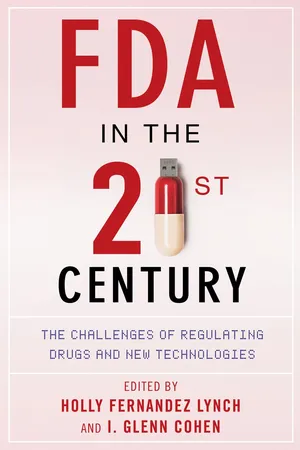
In its decades-long effort to assure the safety, efficacy, and security of medicines and other products, the Food and Drug Administration has struggled with issues of funding, proper associations with industry, and the balance between consumer choice and consumer protection. Today, these challenges are compounded by the pressures of globalization, the introduction of novel technologies, and fast-evolving threats to public health. With essays by leading scholars and government and private-industry experts, FDA in the Twenty-First Century addresses perennial and new problems and the improvements the agency can make to better serve the public good.
The collection features essays on effective regulation in an era of globalization, consumer empowerment, and comparative effectiveness, as well as questions of data transparency, conflicts of interest, industry responsibility, and innovation policy, all with an emphasis on pharmaceuticals. The book also intervenes in the debate over off-label drug marketing and the proper role of the FDA before and after a drug goes on the market. Dealing honestly and thoroughly with the FDA's successes and failures, these essays rethink the structure, function, and future of the agency and the effect policy innovations may have on regulatory institutions abroad.
eBook - ePub
FDA in the Twenty-First Century
The Challenges of Regulating Drugs and New Technologies
- English
- ePUB (mobile friendly)
- Available on iOS & Android
eBook - ePub
FDA in the Twenty-First Century
The Challenges of Regulating Drugs and New Technologies
About this book
Information
Subtopic
Government & BusinessIndex
Business
CHAPTER ONE
Historical Themes and Developments at FDA Over the Past Fifty Years

I. INTRODUCTION
This chapter provides a historical overview of seven important policies that the Food and Drug Administration (FDA) has addressed over the past fifty years. Each of these policies has had antecedents initially under the Federal Food and Drugs Act of 1906 (34 Stat. 768) and then under the Federal Food, Drug, and Cosmetic Act (FDCA) of 1938 (52 Stat. 1040) that replaced the 1906 act. Each of them has evolved over time and will continue to evolve in the future. FDA has always been a dynamic organization and must continually change to reflect new insights into both risk assessment regarding the products it regulates and risk management to provide a reasonable balance between fostering innovation and protecting the public health.
The origin of FDA extends back to 1839, when Congress first appropriated funds to the Patent Office for “the collection of agricultural statistics, and for other agricultural purposes.” An Agricultural Division was subsequently created in the Patent Office and a Chemical Laboratory was established within the Agriculture Division.1 When the United States Department of Agriculture (USDA) was created by Congress in 1862, the Agriculture Division of the Patent Office formed the nucleus of the new department, and its Chemical Laboratory became the organizational antecedent of what is now FDA. It was officially named the Chemical Division in 1862, the Division of Chemistry in 1890, the Bureau of Chemistry in 1901, the Food, Drug, and Insecticide Administration in 1927, and the Food and Drug Administration in 1930. It resided in the USDA until it was transferred to the Federal Security Administration in 1940, the Department of Health, Education, and Welfare in 1953, and finally the Department of Health and Human Services in 1979, where it resides today. Throughout this chapter, “FDA” will be used to refer to all of these antecedent organizations.
Today FDA regulates food, drugs, cosmetics, medical devices, and tobacco. Together, these consumer products comprise twenty-five cents out of every dollar spent by consumers in the United States. The scope and power of FDA is therefore enormously important for both economic and health reasons. There is a growing academic literature that explores the history and work of FDA, to which this volume makes an important contribution.
II. FDA MANAGEMENT
From its inception, even before it was given the regulatory authority conveyed by the 1906 act, FDA was administered by a single individual, who earlier was called the chemist or chief chemist but since 1940 has been called the commissioner. Throughout this time, the agency has been divided into two components: (1) the Headquarters staff located in Washington, D.C., and the vicinity, and (2) the Field Force, located throughout the entire United States. Although management of the Field Force remains largely unchanged throughout the history of FDA, the organization and management of FDA Headquarters has evolved over time. In the early days of FDA, the Headquarters was organized along functional responsibilities.2 The major functions were scientific research, regulation, and the field. During that time, the vast majority of work related to food, and thus there was no need for FDA to be organized by product categories. With enactment of the Drug Amendments of 1962 (76 Stat. 780) and the emergence of the modern medical device industry,3 the agency was completely reorganized along product lines in 1970. There are now centers within FDA for food, drugs, biological products, animal feed and drugs, medical devices, and tobacco.
Although there is no reliable historical statistical series reflecting the resources of FDA throughout its history, table 1.1 presents the best available data from 1900 to the present. The modest resources available to the agency through 1960 were reflected in a highly personal and close-knit management approach. The commissioner’s team was small and comprised individuals who had spent their entire careers at the agency. They knew most of the people in the Field Force and could reach out for information quickly and efficiently. Following enactment of the FDCA in 1938, there were only two congressional hearings before 1960 (Hutt 1983), and thus there was very little congressional distraction. FDA had not yet become the subject of the intense press interest that it is today. In short, the agency was a small, tightly run organization that attracted little public attention. By 1970, all that had changed. The thalidomide disaster (Mintz 1962), followed by the Drug Amendments of 1962, changed the agency forever.
TABLE 1.1
| Year | Congressional Appropriation (Dollars) | Employees |
| 1900 | 17,100 | — |
| 1910 | 930,560 | 467 |
| 1920 | 1,391,571 | 374 |
| 1930 | 1,849,140 | 530 |
| 1940 | 2,741,000 | 719 |
| 1950 | 4,802,500 | 955 |
| 1960 | 13,800,000 | 1,678 |
| 1970 | 72,352,000 | 4,252 |
| 1980 | 312,796,000 | 7,517 |
| 1990 | 560,271,000 | 7,815 |
| 2000 | 1,048,000,000 | 7,728 |
| 2010 | 2,370,000,000 | 9,368 |
| 2014 | 2,557,963,000 | 9,940 |
Compiled from FDA reports. This table does not include user fees or employees paid with user fees.
From 1862 through 1965, there were fourteen FDA commissioners. Since the last career commissioner retired from FDA in 1965, there have also been fourteen FDA commissioners. Each has reflected his or her own personal management style. For some, their personal management philosophy has been clearly articulated and has had a major impact on the agency. For others, there has been relatively little impact and thus only minor change when a new commissioner has arrived. The following brief summary illustrates the differences that have occurred.
Charles C. Edwards, MD, was FDA commissioner from 1969 through 1973. Although he was trained as a surgeon, he spent the years before he came to FDA as a medical management consultant. He recruited business managers to the agency and initiated a project management system (PMS) to organize the increasing work at Headquarters. Every morning, Dr. Edwards and his immediate staff met with a director of one of the product bureaus (now called centers) and the bureau staff to review important programs and issues. Everyone knowledgeable with respect to an issue was included in the discussion, but the commissioner made the ultimate decision. No issue went unresolved for longer than a week or two.
As the issues proliferated and became more technical and complex and the resources of the agency increased dramatically, the close supervision and decisional authority of the commissioner eroded. By 1990, the weekly meetings of the commissioner with the center directors was abandoned. Since then, the commissioner has become involved in only the most important issues in the agency, as determined largely by Congress and the media. It is rare that a truly important scientific or medical issue will be reviewed by the commissioner, and even then it is usually not the commissioner who makes the final decision.
The personal interests of a commissioner nonetheless remain an important force within FDA. One of the more significant issues that is discussed within both FDA and the regulated industry is the extent to which relations between these two interested parties should be on a collaborative and cooperative level or at arm’s length. Some commissioners have unequivocally established their own policy on this issue (Hutt, Merrill, and Grossman 2007). Others have simply declined to enter the debate. Under the commissioners who have not established clear policy, the FDA employees who have daily contact with the regulated industry make their own personal determinations of what is an appropriate relationship.
Commissioners also leave their imprint on the agency by the type of personnel they recruit as part of the Headquarters team. As noted already, Commissioner Edwards recruited business managers to help him run the agency. In contrast, Commissioner McClellan recruited Ph.D. economists. The differences that occur from these approaches have had significant effects on the work of the agency.
As the number of FDA employees increases, FDA managers at every level within the agency know less and less about what is actually happening when applications of various types are reviewed and regulatory decisions are made. FDA has repeatedly expre...
Table of contents
- Cover
- Title Page
- Copyright
- Dedication
- Contents
- Acknowledgments
- Introduction
- Chapter One: Historical Themes and Developments at FDA Over the Past Fifty Years
- Part One: FDA in a Changing World
- Part Two: Preserving Public Trust and Demanding Accountability
- Part Three: Protecting the Public Within Constitutional Limits
- Part Four: Timing Is Everything: Balancing Access and Uncertainty
- Part Five: Old and New Issues in Drug Regulation
- Part Six: Regulatory Exclusivities and the Regulation of Generic Drugs and Biosimilars
- Part Seven: New Wine in Old Bottles: FDA’s Role in Regulating New Technologies
- Contributors
- Index
Trusted by 375,005 students
Access to over 1.5 million titles for a fair monthly price.
Study more efficiently using our study tools.
Frequently asked questions
Yes, you can cancel anytime from the Subscription tab in your account settings on the Perlego website. Your subscription will stay active until the end of your current billing period. Learn how to cancel your subscription
No, books cannot be downloaded as external files, such as PDFs, for use outside of Perlego. However, you can download books within the Perlego app for offline reading on mobile or tablet. Learn how to download books offline
We are an online textbook subscription service, where you can get access to an entire online library for less than the price of a single book per month. With over 1.5 million books across 990+ topics, we’ve got you covered! Learn about our mission
Look out for the read-aloud symbol on your next book to see if you can listen to it. The read-aloud tool reads text aloud for you, highlighting the text as it is being read. You can pause it, speed it up and slow it down. Learn more about Read Aloud
Yes! You can use the Perlego app on both iOS and Android devices to read anytime, anywhere — even offline. Perfect for commutes or when you’re on the go.
Please note we cannot support devices running on iOS 13 and Android 7 or earlier. Learn more about using the app
Please note we cannot support devices running on iOS 13 and Android 7 or earlier. Learn more about using the app
Yes, you can access FDA in the Twenty-First Century by Holly Fernandez Lynch,I. Glenn Cohen, Holly Fernandez Lynch, I. Glenn Cohen in PDF and/or ePUB format, as well as other popular books in Business & Government & Business. We have over 1.5 million books available in our catalogue for you to explore.