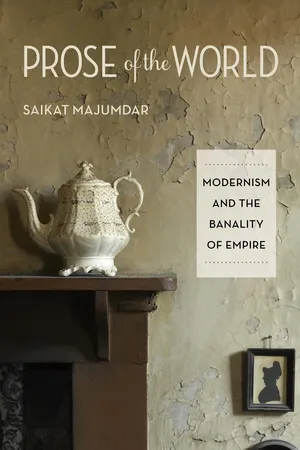
Everyday life in the far outposts of empire can be static, empty of the excitement of progress. A pervading sense of banality and boredom are, therefore, common elements of the daily experience for people living on the colonial periphery. Saikat Majumdar suggests that this impoverished affective experience of colonial modernity significantly shapes the innovative aesthetics of modernist fiction.
Prose of the World explores the global life of this narrative aesthetic, from late-colonial modernism to the present day, focusing on a writer each from Ireland, New Zealand, South Africa, and India. Ranging from James Joyce's deflated epiphanies to Amit Chaudhuri's disavowal of the grand spectacle of postcolonial national allegories, Majumdar foregrounds the banal as a key instinct of modern and contemporary fiction—one that nevertheless remains submerged because of its antithetical relation to literature's intuitive function to engage or excite.
Majumdar asks us to rethink the assumption that banality merely indicates an aesthetic failure. If narrative is traditionally enabled by the tremor, velocity, and excitement of the event, the historical and affective lack implied by the banal produces a narrative force that is radically new precisely because it suspends the conventional impulses of narration.
- English
- ePUB (mobile friendly)
- Available on iOS & Android
eBook - ePub
About this book
Information
Subtopic
African Literary CriticismIndex
Literature• CHAPTER 1 •
James Joyce and the Banality of Refusal
Epic savagery is rendered impossible by vigilant policing, chivalry has been killed by the fashion oracles of the boulevards. There is no clank of mail, no halo about gallantry, no hat-sweeping, no roistering! The traditions of romance are upheld only in Bohemia. Still I think out of the dreary sameness of existence, a measure of dramatic life may be drawn. Even the most commonplace, the deadest among the living, may play a part in a great drama.
—James Joyce, “Drama and Life”
If the radical aesthetic of the banal thrives at the urgent confluence of modernist innovation and colonial anxiety, it has no greater exponent than James Joyce, who transforms the banality of provincial life into an unprecedented narrative force. If the successful artist, in Joyce’s fiction, charts a troubled arc of migration from the provincial margin to the metropolitan center, his path is littered with bodies that fail to do so. Bodies of Dubliners, almost always male, whose desire for the energetic aesthetic culture of the metropolis is stifled by the paralysis that pervades the colonial periphery like dreary smog. Such is the defining reality of the life of Little Chandler in the story “A Little Cloud”: “A dull resentment against his life awoke within him. Could he not escape from his little house? Was it too late for him to try to live bravely like Gallaher? Could he go to London? There was the furniture still to be paid for. If he could only write a book and get it published, that might open the way for him.”1 The story is driven by Little Chandler’s realization of the glaring contrast of his own life with that of his old friend, Ignatius Gallaher, who is back in Dublin on a short visit. Gallaher has apparently cut a “brilliant figure on the London Press” and has matched his success with a promiscuous, bohemian, and richly exciting life in London and Paris (57). Little Chandler has stayed back in Dublin, married, had a child, and let his literary ambitions be swallowed up by the dreariness of a clerical job at the King’s Inn. After a few drinks with the flamboyant Gallaher at the elegant and expensive Corless’s bar, he returns home, his rekindled poetic ambitions locked in a losing struggle against the realities of his domestic life: the small child, the furniture yet to be paid for, and the parcel of coffee that he has forgotten to bring home for his wife. Poetry rises in a last gasp against the prose of this world, to lose itself in the wails of the child, the anger of his wife, and his own shame and remorse at having shouted at his child. “Little Chandler felt his cheeks suffused with shame and he stood back out of the lamplight. He listened while the paroxysm of the child’s sobbing grew less and less: and tears of remorse started to his eyes” (70).
“To labor,” writes Hannah Arendt, “meant to be enslaved by necessity, and this enslavement was inherent in the conditions of human life.”2 Little Chandler’s life seems caught up between the conflicting demands of the human condition famously described by Arendt. He is constrained by what Arendt calls “labor,” the activities essential to the biological sustenance of the body (or the bodies of those one procreates), those that were traditionally hidden from public view. From within such constraints, surrounded by his wailing child and unpaid-for furniture, he longs to etch his literary signature on the world, to articulate a string of words that, for Arendt, shapes “action”: “With words and deeds we insert ourselves into the human world, and this insertion is like a second birth, in which we confirm and take upon ourselves the naked fact of our original physical appearance.”3 But at the end of Joyce’s story, Little Chandler is left not only within the constraints of labor, but also crushed under its moral burden. He “felt his cheeks suffused by shame … tears of remorse started to his eyes” (70). Action, in the Arendtian sense of the term, remains an unborn dream, with the words of poetry we know he will never write; he will go back to his job as a clerk the next day, to provide for himself and his family, to keep his child from wailing.
In Joyce’s fiction, the banality of daily life and the desire for aesthetic transcendence are not so much polarized as held in a mutually enabling dialectic. Nowhere is it brought out more famously than in Ulysses, where the aesthetic is indeed embodied through the banal. In many of the stories in Dubliners, however, the banality of immediate life and the transcending impulse of the aesthetic appear in a relationship of bitter mutual hostility. In Little Chandler’s story, this bitterness takes an especially painful shape—that of the Arendtian duality of labor and action; of the claims of private, biological life and those of the literary artist, lived in the light of public glory. These entwined hostilities are subsumed within what is perhaps the most pervasive artistic duality in Joyce—that of the periphery and the metropolis. It is a duality that is no less true for the artist manqué than for the fulfilled artist. No less for Little Chandler than for Stephen Dedalus. In Little Chandler’s story, the banality of daily, labor-burdened life in the colonial periphery of Dublin is brought into a pointed contrast not only with the glamorous cosmopolitanism of London but with something more than that, by the manner in which the city appears as a realm of infinite, undefined possibilities, of a life of public action and glory. And Gallaher was one who had realized the possibilities. He was not only “a brilliant figure on the London press” but also a man who looked the part. “You could tell that at once by his travelled air, his well-cut tweed suit and fearless accent” (57). A figure like him only deepens the depressing contrast between the infinite potential of the metropolis and the paralytic nothingness of the periphery: “There was no doubt about it: if you wanted to succeed you had to go away. You could do nothing in Dublin” (59). For Chandler, the excitement of meeting Gallaher morphs unnoticed into the excitement of encountering the metropolis, farther and farther away from the prosaic reality around him: “Every step brought him nearer to London, farther from his own sober inartistic life” (60).
The ironies of history pave his path. To the English critics, Chandler hopes to be accepted as a melancholic Celt caught in the wistful nostalgia of a mythical past. “The English critics perhaps would recognise him as one of the Celtic school by reason of the melancholy tone of his poems” (60). Joyce’s skepticism of the Celtic revival in late-nineteenth-century Irish literature reveals itself in this spark of satire on the way the Irish poet manqué dreams of being accepted by the imperial literary establishment. Not one to offer “the cracked looking-glass of a servant”4 to his colonial masters like Stephen Dedalus, Chandler can only focus on enhancing the marketability of his name to them: “Thomas Malone Chandler, or better still: T. Malone Chandler” (60). Gallaher, too, turns out to be a bit of a fake as the story proceeds, or at the very least a poseur. His condescending friendliness demeans Ireland as much as it demeans Little Chandler: “Gallaher was only patronizing him by his friendliness just as he was patronising Ireland by his visit” (60).
That’s our cue not to take too seriously the polarity of the metropolis and the periphery. The aesthetic tension between the banality of an uneventful dailiness and the promise or lure of artistic glory in Joyce’s work parallels the historical tension between colonial periphery and the imperial center. But the mutual hostility, in both situations, is deeply overlaid with irony and hence rarely to be taken at face value. Stephen Dedalus, the true artist, would realize this later in his migration back and forth between provincial Dublin and metropolitan Europe. But it takes Stephen Dedalus a long time to arrive, and to arrive specifically at this deceptive dialectic of the banality of the periphery and the artistic possibilities of the metropolis. Into his making goes all the Dubliners unable to see the deceptive nature of this dialectic, all those disheartened, paralyzed, trapped, disenchanted by what to them is the deadening banality, the utter marginality, and the historical vacuum of life in the far periphery of modernity and progress. And since long before they are old enough to understand the true implication of their marginality: the boy in “Araby,” Eveline from the story named after her, Little Chandler, Farrington from “Counterparts,” and, finally, Gabriel Conroy from “The Dead.”
The banality of colonial life is damningly articulated in the striking Joycean motif of paralysis crippling late-nineteenth- and early-twentieth-century Ireland. The musty, long-enclosed air in the houses in the blind street in “Araby,” “the odor of dusty cretonne” in Eveline’s nostrils, the sentences copied ad infinitum by the clerk Farrington, and the provincial Irish culture so feared by Gabriel Conroy all breathe the tired air held prisoner by the claustrophobic and iterative life of colonial Ireland, banished to the margins of modernity under the rule of Stephen’s “two masters”—“the imperial British state … and the holy Roman catholic and apostolic church” (Ulysses, 6). What is truly radical about Joyce’s fiction is that this aesthetic expression of the historical marginality of the colony becomes one of its most powerful narrative forces. Everybody is driven away by the banality of this life—though more fail to flee it than those who succeed—yet it is this aesthetic of banality that in turn drives Joyce’s narrative of Dublin.
Of all of Joyce’s work, Dubliners is perhaps most immediately driven by this aesthetic of banality. A Portrait of the Artist as a Young Man concludes with the artist’s decision to leave the periphery, not, however, for England, but for metropolitan locations in continental Europe; it is a move that parallels his decision to transform banality into the material of a new aesthetic. Together, they offer a promise to turn the banalized, unheroic, and subordinated reality of colonial life into the stuff of art. Ulysses is, of course, the delivery of this promise. Thus, in Joyce’s fiction, neither the radical aesthetic import of the banal nor Ireland’s peripheral relation to imperial modernity is fully realizable without the other; symbiotically, they make up a subaltern narrative force that, in time, will unsettle the aesthetic relation between the metropolis and the periphery. To make sense of this apparent paradox, we need to turn to the claims of the banal, the trivial, and the marginal that repeatedly stir unease through Joyce’s fictional and critical work.
Transience, Banality, and the Critique of Historicism
Twenty days into the new century, on January 20, 1900, an eighteen-year-old Joyce presented, at the session of the University College Literary and Historical Society, a paper titled “Drama and Life.” I’ve quoted one of the most striking passages from the paper in the epigraph to this chapter. “Still I think,” the passage concludes, “out of the dreary sameness of existence, a measure of dramatic life may be drawn. Even the most commonplace, the deadest among the living, may play a part in a great drama.”5 It is striking because, at the outset, it proposes “the most commonplace” as a proper subject for drama, the literary genre most dependent on conflict and spectacle, as evident in the adjective derived from it: dramatic. Beyond that, it contains a larger literary elegy for a spectacular form of aesthetics that has died along with the fading of the epic and romance. This shift of emphasis from grandeur to banality is an apt description of a crucial transformation of aesthetic value from its classical tradition to that of post-Enlightenment modernity. As hinted in the last sentence of the passage above, Joyce’s own fiction would stake some of its most striking claims for the excitement of “the most commonplace,” where the epic and the romance would come alive in a curiously inverted form, through the ironic outbursts of mock-heroism. “The most commonplace,” as such, is not only part of Stephen’s authorial credo but of his creator’s as well. “It is my idea of the significance of trivial things,” Joyce wrote in a letter to his brother Stanislaus, “that I want to give the two or three unfortunate wretches who may eventually read me.”6
As fictionalized in the extant manuscript pages of the autobiographical Stephen Hero (more autobiographical than the final, completed novel A Portrait of the Artist as a Young Man), Stephen’s paper triggers off a maelstrom of outrage and scandal. Behind this outrage, which climaxes with his championing “scandalous” modern authors like Ibsen, is a sustained onslaught on certain established principles of the aesthetic that has been incubating in Stephen’s mind for a long time. Key among these is “the antique principle that the end of art is to instruct, to elevate and to amuse.”7 A disciple of Thomas Aquinas, Stephen is “unable to find even a trace of this Puritanic conception of the esthetic purpose in the definition which Aquinas has given of beauty” (79). What brings about this obsolescence of the “antique principle” of aesthetics is a widening of the aesthetic criteria, far beyond the moral, spiritual, and pedagogic mandate of Horace, into a process that is indifferent to moral and spiritual uplift, leading up, in the end, to the realm of the ordinary and the common. “The qualifications he expects for beauty are in fact,” Stephen writes, “abstract and common” (79).
Beauty, for Stephen, hinges on patterns of perception and cognition rather than on elements of spiritual uplift or moral sanctification. The utterly ordinary becomes beautiful only when the aesthetic is severed from the sublime. This causes alarm among the authorities in the Jesuit college, who view it as a counterintuitive invocation of Aquinas, one of the most influential Jesuit theologians. The conflict culminates in Stephen’s conversation with the rather amicable college president, whom Stephen bewilders with the claim that the Thomist aesthetic is so far detached from spiritual sanctification that it would apply to “a Dutch painter’s representation of a plate of onions” (95).
This is probably the argument the college president finds most baffling during his exchange with Stephen before the Saturday Stephen is to read out his paper, which is to trigger further uproar:
—Pulcra sunt quae visa placent. He seems to regard the beautiful as that which satisfies the esthetic appetite and nothing more—that the mere apprehension of which pleases …
—But he means the sublime—that which leads man upwards.
—His remark would apply to a Dutch painter’s representation of a plate of onions.
—No, no; that which pleases the soul in a state of sanctification, the soul seeking its spiritual good.
—Aquinas’ definition of the good is an unsafe basis of operations: it is very wide. He seems to me almost ironical in his treatment of the ‘appetites.’
This is a crucial moment in Stephen’s personal rebellion against Jesuit theology’s moral and pedagogic control of Ireland. Confident of this control over the Irish people, the president expresses his cynicism about the effect Stephen’s theories might have: “I do not predict much success for your advocacy in this country, he said generally. Our people have their faith and they are happy. They are faithful to their Church and the Church is sufficient for them. Even for the profane world these modern pessimistic writers are a little too … too much” (97). The shocking pervasiveness of Stephen’s aesthetic theory, by foregrounding the banalized elements of the everyday as fit subjects of artistic representation, disrupts this religious didacticism. For him, there is no place for “instruction” or “elevation” in his own allegiance to the Thomist trinity of “Integritas, consonantia, claritas” (96). In her reading of The Portrait of the Artist as a Young Man, Rebecca Walkowitz identifies “triviality as a tactic of heresy and insubordination.”8 What she calls triviality I call a meditated and consciously theorized aesthetic of the banal that becomes the crucial point of difference between Stephen’s and the president’s positions and that culminates in their respective interpretations of Thomism.
The Thomist criteria for beauty, however, might be “abstract and common” (79) but there is in fact a clear structure to it, one that, according to Stephen, travels across cultural and historical differences. The structure derives neither from the powers of romance or spectacle nor from the promise of spiritual uplift. “You know what Aquinas says,” Stephen tells Cranly, near the end of the available manuscript pages of the draft: “The three things requisite for beauty are, integrity, a wholeness, symmetry and radiance” (212). The object is perceived in its distinction from the rest of the world and in its integrity as a singular thing. This also establishes its symmetry in the eyes of the observer. As a consequence, what emerges as clear and striking is the quidditas of the object, its essential whatness, a point that we find Stephen also making in Portrait.9 It is at this point of recognition, when “its soul, its whatness, leaps to us from the vestment of its appearance,” that the third and the most ambiguous quality, radiance, emerges, and the cumulative effect of all three qualities leads even the most ordinary object to its epiphany: “The soul of the commonest object, the structure of which is so adjusted, seems to us radiant. The object achieves its epiphany” (Stephen Hero, 213).
The “commonest object,” therefore, comes to occupy centrality in Stephen’s theory of the epiphany. In fact, the more insignificant the object, the better suited it is to the unreliable narration of modernism. Garry Leonard points out the significant but overlook...
Table of contents
- Cover
- Half title
- Title
- Copyright
- Dedication
- Epigraph
- Contents
- Introduction: Poetics of the Prosaic
- Chapter 1. James Joyce and the Banality of Refusal
- Chapter 2. Katherine Mansfield and the Fragility of Pākehā Boredom
- Chapter 3. The Dailiness of Trauma and Liberation in Zoë Wicomb
- Chapter 4. Amit Chaudhuri and the Materiality of the Mundane
- Epilogue: The Uneventful
- Acknowledgments
- Notes
- Bibliography
- Index
Trusted by 375,005 students
Access to over 1.5 million titles for a fair monthly price.
Study more efficiently using our study tools.
Frequently asked questions
Yes, you can cancel anytime from the Subscription tab in your account settings on the Perlego website. Your subscription will stay active until the end of your current billing period. Learn how to cancel your subscription
No, books cannot be downloaded as external files, such as PDFs, for use outside of Perlego. However, you can download books within the Perlego app for offline reading on mobile or tablet. Learn how to download books offline
Perlego offers two plans: Essential and Complete
- Essential is ideal for learners and professionals who enjoy exploring a wide range of subjects. Access the Essential Library with 800,000+ trusted titles and best-sellers across business, personal growth, and the humanities. Includes unlimited reading time and Standard Read Aloud voice.
- Complete: Perfect for advanced learners and researchers needing full, unrestricted access. Unlock 1.5M+ books across hundreds of subjects, including academic and specialized titles. The Complete Plan also includes advanced features like Premium Read Aloud and Research Assistant.
We are an online textbook subscription service, where you can get access to an entire online library for less than the price of a single book per month. With over 1.5 million books across 990+ topics, we’ve got you covered! Learn about our mission
Look out for the read-aloud symbol on your next book to see if you can listen to it. The read-aloud tool reads text aloud for you, highlighting the text as it is being read. You can pause it, speed it up and slow it down. Learn more about Read Aloud
Yes! You can use the Perlego app on both iOS and Android devices to read anytime, anywhere — even offline. Perfect for commutes or when you’re on the go.
Please note we cannot support devices running on iOS 13 and Android 7 or earlier. Learn more about using the app
Please note we cannot support devices running on iOS 13 and Android 7 or earlier. Learn more about using the app
Yes, you can access Prose of the World by Saikat Majumdar in PDF and/or ePUB format, as well as other popular books in Literature & African Literary Criticism. We have over 1.5 million books available in our catalogue for you to explore.