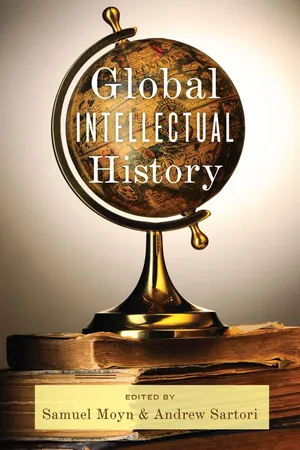
Where do ideas fit into historical accounts that take an expansive, global view of human movements and events? Teaching scholars of intellectual history to incorporate transnational perspectives into their work, while also recommending how to confront the challenges and controversies that may arise, this original resource explains the concepts, concerns, practice, and promise of "global intellectual history," featuring essays by leading scholars on various approaches that are taking shape across the discipline.
The contributors to Global Intellectual History explore the different ways in which one can think about the production, dissemination, and circulation of "global" ideas and ask whether global intellectual history can indeed produce legitimate narratives. They discuss how intellectuals and ideas fit within current conceptions of global frames and processes of globalization and proto-globalization, and they distinguish between ideas of the global and those of the transnational, identifying what each contributes to intellectual history. A crucial guide, this collection sets conceptual coordinates for readers eager to map an emerging area of study.
- English
- ePUB (mobile friendly)
- Available on iOS & Android
eBook - ePub
Global Intellectual History
About this book
Trusted by 375,005 students
Access to over 1.5 million titles for a fair monthly price.
Study more efficiently using our study tools.
Information
Subtopic
Historical Theory & CriticismIndex
HistoryPart I
A Framework for Debate
1
Approaches to Global Intellectual History
SAMUEL MOYN AND ANDREW SARTORI
Among the last decade’s most notable developments in the historians’ guild has been a turn toward “global history.” The roots of global history are older, in different tendencies in international history to strain beyond its usual diplomatic agents or in world history to make into approved topics the transnational flows of populations, diseases, and goods. But the citizens of the post–Cold War world, at least in some places, conceived of themselves as living in an age of “globalization” and pushed this trend to impressive heights.1 The field of intellectual history, however, has lagged behind, although its objects of study—thinkers and concepts—were presumably some of those most amenable to spread across vast geographical spaces.
There are a few reasons for this lag. In the North Atlantic academy, intellectual history has been, and to some extent remains, marginal to the historical discipline. But it also may have had good reason to avoid the trend. Scholars working on the classic areas of this field, western Europe from antiquity to the present, may have felt that this turn beyond the nation hardly affected the practice of a field that had stayed relatively free of the lures of national history in the first place. Early modernists had long been aware of a transnational “republic of letters,” and modernists were often most interested in what Karl Mannheim called the “free-floating” intellectual, among whose other traits was to address larger communities or even travel between them. Meanwhile, with the exception of historians of the early modern Atlantic world, the smaller group of scholars focusing on the intellectual history of the United States maintained a sense of their enterprise as beleaguered in an era of ascendant social history, leading them to stick to the defense of intellectual and cultural history framed in terms of conventional spatial boundaries. If they remained wary of the usual study of American national history, it was not because it was too culturally or geographically parochial. In fact, when one intellectual historian, Thomas Bender, tried to take U.S. history past the global turn, his own home subfield was not given much prominence.2
More recent signs, however, suggest that there will be a “global intellectual history” just as transformative for this part of the discipline.3 When a new journal for the field emerged in 2004, entitled Modern Intellectual History without any geographical designator, its main mission was still to unify practitioners of the European and U.S. intellectual fields. This same journal, however, likewise shows that the turn to “global history” has now begun to influence intellectual history quite significantly.4 In a parallel development, historians of science have woken up to the global percolations of the theories they once studied in drastically restricted geographical locales.5 More important, as pioneering examples of a global concept history begin to be published, the question now is not whether such ventures will take place but what models they will feature and what is at stake in choosing among them. The problem is far more one of theory than one of practice, for posing the difficulty (evidentiary, linguistic, professional, and so forth) of enacting a global history depends, first, on developing plausible models of what the subject matter of such a historiography ought to be.
A Gallery of Alternative Models
Global Intellectual History is intended to showcase the available choices at a threshold moment in the possible formation of an intellectual history extending across geographical parameters far larger than usual. This chapter offers an analytical orientation to the different possible approaches, versions of most of which are then defended by the individual contributors. This orientation then moves to the issue of chronology and the definition of the global itself. Is a premodern global history possible? Even today are there not spaces on the earth that fall outside the networks of social life and intellectual circulation but whose inclusion is required for a truly global framework? Whatever model of global intellectual history is adopted must be tailored to the spaces across which, from era to era, concepts could appear. But it may even be that the expansive space that is today called “the global” has never really existed.
The answer to these kinds of questions depends substantially on how the global is conceptualized as a scale, and there are several nascent approaches that need to be distinguished, for purposes of analytical clarity even if in practice they might overlap. We might begin by distinguishing among, first, the global as a meta-analytical category of the historian; second, the global as a substantive scale of historical process, and hence a property of the historian’s subject matter; and third, the global as a subjective category used by historical agents who are themselves the objects of the historian’s inquiry. With this in mind, we might then identify different versions of these three modes of the “global” in global intellectual history. Consider, first, universal history and comparative history. Then there are the various approaches that emphasize intermediating agents or modes of circulation, or else theories of larger structural transformations (Marxism, notably) that allow for new conceptual movement or networking practices. Each of these approaches has its own lineage, either in older forms of what were, in effect, global intellectual histories or in other historiographies. Finally, and for this reason, it is sometimes thought to be fruitful to take a second-order approach that, without directly addressing how to study global intellectual history now, insists on historical perspective as a first step to gain purchase on that problem. After all, far-flung spaces have long been subject to theorization and interpretation in different times and places, notably as an outcome of the colonization of the world.
Universal and Comparative History
In the early modern period, Europeans moved to craft a “universal history.” Ethnographic encounters, comparative philology, and archaeological discovery made this step unavoidable, challenging and ultimately overturning biblical models that were seen to be too constricted in their geographical and chronological parameters. Of course, early modern Europeans did this in ways that frequently left them “in the grip of sacred history,” with the terms of biblical salvation history barely transformed to accommodate threatening data. The most famous figure to emerge from these traditions, G. W. F. Hegel, produced a version of universal history that placed an extraordinary premium on the role of thought in organizing and driving forward the unfolding of a world history.6
Hegel himself might have ended the narrative of the self-realization of “reason in history” with the European state, but others carried the project forward to examine the implications for other parts of the world of the claims of European modernity to universality. An example is Joseph Levenson’s Confucian China and Its Modern Fate, which examines the crisis of China’s classical claims to civilizational universality in the face of modern Europe’s higher universalism. For Levenson, the Hegelian supersession of Chinese by Western universalism forced Chinese intellectuals into choosing between the radical embrace of modern universalism or a new traditionalism, in which tradition was valued for its particularity rather than its universality. A global history was already implicit here: Confucian China’s fate would be the fate of the nonmodern non-West everywhere as institutionally or culturally contingent rationality was forced to come to terms with the better reason of the modern West. Such an approach was also implicit in much of the area studies and developmentalist work of the postwar period in the United States, and it still has adherents today. This tradition of idealist universal history is alive and well and not just in the controversial propositions of Francis Fukuyama. Extremely sophisticated philosophers like Robert Pippin have proposed reconstructing Hegel’s claim about the specificity of modern society as a unique realization of freedom.7 It also forms the central reference point in “Casting the Badge of Inferiority Beneath Black Peoples’ Feet,” by Mamadou Diouf and Jinny Prais, chapter 9 in this volume. They explore the ways in which black intellectuals have challenged the parochialisms of Hegelian universal history to find a place for both Africa and black people in a reconstituted and cosmopolitan universal history.
Alternatively, a global intellectual history might compare intellectuals or intellectual practices or ideas and concepts geographically or chronologically. In such an enterprise, the point might be to elaborate on processes or tendencies that developed on a global scale or to use comparison to elaborate on the different processes or tendencies that developed in different parts of the world or in different eras. Indeed, in a minimal conception the idea of a “global intellectual history” might be seen as merely a call to create a more inclusive intellectual history that respects the diversity of intellectual traditions and broadens the parameters of thought beyond the narrow limits defined by the traditions institutionalized in the Western or Eurocentric academy. In other words, this would be a call to attend to non-Western intellectual histories with a rigor commensurate with the scholarship on Western intellectual histories.8
If the project of a “total history” could divide the world according to the dominant cereal staple, or the frontier between sedentary and nomadic societies, parallel historical analyses organized around repeating themes or transitions could similarly be developed around the intellectual world, as in Siep Stuurman’s “Common Humanity and Cultural Difference on the Sedentary–Nomadic Frontier,” a comparative study of Herodotus, Sima Qian, and Ibn Khaldun, chapter 2 in this volume. In this approach, “the global” is first and foremost an analytical category in the space of the analysis itself; that is, a comparison treats particular cases as distinct and separate in order to establish them as commensurable and hence comparable. What makes the approach global is not the geographical spread of the concept or thematic but the fact that a comparison between geographically constrained spaces is possible even without a connection between them. Stuurman, for example, does not suggest that the three figures in his study were influenced by or otherwise connected to one another. Indeed, a direct influence or connection between them might even muddy the terms of comparison.
Put differently, the global scale of the enterprise is established by the intention of the investigator and the terms of the investigation. It is not an actor’s or native category, nor does it depend on specific historical conditions of interconnectedness on which many of the other approaches focus. This does not mean that we could not make a case that historically specific forms of connectedness provide an epistemological foundation for specific kinds of comparison. For example, we could conceive of “uneven development” as a historically specific basis for the comparison of nationalist discourses in different parts of the world and, indeed, for the emergence of comparative consciousness within nationalist discourses in different parts of the world.9 Indeed, in order to set the terms of comparability, some meta-analytical categories are required, and they will almost certainly be historical, such as “civilization,” “nation,” “urban culture,” and “literary tradition.” Yet the comparison, as in Stuurman’s chapter, could also proceed from such general categories without much notice of their historical conditions of possibility and could certainly be used as a basis for investigation without regard to more specific arguments about the development of global space as a practical reality. Any loss to the enterprise from not historicizing the possibility of comparison could perhaps be offset by gains in the revelation of striking parallels and distinctive points between compared locales.
For example, one popular topic for comparative intellectual history both old and recent is the development of “science.” In the aftermath of Joseph Needham’s famous and controversial attempt to determine why ancient China never developed modern science—with Confucianism once against taking the blame, together with other factors like the nature of the alphabet—G. E. R. Lloyd more recently compared ancient Greek and Chinese natural thinking.10 Even though he is a historian of science, Lloyd develops a more general notion of “systematic inquiry” that allows the comparison of drastically different systems of knowledge without judgment as to the relative success or failure of either side to anticipate or lay the groundwork for modern approaches. Lloyd’s comparative study—which supposes no historical connection between his geographical scenes—offers an example of a history in which the historian provides the global forum after the fact in order to clearly distinguish the unique characteristics of its different sectors. Offering his own term of art for the object of comparison, presumably in order to skirt the whole problem of how two disparate and disconnected intellectual cultures could develop a comparable intellectual practice, Lloyd suggests that a global juxtaposition offers many opportunities for new interpretations.
Intermediaries, Translations, and Networks
A global intellectual history might be less concerned about establishing the parameters of a global scale of inquiry—in either a Hegelian or a comparative sense—than about insisting on an implicit holism according to which cultural, social, linguistic, civilizational, or geographical boundaries are always occupied by mediators and go-betweens who establish connections and traces that defy any preordained closure. Contrary to claims of the incommensurability of cultures, this approach could be used to show how individuals crossing seemingly insurmountable borders learned how to make intellectual cultures mutually intelligible.
Such intermediation might even undermine the assumption that these cultures could be conceptualized as discrete in the first place.11 In one version, the story of intermediating travelers could focus on their inability to transcend culturally the borders they cross physically; Edward Said’s Orientalism (1978) is the classic example of this approach. But far from seeing a global forum created or lived through travel, this version of intermediation actually reinstates the notion of a parceled system with noncommunicating domains. In the more generous approach, linked to either assumptions about the conditions of hermeneutic intelligibility or the deconstructive impulse to undo oppositions between cultures, intermediation is singled out for its more positive ramifications.
Typically, of course, such studies never use the global as a direct object of analysis. In the most noteworthy accounts of “intellectual migration” in earlier generations, cultural divergence did not need to be thematized beyond the difficulties of language and manners that a European forced to live in America might expect.12 Today, stories about overcoming conceptual boundaries in the past could be taken as a refusal of spatial closure. They focus the historical investigation on mediators (linguistic, practical, institutional, or material) and go-betweens at the boundaries of conventional units of study—between, say, East and West, or North and South. In the large literature on go-betweens from one culture to another, friendship has taken pride of place as a trope through which to conceptualize intellectual transfer that might otherwise remain too abstract.13 Such an approach relies on a historically general holism to suggest that intermediaries have always occupied boundaries but would then typically go on to investigate specific practices of mediation in particular times and places. It might even show that particular achievements are possible by acquiring through travel a sharper understanding of what at first seemed distant and strange.
At this point, the literature on travel and migration is sufficiently well developed that new frontiers for exploration have come into view beyond whether their histories illustrate global misunder...
Table of contents
- Cover
- Half title
- Series Page
- Title
- Copyright
- Contents
- Preface
- Part I. A Framework for Debate
- Part II. Alternative Options
- Part III. Concluding Reflections
- List of Contributors
- Index
Frequently asked questions
Yes, you can cancel anytime from the Subscription tab in your account settings on the Perlego website. Your subscription will stay active until the end of your current billing period. Learn how to cancel your subscription
No, books cannot be downloaded as external files, such as PDFs, for use outside of Perlego. However, you can download books within the Perlego app for offline reading on mobile or tablet. Learn how to download books offline
Perlego offers two plans: Essential and Complete
- Essential is ideal for learners and professionals who enjoy exploring a wide range of subjects. Access the Essential Library with 800,000+ trusted titles and best-sellers across business, personal growth, and the humanities. Includes unlimited reading time and Standard Read Aloud voice.
- Complete: Perfect for advanced learners and researchers needing full, unrestricted access. Unlock 1.5M+ books across hundreds of subjects, including academic and specialized titles. The Complete Plan also includes advanced features like Premium Read Aloud and Research Assistant.
We are an online textbook subscription service, where you can get access to an entire online library for less than the price of a single book per month. With over 1.5 million books across 990+ topics, we’ve got you covered! Learn about our mission
Look out for the read-aloud symbol on your next book to see if you can listen to it. The read-aloud tool reads text aloud for you, highlighting the text as it is being read. You can pause it, speed it up and slow it down. Learn more about Read Aloud
Yes! You can use the Perlego app on both iOS and Android devices to read anytime, anywhere — even offline. Perfect for commutes or when you’re on the go.
Please note we cannot support devices running on iOS 13 and Android 7 or earlier. Learn more about using the app
Please note we cannot support devices running on iOS 13 and Android 7 or earlier. Learn more about using the app
Yes, you can access Global Intellectual History by Samuel Moyn,Andrew Sartori in PDF and/or ePUB format, as well as other popular books in History & Historical Theory & Criticism. We have over 1.5 million books available in our catalogue for you to explore.