A major new work in modern Tibetan history, this book follows the evolution of Tibetan Buddhism's trülku (reincarnation) tradition from the seventeenth to the nineteenth centuries, along with the Emperor of China's efforts to control its development. By illuminating the political aspects of the trülku institution, Schwieger shapes a broader history of the relationship between the Dalai Lama and the Emperor of China, as well as a richer understanding of the Qing Dynasty as an Inner Asian empire, the modern fate of the Mongols, and current Sino-Tibetan relations.
Unlike other pre-twentieth-century Tibetan histories, this volume rejects hagiographic texts in favor of diplomatic, legal, and social sources held in the private, monastic, and bureaucratic archives of old Tibet. This approach draws a unique portrait of Tibet's rule by reincarnation while shading in peripheral tensions in the Himalayas, eastern Tibet, and China. Its perspective fully captures the extent to which the emperors of China controlled the institution of the Dalai Lamas, making a groundbreaking contribution to the past and present history of East Asia.
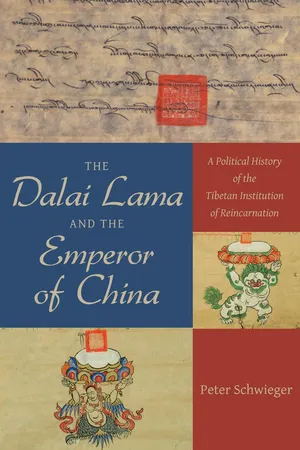
eBook - ePub
The Dalai Lama and the Emperor of China
A Political History of the Tibetan Institution of Reincarnation
- English
- ePUB (mobile friendly)
- Available on iOS & Android
eBook - ePub
The Dalai Lama and the Emperor of China
A Political History of the Tibetan Institution of Reincarnation
About this book
Trusted by 375,005 students
Access to over 1.5 million titles for a fair monthly price.
Study more efficiently using our study tools.
Information
Topic
Theology & ReligionSubtopic
Central Asian History1
THE HISTORICAL DEVELOPMENT OF THE TRÜLKU POSITION
THE SOCIAL POSITION of the trülku in the form we know today did not arise at one specific point, but rather developed gradually over time. Although it is generally accepted that all of its essential components had already been taken from various Mahāyāna doctrines during the thirteenth and fourteenth centuries and then combined to form one homogeneous trülku concept, it was not until the seventeenth century that the position finally embraced all of the religious, social, and political functions that are associated with it today.
THE EARLY DEVELOPMENT
For sketching out the early historical development of the trülku position, we have to rely on scattered references found in Tibetan hagiographical literature. Although this offers a glimpse of the phenomenon, it does not enable us to form a coherent picture. Particularly difficult to identify are the concrete social and economic circumstances and motives.
One of the earliest traditions was to regard Buddhist saints as being manifestations of a transcendent bodhisattva, especially Avalokiteśvara, as was done by the early Kadampas of the eleventh century. Then in the twelfth century, holy persons who had either been regarded by others or talked about themselves as being the rebirth of a previous master began appearing in the Kadam tradition. By the thirteenth century, the designation “trülku” was apparently already being applied to quite a few Buddhist saints, and the first efforts being made to establish a female line of reincarnation.1
The Tibetan tradition credits the Karma Kagyü school with the creation of the trülkusystem as a fully established line of succession of ecclesiastical hierarchs in the thirteenth century. And indeed, the Karmapa lineage is the oldest and longest “surviving” reincarnation line today. It began with Düsum Khyenpa (1110–1193), followed by Karma Pakshi (1204/6–1283). Between these incarnations there was a gap of more than ten years. It is therefore obvious that at this early stage there was not yet the idea of establishing a succession of uninterrupted incarnations. Karma Pakshi’s celebrated reputation was as a powerful tantric master, not as a link in a chain of famous reincarnated masters. His reputation also attracted Qubilai Qan and Möngke Qan, both of whom summoned him to their courts. As a result, Karma Pakshi became the target of a number of political intrigues among Tibetan clerics. He ultimately fell out of favor at court and barely escaped being assassinated.2
It has been observed that in the beginning, the Karma Kagyü school lacked a dominant wealthy patron and its economic existence depended on the many nearby common families.3 Wylie has pointed to the Third Karmapa, Rangjung Dorje (1284–1339), as the actual initiator of the concept of reincarnation, adding it to the already existing idea of incarnation or emanation.4 Wylie localized the conceptualization of the idea of reincarnation within Tibetan-Mongolian political relations and consequently assumed “that ‘reincarnation’ developed in Tibetan Buddhism primarily for political reasons, and that its immediate purpose was to provide the Black-hat-Karma-pa hierarchs with a metaphysical lineage devoid of patrimonial connections as a preliminary step toward the replacement of the quarrelsome ’Khon family as regents of Tibet.”5 Although this explanation is plausible, it is drawn from a small base of historical information. In fact, matters were probably far more complex than this, and a number of other factors may have played a role. For instance, the trülku concept includes the promise that the disciple will meet his teacher again in his next life. This idea strengthened the sense of belonging to a specific monastic community beyond the death of its head. In this way, the continuity of a monastic institution could be established without the need for an affiliation with a noble family to ensure survival.
To Tugh Temür, the emperor who was enthroned twice, first as the eighth and then as the tenth emperor of the Yuan Dynasty (1328–1329, 1329–1332),6 the Third Karmapa, Rangjung Dorje, was an outstanding Tibetan cleric. Even so, the emperor still regarded him as one of his subjects whom he could summon to his court. The edict ordering this, issued in 1331, is much more a direct command than a polite invitation. The emperor did not hesitate to threaten the Karmapa should he refuse to come. The document was not handed down as an original but was embedded in Tibetan historiographic works. The context and the careful source-critical analysis suggest no falsification of the text.
Through the blessing of the Three Jewels, based on the glory of great merit, my, the emperor’s, order that is proclaimed to Rangjung Dorje:
Due to the strength of the prophecy that the doctrine of the sugata [i.e., the Buddha] will spread to the kings of the northern regions, all kinds of religious systems of the Buddha were [already] known. Later Sechen Gyelpo [i.e., Qubilai Qan] also relied on a great many lamas [and] spiritual friends and honored them. Therefore, he caused the doctrine of the Buddha to spread in this area. This is clear to everyone. However, since I as well have the wish to render the protection and the service for the doctrine in an excellent manner, and since I have heard [people] saying that you possess great learning and—your positive qualities being especially outstanding—also numerous excellences, I have sent imperial envoys, for example Gönpo, to fetch you.
If—by using other pretenses—you will not come, it would become the fault of repudiating a faithful mind, and a propensity [and] foul-smelling seed [leading to the fact] that the yogin would be unable to give up his own country, and the fault that the special intention of the wish to work impartially for the welfare of others would be destroyed, and the evil not to think of the doctrine [of the Buddha], and the obscuration to give no thought to the hardships and suffering of the sentient beings, and [finally] the violation of the edict of my great legal system. Thereby you would make me sad. That consequently no harm would be done to the whole doctrine [of the Buddha] is unlikely.
Therefore, think about the benefit for all sentient beings, headed by myself, and come swiftly. After your arrival I will accomplish the tasks for the [Buddhist] doctrine in accordance with your wishes.
Written on the thirteenth day of the last spring month of the Sheep year [April 18, 1331],7 when he stayed in Dadu.8
This edict does not yet make explicit reference to the Karmapa’s position as a trülku. Such a reference is first found in the edict sent in 1356 by the twelfth Yuan Emperor, Toghon Temür (reigned 1332–1368), to the Fourth Karmapa, Rolpé Dorje (1340–1383), who most probably was intended by the emperor to act as Imperial Preceptor, or at least to fill an equivalent position.9 At the beginning of the document, the emperor addresses the Fourth Karmapa as someone whose deliberate taking of rebirth was motivated by his empathy for sentient beings, or bodhicitta, and obviously identifies him with the previous Karmapa. The wording of this edict is more polite than the one translated above. The emperor particularly “invited” the Karmapa and did not merely summon him to court:
By the mandate of eternal heaven, relying on the glory of great merit, my, the emperor’s, order that is proclaimed to Rolpé Dorje:
I have heard that by giving thought to the numerous [sentient beings] to be disciplined, starting with myself, you have taken birth in the area of Tibet and reside in Tsurpu Monastery. Therefore, by bearing your previous good qualities and activities in mind, I have—for the benefit of many sentient beings—sent imperial envoys, headed by Dingju and Könchok Gyeltsen, to invite you. Therefore, I ask you, by thinking of the sentient beings who in this degenerate age are tormented by suffering, to give up your country and come swiftly regardless of physical hardships so that those [beings] to be disciplined who possess good fortune in this area will be satisfied through the nectar of the Dharma, and that you act as guide for those sentient beings who have mistaken or lost the path. Moreover, it is clear before your mind that [Śākya]muni, by thinking of the benefit of others, voluntarily accepted suffering and accomplished the benefit of sentient beings in various countries. With regard to the livelihood for your body, the teaching of the Dharma and the listening to the Dharma do not cling to the area of Tibet alone, so think of me right after the imperial envoys sent from here have arrived there. And by keeping in mind to take care as much as you can that at the time of your arrival in this area the doctrine of the Buddha spreads far and wide and many sentient beings are placed on the path of liberation, [you], the great master Rolpé Dorje, know that you should come swiftly without using any pretenses.
[Attached] are utensils used in offerings and—as gifts accompanying the edict—one dre [measure] of gold, three dre of silver, and two sets of nine kinds of inwardly and outwardly [wearable] brocade.
An edict written on the tenth day of the tenth month of the Monkey year [November 2, 135610] in Dadu. May it be auspicious!11
The above edict is the earliest direct evidence that an emperor regarded the trülku position as an outstanding one. This does not, however, mean that the emperor did not still regard the Tibetan cleric as one of his subjects who had to obey imperial orders. The journey of the Karmapa to the emperor’s court was interrupted by warlike turmoil, indicating the looming dissolution of the Yuan Empire. This caused the emperor to seriously threaten the Karmapa again, warning him that Tibetan monasteries and Tibetan people might come to harm should he refuse to come:
Thinking of me, you have arrived in Domé. However, the chief administrators [of Tibet] are incapable. Therefore, you have again returned to Tibet. But how after the arrival of the lama the task of propagating and spreading the precious doctrine of the Buddha and the excellent task of making the great empire happy will be performed, we, patron and priest, will know when you meet me! In case you do not come, I will send many chief administrators. Because this might become the cause of damage to many monasteries and laypeople, I ask you to come immediately after the arrival of the dispatched imperial envoys by thinking of the precious doctrine of the Buddha and of me.12
Thereupon the Karmapa followed the order of the emperor and finally arrived at the court on December 26 or 27, 1360.13
Although the notion that a reincarnation was simultaneously an emanation of a transcendent bodhisattva already existed at this early stage, it is reasonable to assume “that the theory and procedure developed gradually in various Kagyüpa suborders in the course of the thirteenth and fourteenth centuries.”14
In the fourteenth century, the Karma Kagyüpa established its second major reincarnation line. Khachö Wangpo, the Second Zhamarpa or “Holder of the Red Hat,” was born in 1350 (and died in 1405). At the age of five, he was officially identified as the reincarnation of Tokden Drakpa Sengge, a disciple of the Third Karmapa, Rangjung Dorje. Thereafter he was brought to Tsurpu Monastery. At the age of six, he was ordained by the Fourth Karmapa, Rolpé Dorje.15 The early identification and installation of the Second Zhamarpa is remarkable because it indicates a deliberate strategy.
After the fall of the Yuan Dynasty in 1368, Yongle (1403–1424), the third emperor of the Ming Dynasty, developed a strategy to reintegrate Tibet into the empire. Just like the previous dynasty, he intended to rule Tibet with the help of outstanding clerics. But unlike the Yuan emperors, he now chose to rely on the Karmapa, a well-established trülku lineage. Thus in 1406, the Fifth Karmapa, Dezhin Shekpa (1384–1415), received an invitation to the court.16 When he arrived in Beijing the following year, the emperor gave him a pompous reception.17 What the emperor wished to accomplish with this visit and the way he tried to win over the Karmapa are directly addressed in a report by one of the Tibetans participating in the journey:
In general, it was the intention of the emperor to bring Tibet by means of war under the [imperial] law, just as in the times of the Mongols. He intended to subdue the country through a single rule of priest and patron, just as the Sakyapa and the Mongols [had done]. However, since the precious lord of the Dharma [i.e., the Karmapa] taught the Dharma in accordance with the Dharma, he was unhappy about conducting a Chinese campaign [to Tibet]. Finally, the emperor proposed: “Because there are different traditions of the Dharma in Tibet, they will quarrel among themselves. Because the lord of the Dharma would not be pleased if troops were really sent [to Tibet], I will send just a few of my horsemen along with the transport of the tiles of the golden roof that are left over in Gachu. If they each carry one tile on the front side of their saddle, [the tiles] will arrive safely. All traditions of the Dharma will be united in your school. Annually the people of Dokham, Rapgang, and Central Tibet will celebrate in Lhasa the [festival in honor of the Buddha’s] great turning of the wheel of Dharma. Therefore, I ask for your approval.” However, [the Karmapa] did not approve it, saying: “The sentient beings are not disciplined by a single tradition of the Dharma. In accordance with their respective interest the compassion of the Buddha starts working. It is all right if everyone practices according to the religious manner of his own school.” When later imperial envoys were robbed in Serurong behind Drikhung, and thereupon from Tibet also many people who reported slanders appeared [at the court], the invasion of Chinese troops was near. At that time I saw truly a sequence of three petitions, through which the Pakmodrupa ruler Drakpa Gyeltsen lamented to the lord of the Dharma...
Table of contents
- Cover
- Title Page
- Copyright
- Contents
- Preface
- Introduction
- 1. The Historical Development of the Trülku Position
- 2. A Trülku as the Head of Society
- 3. Struggle for Buddhist Government
- 4. The Emperor Takes Control
- 5. Buddhist Government Under the Imperial Umbrella
- 6. Imperial Authority Over the Trülku Institution
- 7. The Aftermath
- Conclusion
- Appendix 1: Tibetan Reincarnation Lines of Major Political Significance
- Appendix 2: Qing Emperors and Qoshot Kings of Tibet
- Abbreviations
- Notes
- Tibetan Orthographic Equivalents
- Bibliography
- Index
Frequently asked questions
Yes, you can cancel anytime from the Subscription tab in your account settings on the Perlego website. Your subscription will stay active until the end of your current billing period. Learn how to cancel your subscription
No, books cannot be downloaded as external files, such as PDFs, for use outside of Perlego. However, you can download books within the Perlego app for offline reading on mobile or tablet. Learn how to download books offline
Perlego offers two plans: Essential and Complete
- Essential is ideal for learners and professionals who enjoy exploring a wide range of subjects. Access the Essential Library with 800,000+ trusted titles and best-sellers across business, personal growth, and the humanities. Includes unlimited reading time and Standard Read Aloud voice.
- Complete: Perfect for advanced learners and researchers needing full, unrestricted access. Unlock 1.5M+ books across hundreds of subjects, including academic and specialized titles. The Complete Plan also includes advanced features like Premium Read Aloud and Research Assistant.
We are an online textbook subscription service, where you can get access to an entire online library for less than the price of a single book per month. With over 1.5 million books across 990+ topics, we’ve got you covered! Learn about our mission
Look out for the read-aloud symbol on your next book to see if you can listen to it. The read-aloud tool reads text aloud for you, highlighting the text as it is being read. You can pause it, speed it up and slow it down. Learn more about Read Aloud
Yes! You can use the Perlego app on both iOS and Android devices to read anytime, anywhere — even offline. Perfect for commutes or when you’re on the go.
Please note we cannot support devices running on iOS 13 and Android 7 or earlier. Learn more about using the app
Please note we cannot support devices running on iOS 13 and Android 7 or earlier. Learn more about using the app
Yes, you can access The Dalai Lama and the Emperor of China by Peter Schwieger in PDF and/or ePUB format, as well as other popular books in Theology & Religion & Central Asian History. We have over 1.5 million books available in our catalogue for you to explore.