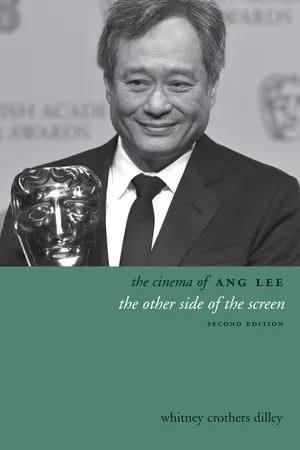
Born in Taiwan, Ang Lee is one of cinema's most versatile and daring directors. His ability to cut across cultural, national, and sexual boundaries has given him recognition in all corners of the world, the ability to work with complete artistic freedom whether inside or outside of Hollywood, and two Academy Awards for Best Director. He has won astounding critical acclaim for Crouching Tiger, Hidden Dragon (2000), which transformed the status of martial arts films across the globe, Brokeback Mountain (2005), which challenged the reception and presentation of homosexuality in mainstream cinema, and Life of Pi (2012), Lee's first use of groundbreaking 3D technology and his first foray into complex spiritual themes.
In this volume, the only full-length study of Lee's work, Whitney Crothers Dilley analyzes all of his career to date: Lee's early Chinese trilogy films (including The Wedding Banquet, 1993, and Eat Drink Man Woman, 1994), period drama (Sense and Sensibility, 1995), martial arts (Crouching Tiger, Hidden Dragon, 2000), blockbusters (Hulk, 2003), and intimate portraits of wartime psychology, from the Confederate side of the Civil War (Ride with the Devil, 1999) to Japanese-occupied Shanghai (Lust/Caution, 2007). Dilley examines Lee's favored themes such as father/son relationships and intergenerational conflict in The Ice Storm (1997) and Taking Woodstock (2009). By looking at the beginnings of Lee's career, Dilley positions the filmmaker's work within the roots of the Taiwan New Cinema movement, as well as the larger context of world cinema. Using suggestive readings of both gender and identity, this new study not only provides a valuable academic resource but also an enjoyable read that uncovers the enormous appeal of this acclaimed director.
- English
- ePUB (mobile friendly)
- Available on iOS & Android
eBook - ePub
About this book
Information
Subtopic
Film & VideoONE
Introduction: Ang Lee—A History
Repression is a main element of my movies. It’s easier to work against something than go along with something.1
The Auteur
ANG LEE HAS been referred to as an auteur and it is not difficult to see why—he is an artist with his actors, and seems to draw amazing work out of his cast, from the smallest to the greatest, while continuing to reiterate common themes of family, culture, and identity in an astonishing variety of genres. Keeping in mind that he has made films in Mandarin Chinese, Taiwanese, British English from the time of Jane Austen, high-school drop-out cowboy English, American English from the Civil War era, and 1960s American hippie slang—with six languages (Mandarin, English, Japanese, Hindi, Shanghainese, and Cantonese) represented in Lust/Caution (Se jie, 2007) alone—this is no small feat. He has drawn performances of the highest quality out of actors as diverse as Kevin Kline, Joan Allen, Chow Yun-fat, and Tony Leung, as well as defining and prodigious early work from a young Tobey Maguire, Christina Ricci, Katie Holmes, and, at 19, Kate Winslet and Zhang Ziyi. As Jake Gyllenhaal reflected after the making of Brokeback Mountain (2005), Ang Lee is also “fluent in the language of silence.”2 This has been proven by his films from his earliest 15-minute dialogue-free scene between Deb Snyder and Sihung Lung (Lang Xiong) in Pushing Hands (Tuishou, 1991), to the paean to noncommunication and 1970s angst, The Ice Storm (1997), and finally, to the tortured secrets of repressed souls in Brokeback Mountain. Indeed, the use of silence is so effective for this director that the last fifteen minutes of The Ice Storm were virtually a silent movie; similarly, 16-year-old first-time actor Suraj Sharma had to carry much of Life of Pi (2012) with nothing but a blue screen to share his soliloquies. While Lee uses language and silence to tell his stories, he also narrates them through physical posture and facial expression. Thus, he brought out such memorable performances as Heath Ledger’s clenched-jaw repression, Sigourney Weaver’s languid and vampish physicality, Joan Allen’s erasing of her own identity, Michelle Yeoh’s fathomless loyalty, Hugh Grant’s internalized awkwardness, Tony Leung’s brutal indifference, and Tobey Maguire’s passage from boyhood to maturity. The nuanced performances in Brokeback Mountain were widely recognized as the three young actors in the film, all just in their twenties, were each nominated for Academy Awards, one of the youngest casts in history to receive such recognition.3
Ang Lee’s talent for drawing out the best from his actors is mixed with his flawless incorporation of the natural environment, utilizing breathtaking vistas and frames. In Sense and Sensibility (1995), animals, hedges, and the natural effects of wind create subtleties in mood; in Ride with the Devil (1999), sun-dappled woods filmed on location in Missouri coupled with peaceful scenes of farmstead domesticity contrast markedly with the bloody and violent battles that take place in that setting. In Crouching Tiger, Hidden Dragon (Wohu canglong, 2000), he utilizes the startling green bamboo grove and the grid of old Beijing; in Brokeback Mountain, the hundreds of sheep stumbling up a mountainside, the headlights of a lone truck moving at a distance down a country road; in The Ice Storm, the cool metallic look of ice-encased branches and snow-slick streets. All are extremely evocative and unforgettable, almost haunting, images. It is the style of Ang Lee: emotionally resonant (in human relationships) and visually splendid (in the natural world).
After the critical and commercial failure of Hulk in 2003, Lee faced a grueling depression. During an introductory speech at the Toronto International Film Festival in September 2005, where Brokeback Mountain was previewed, Ang Lee said that after Hulk he wasn’t sure if he wanted to continue to be a filmmaker. He considered quitting the profession, and giving up directing entirely. Ironically, it was his father, a conservative high school principal and teacher who had always longed for his son to follow in his footsteps and settle into a more stable career, who pushed Ang Lee back into the game. Ang Lee’s father, who had never encouraged him to be a filmmaker, stunned his son by telling him “You need to go and make a movie.”4
Lee elaborates in Michael Berry’s Speaking in Images, a 2005 volume of interviews with contemporary Chinese filmmakers:
[My father told me] he wished that I would continue making movies even though I told him I wanted to stop. That was in February 2004. He saw Hulk and loved it—I don’t know why. He was very old. I told him I wanted to retire, or at the least, take a long break from filmmaking. He asked me if I wanted to teach, but I told him I didn’t think so. He warned me that I would be very depressed if I stopped. So he told me to just put on my helmet and keep on going. That was the very first time he encouraged me to make a movie. In the past, he would always try to talk me out of making movies.5
Tragically, Lee’s father died two weeks after this crucial conversation, which was the first time he had been supportive of his son’s dream of being a director.
Ang Lee took his father’s advice. The film that he went to make was Brokeback Mountain. Regarding this film, Lee says, “In some ways, it was a movie I didn’t dare to make, for both economic and subject-matter reasons.”6 He had read the script several years earlier and found it extremely moving, especially the ending, but he felt it would be very difficult to bring the story to the screen. (Instead of pursuing it, he turned his attention to Hulk.) Finally, after his father’s nudge, in late spring 2004 Lee began filming Brokeback Mountain in a remote part of Canada. In contrast to the multimillion-dollar Hulk, it was a return to the simpler, small-budget, independent-style filmmaking he had enjoyed in the past. Little did he know that his simple film with a small cast of young and (at the time) lesser-known actors would put him on the road to the Academy Awards.
The Outsider
The whole of Asia was held in thrall on the morning of Monday, the 6th of March, 2006, during the live presentation of the Academy Awards (broadcast at 9:00 a.m. in Taiwan), while waiting to see if Ang Lee would be named Best Director, thereby becoming the first Asian in history to win the award. At the ceremony in 2001, when Crouching Tiger, Hidden Dragon had been nominated in the Best Film and Best Foreign Language Film categories, Lee’s disappointment was palpable when Crouching Tiger, Hidden Dragon won the latter award. The film had taken America by storm in 2001 and arguably was more deserving of the Academy Award that ultimately went to Gladiator (2000). Crouching Tiger, Hidden Dragon had dominated the headlines that year, and all who saw it were claiming it was something really special: not only was it the most popular subtitled Mandarin film ever to be received in the West, but it spawned imitators hoping to capitalize on the new popularity of the martial arts genre (Hero, 2002, and House of Flying Daggers, 2004, are just two examples).7 Within a year of its release, Crouching Tiger, Hidden Dragon became the highest-grossing foreign-language film ever released in the United States,8 and it triggered a cultural phenomenon, much the way Brokeback Mountain did following its release in 2005. There was hardly a moviegoer in America that year who did not see the film, or make a joke about “Crouching Something, Hidden Something-else.”9 While the film took home four Academy Awards, Lee’s disappointment was evident as his movie won for Best Foreign Language Film; he was clearly upset that the top award, Best Film, was going to elude him. Even while delivering his acceptance speech on the Academy stage, the bittersweet look on his face revealed his true feelings. The filmmaker who had unstintingly championed the cause of the outsider, the alienated, and the foreigner was still considered a foreigner/outsider himself, and it clearly irked him.
Ang Lee was 37 years old when he began his career as a professional filmmaker. He had lived in America since he was 23. Ironically, although Lee had to overcome numerous obstacles due to his “outsider” status in America, he initially did not find himself quite “fitting in” with Asian society, either. Born on October 23, 1954, in Ping-tung County, Taiwan, and growing up both in Hualien and later in Tainan City, he faced increasing difficulty conforming to his own culture’s expectations, particularly that of the model Chinese son. His father, Lee Sheng, a traditionalist in his Confucian emphasis on education as well as subjection to authority and conformity, was disappointed by his son’s failure in the important national university entrance exams (Lee twice failed this exam that every Taiwanese youth spends his middle school and high school years preparing for—both times he developed a mental block after panicking on the mathematics section). He had attended his father’s own high school, Tainan First Senior High School, the best in the city. Lee Sheng was frequently disappointed by his son’s lack of attention to books and poor performance at school; in the summer, during the school holiday, he would have both his sons practice calligraphy and study Chinese classics. Tainan First Senior High School was a strictly-regimented place where students wore the standard school uniform—identical khaki pants and short-sleeved shirts embroidered with their student number—and studied in crowded classrooms in sweltering tropical heat. Lee frequently escaped to the Chin Men Theater to watch movies, the only thing he was “good at.”10
After his repeated failure at the university entrance examination, Lee finally enrolled in the Theater and Film program at the Taiwan Academy of Arts (now the National Taiwan University of Arts) which, when he attended in 1973, was a three-year vocational school rather than a prestigious university, a real step down in status in the eyes of his father.11 Worse, he was majoring in Theater and Film, a field not considered gentlemanly and respectable, and in the conservative 1970s environment of Taiwan, one viewed with a jaundiced eye. People in the entertainment business in Taiwan at that time were considered somewhat akin to vaudeville entertainers in early American theatrical history—one step above prostitution and debauchery. Lee’s proper, highly-educated father was appalled and shamed by this career choice; friends of Ang Lee’s parents would deliberately not ask about him—and instead ask about his younger brother, Khan—to avoid embarrassing Lee Sheng. It was almost unthinkable in Chinese culture for the son of a high school principal to go into acting.
Nevertheless, Lee was delighted with his experiences at the Taiwan Academy of Arts and felt immediately at home acting onstage. In his own words, “My spirit was liberated for the first time.”12 Clearly, this type of cathartic experience had not been available to him growing up in a heavily academic environment, where his father was often a silent, fearsome presence (according to childhood friends, Lee’s father did not speak at the dinner table and relaxed, casual conversations would take place there only when his father had left the room). One of his most memorable roles was Tom Wingfield in Tennessee Williams’ The Glass Menagerie—a drama best-known for its intergenerational conflicts, and the son’s ultimate flight from parental control. While originally he had entered the Academy to avoid conscription into Taiwan’s mandatory military service—he was planning to take the college entrance exam again, for the third time, to transfer to a better school—he instead fell deeply in love with drama. His father allowed him to stay at the Academy, with the appended promise that after graduation he would go abroad for further study. Lee was clearly a gifted performer; he acted in numerous roles, and in his second year at the Academy he won a top acting prize in a national competition. In his third year, he made a Super-8 film as a graduation project—the film was called Laziness on a Saturday Afternoon (Xingqiliu xiawu de lansan, 1976), an 18-minute black-and-white silent film about a kite. This film would later be included in the application materials that would gain him acceptance into New York University’s film school.13
American Education
In 1978 Ang Lee went to the United States and, with financial support from his family, entered the University of Illinois at Urbana-Champaign as a theater major.14 Within a few months of beginning his studies there, he turned 24; thus he was considerably older than his fellow students, since he had been obligated to complete his two years of government-required military service in Taiwan following his time at the Academy. In addition to the drawback of being older, his English was heavily accented and far from fluent. Therefore, he faced inevitable difficulties with his drama performance courses because it took him longer to read scripts and memorize his lines than it did his American classmates.15 However, during his time at the University of Illinois, he began experimenting with directing rather than acting and discovered a way to use his artistic vision that rendered his accented and grammatically imperfect English less of a problem. Although he had enjoyed acting and performing, he now threw himself into this new medium. He directed a production of Ionesco’s The Chairs, and studied the plays of Bertolt Brecht, Harold Pinter, Tennessee Williams, and Eugene O’Neill. Describing his experience from that period, he says: “the look of Western theatre struck me in a big way. … I got very good at it.”16
Lee graduated from the University of Illinois with a B.F.A. (Bachelor of Fine Arts) in Theatre/Theatre Direction in 1980. After graduation, he went on to the Tisch School of the Arts at New York University to complete a master’s degree in Film Production. At NYU, Lee enjoyed a very prolific early period producing student shorts. These films included The Runner (1980), Beat the Artist (1981), I Love Chinese Food (1981), and Shades of the Lake (1982). Shades of the Lake, also known as I Wish I Was By That Dim Lake, won Best Short Film in Taiwan’s Golden Harvest Film Festival. This second-year film project also won a full scholar...
Table of contents
- Cover
- Series Page
- Title Page
- Copyright
- Contents
- Acknowledgments
- Note on Transliteration
- 1. Introduction: Ang Lee—A History
- 2. Ang Lee as Director: His Position in Asian and World Cinema
- 3. Confucian Values and Cultural Displacement in Pushing Hands
- 4. Transgressing Boundaries of Gender and Culture in The Wedding Banquet
- 5. Globalization and Cultural Identity in Eat Drink Man Woman
- 6. Opposition and Resolution in Sense and Sensibility
- 7. Fragmentary Narratives/Fragmented Identities in The Ice Storm
- 8. Race, Gender, Class, and Social Identity in Ride with the Devil
- 9. Wuxia Narrative and Transnational Chinese Identity in Crouching Tiger, Hidden Dragon
- 10. The Ultimate Outsider: Hulk
- 11. Transcending Gender in Brokeback Mountain
- 12. Eroticism and Performance in Lust/Caution
- 13. Memory, Narrative, and Transformation in Taking Woodstock
- 14. Storytelling and Truth in Life of Pi: A Spiritual Journey
- 15. Conclusion: The Dream of Cinema
- Notes
- Bibliography
- Index
Trusted by 375,005 students
Access to over 1.5 million titles for a fair monthly price.
Study more efficiently using our study tools.
Frequently asked questions
Yes, you can cancel anytime from the Subscription tab in your account settings on the Perlego website. Your subscription will stay active until the end of your current billing period. Learn how to cancel your subscription
No, books cannot be downloaded as external files, such as PDFs, for use outside of Perlego. However, you can download books within the Perlego app for offline reading on mobile or tablet. Learn how to download books offline
Perlego offers two plans: Essential and Complete
- Essential is ideal for learners and professionals who enjoy exploring a wide range of subjects. Access the Essential Library with 800,000+ trusted titles and best-sellers across business, personal growth, and the humanities. Includes unlimited reading time and Standard Read Aloud voice.
- Complete: Perfect for advanced learners and researchers needing full, unrestricted access. Unlock 1.5M+ books across hundreds of subjects, including academic and specialized titles. The Complete Plan also includes advanced features like Premium Read Aloud and Research Assistant.
We are an online textbook subscription service, where you can get access to an entire online library for less than the price of a single book per month. With over 1.5 million books across 990+ topics, we’ve got you covered! Learn about our mission
Look out for the read-aloud symbol on your next book to see if you can listen to it. The read-aloud tool reads text aloud for you, highlighting the text as it is being read. You can pause it, speed it up and slow it down. Learn more about Read Aloud
Yes! You can use the Perlego app on both iOS and Android devices to read anytime, anywhere — even offline. Perfect for commutes or when you’re on the go.
Please note we cannot support devices running on iOS 13 and Android 7 or earlier. Learn more about using the app
Please note we cannot support devices running on iOS 13 and Android 7 or earlier. Learn more about using the app
Yes, you can access The Cinema of Ang Lee by Whitney Crothers Dilley in PDF and/or ePUB format, as well as other popular books in Media & Performing Arts & Film & Video. We have over 1.5 million books available in our catalogue for you to explore.