The issue of racial disproportionality in the child welfare system, particularly as it impacts African American children and families, has long been a concern to practitioners and policymakers. However, disproportionality is not limited to the African American community. Latino, Native American, Asian American, and Pacific Islander populations experience inequities in treatment. From leading voices on culturally-competent care comes a cutting-edge book that examines disproportionalities across all of these racial and ethnic groups.
Eliminating Racial Disproportionality and Disparities examines a wide range of systems that often affect and interact with child welfare. Chapters are devoted to the juvenile justice system, mental health, the courts, education, and healthcare, making it the only book to offer a multisystemic approach to disparities and disproportionality. Filled with in-depth case studies, key terms, study questions, and resources, and written to reflect CSWE-mandated competencies, this expansive book gives students, educators, policymakers, practitioners, and administrators new knowledge for providing culturally competent services while simultaneously addressing disproportionality across various systems of care.
eBook - ePub
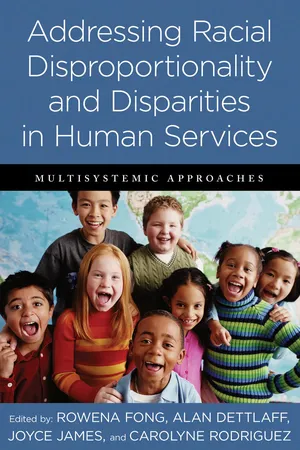
Addressing Racial Disproportionality and Disparities in Human Services
Multisystemic Approaches
- English
- ePUB (mobile friendly)
- Available on iOS & Android
eBook - ePub
Addressing Racial Disproportionality and Disparities in Human Services
Multisystemic Approaches
About this book
Information
Subtopic
Social PolicyIndex
Social SciencesPART |  |
Introduction

Introduction to Racial Disproportionality and Disparities

INTRODUCTION TO RACIAL DISPROPORTIONALITY AND DISPARITIES
RACIAL DISPROPORTIONALITY AND DISPARITIES ARE a growing concern as the population of ethnic minorities increases in the United States. As of 2010, the U.S. Census Bureau reported that Latinos represented the largest and fastest growing minority group, with 50.5 million people representing 16.3% of the U.S. population. Between 2000 and 2010, the Latino population grew by 43%, increasing from 35.3 million in 2000 (Humes, Jones, & Ramirez, 2011). African Americans, with 39 million people, represented the second largest minority group in the United States, at 12.6% of the total U.S. population (Humes et al., 2011). In contrast, African Americans represent 26% of juvenile arrests, 44% of youth detained, 46% of youth judicially waivered to criminal court, and 58% of youth admitted to state prisons (National Association for the Advancement of Colored People, 2012). Within the public child welfare system, African American children represented 24.1% of new entries into foster care in 2010 and 28.8% of all children in foster care (Summers, Wood, & Russell, 2012).
Although African American youth are disproportionately overrepresented in the juvenile justice and child welfare systems (McRoy, 2012; Models for Change, 2011), they and Latino youth are also overrepresented among those receiving disciplinary actions in public schools in the educational system, including suspensions and expulsions (U.S. Department of Education, 2012). Disproportionality and disparities challenge Asian/Pacific Islander and American Indian/Alaska Native populations as well. With the mandate to provide culturally relevant services, the child welfare, juvenile justice, education, health, and mental health systems each face the burden of examining the overrepresentation of ethnic minority children and families in their processes of service delivery. This chapter will begin by defining disproportionality and disparities and then begin to examine how they manifest across systems, a theme that will be expanded upon in later chapters. The chapter will then present a theoretical framework for examining disproportionality and disparities across systems in order to further an understanding of how and why disproportionality and disparities exist and to begin a dialogue on how they can be addressed using a cross-systems perspective.
DEFINING DISPROPORTIONALITY AND DISPARITIES
The terms used to describe disproportionality and disparities vary across systems, yet they describe similar phenomena. However, the meaning of these terms has evolved over time, and it is only recently that a common understanding of these terms has reached consensus. For example, within the child welfare system, the terms disproportionality and disparities have held numerous definitions in the literature devoted to this topic over the past two decades. The concept of disproportionality in child welfare initially grew from efforts in the juvenile justice system and arose from a growing recognition that children of different races were represented in the child welfare system at different rates (Derezotes & Poertner, 2005). The initial identification and use of the term disproportionality was intended to document this phenomenon and to acknowledge the need to better understand why it was occurring (Derezotes & Poertner, 2005). However, as the use of the terms disproportionality and disparities evolved over time, the words have taken on connotations that denote a problem resulting from either racial bias or from differential treatment of children of color. Understanding these terms and what they mean for health and other service systems is an important component in developing an appropriate response for addressing them.
Disproportionality
The term disproportionality refers to the state of being out of proportion. It describes a condition that exists when the proportion of people of a certain race or ethnicity in a target population differs from the proportion of people of the same group in a reference population. For example, in the context of the child welfare system, disproportionality is most commonly used to describe a condition when the proportion of one group in the child welfare population (i.e., children in foster care) is either proportionately larger (overrepresented) or smaller (underrepresented) than the proportion of the same group in the general child population. This phenomenon has most significantly affected African American children, with data from 2010 indicating that African American children represented 29% of children in foster care, although they represented only 14.5% of children in the general population (U.S. Census Bureau, 2012; U.S. Department of Health and Human Services, 2011). In and of itself, overrepresentation in the child welfare system may not be indicative of a problem because representation in this system should be based on need. This can be true for any system that provides services based on need within the population. However, when disproportionality results from racial biases or stereotypes that negatively impact ethnic minority populations, there is clearly a need to understand and address this issue to avoid the harmful effects that may result from this overrepresentation.
Disparity
Although disproportionality refers to the state of being out of proportion, disparity refers to a state of being unequal. Within systems, disparity is typically used to describe unequal outcomes experienced by one racial or ethnic group when compared to another racial or ethnic group (in contrast, disproportionality compares the proportion of one racial/ethnic group in the child welfare system to the same racial/ethnic group in the population). Continuing with the example of the child welfare system, disparities can occur at every decision-making point in this system, including the initial report that brings children to the attention of the system, acceptance of reports for investigation, substantiation of maltreatment, entries into substitute care, and exits from substitute care. For example, if the rate of African American children being reported to the child welfare system in a state differed considerably when compared to the rate of White children being reported to the same system, this would denote a disparity. Ultimately, disparities that occur in entries to and exits from the system produce disproportionality. Thus, understanding where disparities exist and why they are occurring is essential to understanding disproportionality. However, similar to disproportionality, the presence of a disparity at a given decision-making point is not an indicator of bias or of disparate treatment in the absence of data that identifies the explanatory factors contributing to the disparity. Efforts to understand these explanatory factors have received considerable attention over the past two decades.
A number of studies have identified disparities at various decision-making points along the child welfare service delivery pathway. These include the initial report of alleged maltreatment (Fluke, Yuan, Hedderson, & Curtis, 2003; Lu et al., 2004), acceptance for investigation (Gryzlak, Wells, & Johnson, 2005; Zuravin, Orme, & Hegar, 1995), substantiation of alleged maltreatment (Ards, Myers, Malkis, Sugrue, & Zhou, 2003; Rolock & Testa, 2005), placement into out-of-home care (Rivaux et al., 2008; Wulczyn & Lery, 2007), and exits from care (Hill, 2005; Lu et al., 2004). Several studies have examined factors that may explain these disparities, and findings have been mixed regarding the role of race. Some studies have found that race is a significant factor at various decision-making points (e.g., Hill, 2005; Lu et al., 2004; Rivaux et al., 2008), while others have found no significant effect for race when controlling for other factors (e.g., Goerge & Lee, 2005; Harris, Tittle, & Poertner, 2005). Still others have found that it is a combination of race with other factors that results in observed disparities (e.g., type of abuse by race—Gryzlak, Wells, & Johnson, 2005; severity of injury by race—Sedlak & Schultz, 2005; family structure by race—Harris & Courtney, 2003).
Although the existence of racial disproportionality and disparities in the child welfare system has been well-established, of concern to the field are the explanatory factors that underlie them because these are the issues that must be understood in order to develop appropriate responses as well as to shape policy. In addition to the child welfare system, relevant discussions have occurred in the juvenile justice, education, mental health, and health systems about the definitions and existence of disproportionality and disparities among ethnic minority populations. Yet although the identification of the explanatory factors that underlie disproportionality and disparities is an essential step in addressing those phenomena, it is a complex undertaking due to the multiple and intersecting factors that are likely contributors.
At issue within most systems when attempting to identify the factors that contribute to disproportionality and disparities is whether observed levels of overrepresentation result from racial biases within those systems or from differing levels of need among children and families of color. Continuing with the example of the child welfare system, much of the research over the past two decades that has identified the existence of disproportionality and disparities has consistently cited racial bias as a primary cause. This conclusion was based on findings from the federally funded National Incidence Studies of Child Abuse and Neglect (NIS) conducted in 1980 (NIS–1), 1986 (NIS–2), and 1993 (NIS–3), which had consistently shown no significant differences in the actual incidence of maltreatment across children of different racial groups (Sedlak, 1991; Sedlak & Broadhurst, 1996; Sedlak & Schultz, 2005). This led to many researchers concluding that in the absence of differences in the incidence of maltreatment, any observed overrepresentation among children of color must be the result of some form of bias within the system.
Yet this prevailing view was called into question upon publication of a paper by Elizabeth Bartholet (2009) entitled, The Racial Disproportionality Movement in Child Welfare: False Facts and Dangerous Directions. In her paper, Bartholet contended that the observed differences in the representation of African American children in the child welfare system occur because African American children are in fact maltreated at higher rates than children of other races and thus should be placed into foster care at higher rates than other children. She contended that higher rates of maltreatment in African American families are to be expected because African American children are more likely to be exposed to many of the risk factors associated with maltreatment, including poverty, substance abuse, and single parenting.
These claims were initially met with resistance because of the findings of the prior National Incidence Studies. However, in 2010, just a few months after the publication of Bartholet’s paper, the latest version of the NIS (NIS–4) was released, which found for the first time that rates of maltreatment for African American children were significantly higher than those for White or Hispanic children (Sedlak et al., 2010). In supplemental analyses of these race differences, the authors concluded that these observed differences were the result of greater precision of the NIS–4 estimates as well as an increased disparity in income between African American and White families since the NIS–3 (Sedlak, McPherson, & Das, 2010). These findings and the subsequent discussions that arose regarding their implications have led many child welfare systems to reevaluate their efforts to address disproportionality, particularly those efforts that focused solely on reducing bias within child welfare...
Table of contents
- Cover
- Title Page
- Copyright
- Dedication
- Contents
- Foreword
- Preface
- Part 1: Introduction
- Part 2: Ethnic Minority Populations
- Part 3: Cross Systems
- Part 4: Conclusion
- About the Contributors
- Index
Trusted by 375,005 students
Access to over 1.5 million titles for a fair monthly price.
Study more efficiently using our study tools.
Frequently asked questions
Yes, you can cancel anytime from the Subscription tab in your account settings on the Perlego website. Your subscription will stay active until the end of your current billing period. Learn how to cancel your subscription
No, books cannot be downloaded as external files, such as PDFs, for use outside of Perlego. However, you can download books within the Perlego app for offline reading on mobile or tablet. Learn how to download books offline
Perlego offers two plans: Essential and Complete
- Essential is ideal for learners and professionals who enjoy exploring a wide range of subjects. Access the Essential Library with 800,000+ trusted titles and best-sellers across business, personal growth, and the humanities. Includes unlimited reading time and Standard Read Aloud voice.
- Complete: Perfect for advanced learners and researchers needing full, unrestricted access. Unlock 1.5M+ books across hundreds of subjects, including academic and specialized titles. The Complete Plan also includes advanced features like Premium Read Aloud and Research Assistant.
We are an online textbook subscription service, where you can get access to an entire online library for less than the price of a single book per month. With over 1.5 million books across 990+ topics, we’ve got you covered! Learn about our mission
Look out for the read-aloud symbol on your next book to see if you can listen to it. The read-aloud tool reads text aloud for you, highlighting the text as it is being read. You can pause it, speed it up and slow it down. Learn more about Read Aloud
Yes! You can use the Perlego app on both iOS and Android devices to read anytime, anywhere — even offline. Perfect for commutes or when you’re on the go.
Please note we cannot support devices running on iOS 13 and Android 7 or earlier. Learn more about using the app
Please note we cannot support devices running on iOS 13 and Android 7 or earlier. Learn more about using the app
Yes, you can access Addressing Racial Disproportionality and Disparities in Human Services by Rowena Fong,Alan J. Dettlaff,Joyce James,Carolyne Rodriguez, Rowena Fong, Alan Dettlaff, Joyce James, Carolyne Rodriguez in PDF and/or ePUB format, as well as other popular books in Social Sciences & Social Policy. We have over 1.5 million books available in our catalogue for you to explore.