A distinctive feature of Ludwig Wittgenstein's work after 1930 was his turn to a conception of philosophy as a form of social inquiry, John G. Gunnell argues, and Thomas Kuhn's approach to the philosophy of science exemplified this conception. In this book, Gunnell shows how these philosophers address foundational issues in the social and human sciences, particularly the vision of social inquiry as an interpretive endeavor and the distinctive cognitive and practical relationship between social inquiry and its subject matter.
Gunnell speaks directly to philosophers and practitioners of the social and human sciences. He tackles the demarcation between natural and social science; the nature of social phenomena; the concept and method of interpretation; the relationship between language and thought; the problem of knowledge of other minds; and the character of descriptive and normative judgments about practices that are the object of inquiry. Though Wittgenstein and Kuhn are often criticized as initiating a modern descent into relativism, this book shows that the true effect of their work was to undermine the basic assumptions of contemporary social and human science practice. It also problematized the authority of philosophy and other forms of social inquiry to specify the criteria for judging such matters as truth and justice. When Wittgenstein stated that "philosophy leaves everything as it is," he did not mean that philosophy would be left as it was or that philosophy would have no impact on what it studied, but rather that the activity of inquiry did not, simply by virtue of its performance, transform the object of inquiry.
eBook - ePub
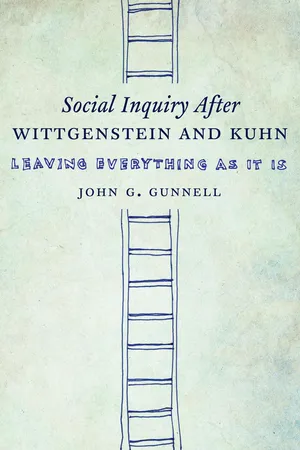
Social Inquiry After Wittgenstein and Kuhn
Leaving Everything as It Is
- English
- ePUB (mobile friendly)
- Available on iOS & Android
eBook - ePub
About this book
Information
Topic
PhilosophySubtopic
Political PhilosophyTable of contents
- Cover
- Title Page
- Copyright
- Dedication
- Epigraph
- Contents
- Preface
- List of Abbreviations
- Introduction
- 1. Thomas Kuhn & the Shadow of Wittgenstein
- 2. Wittgenstein & Social Theory
- 3. Mind, Meaning, & Interpretation
- 4. Investigating the Investigations
- 5. Conventional Objects, Concepts, & the Practice of Interpretation
- 6. Interpreting Science: Kuhn as a Social Theorist
- 7. Wittgenstein on the Moon: Certainty, Truth, & Value
- References
- Index
Trusted by 375,005 students
Access to over 1.5 million titles for a fair monthly price.
Study more efficiently using our study tools.
Frequently asked questions
Yes, you can cancel anytime from the Subscription tab in your account settings on the Perlego website. Your subscription will stay active until the end of your current billing period. Learn how to cancel your subscription
No, books cannot be downloaded as external files, such as PDFs, for use outside of Perlego. However, you can download books within the Perlego app for offline reading on mobile or tablet. Learn how to download books offline
Perlego offers two plans: Essential and Complete
- Essential is ideal for learners and professionals who enjoy exploring a wide range of subjects. Access the Essential Library with 800,000+ trusted titles and best-sellers across business, personal growth, and the humanities. Includes unlimited reading time and Standard Read Aloud voice.
- Complete: Perfect for advanced learners and researchers needing full, unrestricted access. Unlock 1.5M+ books across hundreds of subjects, including academic and specialized titles. The Complete Plan also includes advanced features like Premium Read Aloud and Research Assistant.
We are an online textbook subscription service, where you can get access to an entire online library for less than the price of a single book per month. With over 1.5 million books across 990+ topics, we’ve got you covered! Learn about our mission
Look out for the read-aloud symbol on your next book to see if you can listen to it. The read-aloud tool reads text aloud for you, highlighting the text as it is being read. You can pause it, speed it up and slow it down. Learn more about Read Aloud
Yes! You can use the Perlego app on both iOS and Android devices to read anytime, anywhere — even offline. Perfect for commutes or when you’re on the go.
Please note we cannot support devices running on iOS 13 and Android 7 or earlier. Learn more about using the app
Please note we cannot support devices running on iOS 13 and Android 7 or earlier. Learn more about using the app
Yes, you can access Social Inquiry After Wittgenstein and Kuhn by John Gunnell,John G. Gunnell in PDF and/or ePUB format, as well as other popular books in Philosophy & Political Philosophy. We have over 1.5 million books available in our catalogue for you to explore.