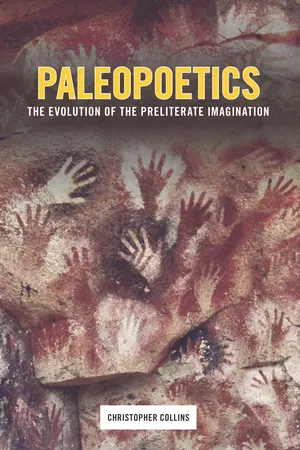
Christopher Collins introduces an exciting new field of research traversing evolutionary biology, anthropology, archaeology, cognitive psychology, linguistics, neuroscience, and literary study. Paleopoetics maps the selective processes that originally shaped the human genus millions of years ago and prepared the human brain to play, imagine, empathize, and engage in fictive thought as mediated by language. A manifestation of the "cognitive turn" in the humanities, Paleopoetics calls for a broader, more integrated interpretation of the reading experience, one that restores our connection to the ancient methods of thought production still resonating within us.
Speaking with authority on the scientific aspects of cognitive poetics, Collins proposes reading literature using cognitive skills that predate language and writing. These include the brain's capacity to perceive the visible world, store its images, and retrieve them later to form simulated mental events. Long before humans could share stories through speech, they perceived, remembered, and imagined their own inner narratives. Drawing on a wide range of evidence, Collins builds an evolutionary bridge between humans' development of sensorimotor skills and their achievement of linguistic cognition, bringing current scientific perspective to such issues as the structure of narrative, the distinction between metaphor and metonymy, the relation of rhetoric to poetics, the relevance of performance theory to reading, the difference between orality and writing, and the nature of play and imagination.
- English
- ePUB (mobile friendly)
- Available on iOS & Android
eBook - ePub
About this book
Information
Subtopic
LinguisticsIndex
Biological Sciencesone
The Idea of a Paleopoetics
How did it all begin? If some human activity especially fascinates us, we might become curious enough to ask that question. If that activity happens to be the reading of literature, our first impulse might be to think of the oldest preserved texts, such as the Chinese Book of Songs or the Vedic Hymns, portions of the Hebrew Bible or the Homeric epics. But we know these could not have been the earliest compositions. Thousands of years of preliterate chants, songs, and dramas must have preceded them. When we search for works of verbal art prior to these surviving texts, however, our eyes have nothing to peer into but what Prospero called “the dark backward and abysm of time.” Archaeology can show us Neolithic textiles, Paleolithic figurines and cave paintings, 450-thousand-year-old wooden spears, and stone hand axes crafted some 2.5 million years ago (mya), but not one single prehistoric artifact made of words. True, the absence of evidence, as Carl Sagan liked to say, is not the evidence of absence (Sagan and Druyan, 1992:387). All the same, some small scrap of physical evidence that Pleistocene poets once roamed the earth would be reassuring.
The absence of material evidence is not the only challenge facing us. Even if we were to ask how the earliest historic—i.e., written—poetry came into being, we would still need to confront another vexing question: What do we mean by “poetry?” After all, we have to know what we are looking for. When we think of poetry, most of us think of lyric poems, printed texts in which rhythmical monologists express strong feelings as they struggle through problems to achieve moderately satisfying resolutions. Yet, for Aristotle, the man who gave us the word “poetics,” poetry was not a thing or a set of cultural products but rather an activity, a “making” expressed in the verbal noun poiêsis. Moreover, it meant the making of narratives, dramas, and hymns, composed to be publicly performed—not the written lyric, our standard form of “poetry.” And what of prose narrative fiction? What of the personal essay with its monologic voice searching for revelations and resolutions? What of prose poetry? What of unrhymed, unmetered free verse? What of folk songs, folk ballads, and children’s rhymes? We recognize all these genres as somehow “poetic,” but, as for “poetry,” the object of our search seems to have been constantly changing over history into something else. One thing is certain: if the object of our search is prehistoric poiêsis and the cognitive skills that must have made it possible, we must at the outset lay aside our literate conception of poetry as lines of words printed on white paper rectangles.
Relitigating Plato v. Poiêsis
We have many questions to ask as we undertake this search, but, before we do so, I must pose a metaquestion: What purpose would be served by answering those questions? That is, how would a theory of proto-poiêsis, a paleopoetics, affect the way we now understand and experience literature? Satisfying our curiosity about anything simply by weaving conjectures into a hypothesis, however artful the weave, is never ultimately satisfying. The only useful purpose of this or any study of origins is to shed new light on the objects under study and thereby encourage further research.
Despite their variety, what we recognize as imaginative compositions have some traits that seem regularly to recur. One of their traits is, for want of a better word, craziness, though perhaps they only seem to display that trait: the fact that verbal poiêsis, unlike the other arts, uses the medium upon which reason and logic are founded means that its moments of irrationality, when they do occur, seem all the more perverse. There is, on the other hand, a long tradition according to which poets, like prophets and shamans, are possessed by spiritual beings that speak through them. Plato, who banned all poets from his ideal republic because they told untruthful stories, explained in the Ion and the Phaedrus that they were also god-possessed madmen. According to the tradition he referred to, poetic utterances are the words of beings outside the human world that speak from within the bodies of humans, making poiêsis—verbal creation—both otherworldly and innerworldly.
Plato’s Socrates, it should be recalled, left exiled Poiêsis the option to defend herself in court or to hire advocates to do so, a challenge that has prompted a series of writers—arguably Aristotle was the first—to reopen her case and appeal her sentence (Republic, book 10). (In English, Sir Philip Sidney and Percy Shelley also penned notable defenses.) If I, too, were to take up this long-standing challenge—and I suppose I am here doing so, after a fashion—I would begin by agreeing with Plato that poets do regularly deviate from rational discourse. But then I would argue that, when they do so, they do not go out of, nor do divine beings go into, their minds. Instead, poets go into their own minds and, doing so, guide us deeply into our own. To help establish that point, I would then proceed to call up a series of character witnesses, persons familiar with the defendant and able to share their insights with the court.
Consider how one extraordinary prose poet, Ralph Waldo Emerson, describes the effect words and thoughts could sometimes have on him:
Underneath the inharmonious and trivial particulars [of our daily lives], is a musical perfection, the Ideal journeying always with us, the heaven without rent or seam. Do but observe the mode of our illumination. When I converse with a profound mind, or if at any time being alone I have good thoughts, I do not at once arrive at satisfactions, as when, being thirsty, I drink water, or go to the fire, being cold: no! but I am at first apprised of my vicinity to a new and excellent region of life. By persisting to read or to think, this region gives further sign of itself, as it were in flashes of light, in sudden discoveries of its profound beauty and repose, as if the clouds that covered it parted at intervals, and showed the approaching traveler the inland mountains, with the tranquil eternal meadows spread at their base, whereon flocks graze, and shepherds pipe and dance. But every insight from this realm of thought is felt as initial, and promises a sequel. I do not make it; I arrive there, and behold what was there already. I clap my hands in infantine joy and amazement, before the first opening to me of this august magnificence, old with the love and homage of innumerable ages, young with the life of life…. (“Experience,” Emerson, 2001:207–8)
This experience seems to be above and outside him, a “heaven,” and inside him, a mental space that opens into a vast world he has had no part in creating. He discovers it there where it has always been, a landscape immeasurably ancient, yet forever new, and, like a child he claps his hands with joy. A century later, Robert Duncan (1960) spoke of a similar visionary homeland in his poem “Often I Am Permitted to Return to a Meadow”: it is “as if it were a scene made-up by the mind, / that is not mine, but is a made place, / that is mine….”
After Emerson, I would introduce the sixteen-year-old Arthur Rimbaud, himself a poet of prose as well as verse, and have him describe his own mode of illumination: “It’s wrong to say ‘I think.’ One should say: ‘somebody thinks me.’ Pardon the word play. I is someone else…. If brass wakes up as a trumpet, that’s not its fault. To me that’s obvious. I witness the unfolding of my thought: I look at it, I listen to it. I raise my bow to strike a note: the symphony begins to stir in the depths or comes leaping onto the stage.” Though he may not have then read these latter passages, T. S. Eliot echoed them when he proposed his “impersonal theory of poetry” according to which the “progress of an artist is a continual self-sacrifice, a continual extinction of personality” until the poet becomes a medium, a crucible within which thoughts, feelings, and emotions are transmuted.1
In the Western tradition, the idea that each of us possesses, and is sometimes possessed by, some Inner Other derives (ironically) from Socrates’ inner guardian spirit, his daimonion, later modulated by the Judeo-Christian body/soul dualism. This tradition was what Whitman used in order to articulate the curious relationship, sometimes discordant, sometimes erotic, between his inner and outer selves. For him his soul was the wise, deathless, visionary other, an entity that had already lived thousands of lives, while the body was the current, public self, the conscious identity that wore boots and a slouch hat, talked and sang, ate and drank and rode the Broadway omnibus. When poetry stirred within him, it was the soul that spoke, filling the body with a sudden influx of energy. The soul for Yeats was similarly ageless and energetic:
An aged man is but a paltry thing,
A tattered coat upon a stick, unless
Soul clap its hands and sing, and louder sing
For every tatter in its mortal dress.2
This language of spirit and inspiration is also linked to that tradition of spirit possession, which Plato spoke of as “divine madness,” a tradition that includes the theology of prophecy with all its mysterious visitants, from the Muses of Hesiod, the ruach of Ezekiel, and Caedmon’s dream-messenger to Lorca’s duende, Graves’s White Goddess, and the terrifying angels of Rilke.3
Reading, as well as writing, one can be overwhelmed by experiences that defy rational explanation. Consider Emily Dickinson’s poetic touchstone: “If I read a book and it makes my whole body so cold no fire can ever warm me, I know that is poetry. If I feel physically as if the top of my head were taken off, I know that is poetry. These are the only ways I know it. Is there any other way?” For Ezra Pound the test was whether or not a set of words created in the reader what he called an “Image,” a verbal pattern capable of presenting “an intellectual and emotional complex in an instant of time.” Such a pattern, he continues, “is the presentation of such a ‘complex’ instantaneously which gives that sense of sudden liberation; that sense of freedom from time limits and space limits; that sense of sudden growth, which we experience in the presence of the greatest works of art.” Pound’s phrase “intellectual and emotional complex” reformulates the ancient claim that poiêsis uses rational discourse as a conduit for nonrational knowledge. This intuited knowledge, though prompted by language, would not itself consist of language. It would instead represent those prelinguistic processes associated with sensory input and motoric output, processes that, when they reach the level of thought, are often accompanied by emotion. T. S. Eliot (1919/1957) in his essay “The Metaphysical Poets” argued that intellect and emotion had, since the mid-seventeenth century, drifted so far apart that poetry had now assumed a sort of split personality, a “dissociation of sensibility” in which thought and feeling could no longer coexist. Poets needed to “find the verbal equivalent of states of mind and feeling.” He concluded: “Those who object to the ‘artificiality’ of Milton or Dryden sometimes tell us to ‘look into our hearts and write.’ But that is not looking deep enough: Racine and Donne looked into a good deal more than the heart. One must look into the cerebral cortex, the nervous system, and the digestive tracts.”4
If intellect and emotion can manage to merge “in an instant of time,” the relatively slow serial processing of language must coexist with swift, “sudden,” parallel-processed information associated with emotion. Whitman’s defense of poetry, or the particular quotation from “Song of Myself” I would like to insert as his offering, is not a celebration of language or of the Platonic universes of discourse that philosophy can project. Instead, he creates a curious little unplatonic dialogue between himself and language. Language (speech) thinks that, just because it is able to represent anything and everything, it can override visuality (perception and imagination) and directly verbalize the inner self:
My voice goes after what my eyes cannot reach,
With the twirl of my tongue I encompass worlds, and volumes of worlds.
But
Speech is the twin of my vision, it is unequal to measure itself,
It provokes me forever, it says sarcastically,
Walt you contain enough, why don’t you let it out then?
Come now, I will not be tantalized, you conceive too much of articulation.
Earlier in that text he had likened speech to the grass that grows on graves where, rooted in the breasts and mouths of the dead, it emerges as myriad tonguelike leaves. Now, elaborating that metaphor, he tells speech that it is like perennial grass whose rooted “live parts” survive the winter. His poems, formed of speech, may manifest themselves as leaves of grass, but their roots constitute an unspoken, unspeakable knowledge that corresponds to (tallies with) the ultimate meaning of things, a rerum natura that he equates with happiness. When this knowledge bursts open its buds in spring, what it utters is not language but some far more primordial sound:
Do you not know O speech how the buds beneath you are folded?
Waiting in gloom, protected by frost,
The dirt receding before my prophetical screams;
I underlying causes, to balance them at last,
My knowledge my live parts, it keeping tally with the meaning of things,
Happiness, (which whoever hears me let him or her set out in search of this day).5
If we agree that the primary purpose of language is to share with one another the knowledge we receive from nonverbal sources, i.e., internal sense data (what we feel and what we remember having felt) and external sense data (what we perceive in our environment), then language may be regarded as a sign system that mediates between these two fields of sensory reference. Whitman’s metaphor suggests that this language art serves as a tally sheet to balance inner knowledge against the meaning of external things. Charles Olson also spoke to that point when he asserted that man as a “creature of nature (with certain instructions to carry out)” stands in direct relation to
those other creations of nature which we may, with no derogation, call objects. For a man is himself an object, whatever he may take to be his advantages, the more likely to recognize himself as such the greater his advantages, particularly at that moment that he achieves an humilitas sufficient to make him of use. It comes to this: the use of a man, by himself and thus by others, lies in how he conceives his relation to nature, that force to which he owes his somewhat small existence. If he sprawl, he shall find little to sing but himself, and shall sing, nature has such paradoxical ways, by way of artificial forms outside of himself. But if he stays inside himself, if he is contained within his nature as he is participant in the larger force, he will be able to listen, and his hearing through himself will give him secrets objects share (Olson, 1950/1959).
That last phrase seems at first counterintuitive. Don’t we humans share secrets with one another as subjects and do this through a language that is often self-referential and recursive (“What do you mean by ‘thinks he doesn’t know?’” “What I mean is that she thinks he doesn’t know that her father really intends to …,” etc.)? But Olson is saying that the goal of poetic language is to tell the secrets that objects share with one another, a sharing by human and nonhuman objects that is essentially nonverbal. As Thomas McGrath wrote, “in the beginning was the world” (1982:287), and the word, when it did come, finally allowed humans to share with one another the overheard secrets of that world. This listening, which the Romantics meant when they spoke of “communing with Nature,” science expresses as its faith in the intelligibility of the physical universe.
To a large extent, the dispute between philosophy and poetry that Plato instigated may be methodological. Philosophy, like science, is an open-ended activity, a conversation among opposing principles that manifests itself in “philosophizing.” Poiêsis, on the other hand, manifests itself in compositions that may be sung, intoned, read, or acted out, verbal artifacts that, when performed from memory or silently perused, are objects that transform themselves into instruments by means of which their users extend their own powers of knowing. With that thought in mind, I might close this phase of my defense by introducing the testimony of William Carlos Williams on the vital knowledge—the “news”—that poiêsis has to communicate:
Look at
what passes for the ne...
Table of contents
- Cover
- Half title
- Title
- Copyright
- Dedicaton
- Contents
- Preface
- Some Notes on Dating and Nomenclature
- Acknowledgments
- 1. The Idea of a Paleopoetics
- 2. From Dualities to Dyads
- 3. Play and Instrumentality
- 4. The World as We See It
- 5. Human Communication: From Pre-Language to Protolanguage
- 6. Language: Its Prelinguistic Inheritance
- 7. The Poetics of the Verbal Artifact
- Epilogue: The Neopoetics of Writing
- Notes
- Bibliography
- Index
Trusted by 375,005 students
Access to over 1.5 million titles for a fair monthly price.
Study more efficiently using our study tools.
Frequently asked questions
Yes, you can cancel anytime from the Subscription tab in your account settings on the Perlego website. Your subscription will stay active until the end of your current billing period. Learn how to cancel your subscription
No, books cannot be downloaded as external files, such as PDFs, for use outside of Perlego. However, you can download books within the Perlego app for offline reading on mobile or tablet. Learn how to download books offline
Perlego offers two plans: Essential and Complete
- Essential is ideal for learners and professionals who enjoy exploring a wide range of subjects. Access the Essential Library with 800,000+ trusted titles and best-sellers across business, personal growth, and the humanities. Includes unlimited reading time and Standard Read Aloud voice.
- Complete: Perfect for advanced learners and researchers needing full, unrestricted access. Unlock 1.5M+ books across hundreds of subjects, including academic and specialized titles. The Complete Plan also includes advanced features like Premium Read Aloud and Research Assistant.
We are an online textbook subscription service, where you can get access to an entire online library for less than the price of a single book per month. With over 1.5 million books across 990+ topics, we’ve got you covered! Learn about our mission
Look out for the read-aloud symbol on your next book to see if you can listen to it. The read-aloud tool reads text aloud for you, highlighting the text as it is being read. You can pause it, speed it up and slow it down. Learn more about Read Aloud
Yes! You can use the Perlego app on both iOS and Android devices to read anytime, anywhere — even offline. Perfect for commutes or when you’re on the go.
Please note we cannot support devices running on iOS 13 and Android 7 or earlier. Learn more about using the app
Please note we cannot support devices running on iOS 13 and Android 7 or earlier. Learn more about using the app
Yes, you can access Paleopoetics by Christopher Collins in PDF and/or ePUB format, as well as other popular books in Biological Sciences & Linguistics. We have over 1.5 million books available in our catalogue for you to explore.