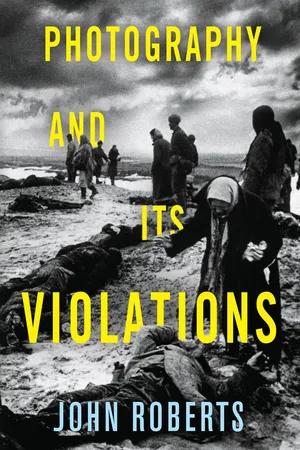
Theorists critique photography for "objectifying" its subjects and manipulating appearances for the sake of art. In this bold counterargument, John Roberts recasts photography's violating powers of disclosure and aesthetic technique as part of a complex "social ontology" that exposes the hierarchies, divisions, and exclusions behind appearances.
The photographer must "arrive unannounced" and "get in the way of the world," Roberts argues, committing photography to the truth-claims of the spectator over the self-interests and sensitivities of the subject. Yet even though the violating capacity of the photograph results from external power relations, the photographer is still faced with an ethical choice: whether to advance photography's truth-claims on the basis of these powers or to diminish or veil these powers to protect the integrity of the subject. Photography's acts of intrusion and destabilization, then, constantly test the photographer at the point of production, in the darkroom, and at the computer, especially in our 24-hour digital image culture. In this game-changing work, Roberts refunctions photography's place in the world, politically and theoretically restoring its reputation as a truth-producing medium.
- English
- ePUB (mobile friendly)
- Available on iOS & Android
eBook - ePub
Photography and Its Violations
About this book
Information
Topic
FilosofíaSubtopic
Arte y políticaPart I
THE DOCUMENT, THE FIGURAL, AND THE INDEX
1
PHOTOGRAPHY AND ITS TRUTH-EVENT
The history of photography now possesses a history itself. That is to say, it is only until recently that the history of photography has “stabilized” itself as a field of inquiry, allowing its methodological problems and inconsistencies and ruling myths to be subject to criticism and revision, and as such providing the means for the development of a theoretical literature. This is obviously due partly to the maturity of photography as a set of practices and techniques across its social domains (necessitating a critique of photography’s effects, affects, and functions), but it is also the result of the massive incorporation of photography into the relations of production over the last 120 years: the embodiment of photography in the (scientific) production and (cultural) exchange of commodities. With the force of the latter, photography has become a determinate part of the twofold and dialectical dynamic of the logic of abstraction under commodity exchange: the equalization and naturalization of things (reification), but contrariwise, the production of knowledge. This is why photography retains its theoretical fascination, because, essentially, its effects, affects, and functions are split between these forces of abstraction and the exigencies of knowledge production in palpable, living, and intrusive ways. And accordingly, this is why the theoretical literature—or the reflexive history of photography, as we might now call it—has grown enormously since the 1960s. The determinate role of photography within the production and exchange of commodities, along with, concomitantly, photography’s increased status as a primary commodity itself, has meant that the history of photography has of necessity—given photography’s embeddedness in relations of production and relations of power and truth—had to be thoroughly deaestheticized.
But, interestingly, one of the consequences of this since the first wave of the new literature (by Roland Barthes, Susan Sontag, Victor Burgin, Rosalind Krauss, John Tagg, Vilem Flusser, Henri Van Lier) is that this process of deaestheticization has produced a literature that has tended to emphasize the photograph’s place in the reification of things, at the expense of photography’s relationship to the production of knowledge. Indeed because photographs are reified things—reified things in a world of other reified things—their relationship to truth and the real is unstable and suspect. Yet, the initial drive of this writing was in no sense conservative. The diminishment of the truth-claims of photography was held to be not a loss to photography as such, but, on the contrary, an indication of how close photography is under the logic of commodity exchange and the modern autonomization of cultural production, to the figural and metaphoric operations of art. A paradox, therefore, enters this literature: at the point where the photograph is deaestheticized through a recognition of photography’s embeddedness in the relations of production and (state) power and of its semiotic undecidability, it is reaestheticized through its perceived fundamental figural character. This is not to say that these authors did not recognize this conflict; but driven as the writing was by the desire, in the spirit of a modernist semiotics, to affirm photography as pictures, rather than as “windows on the world,” the photograph’s singular relationship to the claims of realism and the real was weakened.
In the 1990s, however, under the formative influence of the photographer and writer Allan Sekula (very much writing from within and against this first wave of literature), a second wave of theoretical literature emerged (Richard Shiff, Laura Mulvey, Molly Nesbit, Abigail Solomon-Godeau, Steve Edwards, Blake Stimson, Ariella Azoulay). This second wave has in a sense qualified the notion of photographs as pictures, without either dropping the framework of reification-theory or returning to a window-on-the-world model. What distinguishes photography in its specificity is that it is more—or less—than art, and it is this that defines its epistemological, cultural, and historical status. Thus photographs may be pictures, but they are pictures of a particular kind: that is, they are light traces, indices of things, and as such the result of the “spontaneous” ordering of contingent appearances. This makes their production and reception “unconscious” at one level, insofar as the producer at the point of the photograph’s inception has incomplete control over the production process. Consequently, the modern photographer’s notion of himself or herself as an artist—the issue, essentially, that drove the first wave of literature—is continually made unfamiliar to itself: in making pictures the photographer is not an independent creator, in any conventional sense, but a kind of “unreliable” functionary. The photographer seeks control over an objective and anonymous process, but the process continually and necessarily betrays his or her attempts at control.
THE DEBATE ON INDEXICALITY
A reinvigoration of the debate on the relations between the index, the icon, and the symbol in representation—out of renewed interest in Charles Sanders Peirce—became crucial, therefore, to this second wave of literature, in order to let some fresh air into what had become an unproductive stand off between the artists and documenters. In what ways does the relationship between indexicality, iconicity, and the symbolic in the photograph produce meaning? What kind of pictures are indexes? How do indexes produce photographs as icons/pictures? This in turn has generated something of a post-second-wave stage, in which the position you adopt on this question is largely where you place the significance of the index in the index/icon/symbol mix: is it subordinate to the process of picturing, or is it beneath it, or perhaps athwart it, in some way, as a kind of recalcitrant presence? Indeed, if anything, there has been a general swing back to first-wave thinking, with the rise of digitalization. For it is precisely digitalization’s precocious emphasis on figuralization in the production of photography—the putting together of the image—that has revived the artistic claims of photography and delimited the “objectivist” and functional role of the photographer. This is not to say that these writers believe the index to have disappeared from photography; instead, they assert that its role has become greatly diminished, relieving photography of many of its (tiresome) veridical burdens: if we have to talk about truth and the index in photography, let’s only talk about it within the space of figuralization and picturing (Joel Synder, Geoffery Batchen, Andrew Benjamin, Michael Fried), or more precisely, a certain kind of picturing that takes on the ambitions of painting.
The debate on the index continues to shape the debate on photography, because it puts into sharp relief where photographers and artists stand on the social ontology of photography. Is indexicality an ideological hangover from the social-relational functions of photography, or does it remain, in some form, the primary determining force on photography? In this light it is worth mentioning James Elkins’s anthology Photography Theory (2006),1 because of the focus it gives to the index debate, and the fact that in its capaciousness it draws on the writing of numerous leading photographers and theorists, thereby giving an overview of where the debate stands for many photographers and theorists today. Derived from a series of papers and a seminar at University College Cork in 2006, Elkins’s book is very much the product of the second-wave reassessment of indexicality after digitalization—indeed obsessively so. Most of Photography Theory is taken up with a discussion on the index at the expense of any other significant topics. Looking again at the index in this depth is surely a good and valuable thing, and this collection certainly provides a number of entry points into a discussion of its continuing significance.2 The status of the index in photography is clearly what challenges us to think about photographs as photographs; and therefore clarifying the function of indexicality as part of post-second-wave thinking is important. Unfortunately, driven by Joel Synder’s powerful desire in the roundtable discussion to have done with the index altogether—“photography is incredibly plastic, and…indexicality stops us from seeing the plasticity, and enjoying it”3—and the general depoliticized context of the discussion, much of the debate gets locked into a endless to-and-froing between first-wave and second-wave thinking. Contributors line up, to a man and woman, to either dismiss or defend (some aspects of) Synder’s views. What is missing, as a consequence, is a sustained dialectical account of indexicality.
One exception to this rule is Martin Lefebvre’s contribution to the collection. In a finely nuanced analysis of Peirce and the index, he argues that without indices “our representations would only stand for objects that are utterly vague and distinct or general and without any anchor in the world.”4 But the idea that photographic indices are the only indices worth talking about and that other forms of representation—such as paintings and “painting-like” things such as computer-generated images—are index-free or index-deficient is inadequate. Paintings and “painting-like” things such as computer-generated images are no less reliant on indexicality than photographs. But whereas photographs rely on direct indexical relations, paintings and computed-generated images are reliant on indirect indexical relations: “if all portraits, whether they be photographic or painted, necessitate the existence of their object as a determining factor in the existence of the sign, then the only difference between them—from the point of view of indexicality—lies in the fact that photography requires a direct contact between the object and the sign, whereas in a painting both are indirectly connected through yet another sign (namely the painter) which is in direct contact with the painting (efficient causality) and either in direct or indirect contact with the object.”5 In other words, echoing Peirce, there are no such things as “pure icons” unconnected existentially, in some way, to the world they inhabit and figure. Thus Lefebvre seems to be working both sides of the debate simultaneously: photographs are not the sole productive source of indexicality; and no embodied sign (be it analogue or digital) is free of indexicality’s effects.
Any worldly thing whatsoever—whether it be a photograph, a film, a painting, or a CGI [computer-generated image]—is dyadically connected to the world (or reality) in a potentially limitless number of ways, each one of them can form the basis for an indexical function. This implies that it is absurd to pretend that a photograph is more indexical tha[n] a painting or a CGI, since it is impossible to quantify the number of ways in which something may serve as a sign.6
As with fingerprints, photographs—photodocuments—fall into the first category; and paintings and digital images fall into the second category. Whereas photographs are the result of an immediate contact between object and sign, object and sign in painting and digital images are connected via another sign (the hand of the painter or digital artist). Thus, in this category the sign is a secondary effect of the object that causes it. Accordingly all embodied signs have some indexical relationship to the world of objects.
In this sense digitalization does not, in fact, represent a loss of indexicality at all. Firstly, this is because the translation of the distribution of light intensities into binary code is no less the product of a causal relationship between image and appearance than that of chemical photography’s contiguous and contingent capturing of light on light-sensitive film. And secondly, therefore, there is nothing inherent in digital photography’s “secondary” indexicality that positions it against the traditional documentary imperative. Indeed many digital photographers reject the constructed, artifactual implications of the new digital technology on the grounds that digitalization is first and foremost reportage made compatible with a twenty-four-hour global news services, and not evidence of reportage made epistemologically unrealizable. This integral presence of the index across modes of representation, then, allows a shift away from the mournful and melancholic view that digitalization represents the demise of indexicality and as such opens the debate beyond the old binarisms.
Lefebvre’s argument on secondary indexicality has two important implications, then: firstly, the digitalization of photography has made explicit the transitive technical and cultural character of photography (that is, there is no such thing as photography as a distinct medium based upon a stable technology grounded in the chemical development of the image); and secondly, in direct opposition to the prevailing technological determinist reading of these changes, the digital and virtual dissolution of photography does not thereby mean the disappearance of “realism” and the document as key aspects of photography’s truth-claims. On the contrary, far from digitalization eroding realism and photographic truth, the malleability of the digital image has prized photography away from the positivization and reification of realism and photographic truth as categories. For if there is no natural or unmediated relationship between the photographic referent and photographic truth, no one kind of photograph—chemically produced or otherwise—can be said to privilege the photograph’s access to truth. Digitalization does not destroy the truth-claims of photography; rather it makes such claims an explicit condition of critical reconstruction, the thing, of course, that has constituted the historical critique of positivism and naturalism in photography itself, since the classic exposition of this position in Brecht’s critique of the political indeterminacy of the decaptioned photograph. Thus, given the requisite discursive support required for image interpretation, it is difficult—to borrow Peirce’s terms—to talk of computergenerated images being interpreted as rhemes (metaphors) and photographs as dicents (matters of fact). Both are discursively reconstructable as dicents, as things connected to the world. Hence, neither the chemically produced photodocument nor the digitally produced image tell the truth of things; rather, photographs are able, through causal analysis and the act of interpretation, to put themselves in the way of truth—a different matter altogether. Importantly, therefore, digitalization has no less a responsibility to reveal the conditions of its material constructedness than have documentary practitioners, who have deliberately manipulated and orchestrated scenes to create a particular “truth-effect.”
Yet, if secondary indexicality seems a progressive and dialectical move on Lefebvre’s part, it is nonetheless not without its problems, and these center on the qualitative distinction between the direct index and indirect index, and what this means in terms of the affects and effects of the photographic document and the political and social history of photography. For despite Lefebvre’s recognition that photography’s indexicality is of a different order than that of painting and “paintinglike” things—what he calls its “semiotically pertinent difference”7—this is not opened up in his discussion to the vast political and social history that has shaped and driven this distinction in the twentieth century. We would all seem to be painters or rather “painter-like” producers now—photographers and photo theorists alike. This prognosis in many ways affects the whole collection, given its unwillingness to engage with, or indifference toward, the ways in which the photographic index has been mobilized, transfigured, and invaded by the real in the twentieth century. Indeed, as Abigail Solomon-Godeau puts it in Elkins’s collection—she is one of the few dissenters in the collection against the general tenor of the discussion (rather than one of those dissenters, more generally, who are bored or irritated by the prominence or direction of the debate on the index per se)—“there is no discussion of [indexicality’s] profound imbrication with the social, ideological, or political.”8 The crucial point, therefore, is this: indexicality is meaningful insofar as it is subject to an interpretative process of truth-disclosure, to the claims of realism, so to speak. This means that we should be asking of realism and photography a very different question than usually gets asked on either side of the indexical divide. Not: what is to be gained by defending the primacy of the photographic index? Or: what is to be gained by dropping the primacy of the index altogether? But rather: what is it about the direct indexicality of the photograph and the indirect indexicality of the digital image that makes it worthwhile investing in photography as a distinct process of truth-disclosure, and as such, why is it worthwhile defending the category of realism? That is, how might realism be constructed in and for photography, if we know that the photographic index produces a different existential relationship to the world than the secondary index of the computer-generated image and painting? And in addition what is it about the photographic index in both its analogue and its digital forms that allows photography to contribute to the debate on realism in ways that are specific to the function and character of the document (rather than substituting itself in general terms for the realist debate)?
In this sense we have a reflexive history here of the histories of photography without the ways in which indexicality has brought truth and the real into not just artistic and cultural theory, but cultural and social praxis itself. In this respect what is lacking in Photography Theory is a discussion on indexicality and photography as it bears on the social and cultural mediation of the photograph. What is it that artists, writers, and cultural producers have noticed about photography’s indexicality that has made photography a suitable, vigorous, and exacting candidate for the forces of modernity, political and cultural democracy, revolution and truth in the twentieth century? In what ways does indexicality, therefore, ground the social ontology of photography?
Well, it seems to me that in order to answer this question effectively we need a concept of violation, but, more precisely, a concept of violation that is mediated by the violations and negations of the political process. So we might say that indexicality is certainly born with photography in the 1830s, but its actual conceptualization is emergent in the twentieth century precisely through photography’s increasingly systematic dehierarchization of appearances, and by extension its world-transforming incorporation of the nonidentitary (the heterogeneous) into a political and philosophical program of social transformation—hence, the absolute centrality of the Russian revolution for this moment of demotic self-consciousness. For what the Russian revolution concretized for, and in, photography was a set of social and cultural perceptions that up until that point had been largely invisible or had exist...
Table of contents
- Cover
- Title Page
- Copyright
- Contents
- Acknowledgments
- Introduction: The Social Ontology of Photography
- Part I: The Document, the Figural, and the Index
- Part II: Abstraction, Violation, and Empathy
- Conclusion
- Notes
- Bibliography
- Index
- Series List
Trusted by 375,005 students
Access to over 1.5 million titles for a fair monthly price.
Study more efficiently using our study tools.
Frequently asked questions
Yes, you can cancel anytime from the Subscription tab in your account settings on the Perlego website. Your subscription will stay active until the end of your current billing period. Learn how to cancel your subscription
No, books cannot be downloaded as external files, such as PDFs, for use outside of Perlego. However, you can download books within the Perlego app for offline reading on mobile or tablet. Learn how to download books offline
Perlego offers two plans: Essential and Complete
- Essential is ideal for learners and professionals who enjoy exploring a wide range of subjects. Access the Essential Library with 800,000+ trusted titles and best-sellers across business, personal growth, and the humanities. Includes unlimited reading time and Standard Read Aloud voice.
- Complete: Perfect for advanced learners and researchers needing full, unrestricted access. Unlock 1.5M+ books across hundreds of subjects, including academic and specialized titles. The Complete Plan also includes advanced features like Premium Read Aloud and Research Assistant.
We are an online textbook subscription service, where you can get access to an entire online library for less than the price of a single book per month. With over 1.5 million books across 990+ topics, we’ve got you covered! Learn about our mission
Look out for the read-aloud symbol on your next book to see if you can listen to it. The read-aloud tool reads text aloud for you, highlighting the text as it is being read. You can pause it, speed it up and slow it down. Learn more about Read Aloud
Yes! You can use the Perlego app on both iOS and Android devices to read anytime, anywhere — even offline. Perfect for commutes or when you’re on the go.
Please note we cannot support devices running on iOS 13 and Android 7 or earlier. Learn more about using the app
Please note we cannot support devices running on iOS 13 and Android 7 or earlier. Learn more about using the app
Yes, you can access Photography and Its Violations by John Roberts in PDF and/or ePUB format, as well as other popular books in Filosofía & Arte y política. We have over 1.5 million books available in our catalogue for you to explore.