- English
- ePUB (mobile friendly)
- Available on iOS & Android
eBook - ePub
About this book
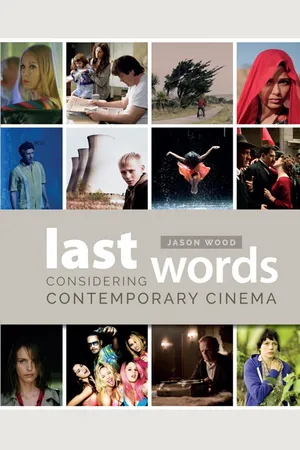
Last Words features extensive interviews with Christopher Nolan, Harmony Korine, Charlie Kaufmann, Nicolas Winding Refn, Wim Wenders, Michael Winterbottom, Christian Petzhold, and many others. Each interview is preceded by an overview of the director's work, and the volume's authoritative introductory essay explores the value of these directors and why they are rarely given an appropriate platform to discuss their craft.
Information
Subtopic
Film & VideoJoe Lawlor and Christine Molloy
Over the past four years Christine Molloy and Joe Lawlor have been working on a project called Civic Life. It involves local community groups in the production of nine high-quality short films for the cinema, shot on 35mm Cinemascope and making extensive use of long takes. In 2004, their film Who Killed Brown Owl won the award for Best British Short Film at the Edinburgh International Film Festival. In January 2008 their latest short film Joy won the Prix UIP Rotterdam at the International Film Festival Rotterdam. Helen (2008), the first feature of the duo, who work under the title of Desperate Optimists, marks the culmination of the Civic Life series.
An expansion of Joy, Helen is an hypnotic first feature and marks an exciting discovery for British arthouse cinema. An 18-year-old girl named Joy has gone missing. A college-mate a few weeks away from leaving her care home, Helen, is asked to ‘play’ Joy in a police reconstruction that will retrace Joy’s last known movements. Joy represents all that was missing from Helen’s life – she had parents, a boyfriend, a future. Gradually Helen immerses herself in the role, and by borrowing elements of Joy’s life begins herself to bloom.
Remarkable for its examination of identity and representation, Helen is also marked by its casting from within the community in which it was set and its incredibly epic visual aesthetic and use of Cinemascope.
Desperate Optimists have recently completed their second feature, the Singapore-set Mister John (2013), which features Aiden Gillen as a man seeking the truth behind his brother’s death.

JASON WOOD: How did Desperate Optimists and your initial work in community theatre and experimental performance begin?
CHRISTINE MOLLOY AND JOE LAWLOR: We both started to work together, in what can broadly be described as community arts, back in the mid-1980s in Dublin. Initially the kinds of projects we ran were not art-form led, but instead we allowed the interests of the given community groups we were working with to suggest the art form required. So for example, some projects required writing to be the focus, others were more visual arts orientated and some navigated towards the theatre. The side effect of this is that we developed a very eclectic way of working before finally specialising in writing and theatre. However, we guess the art form that has inspired us the most has always been cinema. To our shame, long periods of time can go by now without us ever going to the theatre but we watch films pretty much on a daily basis.
JW: How did this interest in cinema evolve to encompass the production of short films and how was this production informed by other disciplines?
CM/JL: Because we did not specialise early on in our various community projects, but instead kept things very open and fluid, we thought nothing of having live or pre-recorded film and video on stage in our subsequent theatre work. We liked very much sharing the stage with these other art forms and technologies in our live performances. They were a lot of fun to work with in creating more complex and layered approaches to narrative, performance and time. The audience reactions were not always much fun. We made very challenging theatre; maybe too much so. We noticed, however, that the more we worked with film and video the more we enjoyed the filmmaking process. We recall on one of our last theatre shows that the moving image component was around fifty per cent of the live experience. We calculated that it wouldn’t be long before our theatre work would be a hundred per cent moving image and none live and that this could be a real problem for a paying public intent on seeing a live production. The writing was on the wall in that sense and it was an easy decision to make to stop live theatre work and concentrate on the thing that made us happiest.
In the late 1990s when we began to move from theatre into moving image the practical reality of limited access to expensive technology and lack of money directed us to internet moving image projects to begin with before we progressed to video works and finally to short films on 35mm for cinema. One of the things about this progression is that we were always interested in what was formally possible in the medium we were working in. This clearly carries its responsibilities but we also enjoyed pushing the boundaries. Cinema, for reasons perhaps beyond the scope of this response, is a form that is quite conservative and one you have to be careful with in terms of how you push the form. That said, we love cinema driven by a formal bravery.
JW: The notion of community has been a constant thread. Why is this notion so essential to you and what benefits have you found to have arisen from working in what can be considered a grass roots fashion?
CM/JL: Even though we have been working on and off with various community groups for over twenty years it is only in the last six years, while working on our Civic Life project, that something of a certain clarity has begun to emerge. There’s no doubt that much of the impetus for our work as been a certain social and political commitment. At the same time we are fascinated by the interplay of seemingly contradictory processes that underpin our Civic Life films. So, on the one hand, we very deliberately strive for the high production values of big budget mainstream Hollywood films by making use of 35mm Cinemascope, anamorphic lenses, elaborate and technically complicated crane shots (or steadicam shots) and highly choreographed long takes. While on the other hand we use ordinary, real people from the community – non-professionals – who we then immerse in this stylised cinematic world. What emerges is a sort of authenticity that arises from the rawness of the performances counteracted by the slickness of the production values.
We like tension and it is this that has drawn us to working with community groups on these films. The flawed, imperfect nature of the films, we hope, are the very qualities that open up a space for the audience. It is this ‘space’ that we try to create when making the films – a space in which accidents might happen and in which things might come alive. We see Helen as a sort of high point in all of this but the film also exposes some potential limitations in the Civic Life method. We have a growing sense that it’s possible Helen may represent the end of a way of working for us. This might need explaining. In very crude terms Helen has allowed us to imagine our next feature film and because of the ambitions we have for it we are aware that these ambitions may not be best served using the Civic Life approach. Some of the methods we have honed and explored over the past five years may have to be attenuated but this is something we are ready for, as we believe that with Helen we have probably pushed the Civic Life project as far as it can go.
JW: How did Who Killed Brown Owl, the first film in the Civic Life series come about and what decisions shaped your aesthetic approach and distinct take on narrative?
CM/JL: The commission came from Enfield Council. Rather than spending the money on fireworks – which was very much an option – Enfield Council wanted to commission a film project to celebrate the successful completion of the Council’s New River Loop Restoration Project. It was our desire to involve as many local people as possible in the project and to this end we held a number of civic meetings and ran a stall at a local summer fete in an attempt to drum up local involvement. Mindful that we wanted to avoid the pitfall of producing a Tourist Board film, we were nonetheless convinced we should strive for something painterly, beautiful and elegant to match the setting itself. Although we did undercut this Arcadian fantasy by lacing the film with some murder, mayhem and dysfunction.
Instinctively we knew that video would never deliver the film that we wanted to produce but we had no idea, never having worked with film before, if the budget of £20,000 would cover the dramatically cinematic ambitions we were beginning to develop, particularly knowing that we also wanted to output to film. There were two things that became clear to us very early on. Firstly, in order for the production budget to work we would only be able to afford the equipment and crew for one day. Secondly, in order for the post-production budget to work we would only be able to develop a minimal quantity of stock.
The logistical constraints demanded by the limited budget began to force a set of aesthetic decisions on us that very much fell into line with our own desires about how we might ‘stage’ the film event itself and develop strategies for working with a cast of non-professionals. It became clear very quickly that the ‘long take’ would provide us with the solution we required and it is this use of the long take, coupled with the challenge of working with non-professional actors and minimal rehearsal time, that has resulted in the distinctive approach to narrative and performance to have emerged from the Civic Life series of films. One way or another, given our background in experimental performance in which the ‘live-ness’ of the event was always foregrounded, we’re convinced we would have been drawn to the long take and what it offered up to us as short filmmakers desiring to experiment in cinematic time and space.
JW: How did you find the transition from shorter pieces to feature-length work?
CM/JL: To date we have made nine Civic Life short films. All of these have been made using more or less the same rules. We use long takes, we work with mainly non-professional casts from the local community, we shoot 35mm Cinemascope using anamorphic lenses and we output to film, preferably premiering in a local multiplex cinema. Over these five years we have certainly discovered the parameters of what is possible working in this way.
After the success of Who Killed Brown Owl we decided we wanted to make a series of films using this methodology and we randomly came up with the idea of seven short films. It was never our intention to aim towards a feature-length film. It was only after we’d completed the final film in the series and were receiving invitations from festivals to screen all seven films together that the idea of a Civic Life feature film began to take hold.
A well-funded commission from the Liverpool Biennial and the Liverpool Culture Company allowed us to experiment with making a longer Civic Life film. The resulting half-hour film, Daydream, was shot over four days and provided us with a very tough learning curve. A beautiful but deeply flawed film – a noble failure we hope – Daydream provided us with the key to plan our approach to the shooting of a feature film. Indeed, if we hadn’t made Daydream we’re convinced Helen would have been a disaster. We learnt that we would have to free ourselves from a strict adherence to the Civic Life rules and explore a more flexible approach to the use of the long take to ensure that we would have options at the editing stage. The realities of working with such a perilously low shooting ratio of only 1:3 and having only 30,000 feet of film (equivalent to only 300 mins of exposed film in the can) from which to extract a 79-minute feature film meant we had to come up with some new strategies. At the end of the day, this was always going to be the challenge of translating the Civic Life method from a short film to a feature-length film – the need to develop the narrative over time.
The long take has always allowed us a tremendous sense of flexibility, enabling us to react on the day regardless of the many variables thrown up by our methodology. For a feature film – that is ultimately dramatic in its structure – by its very nature, more has to be pinned down and no matter how loose, fluid and open we might want to keep things as we are filming, the narrative structure has to work. Understanding how we might use cutaways and sequences that were freed up from serving the demands of the narrative – like the sequences in the woods – was central to making the transition to a feature-length film.
JW: Environment is also essential to you. How did you utilise your local environment in Helen and how did you seek to replicate this environment on screen?
CM/JL: As a precondition to how the financing works on these Civic Life films, the commissioning organisation often has strong feelings about where the film should be located. For example, Birmingham was very much interested in us filming not just in their city but also specifically in Handsworth Park itself. Now, to some this might sound like a real constraint but we find it helpful to have these strictures. Our analogy is something like a jazz structure. The stronger the structure that Miles Davis lays down the easier it will be for John Coltrane to find the freedom to play. If there’s no structure you end up spending all your time looking for it. So, by narrowing down the locations we can work in, you begin (subconsciously) to work with some parameters. So in effect, the starting points for all these films are, as the question suggests, environments, locations and sites. These become central to everything.
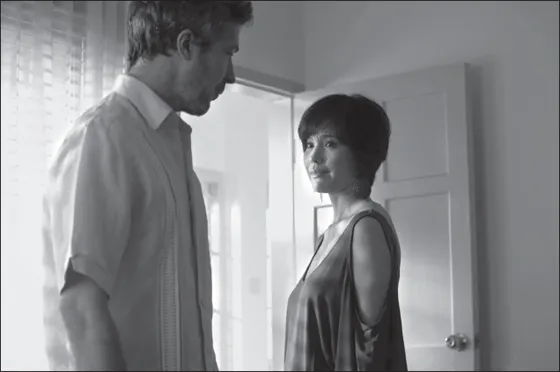
Mister John, Joe Lawlor and Christine Molloy, 2013 (Desperate Optimists/Artificial Eye)
Many years ago we used to go through writing exercises. A thorny issue for writers is starting points. How does one start? Over the years this question has become quite abstract for us, as it seems very simple. Yes, it could be a location like a park or a building for that matter. One phrase that came up many years ago was a Williams Carlos Williams quote: ‘In things not in ideas.’ Location seems a perfect place from which to build narratives. In fact they are perfectly suited to cinema. We’ll come back to the question of how we seek to replicate this environment on screen further down the line.
JW: I imagine that you also cast from within the local community. If so, this tactic pays particular dividends in the performance of Annie Townsend as the eponymous college girl whose upbringing is in contrast to the missing person she is asked to replicate.
CM/JL: Our cast for Helen came entirely from within the local community. As with all our Civic Life films, by and large, whoever turns up on the day is in the film. The exception to this is how we cast the title role of Helen. We knew it would be impossible without a more traditional approach to the casting process. We couldn’t just take the first young woman that came our way and give her the part. In fact, in the end, we really struggled to get anyone even close to what we needed and time was very quickly running out. With only two weeks to go before we were due to begin shooting our film we still hadn’t found our lead performer. In the end it came down to two young women. We were getting nervous, come early October, so much so that we actually approached the agent of a very talented rising star from Dublin and asked if we could arrange an audition. It went agains...
Table of contents
- Cover
- Title Page
- Copyright
- Contents
- Acknowledgments
- Fore Words
- Introduction
- Lenny Abrahamson
- Clio Barnard
- Marco Bellocchio
- Anton Corbijn
- Florian Henkel von Donnersmarck
- Fernando Eimbcke
- Michel Gondry
- Joanna Hogg
- Tom Kalin
- Charlie Kaufman
- Gideon Koppel
- Harmony Korine
- Andrew Kötting
- Joe Lawlor and Christine Molloy
- Ray Lawrence
- James Marsh
- Christopher Nolan
- Christian Petzold
- Nicolas Winding Refn
- Kelly Reichardt
- Ben Rivers
- Ira Sachs
- Céline Sciamma
- Peter Strickland
- Tilda Swinton
- Wim Wenders
- Ben Wheatley
- Michael Winterbottom
Trusted by 375,005 students
Access to over 1.5 million titles for a fair monthly price.
Study more efficiently using our study tools.
Frequently asked questions
Yes, you can cancel anytime from the Subscription tab in your account settings on the Perlego website. Your subscription will stay active until the end of your current billing period. Learn how to cancel your subscription
No, books cannot be downloaded as external files, such as PDFs, for use outside of Perlego. However, you can download books within the Perlego app for offline reading on mobile or tablet. Learn how to download books offline
Perlego offers two plans: Essential and Complete
- Essential is ideal for learners and professionals who enjoy exploring a wide range of subjects. Access the Essential Library with 800,000+ trusted titles and best-sellers across business, personal growth, and the humanities. Includes unlimited reading time and Standard Read Aloud voice.
- Complete: Perfect for advanced learners and researchers needing full, unrestricted access. Unlock 1.5M+ books across hundreds of subjects, including academic and specialized titles. The Complete Plan also includes advanced features like Premium Read Aloud and Research Assistant.
We are an online textbook subscription service, where you can get access to an entire online library for less than the price of a single book per month. With over 1.5 million books across 990+ topics, we’ve got you covered! Learn about our mission
Look out for the read-aloud symbol on your next book to see if you can listen to it. The read-aloud tool reads text aloud for you, highlighting the text as it is being read. You can pause it, speed it up and slow it down. Learn more about Read Aloud
Yes! You can use the Perlego app on both iOS and Android devices to read anytime, anywhere — even offline. Perfect for commutes or when you’re on the go.
Please note we cannot support devices running on iOS 13 and Android 7 or earlier. Learn more about using the app
Please note we cannot support devices running on iOS 13 and Android 7 or earlier. Learn more about using the app
Yes, you can access Last Words by Jason Wood in PDF and/or ePUB format, as well as other popular books in Media & Performing Arts & Film & Video. We have over 1.5 million books available in our catalogue for you to explore.