William Duggan's 2007 book, Strategic Intuition, showed how innovation really happens in business and other fields and how that matches what modern neuroscience tells us about how creative ideas form in the human mind. In his new book, Creative Strategy, Duggan offers a step-by-step guide to help individuals and organizations put that same method to work for their own innovations.
Duggan's book solves the most important problem of how innovation actually happens. Other methods of creativity, strategy, and innovation explain how to research and analyze a situation, but they don't guide toward the next step: developing a creative idea for what to do. Or they rely on the magic of "brainstorming"—just tossing out ideas. Instead, Duggan shows how creative strategy follows the natural three-step method of the human brain: breaking down a problem into parts and then searching for past examples to create a new combination to solve the problem. That's how innovation really happens.
Duggan explains how to follow these three steps to innovate in business and any other field as an individual, a team, or a whole company. The crucial middle step—the search for past examples—takes readers beyond their own brain to a "what-works scan" of what others have done within and outside of the company, industry, and country. It is a global search for good ideas to combine as a new innovation. Duggan illustrates creative strategy through real-world cases of innovation that use the same method: from Netflix to Edison, from Google to Henry Ford. He also shows how to integrate creative strategy into other methods you might currently use, such as Porter's Five Forces or Design Thinking. Creative Strategy takes the mystery out of innovation and puts it within your grasp.
- English
- ePUB (mobile friendly)
- Available on iOS & Android
eBook - ePub
About this book
Information
Subtopic
Business StrategyIndex
BusinessI
Creative Strategy from the Inside
Part I of this book immerses you in the method of creative strategy. It shows step-by-step how to use creative strategy for innovation problems of various kinds. By the end you become an insider—you know how it works, what makes it tick, and all the moving parts.
Each step in creative strategy has its own complexity and calls for different skills to master. Here I present a much simplified version, which will fit no situation exactly. But it does fit all kinds of situations to some degree. Whenever you face a complex problem that you don’t see a way to solve, you need an innovation. But you might not realize that’s what you need. You were hired because you know the answers, and it’s hard to admit that you don’t, that instead you need something new.
Normal planning methods often hide the need for innovation. You lay out your goals and initiatives and timetables for marketing, operations, product development, or your overall strategy. You know how to plan, so that’s what you do. But for every goal you set, every initiative you design, there might be a better one just beyond your grasp—an innovation you don’t yet see. Creative strategy helps you see it.
1
From Mind to Method
This chapter shows how the human mind creates solutions to new problems and then translates that mental method into a series of formal steps that an individual or group can use for innovation of any kind. The mental method is “strategic intuition,” and my previous book Strategic Intuition explains it in detail. “Creative strategy” is the set of formal steps you can use to apply strategic intuition.
Strategic Intuition
To start, we must go back to three key milestones in the recent history of the science of the mind. The first came in 1981, when Roger Sperry won the Nobel Prize in Physiology or Medicine for his work on the two sides of the brain. Sperry concluded from his experiments that one side of the brain is rational and analytical but lacks imagination and that the other side of the brain is creative and intuitive but irrational. This conclusion fit the much older idea that human thought is sometimes rational and sometimes irrational. Sperry located these two kinds of thinking in two different parts of the brain.
Traditional views of innovation all conform in some way to this dual model of the human brain. They all involve some “hard/soft” sequence, such as deductive plus inductive reasoning, analysis plus creativity, art plus science, critical thinking plus gut instinct, logic plus feeling, and so on. Some versions add iteration: first analysis, then creativity, then analysis again, then creativity, and so on.
Unfortunately, our second key milestone overturned this dual model of the mind. In the early 1990s, Seiji Ogawa figured out how to use magnetic resonance imaging (MRI) scans to show how ideas emerge in the human brain. Ogawa has been on the short list for the Nobel Prize for some years now. His work let scientists see which parts of the brain different mental tasks actually use. From Ogawa’s first MRIs, it was immediately clear that there are not two kinds of thinking that operate on two different sides of the brain.
Although Ogawa’s work overturned Sperry’s dual model, it took science another decade to arrive at a new model to replace it. Our third key milestone came in 2000, when Eric Kandel won the same Nobel Prize as Sperry for his work on this new model. Kandel called it “learning-and-memory,” where the whole brain takes in and stores information through sensation and analysis and retrieves it through conscious and unconscious search and combination. In this model, analysis and intuition are not two different kinds of thought, in two different locations, but rather two key inputs into a single mode of thought that operates throughout the brain. Some thought has more analysis, some has more intuition, but all thought requires both.
Learning-and-memory gives a very different picture of how innovation works. Let’s start with analysis. We commonly say analysis is a rational or logical process, but it can never be purely so except in mathematics. We can break down the number 20 into factors of 10 and 2 or 5 and 4. Mathematics is a closed system, so we know we are right. It’s logical. But now let’s analyze something that is not pure math: the performance of your company or organization over the past decade. What do I include in my analysis, and what do I leave out? For example, the weather: Should we gather data on temperature and plot that against a measure of unit performance? If I say yes and you say no, which one of us is right? And what is our measure of unit performance? What if you and I have different ones? Which one is right?
There is no logical answer for any of these questions. In all cases, we do our best to make an educated guess. You use your judgment, and I use mine. If we disagree, we argue using “logical” arguments, but that does not mean our educated guesses came to us through logic. And our arguments are not purely logical at all, of course, regardless of what we might claim. So how did our educated guesses arrive? Why did I say we should collect weather data, and why did you say we should not? If not by logic, then by what?
Learning-and-memory gives us a clue. You and I have different information in our memories, which we acquired by learning different things. Although we face the same question—the performance of your company or organization over the past decade—we draw on different memories to analyze it. And we do so in two distinct ways: “expert intuition” and “strategic intuition.” These are the two main mechanisms the brain uses to apply memories to current and future situations.
Let’s start with expert intuition. Herbert Simon won the Nobel Prize in Economics in 1978 partially for his research on how experts think, and in the 1990s Gary Klein took to the field to study experts in action, such as firefighters, emergency room nurses, and soldiers in battle. In the past decade, expert intuition has become a significant field of study in its own right. Malcolm Gladwell’s popular book Blink gives a recent summary of that research.
We now know that expert intuition is the rapid recall and application of thoughts and actions from direct experience in similar situations. The more experience, the better and faster your expert intuition. So a nurse can walk across the emergency room floor, glance at a child, and rush over to save the child’s life. How did she do it? She noticed something she had seen before—in the child’s eyes, how the child was sitting, and so forth. Expert intuition happens so fast that experts can seldom explain how they did it, but Klein developed an interview method that pins down to a surprising degree exactly what they recall from their prior experience.
We develop and use expert intuition every day, in all kinds of skills and tasks. Most professional training increases expert intuition. But expert intuition can be the enemy of innovation. We see a new situation and quickly see what’s familiar within it and act accordingly. But if the situation is different enough, we’ve just made a big mistake. Expert intuition cannot solve a strategic or creative problem, which by definition is a new situation. What if our nurse’s emergency room is dirty, crowded, and losing money—and she’s never experienced that before? She can’t just walk across the floor and recall the answer from her past experience. Expert intuition won’t work.
She needs strategic intuition instead. This is a particular form of learning-and-memory that has strong roots both in the science of how ideas form in the mind and in empirical cases of successful strategy. The brain selects a set of elements from memory, combines them in a new way, and projects that new combination into the future as a course of action to follow. Strategic intuition typically occurs as one or a series of flashes of insight when the mind is relaxed. The past elements come from both direct experience and the experience of others that you learned through reading, hearing, or seeing.
Once we understand how learning-and-memory creates new ideas, we can go back to some classics of strategy and see elements of strategic intuition within them, in particular Sun Zi’s Art of War and On War by Carl von Clausewitz. Modern brain research shows that Sun Zi’s Dao philosophy promotes a state of mind conducive to flashes of insight. Modern Asian martial arts feature the same mental discipline: the do in judo, aikido, and taekwando, and the like means “Dao.” And Clausewitz gives four keys to strategic intuition that produce innovation in any field of endeavor: examples from history, presence of mind, coup d’oeil, and resolution.
These four steps of Clausewitz offer a useful bridge from the science of strategic intuition to the method of creative strategy. They help us see how you can make conscious use of your unconscious learning-and-memory, at least in part. Let’s look at each step in turn to see how.
In the first step, “examples from history,” you learn, retain, and recall in memory the elements of what others did to succeed in a previous situation. This happens naturally, because we’re human. It’s how you learned most things in life, from walking and talking to sports and calculus. But it can happen actively as well through study. And here we meet Clausewitz’s main example: Napoleon. By studying what Napoleon himself described as the “eighty-three campaigns” of the “great captains whose high deeds history has transmitted to us,” he had an arsenal of elements to combine in each new situation he faced.
The second step, “presence of mind,” has a direct parallel in the Dao philosophy of Sun Zi and Asian martial arts. You must free your mind of all expectations. You “expect the unexpected,” as Clausewitz puts it. This is actually very difficult to do. The two biggest obstacles to presence of mind are excessive focus and negative emotions. Excessive focus means you can’t let go of your current understanding of the problem, your goals, your timeline, options you’ve already listed, and so on. You must free your mind of all of that in order for your brain to make new connections. And all kinds of negative emotions—anger, frustration, worry, fear—flood the brain with the hormone cortisol, which blocks recall. You literally cannot think creatively.
The third step, coup d’oeil—or “glance” in French—is the term Clausewitz uses for a flash of insight. Modern brain science shows how presence of mind fosters flashes of insight. When your mind is clear, selected examples from your memory combine in a new way to show you what course of action to take. The result is a strategy, but not a complete one—just key elements that show you the way. It may be one big coup d’oeil—the famous “Eureka!” in the bath—or a series of smaller ones that you hardly feel as discrete cognitive events. But the mental mechanism is the same for epiphanies large and small.
Last comes “resolution,” that is, resolve, determination, will. The flash of insight sparks a conviction that this is the right path despite the obstacles and resistance you will face, especially from others around you who did not have the idea. Of course, it is hard to distinguish good resolution for a good coup d’oeil from stubborn persistence for a bad idea. But examples from history offer help. If these examples that made up the coup d’oeil are solid and in sum cover the new situation, then it’s likely a good idea.
We can now look at how innovation really works. Let’s go back to the question of your company’s performance over the past decade. You look at the situation and come up with a set of measures and data that you compile from memory of similar situations. If these parallels come quickly, from only your own direct experience, that’s expert intuition. If it takes more time, and you draw from situations you know about but are not from your direct experience, that’s strategic intuition. In practice you typically draw from both and don’t sort out which is which. But the strength of your resolution—how hard you argue your case and how firmly you believe the idea will work—depends on how strong those parallels seem to you, regardless of whether you are conscious of them and able to explain them to others.
It is unlikely that anyone on earth has had enough of the right direct experience to understand every aspect of your company’s performance over the past decade solely through expert intuition. Situations where expert intuition alone won’t suffice are “strategic,” so you need strategic intuition to find a solution. If the situation is within your direct experience, that’s a “tactical” situation, and expert intuition can work. Innovation as strategic intuition is thus the search for the right combination of parallels within and beyond your own experience to apply to a new situation.
In the same way that learning-and-memory applies to understanding your situation, it helps you decide what action to take in the face of the situation. Quite literally, an idea comes together in your mind. Here we can apply the same distinction between expert and strategic intuition: Do the elements of your idea come just from your own experience (expert) or also from the experience of others (strategic)? What course of action your company should pursue in the future is clearly a strategic question, where no one person has enough direct experience to give a good answer solely from that source. Expert intuition won’t work. You need strategic intuition instead.
Creative Strategy
In ordinary practice, innovators are seldom conscious of the precise examples from history that make up their flashes of insight. But in team situations, it helps greatly to make your examples explicit. Once he was in charge, Napoleon never had to explain his coup d’oeil. In modern organizations, we do. The solution is to convert the four elements of Clausewitz into a more formal method of innovation for teams. The result is “creative strategy,” where you apply strategic intuition in a systematic way to find a creative solution to a strategic problem.
The rest of this chapter summarizes the creative strategy method and shows how it follows the four elements of Clausewitz. The next few chapters go through the steps of the method in greater detail.
The method of creative strategy follows three phases that draw from three diverse sources beyond those I’ve cited so far: “rapid appraisal” in international economic development, a “what-works scan” from social policy research, and “creative combination” from General Electric’s corporate university in the late 1990s. Together, these three sources give us a team method that matches what a single brain does in the flash of insight that comes from strategic intuition.
All three phases—rapid appraisal, the what-works scan, and creative combination—use an “insight matrix” to organize examples from history that the rapid appraisal and what-works scan discover. Figure 1.1 shows the basic matrix before you start. At the top of the matrix, your team writes down your current understanding of the situation or problem, always as a provisional draft, because the problem might change as you proceed to solve it. This kind of shift is normal in innovation: sometimes that flash of insight you have at night or in the shower is a realization that the problem is actually different from what you first thought.
Once you have a preliminary problem statement, analysis comes next: you break down the problem into smaller pieces. You list these in rows, also in draft, because they too might change as you proceed. We call these problem pieces “elements,” as in chemistry, where different chemical compounds are made up of elements in various combinations. After all, the term analysis itself comes from chemistry, where you break down a compound into its elements.
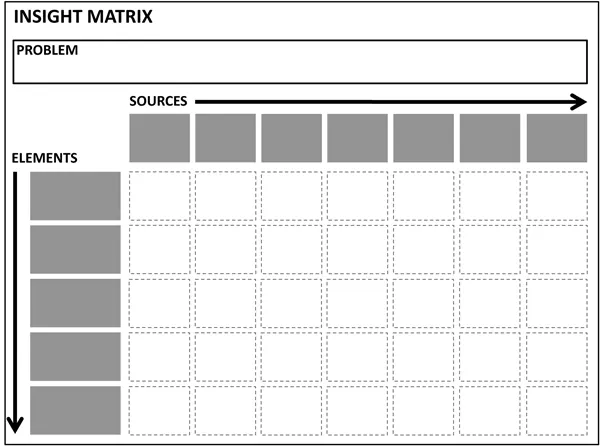
Figure 1.1
Insight matrix.
These first two parts of creative strategy—stating the problem and its elements—need not take much time, but you must do them well and with the right people. This is where rapid appraisal comes in. It’s a set of iterative interview and research techniques that gain insight into a complex problem. The interviewees must include the leaders who will ultimately decide what innovation to pursue in addition to the leaders who will take the lead in pursuing it. These are sometimes the same person, sometimes two people, sometimes more. In complex si...
Table of contents
- Cover
- Half title
- Title
- Copyright
- Dedication
- Contents
- Introduction
- Part I: Creative Strategy from the Inside
- Part II: Creative Strategy from the Outside
- Part III: References
- Acknowledgments
- Bibliography
- Index
Trusted by 375,005 students
Access to over 1.5 million titles for a fair monthly price.
Study more efficiently using our study tools.
Frequently asked questions
Yes, you can cancel anytime from the Subscription tab in your account settings on the Perlego website. Your subscription will stay active until the end of your current billing period. Learn how to cancel your subscription
No, books cannot be downloaded as external files, such as PDFs, for use outside of Perlego. However, you can download books within the Perlego app for offline reading on mobile or tablet. Learn how to download books offline
Perlego offers two plans: Essential and Complete
- Essential is ideal for learners and professionals who enjoy exploring a wide range of subjects. Access the Essential Library with 800,000+ trusted titles and best-sellers across business, personal growth, and the humanities. Includes unlimited reading time and Standard Read Aloud voice.
- Complete: Perfect for advanced learners and researchers needing full, unrestricted access. Unlock 1.5M+ books across hundreds of subjects, including academic and specialized titles. The Complete Plan also includes advanced features like Premium Read Aloud and Research Assistant.
We are an online textbook subscription service, where you can get access to an entire online library for less than the price of a single book per month. With over 1.5 million books across 990+ topics, we’ve got you covered! Learn about our mission
Look out for the read-aloud symbol on your next book to see if you can listen to it. The read-aloud tool reads text aloud for you, highlighting the text as it is being read. You can pause it, speed it up and slow it down. Learn more about Read Aloud
Yes! You can use the Perlego app on both iOS and Android devices to read anytime, anywhere — even offline. Perfect for commutes or when you’re on the go.
Please note we cannot support devices running on iOS 13 and Android 7 or earlier. Learn more about using the app
Please note we cannot support devices running on iOS 13 and Android 7 or earlier. Learn more about using the app
Yes, you can access Creative Strategy by William Duggan in PDF and/or ePUB format, as well as other popular books in Business & Business Strategy. We have over 1.5 million books available in our catalogue for you to explore.