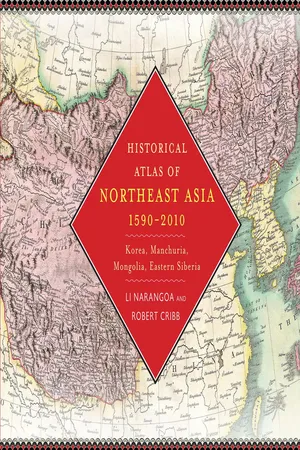
Four hundred years ago, indigenous peoples occupied the vast region that today encompasses Korea, Manchuria, the Mongolian Plateau, and Eastern Siberia. Over time, these populations struggled to maintain autonomy as Russia, China, and Japan sought hegemony over the region. Especially from the turn of the twentieth century onward, indigenous peoples pursued self-determination in a number of ways, and new states, many of them now largely forgotten, rose and fell as great power imperialism, indigenous nationalism, and modern ideologies competed for dominance.
This atlas tracks the political configuration of Northeast Asia in ten-year segments from 1590 to 1890, in five-year segments from 1890 to 1960, and in ten-year segments from 1960 to 2010, delineating the distinct history and importance of the region. The text follows the rise and fall of the Qing dynasty in China, founded by the semi-nomadic Manchus; the Russian colonization of Siberia; the growth of Japanese influence; the movements of peoples, armies, and borders; and political, social, and economic developments—reflecting the turbulence of the land that was once the world's "cradle of conflict." Compiled from detailed research in English, Chinese, Japanese, French, Dutch, German, Mongolian, and Russian sources, the Historical Atlas of Northeast Asia incorporates information made public with the fall of the Soviet Union and includes fifty-five specially drawn maps, as well as twenty historical maps contrasting local and outsider perspectives. Four introductory maps survey the region's diverse topography, climate, vegetation, and ethnicity.
eBook - ePub
Historical Atlas of Northeast Asia, 1590-2010
Korea, Manchuria, Mongolia, Eastern Siberia
- English
- ePUB (mobile friendly)
- Available on iOS & Android
eBook - ePub
Historical Atlas of Northeast Asia, 1590-2010
Korea, Manchuria, Mongolia, Eastern Siberia
About this book

1590–1600
IN 1592, THE JAPANESE MILITARY RULER Toyotomi Hideyoshi, who had recently brought peace to Japan after the Warring States period, ambitiously planned to conquer the Asian mainland and displace the Ming rulers of China. Japanese troops landed in Busan and soon overwhelmed the whole of Joseon, except for Jeolla. The Joseon rulers, influenced by Neo-Confucian emphasis on good governance, had allowed the army to deteriorate, and Joseon was poorly prepared to resist the Japanese. At sea, though, the Joseon admiral Yi Sunshin had ironclad “turtle ships” built, and he defeated Japanese forces in several battles off the southern coast, especially at Hansan Island. These operations cut Japanese supply lines and seriously weakened the invasion forces. On land, the Korean forces defeated the Japanese at Haengju and Jinju. A Ming army came to the assistance of the Koreans and captured Pyongyang, but was defeated near Hanyang. By mid-1593, attacks by the Ming armies and Korean militias on land had forced the Japanese armies back to Busan, while Japanese and Ming diplomats negotiated a possible settlement without success. The attack left Joseon devastated. A vast number of buildings were in ruins, government records were destroyed, more than half the arable fields were abandoned, and many Korean craftsmen were carried off to Japan.1 The destruction of records made it difficult for the government to collect taxes, and it began to sell titles and official positions. The need to invest in defense added further to the burden on the peasants. In 1596, when the last Japanese troops left Korea, a major rebellion broke out near Hanyang.
In 1597, Hideyoshi launched a second attack. This time, the Koreans were better prepared and Ming assistance came more rapidly, so the Japanese occupation was confined to the Gyeongsang and Jeolla regions. The Korean navy defeated the Japanese in the Battle of Myeongnyang Strait, and the Japanese troops withdrew in 1598 after the death of Hideyoshi. The invasions from Japan were the first major wars in Northeast Asia in which firearms played a large role. The Chinese troops remained in occupation after the Japanese withdrawal in case of a counterattack.2 Devastating for Joseon, the wars also put a heavy strain on the Ming, draining resources and distracting them from the growing threat of the Jianzhou under their emerging leader, Nurhaci.

At the time of Hideyoshi’s first invasion of Korea, Nurhaci had offered to join the Ming expedition to support Joseon. Increasingly, however, he presented himself to the people of the Manchurian Plain as a stern avenger of Ming excesses in the region. In 1593, Nurhaci defeated an attack by an alliance of Hulun Jurchen and Khorchin Mongols at the Battle of Gure.3 Thereafter, he deftly wove a network of alliances with Jurchen and nearby Mongol groups. In 1599, Nurhaci adopted a form of the Mongol script for writing the Jurchen language.4
The delay of the Ming in responding to Hideyoshi’s first invasion was partly due to their being distracted by a Mongol revolt in Ningxia. Throughout the Ming dynasty, the main security concern of the Chinese court was that the Mongols would again coalesce into an empire and sweep southward. To avoid this possibility, they launched periodic raids against the Mongols, maintained walls, and recruited Mongols to serve as border guards. In 1590, the border was troubled by three Mongol leaders in Ordos, Chürüke, Bushugtu, and Khulaci, who repeatedly raided to the south. Against such threats, the Ming had recruited a Chakhar Mongol military leader named Pubei to organize resistance to the attacks, but in 1592 he played a major role in a revolt in Ningxia that mobilized the rhetoric of Mongol empire, though it was triggered by the failure of Ming officials to pay wages to Pubei’s troops. The rebellion failed to win significant support from the Ordos Mongols and was brutally suppressed.5
In 1594, Barga Khori, who had been been living to the east of the Greater Khinggan Range, fled from the domination of Daur chiefs and settled in the area of the Onon and Nercha rivers.6
1600–1610
AFTER TOKUGAWA IEYASU took power in Japan in 1600, he opened diplomatic negotiations with Joseon to exchange prisoners of war and restore peace. The two sides concluded a treaty in 1609. The reconstruction of Joseon after the Japanese invasions was primarily in the hands of Crown Prince Gwanghaegun (r. 1608–1623), son of the aging king Seonjo (r. 1567–1608). He was an effective administrator, but his position was weakened by his status as the younger son of a concubine. When he finally succeeded his father in 1608, he consolidated his rule by killing many factional rivals. He reintroduced the system of population registration known as hopae as a means of social control and began to develop the Korean army in the face of the potential threat from the Jurchen in the north. In 1605, he had sent an expedition north of the Tumen River and destroyed the Holjaon community of Jurchen.7 He also encouraged maritime trade with China and maintained a post at Gyeongwon for trade with the Jurchen.8
The fate of most of the Jurchen, however, was to be incorporated into the growing realm of Nurhaci, whose capital was at Fe Ala. He defeated the Hulun in a series of campaigns, and then subjugated the Hada in 1601 and the Hoifa in 1607. Nurhaci was also adept at recruiting support among the Mongols to the west, especially by arranging strategic marriages. Nine of Nurhaci’s fourteen daughters married Mongol princes, especially from the Kharachin and the Khorchin. These alliances increasingly marked him as more than a regional chieftain; in 1607, a delegation from the Five Khalkha addressed him for the first time as khan, the title of the revered Chinggis (r. 1206–1227) and the Mongol–Manchu term used for the Ming emperor.9
As his realm expanded, Nurhaci reformed his system of military organization. Following the method used by Chinggis Khan, he replaced the former structure of small units of ten to twelve warriors based on kinship ties with larger mixed companies (niru), grouped into battalions (jalan), which in turn formed four banners (gusa), each assigned its own color (yellow, white, blue, and red).10
An important element in Nurhaci’s military success was his command of the trade in ginseng (Panax spp.). Although Ming imperial ideology insisted that China need not import anything, ginseng was much in demand and was worth its weight in silver in the markets of northern China. The Ming rulers’ concern that ginseng was a source of revenue for Nurhaci’s expansion and Nurhaci’s concern about the intrusion of Chinese ginseng collectors into Jurchen territory led to enduring tension. In 1609, the local Ming military commander banned the trade, leaving vast amounts of ginseng to rot.11

Nurhaci’s main rival in Northeast Asia was the Chakhar Mongol ruler Ligdan Khan, who came to power in 1604. He was a descendant of Chinggis Khan and reputedly held the great seal that the former Mongol (Yuan) rulers had brought back to Mongolia when they gave up their imperial ambitions in China in 1368. The early years of the Ligdan Khan’s rule were marked by a strong promotion of Buddhism among the Mongols, and he soon began to take seriously his status as heir of Chinggis Khan, claiming the allegiance of all the Mongols.12 Despite this claim, Ligdan’s authority among the Khalkha in the north and the Khorchin, Kharachin, and other Mongol groups in the east and southeast grew steadily weaker.
In 1609, a Khalkha chief, Sholoi Ubashi Hongtaiji, drove the Oirats out of the Uvs Nuur region and took the title khan, founding what the Russians later called the Altan Khanate. (He is sometimes called the Khotogoit Altan Khan to distinguish him from the earlier Tümet Altan Khan.) His military ambitions were aimed mainly to the west, against the Oirat confederation, which had been under the Khalkha domination.13
Meanwhile, in the far northwest of the region, the first signs appeared of a new power whose presence would transform Northeast Asia profoundly over the next four centuries. Pushing their way across the West Siberian Plain came Russians in search of furs. Russia Proper lay far to the west, beyond the Ural Mountains, but over four decades from 1581, the whole of the Siberian Plain fell under Russian hegemony. The initial motivation for this expansion was the search for furs, especially sable (Martes zibellina), which fetched huge prices in the markets of prosperous western Europe. The frenzy of hunting brought dramatic political changes in its wake. Like the Spanish conquistadors in the Americas, the Russian Cossacks who searched for furs brought superior weaponry, which enabled them to impose their will on indigenous communities. They carried with them the authority of a distant monarch, the tsar, who gave them the loose authority to levy tribute (yasak) from the local peoples but who did nothing to restrict their excesses. Russian domination was catastrophic for the indigenous peoples, enslaved to provide labor a...
Table of contents
- Cover
- Title Page
- Copyright
- Contents
- Acknowledgments
- Methodology and Sources
- Terminology and Spelling
- List of Abbreviations
- Introduction Northeast Asia
- Part I: 1590–1700
- Part II: 1700–1800
- Part III: 1800–1900
- Part IV: 1900–2010
- Appendix A. Historical Maps
- Appendix B. Gazetteer
- Bibliography
- Map Sources
- Index
Trusted by 375,005 students
Access to over 1.5 million titles for a fair monthly price.
Study more efficiently using our study tools.
Information
Publisher
Columbia University PressYear
2014Topic
Physical SciencesSubtopic
Asian HistoryeBook ISBN
9780231537162
Frequently asked questions
Yes, you can cancel anytime from the Subscription tab in your account settings on the Perlego website. Your subscription will stay active until the end of your current billing period. Learn how to cancel your subscription
No, books cannot be downloaded as external files, such as PDFs, for use outside of Perlego. However, you can download books within the Perlego app for offline reading on mobile or tablet. Learn how to download books offline
Perlego offers two plans: Essential and Complete
- Essential is ideal for learners and professionals who enjoy exploring a wide range of subjects. Access the Essential Library with 800,000+ trusted titles and best-sellers across business, personal growth, and the humanities. Includes unlimited reading time and Standard Read Aloud voice.
- Complete: Perfect for advanced learners and researchers needing full, unrestricted access. Unlock 1.5M+ books across hundreds of subjects, including academic and specialized titles. The Complete Plan also includes advanced features like Premium Read Aloud and Research Assistant.
We are an online textbook subscription service, where you can get access to an entire online library for less than the price of a single book per month. With over 1.5 million books across 990+ topics, we’ve got you covered! Learn about our mission
Look out for the read-aloud symbol on your next book to see if you can listen to it. The read-aloud tool reads text aloud for you, highlighting the text as it is being read. You can pause it, speed it up and slow it down. Learn more about Read Aloud
Yes! You can use the Perlego app on both iOS and Android devices to read anytime, anywhere — even offline. Perfect for commutes or when you’re on the go.
Please note we cannot support devices running on iOS 13 and Android 7 or earlier. Learn more about using the app
Please note we cannot support devices running on iOS 13 and Android 7 or earlier. Learn more about using the app
Yes, you can access Historical Atlas of Northeast Asia, 1590-2010 by Narangoa Li,Robert Cribb in PDF and/or ePUB format, as well as other popular books in Physical Sciences & Asian History. We have over 1.5 million books available in our catalogue for you to explore.