In the middle of the fourteenth century, the Franciscan friar John of Rupescissa sent a dramatic warning to his followers: the last days were coming; the apocalypse was near. Deemed insane by the Christian church, Rupescissa had spent more than a decade confined to prisons—in one case wrapped in chains and locked under a staircase—yet ill treatment could not silence the friar's apocalyptic message.
Religious figures who preached the end times were hardly rare in the late Middle Ages, but Rupescissa's teachings were unique. He claimed that knowledge of the natural world, and alchemy in particular, could act as a defense against the plagues and wars of the last days. His melding of apocalyptic prophecy and quasi-scientific inquiry gave rise to a new genre of alchemical writing and a novel cosmology of heaven and earth. Most important, the friar's research represented a remarkable convergence between science and religion.
In order to understand scientific knowledge today, Leah DeVun asks that we revisit Rupescissa's life and the critical events of his age—the Black Death, the Hundred Years' War, the Avignon Papacy—through his eyes. Rupescissa treated alchemy as medicine (his work was the conceptual forerunner of pharmacology) and represented the emerging technologies and views that sought to combat famine, plague, religious persecution, and war. The advances he pioneered, along with the exciting strides made by his contemporaries, shed critical light on later developments in medicine, pharmacology, and chemistry.
eBook - ePub
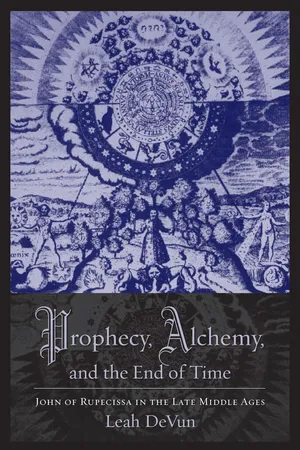
Prophecy, Alchemy, and the End of Time
John of Rupescissa in the Late Middle Ages
- English
- ePUB (mobile friendly)
- Available on iOS & Android
eBook - ePub
About this book
Information
Subtopic
European Medieval HistoryIndex
HistoryOne
INTRODUCTION
From the confines of his prison cell in the mid-fourteenth century, the Franciscan friar and alchemist John of Rupescissa boldly predicted the destruction of the society that held him captive. Rupescissa (also called Jean de Roquetaillade or Rochetaillade) was born around 1310 near the town of Aurillac, in the region of southern France known as the Auvergne.1 By the age of roughly forty-six, when he wrote his Liber ostensor quod adesse festinant tempora (The Book That Shows That the Times Are Soon to Be at Hand), he was a tireless predictor of the apocalypse and a thorn in the side of the church.2 By 1356, Rupescissa had already been imprisoned for more than a decade: he was bound in chains, locked under a staircase in the hopes he might die quietly, even declared a fantasticus—a foolish or insane person—by the highest juridical body in the Christian church, the papal court at Avignon. But all of this poor treatment in no way deterred Rupescissa from spreading his message. The last days were coming; the horrors of Antichrist were about to begin.
Although some members of the high clergy supported Rupescissa, his apocalyptic tendencies were hardly welcomed by the majority of his superiors in the Franciscan order and the larger church. During a hearing before the papal curia in 1354, Rupescissa’s examiner was openly skeptical, ridiculing Rupescissa and throwing his books to the ground. According to Rupescissa’s account in the Liber ostensor, the judges asked how he could presume to know the future when the many learned doctors of the church did not. The friar answered defiantly that a person had to be “whitened” and “dyed” in order to understand divine secrets.3 The years of persecution and imprisonment he suffered at the hands of the church, Rupescissa argued, actually primed him to receive supernatural gifts from God. He explained:
Those who have been obligated to capture secrets [in the past] had to be cooked in the fire of many tribulations; therefore, [as Isaiah] says, “and just like fire they were proved.” For nearly twelve years now I have been cooked in prison cells, and the fiery boilings do not cease, but continually burn hotter against me…. And therefore it pleases God to reveal to me—“fantastic” and insane—the secret.4
Rupescissa went on to claim that he had secret knowledge of the events of the apocalyptic crisis, including the dates of apocalyptic floods, plagues, wars, and, ultimately, the appearance of Antichrist himself. He also offered innovative and highly inflammatory predictions about the identity of Antichrist and the duration of the millennium that would follow his reign.
Rupescissa’s obsession with apocalypticism had roots in the tragedies of his lifetime. The Great Famine, the Black Death, and the Hundred Years War between England and France were terrible events that transformed Western Europe and prompted intense spiritual reflection among observers. The apocalyptic scenes described in Christian prophecy, particularly those in St. John’s Apocalypse, appeared hauntingly similar to contemporary events. Apocalyptic spirituality thus became for many, including Rupescissa, a way to understand the natural and political disasters they witnessed. For Rupescissa, it also gave meaning to his own personal disasters—his humiliating arrest and many years of imprisonment. He came to view the events of his lifetime as an apocalyptic storm with his own trials at its center. The dramatic episodes of his day were predicted by astrology and prophecy; his persecution paralleled that of the martyrs and prophets of the past.
But Rupescissa’s statement to the curia at his 1354 hearing hints at something more than his penchant for apocalypticism and self-aggrandizement: his language of boiling, cooking, and proving also evokes the traditional process of an alchemical transmutation. According to Rupescissa, humans who wished to understand prophetic secrets were tested by the heat of flames and transformed by whitening and dying. Purgatorial cleansing by fire was a standard biblical image, but Rupescissa’s language brings to mind the alchemical purifications so important to two of his other writings, the Liber lucis (Book of Light, c. 1350) and the Liber de consideratione quinte essentie omnium rerum (Book on the Consideration of the Quintessence of All Things, 1351–1352), both manuals aimed at combating apocalyptic disasters through alchemy.5 The images that Rupescissa selected to describe his life in the Liber ostensor—the cooking, the whitening, the proving—were thus highly significant, for alchemy was central to Rupescissa’s apocalyptic message. Rupescissa claimed that humans could weather the apocalypse by using metals and medicines made with alchemy. Furthermore, Rupescissa found in Christian eschatology ideas that helped him both to understand alchemy and to explain it to his readers through metaphors borrowed from religion.
Much as Rupescissa lamented the scant attention paid to his recommendations by church authorities in the fourteenth century, modern scholars might now lament how few published works on Rupescissa have appeared in recent decades, making him one of the most underappreciated figures in the history of science. Rupescissa has been credited by scholars such as Robert P. Multhauf and Robert Halleux, among others, with the invention of “medical chemistry,” a genre of early modern alchemical literature devoted to human health, now considered the conceptual forerunner of pharmacology.6 It is clear that Rupescissa was responsible for at least two significant innovations: first, he invented the “quintessence,” an extremely influential alcohol-based medicine that overturned conventional wisdom about the human body and the cosmos. Second, he seems to have been the first to argue that a vital, heavenly principle could be distilled from different herbs, animal products, and minerals (particularly gold, mercury, vitriol, and antimony) to produce different internal medicines suited to different diseases. While alchemy was used for medicinal purposes (particularly external medicine) at least as early as the thirteenth century, Rupescissa’s systematic treatise on the application of inorganic materials to internal medicine more closely resembles texts of a much later period.7 In fact, Rupescissa’s theories had enormous consequences for the development of alchemical and materia medica tracts in the early modern period. Classic alchemical and distillation works of the sixteenth century, including those by Hieronymous Brunschwygk, Philipp Ulstad, Paracelsus, and Andreas Libavius borrowed heavily from Rupescissa’s ideas on distillation and the quintessence and extended them in new directions.8 Historians of science are now especially interested in these early modern alchemists, whose experiments they view as crucial to the development of modern chemistry. Yet many alchemical concepts and techniques traditionally attributed to early modern alchemists—for instance, the production of medicinal mineral acids and the use of gold in circulated alcohol—already appear in Rupescissa’s texts.
But Rupescissa’s significance is not only his influence on later generations. His program of alchemy and prophecy allows us insight into the world of the fourteenth century. While modern historians interpret theology, natural philosophy, and medicine, among other subjects, as distinct disciplines, Rupescissa’s intellectual system suggests that such boundaries were not shared—or at least not shared in the same way—by those who lived in the late Middle Ages. Rupescissa’s alchemy was a religious endeavor and a thoroughly Christian science. His writings situated Greco-Roman natural philosophy and Arab alchemy squarely within the context of Christian apocalyptic time and history. According to Rupescissa, humanity’s knowledge of alchemy would reach its apogee during the period of the Christian last days, in which alchemy would play a crucial role that would legitimate its study. In addition, alchemy could intervene in the cosmic events of the apocalyptic crisis through the reenactment of the central episodes of Christian history: the incarnation, the crucifixion, and the resurrection. Rupescissa’s synthetic vision of Christian alchemy offers historians a new way of viewing both religion and naturalism. His multifaceted approach to the problem of the apocalyptic crisis—encompassing prophetic exegesis, metal transmutation, astrology, and alchemical medicine—should surely give pause to those who would assume the stability of such disciplinary categories across time.
Rupescissa also offers an important perspective on the attitudes of those who encountered the uncertainties of the late Middle Ages. Rupescissa’s writings emphasize the power of human agency to affect the course of history. Rupescissa imagined a version of the last days in which human beings could use prophecy and naturalist knowledge to actively engage with and successfully battle Antichrist and the disasters that would accompany his reign. Rupescissa was apparently the first to argue that humankind could survive this apocalyptic crisis and populate the postapocalyptic millennium, which would endure for a literal one thousand years. In addition, he claimed that such survivors could use the art of alchemy to access the perfection of the superlunary sphere and channel its heavenly effects onto earth. The catastrophes of Rupescissa’s lifetime could well have inspired a pessimistic outlook in which individual action was deemed fruitless. Yet for Rupescissa, disaster entailed an obligation for Christians to fight using every possible weapon in their arsenal. Furthermore, he believed that in such a battle they would be victorious.
Rupescissa’s alchemical and apocalyptic innovations, and how he came to imagine them, are the focus of this study. Guided by predictions of the end in biblical and “Joachite” prophecy, Rupescissa devised a plan for human beings to escape what he called the “infelicities of nature”—that is, disease, aging, and even death—through alchemy. Rupescissa’s immersion in apocalyptic spirituality led him to believe that human bodies could be perfected by a process of purgation and redemption that mirrored apocalyptic prophetic narratives. According to his vision, everything on earth contained within it a “quintessence,” a kernel of heavenly perfection that could be distilled and used as a medicine, improving human bodies to the point of near-immortality. His claim constituted a challenge to the most basic tenets of medieval medicine and natural philosophy. Despite his iconoclastic approach to received wisdom about the human body and the universe, contemporary scholastic discussions of medicine and natural philosophy deeply influenced Rupescissa’s understanding of natural processes—and how they might be overturned through alchemy.
In recent decades, our knowledge of alchemy has been greatly enhanced by research in the history of science. In response to earlier scholarship that judged alchemy to be a “pseudoscience,” a hindrance to the progress of chemistry not worthy of serious study, a new generation of scholars has called for a reevaluation of alchemy because of its significance to premodern religious, intellectual, and cultural trends. Excellent work has been done on individual alchemists or alchemical texts by historians such as Chiara Crisciani, Michela Pereira, William Newman, and Barbara Obrist, who have attempted to place specific theorists within a broader history of medicine and natural philosophy.9 Recent studies have also explored the mutually beneficial relationship between alchemy and artisanal traditions, which promoted both technological innovation and the documentation of oral traditions.10 Scholars of early modern alchemy such as Betty Jo Teeter Dobbs and Lawrence Principe have similarly attempted to recast alchemy as crucial to the thought of such iconic figures as Isaac Newton and Robert Boyle, rather than as a misstep in a teleological history of science.11
Such studies have made it possible to assess John of Rupescissa’s historical context, as well as his contribution to the discipline of alchemy. As I noted, scholars such as Multhauf and Halleux have deemed Rupescissa the originator of “medical chemistry,” and they have linked his ideas to the emergence of Paracelsian therapeutics in the sixteenth century. Their work is invaluable for situating Rupescissa within the history of alchemy and medicine, yet they have tended to dismiss Rupescissa’s religious writings as unrelated to his scientific ideas. As a result, they have failed to notice much of the complexity of his alchemy, which derived from the different intellectual and spiritual traditions that informed his theory.12 Historians of religion, such as Robert E. Lerner, Jeanne Bignami-Odier, Marjorie Reeves, and André Vauchez, have similarly produced admirable studies that place Rupescissa’s prophecy within a long-standing tradition of apocalyptic hermeneutics.13The growing number of studies of Rupescissa’s apocalypticism over the last two decades has signaled a resurging interest in his life and legacy. But these analyses have not considered his alchemical writings, and thus they have not addressed the centrality of nature to his reading of salvation history. This book will put John of Rupescissa back together: rather than citing him within separate histories of science and religion, it will evaluate the different aspects of naturalist and religious thought that operate within his work. My purpose is to show that spirituality and naturalism need not be discussed in isolation from each other. Only an integrated approach can account for the multiple bodies of knowledge that intersect with one another and inflect one another in Rupescissa’s writings.14
Because I intend this book to be accessible to those interested in the history of science and the history of Christianity, I discuss medieval naturalist and apocalyptic concepts in detail in order to demonstrate the originality and significance of Rupescissa’s ideas. Some of the material that I include will be familiar to specialists, although because my approach and my emphasis are new, so too are my conclusions. In chapters 2 and 3, I place Rupescissa’s life and work within the context of various late-antique and medieval apocalyptic traditions, and I demonstrate how his eschatological views arose from developments in the “Franciscan Spiritual” conflict of the thirteenth and early fourteenth centuries. During this period, the apocalyptic writings of Joachim of Fiore (c. 1135–1202) inspired great enthusiasm among Franciscan friars, who expected the appearance of Antichrist and the establishment of a “third state,” an earthly paradise that would follow the apocalyptic crisis and preface the end of time. Joachite and Franciscan Spiritual prophecy suggested an active role for human intervention in the apocalyptic drama by opposing Antichrist and shaping the future millennial age. Rupescissa found in this textual tradition evidence both that the crisis was near and that humankind had an opportunity (and an obligation) to participate in a historic battle between Christ and Antichrist. These assumptions led Rupescissa to turn to alchemy as a solution to the apocalyptic disasters at hand.
In chapters 4 and 5, I analyze Rupescissa’s alchemical theory, particularly his idea of the “quintessence.” Chapter 4 demonstrates the ways in which Rupescissa drew from Aristotelian natural philosophy and Galenic medicine in order to formulate the quintessence, an alchemical remedy that challenged conventional assumptions about both the human body and the order of nature. According to Rupescissa, the quintessence obeyed the rules of a higher level of “perfected nature,” which also regulated the celestial bodies of the superlunary sphere. Alchemy thus allowed a piece of “heaven” to enter earth, healing disease and prolonging the lives of corruptible human bodies. Chapter 5 enriches this picture by considering the writings attributed to three well-known naturalist authors, Roger Bacon (1214–1292), Arnald of Vilanova (c. 1240–1311), and Ramón Llull (c. 1232–1316). My discussion shows how each author constructed the science of alchemy as it was known to Rupescissa. This genealogy of sources reconstructs the development of the quintessence and establishes the novelty of Rupescissa’s alchemical thought.
Chapter 6 focuses closely on the language of Rupescissa’s two alchemical manuals, the Liber lucis and De consideratione quinte essentie omnium rerum (hereafter, De quinta essentia). I evaluate the context and consequences of Rupescissa’s use of code names, metaphors, and similes (invoking heaven, Christ, the crucifixion, and the resurrection, among other images) to describe alchemical processes. I examine Rupescissa’s choice of imagery alongside images in other texts of the period, including those of theological doctrine and devotional literature. I argue that in such figurative language we are able to see the deep structural relationship between Rupescissa’s apocalyptic and alchemical systems. This section of the book represents a new approach to the much-studied topic of alchemical imagery. My focus upon Rupescissa’s imagery allows us to see alchemy neither in terms of Jungian symbol nor as a precursor to chemistry but rather as an element of fourteenth-century religious reform.
Finally, chapter 7 focuses on alchemy and astrology as naturalist technologies to intervene in salvation history. According to Rupescissa, nature was destined to play a central role in the apocalyptic crisis to come. Through astrology, human beings could read the “Book of Nature” to discover hidden apocalyptic prophecy; through alchemy, they could raise the corrupted state of terrestrial nature to a higher level of perfection, paving the way for a millennial state on earth. Rupescissa’s assertion that the Book of Nature and the Book of Scripture were parallel sources of religious truth constitutes an early version of a doctrine that was to become commonplace in the natural theology of the seventeenth, eighteenth, and nineteenth centuries. The origins of this view are often located by scholars in the revival of Neoplatonism and Hermetism during the Renaissance by humanists such as Marsilio Ficino. Yet Rupescissa’s sentiments—expressed a century earlier—point to the development of early modern approaches to God and nature in the apocalyptic context of the late Middle Ages.
Because religion was such a pervasive aspect of medieval life, historians of science have generally dismissed religious language in alchemy as not particularly significant. As a result, scholars have not studied carefully the specific religious terminology that is so obtrusive and characteristic a part of medieval alchemy. In contrast, this study will demonstrate that such language was critical to the genesis and communication of naturalist ideas during the Middle Ages. Scholars of modern science now believe that metaphors are an inescapable means by which scientists and their audiences conceive and construct th...
Table of contents
- Cover
- Half title
- Title
- Copyright
- Dedication
- Contents
- List of Illustrations
- Acknowledgments
- 1. Introduction
- 2. The Proving of Christendom
- 3. John of Rupescissa’s Vision of the End
- 4. Alchemy in Theory and Practice
- 5. Artists and the Art
- 6. Metaphor and Alchemy
- 7. The End of Nature
- 8. Conclusion
- Notes
- Bibliography
- Index
Trusted by 375,005 students
Access to over 1.5 million titles for a fair monthly price.
Study more efficiently using our study tools.
Frequently asked questions
Yes, you can cancel anytime from the Subscription tab in your account settings on the Perlego website. Your subscription will stay active until the end of your current billing period. Learn how to cancel your subscription
No, books cannot be downloaded as external files, such as PDFs, for use outside of Perlego. However, you can download books within the Perlego app for offline reading on mobile or tablet. Learn how to download books offline
Perlego offers two plans: Essential and Complete
- Essential is ideal for learners and professionals who enjoy exploring a wide range of subjects. Access the Essential Library with 800,000+ trusted titles and best-sellers across business, personal growth, and the humanities. Includes unlimited reading time and Standard Read Aloud voice.
- Complete: Perfect for advanced learners and researchers needing full, unrestricted access. Unlock 1.5M+ books across hundreds of subjects, including academic and specialized titles. The Complete Plan also includes advanced features like Premium Read Aloud and Research Assistant.
We are an online textbook subscription service, where you can get access to an entire online library for less than the price of a single book per month. With over 1.5 million books across 990+ topics, we’ve got you covered! Learn about our mission
Look out for the read-aloud symbol on your next book to see if you can listen to it. The read-aloud tool reads text aloud for you, highlighting the text as it is being read. You can pause it, speed it up and slow it down. Learn more about Read Aloud
Yes! You can use the Perlego app on both iOS and Android devices to read anytime, anywhere — even offline. Perfect for commutes or when you’re on the go.
Please note we cannot support devices running on iOS 13 and Android 7 or earlier. Learn more about using the app
Please note we cannot support devices running on iOS 13 and Android 7 or earlier. Learn more about using the app
Yes, you can access Prophecy, Alchemy, and the End of Time by Leah DeVun in PDF and/or ePUB format, as well as other popular books in History & European Medieval History. We have over 1.5 million books available in our catalogue for you to explore.