Some postcolonial theorists argue that the idea of a single system of belief known as "Hinduism" is a creation of nineteenth-century British imperialists. Andrew J. Nicholson introduces another perspective: although a unified Hindu identity is not as ancient as some Hindus claim, it has its roots in innovations within South Asian philosophy from the fourteenth to seventeenth centuries. During this time, thinkers treated the philosophies of Vedanta, Samkhya, and Yoga, along with the worshippers of Visnu, Siva, and Sakti, as belonging to a single system of belief and practice. Instead of seeing such groups as separate and contradictory, they re-envisioned them as separate rivers leading to the ocean of Brahman, the ultimate reality.
Drawing on the writings of philosophers from late medieval and early modern traditions, including Vijnanabhiksu, Madhava, and Madhusudana Sarasvati, Nicholson shows how influential thinkers portrayed Vedanta philosophy as the ultimate unifier of diverse belief systems. This project paved the way for the work of later Hindu reformers, such as Vivekananda, Radhakrishnan, and Gandhi, whose teachings promoted the notion that all world religions belong to a single spiritual unity. In his study, Nicholson also critiques the way in which Eurocentric concepts—like monism and dualism, idealism and realism, theism and atheism, and orthodoxy and heterodoxy—have come to dominate modern discourses on Indian philosophy.
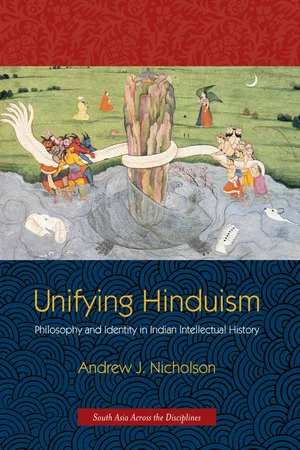
eBook - ePub
Unifying Hinduism
Philosophy and Identity in Indian Intellectual History
- English
- ePUB (mobile friendly)
- Available on iOS & Android
eBook - ePub
About this book
Information
Topic
PhilosophySubtopic
Indian & South Asian History
[1] INTRODUCTION
CONTESTING THE UNITY OF HINDUISM
The word “Hinduism” is loaded with historical and political resonances. Like such comparable terms as Buddhism, Sikhism, Confucianism, and Taoism, this word is a site of contestation, with proponents and detractors, open to varied interpretations. In this introduction I briefly sketch two opposing and influential contemporary interpretations of Hinduism, both of which I believe have significant weaknesses.
The first, often enunciated by Hindus themselves, is that Hinduism is the modern term for what was known in earlier times as the eternal religion (sanātana dharma) described in such texts as the Bhagavad Gītā and the Vedas.1 Properly speaking, it has no history. Although historians today attempt with some degree of success to chronicle the poets and philosophers who found new ways of expressing the truths of Hinduism, the essence of this religion has remained the same since the very beginning of Indian civilization, thousands or even tens of thousands of years ago. In this regard, Hinduism is different from Christianity and Islam, two traditions founded relatively recently by single individuals which have undergone extensive changes in response to world-historical events.
In the second, partly as a response to this portrayal, some scholars of modern history, anthropology, and postcolonial studies have argued that a unified set of beliefs and practices known as Hinduism did not exist before the nineteenth century. According to this narrative, British scholars closely aligned with Britain’s imperial project looked for an Indian analogue to the Western religions that they already knew. But after arriving in India and finding a multitude of popular rites without any unifying philosophical or theological framework, “the first British scholars of India went so far as to invent what we now call ‘Hinduism,’ complete with a mainstream classical tradition consisting entirely of Sanskrit philosophical texts like the Bhagavad-Gita and the Upanishads.”2 This invention was internalized by the English-educated Indians of the so-called Hindu renaissance, who were in fact elaborating on an entirely new religion that had little to do with the self-understanding of their own ancestors. According to this interpretation, the invention of Hinduism is one particular instance of the widespread tendency toward “the invention of tradition” that was so common among the Victorians.3 Hinduism, far from being the oldest religion in the world, is one of the youngest, if it can really be said to exist at all.
These two stories about the provenance of Hinduism could hardly be more starkly opposed. Critics of the first narrative argue that it is simply an ahistorical fabrication. It is based on a selective reading of ancient texts that ignores the great variety of opposed contradictory beliefs and practices and the complete lack of any notion of a “Hindu unity” that existed before the arrival of the British in India. Conversely, many Hindus see the “modern invention of Hinduism” hypothesis as a slap in the face, the final culmination of Western imperialist scholarship on India, portraying faithful Hindus as passive dupes and Hinduism as nothing more than a fraud perpetrated by the imperialists themselves. I argue that these two general approaches, admittedly introduced here only in broad outline, are tendentious readings based on a modern tendency to homogenize and oversimplify premodern Indian history. The idea of Hindu unity is neither a timeless truth nor a fiction wholly invented by the British to regulate and control their colonial subjects.
The thesis of this book is that between the twelfth and sixteenth centuries CE, certain thinkers began to treat as a single whole the diverse philosophical teachings of the Upaniṣads, epics, Purāṇas, and the schools known retrospectively as the “six systems” (ṣaḍdarśana) of mainstream Hindu philosophy.4 The Indian and European thinkers in the nineteenth century who developed the term “Hinduism” under the pressure of the new explanatory category of “world religions” were influenced by these earlier philosophers and doxographers, primarily Vedāntins, who had their own reasons for arguing the unity of Indian philosophical traditions. Before the late medieval period, there was little or no systematic attempt by the thinkers we now describe as Hindu to put aside their differences in order to depict themselves as a single unified tradition. After this late medieval period, it became almost universally accepted that there was a fixed group of Indian philosophies in basic agreement with one another and standing together against Buddhism and Jainism.
In pre-twelfth-century India, many thinkers today labeled “Hindu” went to great efforts to disprove one another’s teachings, including use of ad hominem attacks, straw man arguments, and other questionable means. There was no understanding then that all of these thinkers were part of a shared orthodoxy. Nor was there an idea that schools such as Sāṃkhya and Mīmāṃsā had commonalities that differentiated them from the non-Hindu philosophies of the Jainas and Buddhists. Kumārila Bhaṭṭa, the influential seventh-century Mīmāṃsaka, wrote that “the treatises on righteousness and unrighteousness that have been adopted in Sāṃkhya, Yoga, Pāñcarātra, Pāśupata, and Buddhist works … are not accepted by those who know the triple Veda.”5 Likewise, Sāṃkhya and Yoga philosophers faulted Vedāntins and Mīmāṃsakas for their uncritical acceptance of Vedic authority, which included the performance of what they considered immoral animal sacrifices.6 One author of this period, the eleventh-century Śaiva author Somaśambhu, even asserts that Vedāntins, Mīmāṃsakas, and those who worship other gods such as Viṣṇu will be reborn in hells unless they undergo a complicated conversion ritual designed to make them full-fledged Śaivas.7
Later codifiers of Indian traditions sought to depict the “six systems of philosophy” (ṣaḍdarśanas) as sharing a fundamental commitment to the authority of the Veda that unified them as Hindus and made them understand themselves as fundamentally different from Jainas and Buddhists. However, no single, well-demarcated boundary between “affirmers” (āstikas) and “deniers” (nāstikas) existed before the late medieval period. But by the sixteenth century, most Mīmāṃsakas and Vedāntins did understand themselves united in their shared commitment to the Vedas over and against other groups they designated as nāstikas. In this book, I tell the story of this remarkable shift, arguing that the seeds were planted for the now-familiar discourse of Hindu unity by a number of influential philosophers in late medieval India. I give particular attention to one such philosopher, Vijñānabhikṣu, a sixteenth-century polymath who was perhaps the boldest of all of these innovators. According to him, it was not just that all of the philosophies of the āstikas agreed on the sanctity of the Veda. He claimed that, properly understood, Sāṃkhya, Yoga, Vedānta, and Nyāya were in essence different aspects of a single, well-coordinated philosophical outlook and their well-documented disagreements were just a misunderstanding.
Because of Vijñānabhikṣu’s bold rethinking of the relationship between the schools of Indian philosophy, Western scholars have regarded him with suspicion. The nineteenth-century translator and historian Richard Garbe expressed the opinion of many of his colleagues when he wrote that “Vijñānabhikṣu mixes up many … heterogeneous matters, and even quite effaces the individuality of the several philosophical systems.”8 Nonetheless, Garbe considered Vijñānabhikṣu’s works too important to be written off as the idiosyncratic ramblings of a fringe thinker. He describes Vijñānabhikṣu’s commentary on the Sāṃkhyasūtras as “not only the fullest source we have of the Sāṃkhya system, but also one of the most important.”9 More recently, scholars of Yoga have found Vijñānabhikṣu’s subcommentary on Patañjali’s Yogasūtras similarly indispensable for a detailed understanding of the Yoga system of philosophy10
All of the previous scholarly treatments on Vijñānabhikṣu have had in common an approach that understands him only from a single perspective, through the lens of Sāṃkhya, Yoga, or Vedānta.11 They either sidestep the question of the relationship between the three parts of Vijñānabhikṣu’s corpus or are openly hostile to Vijñānabhikṣu’s efforts toward a concordance of philosophical systems. This attitude is based on an uncritical acceptance of a particular model of the relationship between the philosophical schools of India. According to this model, the schools of Indian philosophy are well established and distinct. Most commonly, they list six āstika darśanas (commonly translated “orthodox schools”), without exploring the provenance of this list.12 On the other side are the nāstika schools, the most well known of which are the Buddhists, Jainas, and Cārvāka materialists. Any attempt to blur the divisions between these discrete philosophical schools is condemned as syncretism, an illicit mixture of irreconcilable philosophies.
It is surprising how widespread and influential this understanding of the schools of Indian philosophy remains today. This picture comes from the writings of Indologists of the eighteenth and nineteenth centuries, although these early Indologists did not invent these ideas by themselves. Rather, they adopted for their own purposes the classificatory schemes they found in reading medieval catalogues of doctrines, or doxographies. These doxographies, composed at a relatively late date by authors who were themselves partisan adherents of one or another of the schools they sought to catalogue, were widely accepted by eighteenth- and nineteenth-century Orientalists as objective depictions of a fixed state of affairs. Orientalists extrapolated from these texts the notion that the Indian philosophical schools arose as separate and distinct in ancient times and have remained stable and essentially unchanged for centuries. By comparison, they understood Western philosophical schools as arising, adapting, and going out of existence in historical time, sometimes portrayed as the unfolding of a larger historical dialectic. Much like Marx’s depiction of traditional Indian social life as “undignified, stagnatory, and vegetative,” Orientalists often understood Indian philosophy as existing outside of history. Unlike Marx, however, they understood this ahistoricity as one of the positive features of Oriental wisdom, in contrast to the changeable fads of European intellectuals.13 Hindu reformers of the modern period picked up the Orientalist narrative of premodern India as a timeless realm of philosophical contemplation to serve their own ends. Although modern Hindus continue to take the great antiquity of Indian intellectual traditions as a source of national pride, many have denied the incompatibility of the āstika philosophical schools, instead arguing for a common essence at the heart of all āstika schools.
One of the ironies of the Orientalists’ use of medieval doxographies to show that the schools of philosophy were distinct and logically incompatible is that it was these same doxographies that began to question earlier assumptions about the logical incompatibility of philosophical schools. Vijñānabhikṣu was only one of a number of late medieval intellectuals in India who sought to find unity among the apparent differences of the philosophical schools of the āstikas. Śaṅkara, the influential eighth-century Advaita Vedāntin, issued scathing attacks on āstika and nāstika alike, hardly distinguishing between the two.14 Yet Śaṅkara’s self-proclaimed followers of the late medieval period rehabilitated the same āstika schools that early Vedāntins had scorned, most notably the Sāṃkhya and Yoga schools. The medieval Advaita doxographers Mādhava and Madhusūdana Sarasvatī suggest that such non-Vedāntic schools are useful as partial approximations of a truth only fully enunciated by Advaita Vedānta. Although his allegiances were to a different school of Vedānta, Vijñānabhikṣu is the most outstanding example of this late medieval movement to find unity among the apparent diversity of philosophical schools. None of these unifiers would have described themselves as “Hindus,” a term that was still uncommon in sixteenth-century Sanskrit usage. But it was their unification of āstika philosophies that nineteenth- and twentieth-century reformers drew on when they sought to enunciate a specific set of beliefs for a world religion called “Hinduism.” While some recent scholars have argued that the vision of Hinduism as a single, all-embracing set of beliefs is wholly a modern fabrication, such assertions ignore the historical developments of the late medieval period. In unifying the āstika philosophical schools, Vijñānabhikṣu and his contemporaries made possible the world religion later known by the name Hinduism.
VIJÑĀNABHIKṢU AND HIS LATE MEDIEVAL MILIEU
Like many premodern Indian authors, Vijñānabhikṣu offers little in his works to help identify his time and place. He makes no mention of his teachers or family, nor does he comment on political or historical events. Although there is consensus among historians that he lived in the latter half of the sixteenth century, this dating is itself based on meager evidence.15 Scholars have estimated Vijñānabhikṣu’s dates based on the dates of his disciples, in particular one disciple named Bhāvāgaṇeśa.16 Since Bhāvāgaṇeśa identifies himself as an immediate disciple of Vijñānabhikṣu, and since Bhāvāgaṇeśa’s life span has been estimated from the late sixteenth to the early seventeenth century, it follows that Vijñānabhikṣu’s dates would be slightly earlier, suggesting that he flourished sometime after 1550.17 Scholars have also attempted to locate Vijñānabhikṣu in time based on perceived influences on his philosophy. So, for instance, S. C. Śrīvāstavya puts Vijñānabhikṣu after Sadānanda Vyāsa, author of the Vedāntasāra, and T. S. Rukmani argues that Vijñānabhikṣu was influenced by the Navya-Naiyāyika Raghunātha Śiromaṇi.18 Since Vijñānabhikṣu neither refers to these authors by name nor quotes their works directly, these, too, are admittedly conjectures. Śrīvāstavya also attempts to determine Vijñānabhikṣu’s place of residence based on his occasional references to Prayāga (modern-day Allahabad) and claims based on his analysis of Vijñānabhikṣu’s Sanskrit usage that he was a Hindi speaker.19 Reviewing all the evidence collectively, there is enough to suggest that he lived in northern India in the late medieval period. Tentatively accepting Gode’s arguments regarding Bhāvāgaṇeśa’s identity, I will assume for the purposes of this study that Vijñānabhikṣu lived in approximately the late sixteenth century, perhaps in the vicinity of what is now Uttar Pradesh.
Vijñānabhikṣu is primarily known to modern scholars for his commentaries on texts from the Sāṃkhya and Yoga schools, especially for his commentary on the Sāṃkhyasūtras (the Sāṃkhyapravacanabhāṣya) and his subcommentary on the Yogasūtras (the Yogavārttika). However, his works on Sāṃkhya and Yoga were written after his Vedāntic works, which make up the majority of Vijñānabhikṣu’s extant corpus.20 These works include Vijñānabhikṣu’s commentary on the Brahmasūtras (the Vijñānāmṛtabhāṣya), his commentaries on numerous Upaniṣads (collectively known by the name Vedāntāloka), and his commentary on the Īśvara Gītā section of the Kūrma Purāṇa (entitled Īśvaragītābhāṣya). Vijñānabhikṣu considers these three texts to be his p...
Table of contents
- Cover
- Half title
- Series Page
- Title
- Copyright
- Contents
- Acknowledgments
- Abbreviations
- 1: Introduction
- 2: An Alternative History of Vedānta
- 3: Vijñānabhiksu’s “Difference and Non-difference” Vedānta
- 4: A History of God in Sāṃkhya and Yoga
- 5: Reading Against the Grain of the Sāṃkhyasūtras
- 6: Yoga, Praxis, and Liberation
- 7: Vedānta and Sāṃkhya in the Orientalist Imagination
- 8: Doxography, Classificatory Schemes, and Contested Histories
- 9: Affirmers (Āstikas) and Deniers (Nāstikas) in Indian History
- 10: Hindu Unity and the Non-hindu Other
- Notes
- Bibliography
- Index
Trusted by 375,005 students
Access to over 1.5 million titles for a fair monthly price.
Study more efficiently using our study tools.
Frequently asked questions
Yes, you can cancel anytime from the Subscription tab in your account settings on the Perlego website. Your subscription will stay active until the end of your current billing period. Learn how to cancel your subscription
No, books cannot be downloaded as external files, such as PDFs, for use outside of Perlego. However, you can download books within the Perlego app for offline reading on mobile or tablet. Learn how to download books offline
Perlego offers two plans: Essential and Complete
- Essential is ideal for learners and professionals who enjoy exploring a wide range of subjects. Access the Essential Library with 800,000+ trusted titles and best-sellers across business, personal growth, and the humanities. Includes unlimited reading time and Standard Read Aloud voice.
- Complete: Perfect for advanced learners and researchers needing full, unrestricted access. Unlock 1.5M+ books across hundreds of subjects, including academic and specialized titles. The Complete Plan also includes advanced features like Premium Read Aloud and Research Assistant.
We are an online textbook subscription service, where you can get access to an entire online library for less than the price of a single book per month. With over 1.5 million books across 990+ topics, we’ve got you covered! Learn about our mission
Look out for the read-aloud symbol on your next book to see if you can listen to it. The read-aloud tool reads text aloud for you, highlighting the text as it is being read. You can pause it, speed it up and slow it down. Learn more about Read Aloud
Yes! You can use the Perlego app on both iOS and Android devices to read anytime, anywhere — even offline. Perfect for commutes or when you’re on the go.
Please note we cannot support devices running on iOS 13 and Android 7 or earlier. Learn more about using the app
Please note we cannot support devices running on iOS 13 and Android 7 or earlier. Learn more about using the app
Yes, you can access Unifying Hinduism by Andrew J. Nicholson in PDF and/or ePUB format, as well as other popular books in Philosophy & Indian & South Asian History. We have over 1.5 million books available in our catalogue for you to explore.