- English
- ePUB (mobile friendly)
- Available on iOS & Android
eBook - ePub
About this book
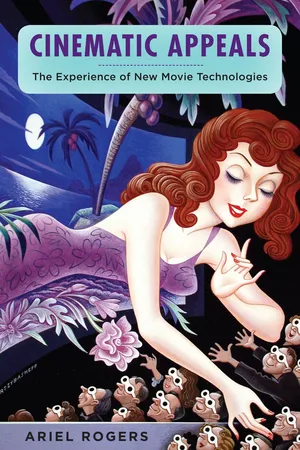
Cinematic Appeals follows the effect of technological innovation on the cinema experience, specifically the introduction of widescreen and stereoscopic 3D systems in the 1950s, the rise of digital cinema in the 1990s, and the transition to digital 3D since 2005. Widescreen cinema promised to draw the viewer into the world of the screen, enabling larger-than-life close-ups of already larger-than-life actors. This technology fostered the illusion of physically entering a film, enhancing the semblance of realism. Alternatively, the digital era was less concerned with the viewer's physical response and more with information flow, awe, and the reevaluation of spatiality and embodiment. This study ultimately shows how cinematic technology and the human experience shape and respond to each other over time.
Information
Subtopic
Kunst Allgemein1
“SMOTHERED IN BAKED ALASKA”
The Anxious Appeal of Widescreen Cinema
The big question, “How does Marilyn Monroe look stretched across a broad screen?” is easily answered. If you insist on sitting in the front row, you would probably feel as though you were being smothered in baked Alaska.
—Otis L. Guernsey Jr.1
In the face of a severe decline in film attendance, widescreen cinema lured viewers in 1950s America by promising a thrilling new experience that set it apart from both traditional moviegoing and the phenomenon of television. Beginning with the debut of Cinerama in 1952 and continuing with the introduction of CinemaScope and numerous similar systems in subsequent years, industry executives and critics described the novel experience widescreen offered with reference to the idea of “audience participation.”2 While this notion of audience participation appears frequently in the advertisements and film reviews surrounding the introduction of widescreen processes and is widely acknowledged in scholarship on the format, the concept of participation itself has not been thoroughly interrogated. How did public discourse present the notion of participation as a new form of cinematic experience? And what was its appeal—what pleasures did it offer moviegoers—at this particular historical juncture?
This chapter addresses these questions by examining how the Hollywood film industry and critical establishment conceptualized and promoted the experience of widescreen at the time of its popularization. Specifically, it shows how discourses of publicity, criticism, and filmmaking conveyed the appeal of—and concern about—the bigger, broader screens via the prospect of close, tactile contact with overwhelming images, including massively inflated images of stars such as Marilyn Monroe. Widescreen, these discourses suggest, offered moviegoers an experience that was both empowering and overpowering, at once rendering the body on a gigantic scale and threatening to smother it. Scholarship on the format has shown widescreen’s affinity for seemingly contradictory concepts, particularly its apparent capacity to enhance the realism and the spectacular nature of the cinematic image, as well as the activity and passivity of the spectator.3 An exploration of widescreen’s appeals does not resolve these tensions but rather shows how they converge around historically inflected ideas about the human body, both in the theater and on the screen.
The move to widescreen can be viewed as the Hollywood studio system’s swan song—a drive to maintain its hegemony despite the 1948 antitrust Paramount Decision, which divested production and distribution companies of their theater chains, and in the face of broad social and economic changes in postwar America, including the rise of television.4 This period also ushered in significant industrial and institutional changes, including Hollywood’s diversification into television and a limitation on the diversity of cinematic output in favor of expensive, large-scale spectacles (which frame widescreen, as John Belton, Sheldon Hall, and Steve Neale contend, as “a model for the Spielberg and Lucas films of the 1970s and later”).5 As Time magazine put it, Hollywood responded to television’s usurpation of “the bread & butter public” by encouraging “a taste for steak and caviar—i.e., fewer and bigger pictures.”6
Insofar as widescreen asserted Hollywood’s power by making the cinematic spectacle bigger, more awe-inspiring, and more homogeneous, even as the studios negotiated their own involvement with television, the format offers a particularly overt instantiation of the mass culture that was of widespread interest at the time. Such interest burgeoned within the academy in the wake of Clement Greenberg’s polemics against kitsch and Theodor Adorno and Max Horkheimer’s indictment of the culture industry, which, despite their differences, share a suspicion of commercial cultural products including movies as homogeneous, formulaic, and deceptive, addressing the masses in a way that eschews critical thought.7 Outside academe there was also concern about the duplicity of the mass media, particularly with what one news story called the “veritable fad” in advertising to draw on the social sciences (notably psychology and sociology) to influence consumer choices.8 That concern existed concurrently with fears about communist techniques for conditioning and propaganda, extending to Hollywood with the House Committee on Un-American Activities (HUAC) hearings, which had resumed in 1951, and the ongoing Hollywood blacklist.9 Hollywood’s offer of massive, overpowering spectacles, in short, emerged in a context deeply interested in—and concerned about—the ways in which the mass media could manipulate the American public.10
While I do not argue that such manipulation defines or delimits spectatorship of widescreen cinema, I do want to highlight the ways in which such ideas emerge in contemporaneous evaluations of the format—and especially its effects on the body. This is a particularly important point given that the bodily address attributed to the format can seem to epitomize the type of embodied spectatorship that recent film theory has described as facilitating viewers’ ability to elude control. While not contradicting that possibility, the discourses examined here offer insight into the specific inflections marking the concept—and framing the experience—of cinematic embodiment at this particular historical juncture. Portraying widescreen’s impact on the body as both a thrill and a threat, these discourses depict the affective charge (either positive or negative) of the new form of spectatorship in terms of the format’s purported capacity to provide a bodily encounter with powerful technological, economic, social, and political forces.11
This period of technological innovation offers a useful comparison to the more recent transition to digital cinema insofar as it seems, in some ways, to provide a sharp contrast. In particular, widescreen’s presentation as a massive, overpowering spectacle with an assertive bodily address may seem to offer a counterpoint to the dispersed and disembodied address that has been attributed to electronic and digital media.12 As is indicated, however, by recent scholarly explorations of topoi and practices such as immersion and multiple-screen display, which suggest significant resonances between 1950s widescreen cinema and contemporary media, the modes of address offered by cinema during these periods of technological change cannot simply be opposed to one another.13 Rather, an archaeology of both instances of upheaval shows how concepts such as immersion and, relatedly, embodiment are not simply activated or deactivated in such contexts but take on specific shades of meaning in conjunction with them. The mapping of cinematic embodiment carried out in this chapter and the next will, ultimately, help to put into relief the ways in which such embodiment has been not simply devalued but reconfigured in conjunction with the ascent of digital cinema.
WIDESCREEN CINEMA
… plunges you into a startling new world.
—This Is Cinerama souvenir program
The term widescreen generally refers to films with aspect ratios significantly greater than the pre-1953 Academy standard of 1.37:1 (usually reaching at least 1.66:1); however, the format encompasses numerous systems, which entail different film gauges, aspect ratios, sound systems, and screens.14 There had been experiments with wide-film formats in both North America and Europe since the 1890s and a particular consolidation of interest in the 1920s—when, for instance, Abel Gance made Napoléon (1927) in his three-camera Polyvision system—with a concerted effort by Hollywood to agree on a wide-film standard in 1930–31 (when Sergei Eisenstein made his famous speech urging Hollywood to adopt a “dynamic square” format).15 Widescreen, however, was not successfully innovated and diffused until the 1950s. As is well known, the studios faced a major crisis at that time, with movie attendance having declined precipitously, from ninety million per week in 1948 to sixty million per week in 1950.16 Although television was widely identified as the culprit, John Belton has shown that wider cultural shifts both threatened traditional moviegoing and framed widescreen (as well as stereoscopic 3D, which was popularized concurrently) as a viable solution.17 Not only did the new systems offer a sensory plenitude (with size, scope, color, apparent depth, and stereophonic sound) that television did not, but they also reframed moviegoing as the kind of active recreation (such as travel and outdoor sports) then in vogue.18 Widescreen films’ portrayal as large-scale events to be experienced presented the act of moviegoing as an activity to be anticipated and remembered, like a visit to Niagara Falls or the Grand Canyon.19
The 1950s widescreen “revolution” was incited by the opening on September 30, 1952, of This Is Cinerama—a film that displayed the eponymous Cinerama system developed by Fred Waller, who had created similar systems for the 1939 World’s Fair and for a “flexible gunnery trainer” for the U.S. military in World War II.20 The Cinerama camera captured a quasi-panoramic view by using three lenses to expose three strips of 35mm negative simultaneously. Each frame on the filmstrips covered an area one and a half times larger than was standard, extending six perforations high rather than four. In the exhibition context three projectors projected these images, at a rate of twenty-six frames per second, onto a broad, deeply curved, louvered screen. While the camera aspect ratio was 2.59:1, the aspect ratio of the screen image varied with different installations and could reach approximately 2.77:1.21 A seven-track stereophonic sound system included five speakers spaced behind the screen, with additional speakers placed on each side and in the rear of the theater to create surround sound (fig. 1.1). Because the cost of theater conversion for Cinerama was so high—requiring the installation of two projection booths, the removal of seats, and the employment of additional personnel—its releases were very limited. Only twenty-two theaters had been equipped for the system by 1959.22
Independently produced, This Is Cinerama was a critical and box-office success, but the studios sought a means to capitalize on the audience appeal of widescreen without such a limitation on exhibition venues. (The studios pursued widescreen in conjunction with stereoscopic 3D, the fad that was launched with the November 1952 release of Arch Oboler’s Bwana Devil; while widescreen itself was not, despite marketing claims, actually three dimensional, it had the advantage, as CinemaScope publicity emphasized, of doing away with the much-maligned glasses.)23 One early means for achieving widescreen images without costly theater conversion was simply to use a wide-angle projection lens to magnify films made in Academy ratio to fit wider screens (with aspect ratios of between 1.66:1 and 1.85:1), cropping the top and bottom of the image—an approach Belton calls “ersatz widescre...
Table of contents
- Cover
- Series Page
- Title Page
- Copyright
- Dedication
- Contents
- List of Illustrations
- Acknowledgments
- Introduction: Moving Machines
- 1. “Smothered in Baked Alaska”: The Anxious Appeal of Widescreen Cinema
- 2. East of Eden in CinemaScope: Intimacy Writ Large
- 3. Digital Cinema’s Heterogeneous Appeal: Debates on Embodiment, Intersubjectivity, and Immediacy
- 4. Awe and Aggression: The Experience of Erasure in The Phantom Menace and The Celebration
- 5. Points of Convergence: Conceptualizing the Appeal of 3D Cinema Then and Now
- Notes
- Selected Bibliography
- Index
- Series List
Trusted by 375,005 students
Access to over 1.5 million titles for a fair monthly price.
Study more efficiently using our study tools.
Frequently asked questions
Yes, you can cancel anytime from the Subscription tab in your account settings on the Perlego website. Your subscription will stay active until the end of your current billing period. Learn how to cancel your subscription
No, books cannot be downloaded as external files, such as PDFs, for use outside of Perlego. However, you can download books within the Perlego app for offline reading on mobile or tablet. Learn how to download books offline
Perlego offers two plans: Essential and Complete
- Essential is ideal for learners and professionals who enjoy exploring a wide range of subjects. Access the Essential Library with 800,000+ trusted titles and best-sellers across business, personal growth, and the humanities. Includes unlimited reading time and Standard Read Aloud voice.
- Complete: Perfect for advanced learners and researchers needing full, unrestricted access. Unlock 1.5M+ books across hundreds of subjects, including academic and specialized titles. The Complete Plan also includes advanced features like Premium Read Aloud and Research Assistant.
We are an online textbook subscription service, where you can get access to an entire online library for less than the price of a single book per month. With over 1.5 million books across 990+ topics, we’ve got you covered! Learn about our mission
Look out for the read-aloud symbol on your next book to see if you can listen to it. The read-aloud tool reads text aloud for you, highlighting the text as it is being read. You can pause it, speed it up and slow it down. Learn more about Read Aloud
Yes! You can use the Perlego app on both iOS and Android devices to read anytime, anywhere — even offline. Perfect for commutes or when you’re on the go.
Please note we cannot support devices running on iOS 13 and Android 7 or earlier. Learn more about using the app
Please note we cannot support devices running on iOS 13 and Android 7 or earlier. Learn more about using the app
Yes, you can access Cinematic Appeals by Ariel Rogers in PDF and/or ePUB format, as well as other popular books in Medien & darstellende Kunst & Kunst Allgemein. We have over 1.5 million books available in our catalogue for you to explore.