- English
- ePUB (mobile friendly)
- Available on iOS & Android
eBook - ePub
About this book
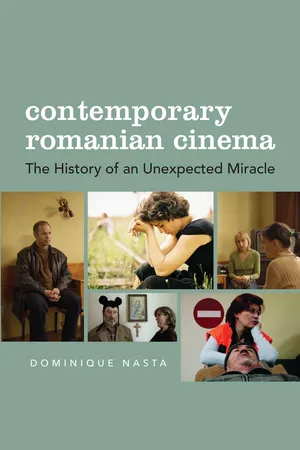
Over the last decade, audiences worldwide have become familiar with highly acclaimed films from the Romanian New Wave such as 4 Months, 3 Weeks and 2 Days (2007), The Death of Mr. Lazarescu (2005), and 12:08 East of Bucharest (2006). However, the hundred or so years of Romanian cinema leading to these accomplishments have been largely overlooked. This book is the first to provide in-depth analyses of essential works ranging from the silent period to contemporary productions. In addition to relevant information on historical and cultural factors influencing contemporary Romanian cinema, this volume covers the careers of daring filmmakers who approached various genres despite fifty years of Communist censorship. An important chapter is dedicated to Lucian Pintilie, whose seminal work, Reconstruction (1969), strongly inspired Romania's 21st-century innovative output. The book's second half closely examines both the 'minimalist' trend (Cristian Mungiu, Cristi Puiu, Corneliu Porumboiu, Radu Muntean) and the younger, but no less inspired, directors who have chosen to go beyond the 1989 revolution paradigm by dealing with the complexities of contemporary Romania.
Information
Subtopic
Film & VideoCHAPTER 1
Difficult Beginnings
HISTORICAL AND CULTURAL LANDMARKS
A Latin island set in a sea of Slavic neighbours, Romania is a country that has consistently felt close to identities and sources that were somehow out of reach. The issue of national identity has always been at the centre of socio-political debates, numerous invasions having left the country with little energy to catch up with the rest of Europe. As Catherine Durandin rightly notes:
Romania’s history is related to its frontiers. Situated at the extreme frontier line of the Roman Empire, Romania borders the Byzantine Empire, close to the Ottoman invasion line, and finally acts as a frontier line between the Russian expansion and its Western opponents, the Austro-Hungarians in the nineteenth century. (1995: 19; author’s translation)
Dina Iordanova similarly argues that
If one looks from the West, the Balkans are perceived as homogeneous; if one looks from within, they are often perceived as diverse and heterogeneous. […] It is a specific feature of the Balkan situation that each one of the countries prefers to look at some West European country for cultural identification rather than to any of its Balkan neighbours: Romanians look traditionally to France, Bulgarians to Germany and Slovenes to Austria and Italy. Unlike the imperial legacy of Austro-Hungary which is considered to have boosted social progress, Ottoman rule is considered as a major interruption and as an impediment to fulfil European goals. (2001: 8)
A beautiful country with a balanced natural potential, Romania has many ethnically configured ancestral traditions represented in its oral folklore. Artists of all kinds have long manifested an unusual propensity for lyricism by way of original poems and songs. In terms of defining categories, the main Romanian symbolic paradigm is to be found in the archetypal tale of Mioritza. Romania’s most enduring cultural text has mixed ethnic origins: a shepherd boy from Moldavia is warned by his beloved ewe (mioară in Romanian), diminutively called the little lamb, Mioritza, that his fellow shepherds – coming from Wallachia and Transylvania – plan to murder him and take his envied flock. He accepts his fate without resisting. The only thing he asks the lamb before he dies is to tell his own mother a different story: that he married a king’s daughter, and that all natural elements were witnesses to the magical wedding. Consequently, the ewe will not tell a story of death and betrayal, but a beautiful, almost metaphysical tale.
In a definitive essay significantly called The Mioritic Space (1936), Lucian Blaga, a well-known Romanian poet from the 1930s, delineates the ballad as some kind of geography of the Romanian poetic imagination, but also as a philosophical attempt to explain the Romanian spirit through landscape, which he saw as a stylistic matrix of Romanian culture. Blaga insists on establishing a distinction between the effects of the natural environment on the collective spirit on the one hand and on the personal subconscious on the other (see Durandin 1995: 25). In a similar vein, reputed philosopher Mircea Eliade sees Mioritza as a collective answer to the terrors inflicted by history: the ballad’s hero finds a meaning in his tragic fate because he does not consider it a personal event, but rather a mythical happening. The shepherd thus provides an answer to an otherwise absurdist situation, countering death and misfortune through a nuptial fairy tale. The cosmic marriage from Mioritza is a mythical one, an example of cosmic Christianity – part pagan, part Christian – clearly dominated by nostalgia for nature (see Pavel 2006: 5). Several critics have suggested that this tale might account for the tendency of the Romanian people to suffer oppression passively, hence the fatalistic Weltanschauung implicit in Mioritza. As many case studies of significant past and present films will try to show, fatality is indeed at the core of the Romanian psyche, precisely counterbalanced by a lot of black humour, spontaneity and ironic wit.
Mid-way between a form of fatalistic resignation and the tragicomic absurdist dimension present in a number of filmic productions over the decades, the Romanian cultural realm has always manifested an obvious penchant for reinterpreting major historical events. Such a tendency has resulted in a deliberate mixture between what French philosopher Paul Ricoeur has called the time of fiction and historical time (1990, III: 180). This aspect will prove crucial for decoding themes and styles conveyed by Romanian culture in general and by fiction and non-fiction cinema in particular, before and after 1989. I suggest that Romanian contemporary fiction films are extremely close to Ricoeur’s redefinition of Aristotle’s three-fold mimesis as developed in his seminal survey Time and Narrative: time of fiction, historical time and audience reception time all mix into one coherent signifying entity. Ricoeur’s considerations surprisingly fit the contents and style of several past and present Romanian films. According to Ricoeur:
We find a basic indication of the way in which the fictive experience of time relates in its own way to lived temporality and time perceived as a dimension of the world in the fact that the epic, the drama and the novel never fail to mix historical characters, dated and datable events, and known geographical sites with invented characters, events and places… Nevertheless, we would be sorely mistaken if we were to conclude that these dated or datable events draw the time of fiction into the gravitational field of historical time. What occurs is just the opposite. From the mere fact that the narrator and the leading characters are fictional, all references to real historical events are divested of their function of standing for the historical past and are set on a par with the unreal status of the other events. (1990, III: 129)
Aristotle’s, hence also Ricoeur’s, mimesis is three-fold: after mimesis 1 (pre-figuration), which tries to understand human action in its semantics and temporality, mimesis 2 (configuration) opens the kingdom of ‘what if?’ and creates narrative configurations which are precisely meant to be antonyms of historically validated, true stories. For Ricoeur, narrated time constitutes (and this point will prove extremely relevant to our purposes here) an alternative to the classical representation of time as flowing from the past towards the future. Thus, when approaching mimesis 3 (refiguration), meaning the reading/interpretive process, what interests Ricoeur is not only the process of restoring the author’s intention behind the text, but also ‘the movement by which the work of art unfolds, as it were, a world ahead of itself’ (1990, I: 70).
A relevant case in point from a totally different cultural domain is the Balada Conducătorului (Ballad of the Dictator, a.k.a. The Song of Revolution, 1990), composed and performed only a few weeks after the fall of Ceauşescu by the world-renowned Roma band Taraf de Haïdouks. The ballad is close in style and mode of address to the already-mentioned Mioritza, yet the content differs drastically. Working out a pre-existing melodic plot, it tells the true, chronological story of the uprising and of the subsequent short trial that toppled the ‘tyrant who has destroyed Romania’, obviously inspired by images shown on television. Lead singer/composer Nicolae Neacşu uses a highly oral expression and non-grammatical verbal forms, distorting his violin’s sound with horsehair tied to it, to great emotional effect. He describes nature’s ‘green leaf, flower of the fields’ as the shepherd speaks to his ewe-lamb in the original ballad:
Green leaf, a thousand leaves…
On December 22
Time caught up with us
… So what did the students do?
Once in Timişoara
… They shouted: no more tyrant
To Bucharest they headed, shouting
Let’s wipe out dictatorship …
Ceauşescu heard their shouting …
And what did the police do?
Brought him back to Bucharest
Locked him in a room
Took his pressure before the trial
And the judges said to him
Tyrant, you have devastated Romania.1
A further comparison between the Ballad of the Dictator and the paradigmatic Mioritza may invite new ways of understanding the Romanian psyche and its subsequent translatability into film. The Ballad has maintained the poetic, rhetorical mode of address to a natural element because it obviously needs an extension, an escape from a very concrete, albeit violent, reality, about a man who destroyed a whole country and who will have to pay for his deeds. The ‘green leaf’ issued from a common natural landscape is nonetheless a passive listener, not an active messenger as was the case with the ewe-lamb from Mioritza. In The Ballad of the Dictator, reality, history and sung narratives are reunited; they become, for a short time span, a homogeneous entity. This explains why one line of the ballad reads ‘time has caught up with us’, or, in a literal translation, ‘time has returned’.
It is not only Romanian contemporary cinema which has used the ‘fall of the dictator’ paradigm as a main point of thematic reference to great effect. Earlier films focusing on real and/or historical facts from Romania’s past share this recurrent integration of ongoing events and recounted ones. Besides, the different types of socio-political and economic upheavals which have prevented Romanian filmmakers from expressing themselves freely and fully demonstrating their craft have paradoxically engendered, as in many other neighbouring countries in the Soviet sphere, codified modes of expression. Different spatiotemporal lines co-exist inside such films: their common ground often lies in a joke, a song or a poem.
THE UPS AND DOWNS OF A FALTERING FILM INDUSTRY
Romania’s highly problematic socio-political situation as a monarchy led by the Hohenzollern dynastic line during the first two decades of the twentieth century, after centuries of Ottoman, Greek or Russian occupation, did not prevent the country’s Byzantine heritage from prevailing. Nor did it diminish the impact of the French spirit in Wallachia and Moldavia and the inevitable Austro-Hungarian way of life in Transylvania. This myriad of European influences had both positive and negative effects on the way film as a new invention was turned into a bankable industry.
Positive effects, confirming Romania’s intention to bridge the cultural gap between Oriental and Western parts of Europe, include very early screenings of Lumière films (in Bucharest in May 1896) and the presence of foreign cameramen shooting on location their Romanian shorts, the ‘vues roumaines’, concentrating exclusively on local topics. The earliest known operator of a motion-picture camera in the Balkan region was Paul Menu, who filmed a military parade in Bucharest in May 1897. A Bucharest-based optician and photographer with French origins, Menu subsequently shared his filming experience with Lumière and Pathé cinematographers. Romanian journals from the early twentieth century also mention the quick connections established for distribution purposes with European countries benefiting from important film production rates such as France, Germany and, to a lesser extent, Italy. In 1908 and 1909, many theatres equipped to show newsreels and fiction films alternating with vaudeville numbers began to be built, first in Bucharest and later on in other important economic and cultural cities in the rest of the country such as Iaşi, Cluj and Sibiu (see Cantacuzino 1968: 98).
While most films from the early years of the century have disappeared due to bad preservation conditions, the most important Romanian feature film produced in 1912, Independenţa României (The Independence War, Grigore Brezeanu/Aristide Demetriade), has been preserved and has even served as a screening subject for Nae Caranfil’s more recent epic Restul e tăcere (The Rest Is Silence, 2007), to be discussed in a subsequent chapter. It depicts the different kinds of wars Romania had to wage for its independence in the nineteenth century, after several centuries of mainly Ottoman domination.
A jack of all trades with a hunchback, the son of renowned actor Ion Brezeanu, raised and known for innumerable accomplishments inside the theatre world throughout his brief life, Grigore Brezeanu co-directed and co-scripted the film with his close collaborator, director and actor Aristide Demetriade. Both had already directed two films produced by the Pathé-Bucharest subsidiary, which are considered the first fiction features ever produced in Romania: Amor Fatal (Fatal Love, 1911) and Inşir-te Mărgărite (Spin a Yarn, 1911), neither of which has been preserved, unfortunately. Brezeanu employed a cast that included celebrated figures from the Bucharest stage such as Constantin Nottara and Aristizza Romanescu, as well as émigré actress Elvire Popesco in her screen debut, in order to convincingly impersonate important Romanian historical figures. Three years before D. W. Griffith’s Birth of a Nation (1915), the film featured hundreds of extras provided by the Ministry of Defence and was almost entirely shot on location in the outskirts of Bucharest. Historical war scene revivals filmed by French camera operator Franck Daniau skilfully alternate between visual and verbal (intertitles with excerpts from odes and poems) celebrations of Romania’s representative assets (that is, peasants dancing in national dress on the battlefield).
Leon Popescu, a theatre owner and manager with influential contacts in the world of high finance, co-produced The Independence War: he continued over subsequent years to develop his film business via his company Filmul de Artă Leon Popescu. Mainly genre films, these eventually proved pale copies of the Pathé-distributed series ‘Films d’Art’ (see Rîpeanu 2004: 24–5). They did not succeed in setting up a real national filmic output: the production rate was extremely slow, and films did not fare well commercially, lacking any international appeal. Furthermore, the economic effects of World War I on the Balkans had a far-reaching impact on the industries of Romania; the local subsidiaries of Pathé and Gaumont ended their business in 1915, and theatre owners were forced to rely on national productions. The most prolific wartime studios were in Cluj (then called Kolosvar and part of Hungary), where from 1914 to 1916 several directors contributed to an impressive output of sixty-two films.
During the first two decades of Romanian cinema’s existence, production teams used well-known literary figures as screenwriters, adapting their novels, plays or short stories but also asking them to re-write pieces of dialogue to provide a cinematic framework for their themes and styles. Such is the case with Liviu Rebreanu, the essential representative of the Naturalistic trend, whose work would actually span more than sixty years of cinema, but also with Mihail Sadoveanu, who specialised in historical novels, and Victor Eftimiu, a poet and playwright. However, the most frequently adapted author remained Ion Luca Caragiale. His feature film and television longevity was greater than that of Rebreanu: his tragicomic, sarcastic depiction of Romanian society has left its mark on classical film directors such as Jean Georgescu through to contemporary auteurs of the twenty-first century, such as Corneliu Porumboiu.
A highly original example from the silent era, Manasse (Jean Mihail, 1925), an adapted play about a dramatic event from the Jewish community, proved an exception, with no sequels in subsequent years: it told the story of an impossible love in a Jewish traditionalist family which refuses a mixed marriage, somehow echoing the storyline of Alan Crosland’s The Jazz Singer (1927). As in many other Eastern and Central European countries, the transition to sound was...
Table of contents
- Cover
- Title Page
- Copyright
- Contents
- Dedication
- Acknowledgments
- Preface
- Introduction
- 1. Difficult Beginnings
- 2. Bright Intervals: Romania’s Short-lived Thaw
- 3. Romanian Cinema in the 1970s: Versatility on the Menu
- 4. Dan Piţa: A Filmmaker for All Seasons
- 5. Mircea Daneliuc: Romanian Cinema’s Rebel with a Cause
- 6. The 1989 Moment: Film and History in the Early 1990s
- 7. Through a Glass, Darkly: Lucian Pintilie as Past and Present Role Model
- 8. The Films of Nae Caranfil: A Taste of Turn-of-the-Century Sophisticated Comedy
- 9. Short Films on the Crest of the New Wave
- 10. Less is More: Puiu, Porumboiu, Muntean and the Impact of Romanian Film Minimalism
- 11. The 4, 3, 2 Paradigm: Cristian Mungiu’s Large-scale Phenomenon
- 12. Making Films for Wider Audiences: Romanian Cinema Turns Global
- 13. Romanian Exilic and Diasporic Cinema: The Case of Radu Gabrea
- Conclusion
- Notes
- Filmography
- Bibliography
- Index
Trusted by 375,005 students
Access to over 1.5 million titles for a fair monthly price.
Study more efficiently using our study tools.
Frequently asked questions
Yes, you can cancel anytime from the Subscription tab in your account settings on the Perlego website. Your subscription will stay active until the end of your current billing period. Learn how to cancel your subscription
No, books cannot be downloaded as external files, such as PDFs, for use outside of Perlego. However, you can download books within the Perlego app for offline reading on mobile or tablet. Learn how to download books offline
Perlego offers two plans: Essential and Complete
- Essential is ideal for learners and professionals who enjoy exploring a wide range of subjects. Access the Essential Library with 800,000+ trusted titles and best-sellers across business, personal growth, and the humanities. Includes unlimited reading time and Standard Read Aloud voice.
- Complete: Perfect for advanced learners and researchers needing full, unrestricted access. Unlock 1.5M+ books across hundreds of subjects, including academic and specialized titles. The Complete Plan also includes advanced features like Premium Read Aloud and Research Assistant.
We are an online textbook subscription service, where you can get access to an entire online library for less than the price of a single book per month. With over 1.5 million books across 990+ topics, we’ve got you covered! Learn about our mission
Look out for the read-aloud symbol on your next book to see if you can listen to it. The read-aloud tool reads text aloud for you, highlighting the text as it is being read. You can pause it, speed it up and slow it down. Learn more about Read Aloud
Yes! You can use the Perlego app on both iOS and Android devices to read anytime, anywhere — even offline. Perfect for commutes or when you’re on the go.
Please note we cannot support devices running on iOS 13 and Android 7 or earlier. Learn more about using the app
Please note we cannot support devices running on iOS 13 and Android 7 or earlier. Learn more about using the app
Yes, you can access Contemporary Romanian Cinema by Dominique Nasta in PDF and/or ePUB format, as well as other popular books in Medien & darstellende Kunst & Film & Video. We have over 1.5 million books available in our catalogue for you to explore.