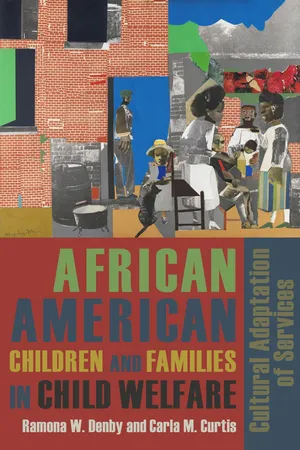
eBook - ePub
African American Children and Families in Child Welfare
Cultural Adaptation of Services
- English
- ePUB (mobile friendly)
- Available on iOS & Android
eBook - ePub
African American Children and Families in Child Welfare
Cultural Adaptation of Services
About this book
This text proposes corrective action to improve the institutional care of African American children and their families, calling attention to the specific needs of this population and the historical, social, and political factors that have shaped its experience within the child welfare system. The authors critique policy and research and suggest culturally targeted program and policy responses for more positive outcomes.
Information
Subtopic
African American StudiesIndex
Social Sciences1
Cultural Adaptation in Effective Child Welfare Practice with African Americans
A CULTURAL ADAPTATION FRAMEWORK
Many authors have called for a critical examination of the United States child welfare system as it relates to African American children and families (Curtis & Denby, 2004; Denby & Curtis, 2003; Dixon, 2008; Hill, 2006; McRoy, 2008; Roberts, 2002, 2008; Testa, 2005; U.S. GAO, 2007). Examiners of the U.S. child welfare system have based their critiques on historical, cultural, political, and service reviews. Most recently, some child welfare scholars have challenged researchers to develop new theories that build on historical traditions and establish evidence-based practices and policies. Traditionally, proponents of evidence-based practices search for appropriate frameworks and practice effectiveness by questioning, searching, analyzing, and then applying and evaluating their conclusions (Cournoyer, 2004). However, the child welfare system reforms that are needed go far beyond the implementation of evidence-based models. What is required instead is a system transformation that takes into account cultural adaptations of policies, research, and practice so that the system is more responsive to the particular needs of African American children and families.
In this text we call for an analytical framework that guides policy, research, and practice interventions for African American families in the child welfare system. However, we believe that the traditional critique of the child welfare system is shortsighted in that its parameters usually extend to a mere mention of historical, cultural, and political influences. While these components are essential to advancing a sound analytical framework, we examine what cultural adaptations are needed to the overall service system and infrastructure as it relates to African Americans in the child welfare system.
The call for cultural competence as it relates to child welfare is not new. Several scholars have provided direction for cultural competency at both the individual and organizational levels, and although the literature is voluminous, several seminal pieces address the topic as it specifically pertains to African American children and families (Barber & Jager, 2007–2008; Gavazzi, Alford, & McKenry, 1996; Waites, 2009; Wells, Merritt, & Briggs, 2009).
We have chosen the framework of cultural adaptation to illustrate how child welfare reform efforts can be implemented to better address the service delivery needs of African American children and families. Given the aim of this book, which is to advance multiple-level approaches (policy, practice, and research) for child welfare intervention with African Americans, we frame the issues from a perspective of both what has caused the crisis and what potentially are some of the viable solutions for overcoming the current problems. We chose cultural adaptation as the guiding framework for four reasons:
1. For decades African Americans’ plight in the child welfare system has been characterized as dire, yet the system lacks a framework that allows us to move our actions, services, and approaches into a system characterized by reform efforts.
2. Cultural adaptation is about being culturally competent, and cultural competence is an ethical and professional imperative.
3. Given the reality of underresourced child welfare systems, there is a need to advance approaches that are both practical and viable and do not place unrealistic financial burdens on systems that are already overburdened.
4. Given the child welfare system mandate of child safety/protection, well-being, and permanency, we must advance approaches that make both clients and professionals more accountable for the realization of these mandates.
Definitions of Culture
In 1949 Douglas Haring posed the question: “Is culture definable?” Implied in this question is the difficulty that many face as they search for clear, simple, and agreed upon definitions of the term culture. Others have suggested that defining culture is a way of drawing lines of demarcation between groups, including some while excluding others (Ortner, 1998; Park, 2005). As further evidence of the complexities associated with defining culture, Allen (1996) argues that culture is not discovered, it is constructed. The field of social work has entered the discourse, with some raising questions concerning whether culture may in fact be a marker for “difference” and arguing that it is at times used to replace race and ethnicity in categorizing minority status (Park, 2005).
The term has multiple meanings. As it has been most commonly used in social and human services professions, culture is defined as follows:
• The “collective programming of the mind which distinguishes the members of one category of people from another” (Hofstede, 1984:51).
• “Learned and shared human patterns or models for living; day-today living patterns. These patterns and models pervade all aspects of human social interaction. Culture is mankind’s primary adaptive mechanism” (Damen, 1987:367).
• The manner in which members of a group interpret and perceive artifacts, tools, and other cultural elements. The cultural groups are distinguished by their values, interpretations, meanings, and symbols. People within defined cultural groups usually interpret phenomena in the same manner (Banks, Banks, & McGee, 1989).
• “The shared knowledge and schemes created by a set of people for perceiving, interpreting, expressing, and responding to the social realities around them” (Lederach, 1995:9).
• “A configuration of learned behaviors and results of behavior whose component elements are shared and transmitted by the members of a particular society” (Linton, 1945:32).
• “Learned and shared behavior of a community of interacting human beings” (Useem & Useem, 1963:169).
Despite the controversy concerning how and why culture is defined, social work and other human services, like many professions, have studied culture and cultural phenomena through the lens of modern anthropology. Such anthropological coding as “hereditary customs and action” or “sharing understandings” have been used to frame definitions of culture (O’Hagan, 1999). Anthropological definitions of culture also remind us that societies have multiple cultures that are often stratified and distinguished by language, attributes, and other classifications. O’Hagan has put forth a definition of culture that can be specifically applied to child and family social work:
Culture is the distinctive way of life of the group, race, class, community, or nation to which the individual belongs. It is the product of the values, ideas, perceptions, and meanings which have evolved over time. These values, ideas, perceptions, and meanings constitute the individual’s knowledge and understanding of the world in which he or she lives, and they derive from, and are embodied in, the physical environment of birth and upbringing, in language, institutions, family and social relationships, child rearing, education, systems of belief, religion, mores and customs, dress and diet, and in particular uses of objects and material life. Culture embraces all of these, and the individual may regard each of them, or any number of them, as culturally significant. (273)
The manner in which people organize and classify their collective experiences is critical, and it is a starting point in the examination of the African American family’s engagement with the child welfare system. We will examine how child welfare experiences that African Americans encounter are arguably best understood within a cultural context. In doing so, in subsequent chapters we consider the possibility that cultural classifications can be used to pathologize behaviors observed in individuals, families, and communities, which may account for some of the adverse conditions that African American children and families face while in the child welfare system. Nonetheless, we consider culture to be a strength, and we use the meanings that African American communities may associate with their culture to propose a set of strategies to adapt policies, practices and research to better address the needs of African American children and families.
Definitions of Adaptation
Webster’s dictionary uses such words as modify, revise, adjust, and alter to define adapt. Like culture, the meaning of adapt or adaptation varies, depending on the area of study or context in which it is used. Biologists and anthropologists think of adaptation as evolutionary or generational processes whereby species or populations better match or conform to their new environments. In human services disciplines, notions of adaptation again derive from anthropological meanings but have been largely framed from research in psychology whereby, simply put, adaptation can be thought of as adjustment, alteration, or change that is motivated by or prompted by voluntary or involuntary new experiences, encounters, or information. Today adaptation is most often defined as Whaley (2003) discusses it: the ability to change one’s behavior and attitudes in order to fit within one’s environment.
Cultural adaptation has long occurred in the context of human service delivery systems. However, the traditional form of cultural adaptation has been one-sided, whereby we have asked clients (individuals, families, groups, and communities) to adapt their behaviors, culture, and environments to fit into available services, program structures, and models of intervention. Traditional cultural adaptation closely adheres to anthropological perspectives of cultural evolution. Barger (2009:17) defines anthropological cultural adaptation as “changes made by a group of people to develop a more viable interaction between the conditions of their environment and their total behavioral patterns.” Implicit in this definition is the belief that adaptation is a positive condition and a group process as opposed to an individual one.
THE NEW ADAPTATION PERSPECTIVE
The adaptation perspective maintains that effective models and programs have sometimes not been planned with respect to the needs of special populations. This is a problem given that some special populations have service needs that are difficult to address. In fact, ethnic minority groups are seldom represented in any significant numbers in studies of evidence-based treatment (Whaley & Davis, 2007). The aim of cultural adaptation is to ensure that interventions are relevant and responsive to the needs of special populations. Therefore, if service models and interventions are targeted to the needs of special populations, the observed outcomes are truly effective. Use of the adaptation perspective has also been referred to as hybrid interventions or adjusted interventions (Holleran Steiker et al., 2008). These interventions explore those aspects of the original program model or intervention approach that are not specific to or have less relevance for the intended cultural group or special population and then make necessary adjustments. The following are examples of how cultural adaptation has been defined in the professional literature:
[A]ny modification to an evidence-based treatment that involves changes in the approach to service delivery, in the nature of the therapeutic relationship, or in components of the treatment itself to accommodate the cultural beliefs, attitudes, and behaviors of the target population. (Whaley & Davis, 2007:570–71)
[T]he process of adjusting the delivery of mental health services to be consistent with the client’s culture. The provision of services is adapted to the culture. Simply put, cultural adaptation is the process of modifying mental health service delivery to make it culturally competent. Just as cultural competence must be addressed at the administrative, service delivery, and clinician level, so must cultural adaptations be developed at all three levels. (Hogg Foundation for Mental Health, 2010:4)
Relevant cultural adaptations can be made in any aspect of an intervention. Cultural adaptations can start with the very premise or principles on which the program is based and end with how program outcomes are measured and tracked. Employing individuals whom Holleran Steiker et al. (2008) refer to as “culturally matched implementers” (individuals who understand class and cultural differences) to deliver services is another way to apply the cultural adaption perspective, as is involving indigenous groups in the design and testing of culturally adapted programs.
Several challenges have been noted to the adaptation perspective. First, Holleran Steiker et al. (2008) report that some believe that adapting to efficacious models threatens fidelity. They argue that if an intervention or program has been shown to be effective, alterations run the risk of diminishing the effect, and therefore the model should be delivered as it was designed. Second, cost has been identified as an issue in trying to produce culturally adapted approaches. Kazdin (1993) considers the practicality of the cost of adjusting evidence-based models to fit various ethnic groups and also suggests that there is a lack of scientific proof that community-specific adaptations of programs work. Joining Kazdin’s argument, Elliot and Mihalic (2004) assert that culturally modified approaches may run the risk of jeopardizing the efficacy of evidence-based programs. Third, some have argued whether cultural adaptations should occur at all (Holleran Steiker et al.). Arguably, models, programs, and interventions need not be adapted if they were designed from the outset to a...
Table of contents
- Cover
- Title Page
- Copyright
- Contents
- Preface
- Acknowledgments
- Introduction
- 1. Cultural Adaptation in Effective Child Welfare Practice with African Americans
- 2. Child Welfare in Perspective: Historical Factors Influencing African American Families and Policy Formulation
- 3. Child Welfare Policy and the African American Family
- 4. Safety and Protection
- 5. Permanence for Children
- 6. Child and Parent Well-Being
- 7. Cultural Adaptation and Research
- 8. Meeting the Challenges to Bring About Change
- Glossary
- Index
Trusted by 375,005 students
Access to over 1.5 million titles for a fair monthly price.
Study more efficiently using our study tools.
Frequently asked questions
Yes, you can cancel anytime from the Subscription tab in your account settings on the Perlego website. Your subscription will stay active until the end of your current billing period. Learn how to cancel your subscription
No, books cannot be downloaded as external files, such as PDFs, for use outside of Perlego. However, you can download books within the Perlego app for offline reading on mobile or tablet. Learn how to download books offline
Perlego offers two plans: Essential and Complete
- Essential is ideal for learners and professionals who enjoy exploring a wide range of subjects. Access the Essential Library with 800,000+ trusted titles and best-sellers across business, personal growth, and the humanities. Includes unlimited reading time and Standard Read Aloud voice.
- Complete: Perfect for advanced learners and researchers needing full, unrestricted access. Unlock 1.5M+ books across hundreds of subjects, including academic and specialized titles. The Complete Plan also includes advanced features like Premium Read Aloud and Research Assistant.
We are an online textbook subscription service, where you can get access to an entire online library for less than the price of a single book per month. With over 1.5 million books across 990+ topics, we’ve got you covered! Learn about our mission
Look out for the read-aloud symbol on your next book to see if you can listen to it. The read-aloud tool reads text aloud for you, highlighting the text as it is being read. You can pause it, speed it up and slow it down. Learn more about Read Aloud
Yes! You can use the Perlego app on both iOS and Android devices to read anytime, anywhere — even offline. Perfect for commutes or when you’re on the go.
Please note we cannot support devices running on iOS 13 and Android 7 or earlier. Learn more about using the app
Please note we cannot support devices running on iOS 13 and Android 7 or earlier. Learn more about using the app
Yes, you can access African American Children and Families in Child Welfare by Ramona Denby,Carla M. Curtis in PDF and/or ePUB format, as well as other popular books in Social Sciences & African American Studies. We have over 1.5 million books available in our catalogue for you to explore.