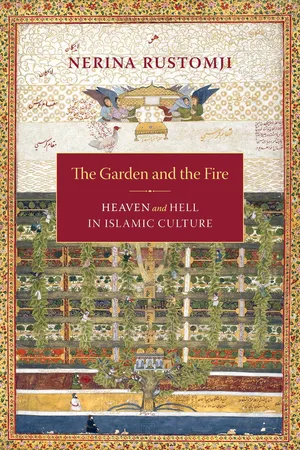
Islamic conceptions of heaven and hell began in the seventh century as an early doctrinal innovation, but by the twelfth century, these notions had evolved into a highly formalized ideal of perfection. In tracking this transformation, Nerina Rustomji reveals the distinct material culture and aesthetic vocabulary Muslims developed to understand heaven and hell and identifies the communities and strategies of defense that took shape around the promise of a future world.
Ideas of the afterworld profoundly influenced daily behaviors in Islamic society and gave rise to a code of ethics that encouraged abstinence from sumptuous objects, such as silver vessels and silk, so they could be appreciated later in heaven. Rustomji conducts a meticulous study of texts and images and carefully connects the landscape and social dynamics of the afterworld with earthly models and expectations. Male servants and female companions become otherworldly objects in the afterlife, and stories of rewards and punishment helped preachers promote religious reform. By employing material culture as a method of historical inquiry, Rustomji points to the reflections, discussions, and constructions that actively influenced Muslims' picture of the afterworld, culminating in a distinct religious aesthetic.
- English
- ePUB (mobile friendly)
- Available on iOS & Android
eBook - ePub
About this book
Information
Subtopic
Histoire du Moyen-Orient[ 1 ]
THE GARDEN, THE FIRE, AND ISLAMIC ORIGINS
NO PERIOD in Islamic history elicits such careful examination and divergent interpretation as prophet Muhammad’s life in Mecca and Medina. There are other eras that figure prominently, of course, but the life of the prophet holds a special lure. Not only does studying Muhammad’s career allow for appreciation of the central figure in Islamic history, but focusing on his life in Mecca and Medina also offers the main way of assessing the nature of the new faith and the behavior of its followers. The allure of focusing on the history of Mecca and Medina is the opportunity not just to scrutinize the earliest texts, but also to interrogate the very narrative of Islamic origins.
The quest for origins offers the ultimate romance in academic study, but in the case of Islam, a focus on origins is also a basic element for understanding the configuration of Islamic societies. If there is an Islamic narrative, then its beginning is seen by Muslims to be formed in the seventh-century Hijaz region of Arabia when living in the community of believers (umma) meant being guided by revelations from God and shaped by Muhammad’s personal example. As a result, this first Islamic society provides a paradigm for the ideal community that Muslims interpret and reinterpret until the present day. When Muslims searched and continue to search for examples of righteous behavior, they turn to Muhammad and his companions. When Muslims needed and continue to need a societal model to guide them through change and transformation, they turn to the trials in Mecca and Medina.
Like any search for origins, the quest for Islamic origins presents its own challenges. There is a problem with texts: the earliest are written over a century and a half after Muhammad’s death, and the only version we have is one edited two hundred years after his demise. There is a problem with verification: we have only texts written by scholars who reflect their own sense of Muslim identity and shape their own present within Islamic chronicles. Most of all, there is the problem of the concept of “origin” itself, which promises to locate the very moment of beginning and, even more daunting, an explanation for that moment. It is not surprising, then, that the quest for origins is seen as dangerous territory for careful, academic study. In particular, the focus on the origins of Islam is even more challenging if one does not incorporate the terms of Islamic faith: after all, how can one historically explain the first revelation from God to Muhammad via the angel Gabriel? All of its challenges notwithstanding, the focus of this chapter is on the role of the Garden and the Fire in the Islamic narrative of origin. In the narrative, Muhammad received revelations in 610 (all dates are CE) from God to deliver a message to his people about the need for faith, the primacy of monotheism, and the inevitability of judgment. Judgment entailed eternal reward and punishment in two respective realms in the world to pass after the end of given time. These realms are the Garden and the Fire.
In the Qur’an and early historical texts, the Garden and the Fire are at the center of the narrative of origin. The Islamic narrative presents the Garden and the Fire as a doctrinal innovation that distinguishes the new faith. Yet, the narrative is also predicated upon the assumption that upon hearing Qur’anic revelations, newly converted Muslims automatically accepted the explanation that they would have to answer for themselves at the end of time. The idea that Muslims accepted the guiding orientation of these new worlds fits into a larger story of faith; however, it contributes to the misleading sense that faith in the Islamic afterlife was axiomatic. That the acceptance of the Islamic narrative necessitates an acceptance that belief in the afterlife was inevitable illustrates just how closely interwoven the afterlife and the Islamic narrative of origins actually are. This chapter will tease apart these two strands and show how the promise of the Garden and the Fire functioned and developed within the earliest Islamic text purporting to chronicle the time period of Muhammad in Mecca and Medina.
What was the precise nature of Muhammad’s message about the afterlife? How did listeners understand the Qur’anic assertion of judgment? What did they make of the various promises and punishments? And how did they come to believe in the existence of a world never experienced? While we know that Muhammad’s detractors resisted his message, we cannot accept without examination that the faithful were unquestioning upon hearing about the Garden and the Fire. Faith in the afterlife has a history, and it has been unexplored. The question, then, is how did early Muslims come to believe in the afterlife? Ibn Ishaq’s (d. 761/2 or 767) Sira Rasul Allah reflects the ways in which the people of Mecca and Medina learned about, believed or disbelieved in, and battled over the reality of the Last Judgment. Instead of a vision of automatic acceptance of the afterworld, the Sira Rasul Allah presents a discourse where Muslim faith in the Garden and the Fire developed over time and through Meccan opposition to Muhammad and Muslims. The Garden was not just an abstract promise made to believers, but also an end for which they worked and fought.
PRE-ISLAMIC ESCHATOLOGICAL TRADITIONS IN ARABIA
There is little evidence that the Arabs in pre-Islamic Arabia believed in an afterlife with a distinct place and time. Unfortunately, what little is known about Central Arabian religion comes from Islamic sources that stress monotheism’s superiority over idol worship in an effort to demonstrate the difference between the two systems.1 Stories about pre-Islamic beliefs suggest a pantheistic system where each tribe worshipped stones, trees, or goddesses.2 The pilgrimage to and the circumambulation of the Ka‘ba, which contained objects of veneration, testify to the same form of worship. Kuhhan, or soothsayers, were said to receive divinely inspired poetry from the gods or from jinn, beings of the desert understood to be composed of vapor and flame.3 The belief in deities and jinn suggests the belief in an unseen world. Yet, that world did not necessarily exist outside the realm of time. Instead, life occurred on one plane of existence. Each person had a fixed time or ajal. What happened after one’s ajal was reached is unclear.4
There may have been some notion of transformation after death, but that transformation did not necessarily entail an afterlife or an afterworld. It has been suggested that hadiths that liken souls to birds may be based on the pre-Islamic belief that the soul becomes like an owlish apparition that hovers over the grave and head of the deceased person.5 Another way to investigate pre-Islamic beliefs is to look at the myth of the prophet Salih of the tribe of Thamud and the she-camel whose piercing screech brought about the end of their world. As narrated in the Qur’an as an example of one of God’s chosen groups gone astray, the people of Thamud were prosperous, but they had become corrupt, so God sent them the prophet Salih. They identified him as a mere mortal and asked that he give them some indication of his divine mission. God then sent a she-camel as a test. The she-camel required water rights every other day, and neither the tribe nor its animals could use water then. The Thamud soon broke the injunction, and they hamstrung and slew the she-camel. Three days later a great scream destroyed them.
In one version of the myth, the scream came with a crash, and a large she-camel emerged from the mountain. Her shrieks brought such pain that people bled from their ears; their skin turned yellow, then red, and finally black. Realizing that their fate was sealed, they prepared themselves for death and awaited their punishment. Then came the final scream. Afterward all was silent. Fire rained down for seven days until everything was ash. On the eighth day, the sky cleared, and Salih and his few adherents carried their belongings and journeyed to Palestine.6 The story is also analogous to Muhammad’s plight. The motif of the scream in the Qur’an functions as a warning to Muhammad’s detractors that unimaginable pain is pending if they do not follow Allah’s messenger just as the Thamud did not follow Salih. Qur’anic verses present analogies between the story of the Thamud and other peoples who “went astray” from rightly guided messengers, such as Lot or Abraham or Noah.
In this story, the scream indicates the beginning of eschatological time. However, while the concept of pain is apparent, there is little indication of a realm or time beyond the scream. The cataclysmic end is brought about not because of the world’s end, but because the Thamud did not respect the she-camel. The end of the tribe, then, is not the end of time; rather, it is the punishment for disobeying divine commandments. Individual judgment is not apparent; instead, there is only a collective fate for the tribe.
When publicly proclaiming the revelations he received, Muhammad had difficulty convincing the people of Mecca and Medina that the Last Judgment was impending. There are numerous revelations in the Qur’an that assert the reality of the Judgment and the consequence for those who do not have faith. Similarly, as recorded in hadiths and the Sira Rasul Allah, Muhammad attempted to persuade people that their lives had a future; and their future lives were in peril if they did not heed the calling of Allah. The concept of the judgment played a central role in the early history of Islam.
What is so innovative about the Last Judgment? As in the case of the Thamud, collective judgment reflected the tribal ethic of solidarity. A judgment for each individual separated him or her from social and familial contexts. Performing pilgrimage and circumambulating the Ka‘ba with its interior idols was deemed unacceptable. What Muhammad presented as a good life was to live by the precepts of “those who submit” to Allah and solely Allah. Other gods and tribal affiliations were irrelevant. Yet, the judgment itself was not limited solely to Muslims; indeed, the judgment was also levied against those who have no belief at all. The Fire affected even those who did not subscribe to the faith.
Other than Muhammad’s visions, the revelations he delivered, and his words that were to become hadiths, there was no proof of an unseen world that lay outside time and space. The belief in jinn was evident; however, the jinn were believed to exist within the spatial parameters of the earthly world.7 A future realm of existence in both time and space, then, was an innovation. That there was a world beyond this one whose options depended on how one lived life in this world did not accord with the common understanding of a life span.
Both the Sira and the Qur’an record the difficulty Meccans faced in trying to understand the afterlife. The following pages will analyze their incomprehension in greater detail. The extension of judgment beyond time and space was the most trying concept to comprehend. The concept of the afterlife not only challenged individual conceptions of life, it also challenged assumptions of earthly tribal solidarity. By contrast, in the afterlife, judgment allowed an individual a new life unencumbered by tribal affiliation; yet, once within the Garden, an individual could experience ultimate solidarity by uniting with ancestors and progeny. One essentially experienced one’s life in the next world, but the framework of life was transformed in terms of time and space.
DEBATING THE DOCTRINE OF THE AFTERLIFE
The Sira Rasul Allah reflects that the Garden and the Fire were used as metonymies for the new faith. The text introduces the two realms as what marks Islam as distinct from other systems of faith before it actually uses the terms “Muslim” or “Islam.” The Garden and the Fire provided a doctrine that focused the attention of both Muhammad’s adherents and detractors. Both alluded to the afterlife in moments of strife: Muhammad’s early companions employed it as inspiration; his detractors used it to illustrate the absurdity of Muhammad’s message. At different points in Muhammad’s life, belief in the afterlife took on different meanings. In Mecca, it provided consolation to new converts who faced persecution. Sometimes the terms al-janna and al-nar are specifically employed; other times there is reference to particular items found in the Garden and the Fire.
The near-iconic power of the Garden and the Fire as a marker of Islam can be best illustrated by the passages in the Sira that chronicle Islam’s place in the world by foretelling the appearance of Muhammad. In one anecdote, Ibn Ishaq reports a Jewish man discussing an upcoming prophet and foretelling the rise of Islam:
Salih b. Ibrahim b. ‘Abdul al-Rahman b. ‘Auf from Mahmud b. Labid, brother of B. ‘Abdu al-Ashhal, from Salama b. Salama b. Waqsh (Salama was present at Badr) said: “We had a Jewish neighbor among Bani ‘Abdu al-Ashhal, who came out to us one day from his house. (At that time I was the youngest person in my house, wearing a small robe and lying in the courtyard.) He spoke of the resurrection [al-qiyama wa-l-ba‘th], the reckoning [al-hisab], the scales [al-mizan], the Garden [al-janna], and the Fire [al-nar]. When he spoke of these things to the polytheists who thought there could be no rising after death, they said to him, ‘Good gracious man! Do you think that such things could be that men can be raised from the dead to a place where there is a Garden [al-janna] and a Fire [al-nar] in which they will be recompensed for their deeds?’ ‘Yes,’ he said, ‘and by Him whom men swear by, he would wish that he might be in the largest oven in his house rather than in that Fire [al-nar al-‘azim]: that they would heat it and thrust him into it and plaster it over if he could get out from that fire on the following day.’ When they asked for a sign that this would be, he said, pointing with his hand to Mecca and the Yaman, ‘A prophet will be sent from the direction of this land.’ When they asked when he would appear, he looked at me, the youngest person, and said: ‘This boy, if he lives his natural term, will see him,’ and by God, a night and a day did not pass before God sent Muhammad his apostle and he was living among us. We believed in him, but he denied him, in his wickedness and envy. When we asked, ‘Aren’t you the man who said these things?’ he said ‘certainly, but this is not the man.’”8
In this passage, the Jew functions as someone who is privileged with divine knowledge not only because of his ability to see the future, but also because the Sira Rasul Allah portrays Jews as legitimate authorities of divine wisdom (although in this case, the man recants his own vision). When the man speaks, it is to signal apocalyptic time when there will be the Resurrection, the Reckoning, and humans’ lives will be weighed by the cosmic Scales. Each one of these events forms a part of eschatological time, which the passage reflects is surprising to the listeners. It is within this framework that the Garden and the Fire is first introduced. In a kind of doctrinal refrain, the Jewish neighbor is questioned about the possibility of an afterlife to which he responds about the heat or the greatest part of the Fire. In the passage, then, it is the Fire that is privileged as a marker of Islamic denial: if one does not accept the future (as the Jewish man does not by the end of the anecdote), then one may face it. The Garden, by contrast, is not highlighted at all.
Even more interesting is what is not mentioned about this new faith. The Jewish neighbor neither mentions the concept of tawhid (unity) that marks forms of Islamic theology, nor monotheism that would reinforce the narrative against polytheism, nor the name of the Islamic God “Allah,” nor what wil...
Table of contents
- Cover
- Half title
- Title
- Copyright
- Dedication
- Contents
- List of Illustrations
- Acknowledgments
- Introduction
- 1. The Garden, the Fire, and Islamic Origins
- 2. Visions of the Afterworld
- 3. Material Culture and an Islamic Ethic
- 4. Otherworldly Landscapes and Earthly Realities
- 5. Humanity, Servants, and Companions
- 6. Individualized Gardens and Expanding Fires
- 7. Legacy of Gardens
- Epilogue
- Notes
- Glossary
- Bibliography
- Index
Trusted by 375,005 students
Access to over 1.5 million titles for a fair monthly price.
Study more efficiently using our study tools.
Frequently asked questions
Yes, you can cancel anytime from the Subscription tab in your account settings on the Perlego website. Your subscription will stay active until the end of your current billing period. Learn how to cancel your subscription
No, books cannot be downloaded as external files, such as PDFs, for use outside of Perlego. However, you can download books within the Perlego app for offline reading on mobile or tablet. Learn how to download books offline
Perlego offers two plans: Essential and Complete
- Essential is ideal for learners and professionals who enjoy exploring a wide range of subjects. Access the Essential Library with 800,000+ trusted titles and best-sellers across business, personal growth, and the humanities. Includes unlimited reading time and Standard Read Aloud voice.
- Complete: Perfect for advanced learners and researchers needing full, unrestricted access. Unlock 1.5M+ books across hundreds of subjects, including academic and specialized titles. The Complete Plan also includes advanced features like Premium Read Aloud and Research Assistant.
We are an online textbook subscription service, where you can get access to an entire online library for less than the price of a single book per month. With over 1.5 million books across 990+ topics, we’ve got you covered! Learn about our mission
Look out for the read-aloud symbol on your next book to see if you can listen to it. The read-aloud tool reads text aloud for you, highlighting the text as it is being read. You can pause it, speed it up and slow it down. Learn more about Read Aloud
Yes! You can use the Perlego app on both iOS and Android devices to read anytime, anywhere — even offline. Perfect for commutes or when you’re on the go.
Please note we cannot support devices running on iOS 13 and Android 7 or earlier. Learn more about using the app
Please note we cannot support devices running on iOS 13 and Android 7 or earlier. Learn more about using the app
Yes, you can access The Garden and the Fire by Nerina Rustomji in PDF and/or ePUB format, as well as other popular books in Théologie et religion & Histoire du Moyen-Orient. We have over 1.5 million books available in our catalogue for you to explore.