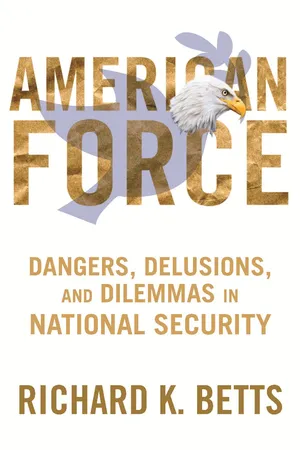
While American national security policy has grown more interventionist since the Cold War, Washington has also hoped to shape the world on the cheap. Misled by the stunning success against Iraq in 1991, administrations of both parties have pursued ambitious aims with limited force, committing the country's military frequently yet often hesitantly, with inconsistent justification. These ventures have produced strategic confusion, unplanned entanglements, and indecisive results. This collection of essays by Richard K. Betts, a leading international politics scholar, investigates the use of American force since the end of the Cold War, suggesting guidelines for making it more selective and successful.
Betts brings his extensive knowledge of twentieth century American diplomatic and military history to bear on the full range of theory and practice in national security, surveying the Cold War roots of recent initiatives and arguing that U.S. policy has always been more unilateral than liberal theorists claim. He exposes mistakes made by humanitarian interventions and peace operations; reviews the issues raised by terrorism and the use of modern nuclear, biological, and cyber weapons; evaluates the case for preventive war, which almost always proves wrong; weighs the lessons learned from campaigns in Iraq, Afghanistan, and Vietnam; assesses the rise of China and the resurgence of Russia; quells concerns about civil-military relations; exposes anomalies within recent defense budgets; and confronts the practical barriers to effective strategy. Betts ultimately argues for greater caution and restraint, while encouraging more decisive action when force is required, and he recommends a more dispassionate assessment of national security interests, even in the face of global instability and unfamiliar threats.
- English
- ePUB (mobile friendly)
- Available on iOS & Android
eBook - ePub
About this book
Information
1 INTRODUCTION
FROM COLD WAR TO HOT PEACE
When the United States became more secure it became more forceful. Since the Cold War ended it has spent far more than any other country or coalition to build armed forces; it has sent forces into combat more frequently than it did in the era of much bigger threats to national security; and it has done so much more often than any other country. The United States has been, quite simply, “the most militarily active state in the world.”1 To many in the mainstream of American politics this is as it should be because the United States has the right and responsibility to lead the world—or push it—in the right direction. To others, more alarmed by the pattern, U.S. behavior has evolved into “permanent war.”2
Some of this belligerence was imposed on the United States by Al Qaeda on September 11, 2001, but the terrorist threat cannot account for the bulk of blood and treasure expended in the use of force over the past two decades. In the first half of the post–Cold War era, until complications in Iraq and Afghanistan, American national security policy was driven not by threats but by opportunities—or rather what an overambitious consensus in the foreign policy elite mistakenly saw as opportunities. Instead of countering immediate dangers, American policy aimed to stabilize the world in order to prevent dangers from arising. There is no evidence, however, that this activism short-circuited more dangers than it generated. And at the same time, American force has been ambivalent, trying to do too much with too little. Policy elites who wanted to make the world right sometimes held back for fear that costly ventures would lack public support. Sometimes they have chosen the worst of both worlds, compromising between all-out effort and doing nothing at all, but with the result of action that is both costly and indecisive.
The use of force is the most extreme instrument of foreign policy, and it is what preoccupies the planners of national security policy. Americans like to believe that the United States does not resort to force lightly, and that when it does, it does so only defensively. Whatever the motives, or however justified force may be in principle, it is hard to control and exploit effectively in practice. Many who want to use American force for good purposes focus too much on motives, too much on the ends rather than the means. They lack sufficient awareness of how limitations of the means complicate and often derail the ends.
The news is not all bad. Some of the American uses of force in recent years were necessary, proper, and effective, and some of the mistakes are clear only in the luxury of critics’ hindsight. The record of judgment and action is inconsistent and not thoroughly explained by any simple theory. The negative part of the record, however, was mostly due to a bad combination of material power, moral conceit, and middling effort. American leaders—both Democrats and Republicans—tried to do a lot, with excessive confidence in their ability to understand and control developments, but they wanted to do it all on the cheap. All too often they wound up surprised when the price turned out to be expensive. They liked to use force frequently but not intensely, when the reverse combination would have been wiser. Too often they found that force proves ineffective if applied sparingly. How did this combination of forcefulness and hesitancy happen?
When the end of the Cold War swept away the epochal threat to Western democracy, the United States had a choice: to relax or to advance. A naïve realist would have expected the first, a comfortable retirement from military exertion. The disappearance of military threat with the collapse of the only other superpower, and of political threat with the worldwide collapse of the only competitive ideology, provided unprecedented national security—at least in the strict sense of the term. (National security is distinguished from “human” security, the wider span of concerns—for example, environmental health—that may well be more important in the end.) The single significant exception to this benign situation in international politics was the potential for interruption of oil supplies, but exporters would have no incentive to exploit that option except in retaliation for American meddling in their interests. Otherwise, the threats left on the post–Cold War roster were indirect rather than immediate, local not global, threats not to vital material interests of the United States but to moral interests, or the interests of other countries’ citizens. Such threats may sometimes warrant American action, but they are mainly matters of charity and human decency, not national security.
As it was, the United States chose the second option—expansion—but hesitantly. American leaders chose not to conceive of security in the strict sense of territorial integrity, political autonomy, and economic viability, but in the broader sense of a congenial world filled with ideological kindred devoted to optimizing economic exchange and resolving disputes through the rule of law. In this view, security ultimately requires extending the West’s preferred world order. This ambitious alternative would push other societies toward organizing themselves and behaving according to the right values, and would suppress disorders that threatened the security not just of Americans but of foreign populations. This latter-day domino theory aimed to prevent threats from emerging by preventing local pathologies from metastasizing and eventually reaching Americans at home.
On balance, this has been the wrong choice. In the dozen-year hiatus between the opening of the Berlin Wall and Al Qaeda’s assaults on September 11, the United States experienced a holiday of sorts from the traditional rough-and-tumble of international conflict. It failed to take advantage of an excellent security situation in this period to manage a transition to a balance of power and modus vivendi with major states. Instead, Washington pushed to exploit unipolarity and dabble in attempts to stabilize and reform countries beset by violence. Some of the initiatives beginning in the 1990s that flowed from the urge to forge world order, promote democracy, and prevent bad behavior made sense, but it proved difficult to keep the sensible moves within bounds and avoid imbroglios that cost more to get out of than they were worth. In the 1990s Washington also indulged an instinct for the capillaries, losing sight of the priority of relations with major powers that are more important than the messes in minor countries on which efforts fixated.3
Then came September 11th. National security policy reacted energetically, and for awhile quite sensibly. Flushed with premature confidence from apparent victory in Afghanistan, however, George W. Bush seized the wrong opportunity and confused counterterrorism with war against Iraq. This venture gravely damaged American interests, worsening threats rather than relieving them. Even if the eventual outcome in Iraq proves reasonably stable, the cost will have far exceeded the benefit.
The frequency of resort to force came out of an elite consensus of strange bedfellows: conservative nationalists unapologetically happy to pump up America’s number one status and get in the face of foreigners; cosmopolitan liberals anxious to make the world a cooperative marketplace in the mold of our own country; and neoconservative zealots aiming to do both. Explicit opposition was weak and limited to anti-interventionist paleoconservatives and liberals, minorities in both parties at least until disappointments piled up. Opposition was latent in the greater skepticism of much of the mass public all along, skepticism that would only be activated by costly failure—which made the more ambitious interventionists reluctant to push their visions except in cases where it seemed they might succeed with modest effort.
It would be a mistake to exaggerate the failures of post–Cold War uses of force or the unrealism of foreign policy leaders’ planning principles. It is always easier to diagnose a mistake than to prescribe a reliable cure. It is especially unfair for critics to shake their fingers self-righteously when, unlike officials in the world of action, they have the luxury of hindsight and lack the responsibility for making things work in real life. Unfair as they may be, the essays that follow will dwell on mistakes and misconceptions rather than policies that did not stumble.
The idea that U.S. foreign policy has overreached is hardly novel at this point; indeed it is even commonplace since the ordeals in Iraq and Afghanistan. The impulse to overreach preceded these ventures, however, and is resilient. Criticism of post–Cold War military activism is not beating a dead horse because the impulse never recedes indefinitely. Americans want to accomplish much at low cost and are even willing to pay high costs for big stakes. High costs were accepted in the twentieth century because the stakes were the survival and security of Western liberal democracy in the face of successive challenges from great powers and transnational ideologies. That long experience of worldwide struggle established habits that colored the approach to the world after victory, and that can revive when recent setbacks fade from attention.
The chapters that follow explore the Cold War background and several of the main issues and cases that preoccupied national security policy after the collapse of communism. They do not present a tightly integrated analysis that weaves all conclusions into a single theme but should be read as independent excursions that share some common concerns. To appreciate the case for getting policy priorities on a different track it helps to clarify the genuinely important dangers the United States faces, recognize the delusions that have driven some repeated mistakes, and confront the dilemmas that limit how well even sensible choices can produce good outcomes.
DANGERS
Americans face many potential threats to their safety, the worst of which may lie beyond the realm of national security properly conceived. Collapse of the international financial system is one disaster that is no longer unimaginable. Scientists can point to a number of potential natural catastrophes that could gravely damage human life—environmental devastation, uncontrolled pandemic disease, massive destruction from collision with asteroids, and so on. The risk of at least one such development is actually far greater than politicians and policymakers appreciate.4 Related to natural disasters would be deliberate devastation inflicted by superempowered individuals or tyrants who make use of malign byproducts of bioengineering, hyperdeveloped artificial intelligence, and other technological advances.5 Some of these overlap with issues of national security, but if the term has any meaning, national security must refer to the more specific category of military vulnerability and threats to the nation’s political autonomy and fundamental economic viability.
In the strict sense of national security the United States has faced far fewer dangers in recent years than it did before the 1990s, or than it may face some years from now. This should be obvious, yet a surprising number of policymakers and commentators, especially among liberals and neoconservatives, seem not to grasp the point. Now more than two decades since the Berlin Wall opened, and under the immediate emotional impact of Al Qaeda’s fanaticism, many Americans have forgotten—or are too young to remember—the tremendously different nature and scale of the threats to “the American way of life” that energized permanent peacetime mobilization.
In the first half of the twentieth century radical nationalist ideologies, fused with great power military capabilities—German fascism and Japanese militarism—threatened the independence of the Western democracies and the huge countries of Russia and China, caused the deaths of fifty to seventy million people, and destroyed most of Eurasia. In the second half of that century a universalist ideology, backed by Soviet and Chinese power, made a prolonged bid for the hearts and minds of people throughout the world. Although young people today may think that the fear of a now-defunct faith taking over the world must have been overwrought, Marxism-Leninism thrived and advanced in many regions. Communism was quite unlike radical Islam today, which is a mobilizing force and model for social organization only in culture areas where the religion is already historically rooted. Rather it was an ideal with appeal and political clout to varying degrees in virtually every part of the world (except, perhaps, the United States). Until close to the end it was not inevitable that communists would lose the Cold War. In that context muscular American activism to compete for control of political and military developments abroad made great sense.
The end of the Cold War blessed the United States with the least dangerous outside world in living memory. That does not mean that recent dangers are small, or that they may not become awesome before long, but that they are more modest than the ones that shaped the modern American national security establishment. It means that since the Berlin Wall opened, Washington has faced nettlesome medium powers but no hostile great power, nor—with the single exception of a potential collective Arab oil embargo—any country or coalition with the power to threaten vital interests even if it became hostile. With the related exception of revolutionary Islamism (an exception whose potency should not be exaggerated), military and political threats today are local, not global, and have scant potential for contagion beyond their neighborhoods.
This window of extraordinary security could remain open for a long time, but not forever, if only because American primacy will not last forever. There are plausible threats on the horizon that are in the same league with those of the twentieth century, and some are discussed later in the book. Some of the conceivable dangers were immanent in the disputes and crises of the past two decades that are examined in the essays that follow. The difference in the post–Cold War world, however, was that policymakers had the freedom to devote most of their attention to matters that were of mild importance compared with the challenges of the past and, potentially, of the future.
DELUSIONS
Some mistaken resorts to force are traceable to enthusiasms common in American liberalism, enthusiasms that were liberated by the collapse of the bipolarity that had constrained them. (Liberalism here does not refer to the colloquial meaning of left-of-center in contemporary domestic politics. Rather it means the classic tradition venerating freedom, political equality, and economic openness that encompasses all of American politics and includes those we call conservatives and neoconservatives.) These enthusiasms have fed on three sets of misconceptions.
Liberal universalism and the habit of empire. Americans have usually thought of their political order as exceptional, but a model for what the world should become. Many of us tend to assume that deep inside every foreigner of good will must be an American struggling to get out. If other countries are given a fair chance, American exceptionalism should evolve into universal Americanism, or at least Western liberal democracy of some sort in tune with the United States. This has been the underlying political agenda in globalization to many in the U.S. foreign policy establishment, including majorities of both political parties.
The idea of an “empire of liberty” goes back to Thomas Jefferson, but for most of U.S. history this hubris was held in check by the limits of American power and the inclination to promote the American model outside of North America by example rather than by force. A century ago nationalism and crusading liberalism were given a mutually reinforcing boost by Theodore Roosevelt and Woodrow Wilson. Then, after 1945, Americans became accustomed to leading the “free world,” and within the West a liberal empire became institutionalized over the course of four decades. By the end of the Cold War Washington had developed the habit of empire and turned from defending it to expanding it. The right and responsibility to advance democracy and human rights where possible were taken for granted, although there was much less agreement on whether this should be done if it required sacrifice.
The extent to which national security became tacitly identified with empire is reflected in how the structure of government defined organizations responsible for national security almost completely in terms of operation far from home rather than at our own shoreline. The National Security Council (NSC) and Department of Defense concerned themselves exclusively with defense lines far forward, on other continents, and the protection of allies, not direct defense of U.S. borders. Military forces were organized for combat in terms of a worldwide set of unified commands, each one with a huge headquarters and bureaucracy, overseeing a given foreign region (EUCOM for Europe, PACOM for Asia, CENTCOM for t...
Table of contents
- Cover
- Title Page
- Copyright
- Dedication
- Contents
- PREFACE
- PART I. THE POST–COLD WAR HIATUS
- PART II. HISTORY STRIKES BACK
- PART III. DECISION AND IMPLEMENTATION
- NOTES
- INDEX
Trusted by 375,005 students
Access to over 1.5 million titles for a fair monthly price.
Study more efficiently using our study tools.
Frequently asked questions
Yes, you can cancel anytime from the Subscription tab in your account settings on the Perlego website. Your subscription will stay active until the end of your current billing period. Learn how to cancel your subscription
No, books cannot be downloaded as external files, such as PDFs, for use outside of Perlego. However, you can download books within the Perlego app for offline reading on mobile or tablet. Learn how to download books offline
Perlego offers two plans: Essential and Complete
- Essential is ideal for learners and professionals who enjoy exploring a wide range of subjects. Access the Essential Library with 800,000+ trusted titles and best-sellers across business, personal growth, and the humanities. Includes unlimited reading time and Standard Read Aloud voice.
- Complete: Perfect for advanced learners and researchers needing full, unrestricted access. Unlock 1.5M+ books across hundreds of subjects, including academic and specialized titles. The Complete Plan also includes advanced features like Premium Read Aloud and Research Assistant.
We are an online textbook subscription service, where you can get access to an entire online library for less than the price of a single book per month. With over 1.5 million books across 990+ topics, we’ve got you covered! Learn about our mission
Look out for the read-aloud symbol on your next book to see if you can listen to it. The read-aloud tool reads text aloud for you, highlighting the text as it is being read. You can pause it, speed it up and slow it down. Learn more about Read Aloud
Yes! You can use the Perlego app on both iOS and Android devices to read anytime, anywhere — even offline. Perfect for commutes or when you’re on the go.
Please note we cannot support devices running on iOS 13 and Android 7 or earlier. Learn more about using the app
Please note we cannot support devices running on iOS 13 and Android 7 or earlier. Learn more about using the app
Yes, you can access American Force by Richard K. Betts in PDF and/or ePUB format, as well as other popular books in Politica e relazioni internazionali & Relazioni internazionali. We have over 1.5 million books available in our catalogue for you to explore.