eBook - ePub
Democracy and Islam in Indonesia
- English
- ePUB (mobile friendly)
- Available on iOS & Android
eBook - ePub
Democracy and Islam in Indonesia
About this book
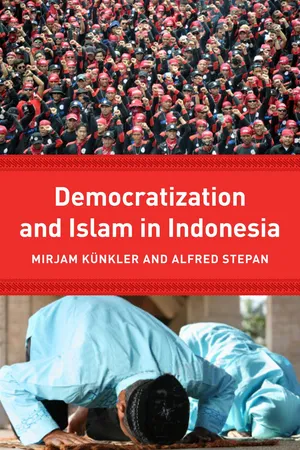
Indonesia's military government collapsed in 1998, igniting fears that economic, religious, and political conflicts would complicate any democratic transition. Yet in every year since 2006, the world's most populous Muslim country has received high marks from international democracy-ranking organizations. In this volume, political scientists, religious scholars, legal theorists, and anthropologists examine the theory and practice of Indonesia's democratic transition and its ability to serve as a model for other Muslim countries. They compare the Indonesian example with similar scenarios in Chile, Spain, India, and Tunisia, as well as with the failed transitions of Yugoslavia, Egypt, and Iran. Essays explore the relationship between religion and politics and the ways in which Muslims became supportive of democracy even before change occurred, and they describe how innovative policies prevented dissident military groups, violent religious activists, and secessionists from disrupting Indonesia's democratic evolution. The collection concludes with a discussion of Indonesia's emerging "legal pluralism" and of which of its forms are rights-eroding and rights-protecting.
Information
Subtopic
Asian HistoryPart I
Introduction
1
Indonesian Democratization in Theoretical Perspective
The democratization literature in political science does not have a widely used, full-scale volume devoted to democratic transition and possible consolidation in an Islamic country. Thus, our understanding of varieties of possible democratizations, especially how democracy can be crafted in Muslim-majority countries, remains impoverished.1 This volume is an attempt to fill these lacunae.
Indonesia, the world’s most populous Muslim-majority country, began a transition to democracy with the overthrow of Suharto in 1998 and now strikes most observers as a democratization miracle.
Indonesia declared its independence in 1945, but its “stateness” has often been challenged: by Dutch reoccupation of its major cities until 1949 and by secessionist movements in areas such as Sulawesi until 1967 and Aceh until 2005. The sheer size and diversity of its polity, scattered over seventeen thousand islands, speaking more than seven hundred living languages, and stretching across five time zones, have at times made Indonesia seem ungovernable.2 Moreover, though the country is rich in oil, gas, tin, and copper resources, wealth has been unevenly distributed, and Indonesia’s per capita gross domestic product (GDP, purchasing power parity) in 1998 was $2,266, with half of the population living under the two-dollar-a-day poverty line.3 From independence until recently, Indonesia had a history of weak parliamentary institutions and was ruled continuously by the military from 1965 until 1998. Moreover, at the beginning of the democratic transition in 1998, the country found itself in the midst of its worst economic crisis since independence, with –14.3 percent growth; indeed, Indonesia’s per capita GDP did not consistently return to 1997 levels until the fifth year of the transition, in 2003.4
For all these reasons and the fact that Indonesia had a Muslim majority with what appeared to be growing violent militants, at the end of the 1990s the country seemed to many analysts an extremely unlikely candidate for a successful democratic transition, much less one to be talked about in terms of democratic consolidation.
But where does the country stand today? Surprisingly, in Freedom House’s world rankings of “political rights,” India, the longest-enduring democracy in the developing world, and Indonesia have since 2006 had an identical ranking, a 2, the second-highest possible score on the Freedom House seven-point democracy scale. Furthermore, Indonesia receives a score of + 8 in Polity IV’s twenty-one-point ranking of all countries in the world, where +10 is the most democratic and –10 the most autocratic.5 Indonesia’s combined democratic ranking by Freedom House and Polity IV has been better since 2006 than any of the nine other Association of Southeast Asian Nations countries, including Catholic Philippines, Confucian Singapore, and Muslim Malaysia.
In the context of its new political stability, Indonesia for the period 2005–2010 joined China, India, and Brazil as one of the world’s fastest-growing economies. Furthermore, the Economist Intelligence Unit estimates that Indonesia’s real GDP growth from 2011 to 2030 should continue at more than 5 percent per year. If so, the acronym used to designate the world’s major emerging economies, BRIC (Brazil, Russia, India, and China) might have to change to include Indonesia.6
How did Indonesia go from thirty-three years of continuous military rule to civilian rule accompanied by dangerously heightened religious and secessionist conflicts and economic disarray from 1998 to 2002, then to completing its democratic transition by 2005, and ultimately to being a possible candidate for democratic consolidation in 2011?
The present volume brings together eleven leading political scientists, legal analysts, scholars of religion, and anthropologists to explore these questions. All the chapters are bound together by reflection on the issues of democratic transition and consolidation. In this chapter, we attempt to put Indonesia’s challenges and achievements and the volume’s structure in theoretical perspective.
Chapter 2, by R. William Liddle, often called the doyen of Indonesian studies in the United States, and Saiful Mujani, Indonesia’s leading survey analyst, offer a conceptual and empirical overview of the end of authoritarianism in Indonesia, the beginning of the democratic transition, and the possibilities of democratic consolidation. In “Indonesian Democracy: From Transition to Consolidation,” Liddle and Mujani address Indonesia’s post-1998 political performance through the lens of Juan J. Linz and Alfred Stepan’s conceptual approach to democratic transitions and consolidations.7 The transition, Liddle and Mujani argue, was completed as early as 2004: the outgoing Parliament in November 1998 set a date for the country’s first free elections since 1955; free and fair elections were held in 1999; the newly elected Parliament then democratized the Constitution in four rounds of constitutional amendments (1999–2001);8 and, finally, the military’s undemocratic participation in the legislature and the election of the president was eliminated in 2004.
Linz and Stepan outline in their framework three dimensions of democratic consolidation, and Liddle and Mujani analyze these three dimensions for Indonesia: the attitudinal dimension toward democracy both before and after the transition; the behavioral dimension, particularly of the key groups that have the capacity to possibly overthrow the democratic regime or fragment the state; and the constitutional dimension, whereby the new regime establishes not only a democratic constitution, but a series of horizontal and vertical checks, particularly on the state apparatus itself, so that the democratic regime itself is law bounded, transparent, responsive, and not solely majoritarian.
Although there is, of course, some overlap between attitudinal, behavioral, and constitutional dimensions, we have divided the volume into three additional parts based on these dimensions. Part II is devoted to citizens’ attitudes, in particular Muslim and non-Muslim religious actors’ attitudes toward democracy. Part III explores the behavioral dimension of three groups who could have overthrown the new democracy or fragmented Indonesia’s precarious territorial integrity: the military, violent Islamists, and territorial secessionists. Part IV explores constitutional dimensions and the rule of law, especially the question of Indonesia’s growing “legal pluralism,” to examine whether there is indeed a sufficient degree of legal hierarchy for democratic consolidation.
Part II. Attitudes: The Development of a Democratic Consensus by Religious and Political Actors
In the literatures on secularism, liberal democracy, and democratic consolidation, two major areas concerning religious actors’ attitudes are frequently debated and are particularly relevant for this volume. The first concerns whether religious actors are a positive or negative force for democratization. There obviously are numerous examples throughout history where various religions have played a nondemocratic role. However, at times religion has been able to act as a positive force, and how this has come about has been underanalyzed in much of these literatures. The second major debate concerns attitudes toward secularism and whether religion, even if it is a positive force, should be an active participant at all in the public sphere of a democracy. Indeed, John Rawls, the most famous twentieth-century political philosopher in the English-speaking world, argued that religion must be “taken off” the political agenda in order to build the “overlapping consensus” he saw as necessary for liberal democracy.9
Is Rawls’s influential injunction that religion should be taken off the public agenda democratically and philosophically reasonable? In our analysis of Islam and democracy in the modern world, we believe that the case for putting Islam and democracy “on” the public agenda is strong in general and particularly strong in four arenas where democratic attitudes can possibly be developed: (1) core scholarship within Islam about religion, the state, and democracy; (2) public intellectuals; (3) civil society; and (4) political society. Consider the following set of hypotheses.
Assume a political situation within a polity where arguments are fairly commonly disseminated in the public sphere by religious and scholarly actors who make the case that modern democracy is incompatible with one or more of the following requirements of a good Islamic society: the need for a worldwide Islamic caliphate (and thus the illegitimacy of any democracy located in only one state); the requirement that God (not citizens or electorates) governs and thus that God-given laws (sharia), not man-made laws, must be obligatory for all; or the content of a Muslim state is spelled out in binding (and democratically restrictive) detail in the Qurʾan. If a situation like this exists—and it does in many polities—the chances that tolerance and democracy will become a consensual sentiment in that polity are much greater if excellent scholarship on Islam is carried out and incorporated into public arguments that confront these arguments and help citizens create what Charles Taylor would call an “imaginary” of committed Muslims living—indeed, in Taylor’s sense, “flourishing”—in a democracy.10
We also hypothesize that the chances for democracy becoming a consensual value in the politics of the polity will become even greater if some of the intellectuals who are engaged in core scholarly or at least conceptual development of a beneficial relationship between Islam and democracy are also public intellectuals. Such public intellectuals’ task is to challenge antidemocratic arguments supposedly based on Islam as soon as they are articulated and to offer in the public sphere credible and attractive democratic alternatives via the creative and constant use of popular and elite press, radio, and television.
We also assume that the chances for winning Gramscian “hegemony” in civil society for democratic values and practices and for protecting a possible democratic transition and consolidation with ideological and organizational “moats” will be vastly increased if some of these public intellectuals are also leaders of major civil society organizations that are active and influential in the public arena for various reasons.11 Leaders of such organizations might have many followers. This state of affairs would raise the cost to the authoritarian regime of imprisoning, torturing, censoring, exiling, or assassinating major visible civil society leaders. Such leaders might also create massive member networks that are engaged in activities that can become increasingly supportive of a more inclusive democratic politics and even available for resistance to the authoritarian regime.
Finally, we assume that if some of these civil society leaders become active in political society, it might increase the impact of their ideas in public life, help legitimate the key institutions of democracy for their followers, and give their organizations incentives and opportunities for entering into pro-democratic alliances and coalitions with secular activists who share democratizing goals with them.
In our judgment, none of the activities by religious actors in these public arenas necessarily violates democratic practices and what Alfred Stepan calls the “twin tolerations” (toleration of democracy by religion and toleration of religion by democratic leaders); indeed, they can advance such activities.12
Indonesia has the two largest member-based Islamic civil society organizations in the world, both of which have taken strong positions against Indonesia as an Islamic state and the establishment of sharia as the only source of law. Both also were strongly supportive of the democratic transition in 1998. One association, Nahdlatul Ulama (NU, Rise of the Ulama) has an estimated 35 to 40 million followers, drawn from a largely tolerant, rural religious tradition built upon Islam, with some additions from animism, Buddhism, and Sufism. In a survey in 2002, 42 percent of Indonesian respondents identified themselves with the NU community, and another 17 percent said they felt close to NU, although they were not affiliated. NU arguments about the state, religion, and democracy are well disseminated among its followers and even reach a broader public. The other large Islamic civic association in Indonesia is Muhammadiyah (Followers of Muhammad), a more urban organization that has what it calls a rational direct engagement with the Qurʾan as well as approximately 30 million members, thousands of schools, high-quality universities that offer doctorates on secular and religious topics, and hundreds of hospitals.
In chapter 3, “How Pluralist Democracy Became the Consensual Discourse Among Secular and Nonsecular Muslims in Indonesia,” Mirjam Künkler addresses the crucial question of how democratic attitudes emerged within the major Muslim civil society groups, NU and Muhammadiyah. She documents in great detail how key religious actors and organizations put Islam and democracy on the public agenda and in the process contributed both to the erosion of the authoritarian regime and to the building of democracy by their actions in all of the four public arenas and, as hypothesized, actually had a positive effect on eroding the authoritarian regime and supporting a democratic transition.
If we compare Egypt and Tunisia with Indonesia, the fact that NU and Muhammadiyah arrived at a consensus supportive of democracy before the transition began contrasts sharply with the situation in Egypt. Egypt’s Muslim Brotherhood has not undergone a comparable change. Indeed, three months after Hosni Mubarak was overthrown in 2011, a resolution was still on the Muslim Brotherhood’s Web site announcing that no woman or Christian could be president of Egypt, thus eliminating 60 percent of the population from the presidency. Also on the site was a suggestion that Parliament have all of its laws reviewed by a court of Islamic judges, thus limiting parliamentary power.
Alfred Stepan has argued that in Tunisia the leaders of the Ennahdha Party, Tunisia’s moderate Islamist party, had arrived at consensual support for democracy beginning in the early 1990s.13 However, because most of Ennahdha leaders were either in exile in England or underground in Tunisia at the time to avoid arrest, they could not develop the routine civil society educational and organizational networks that help socialize followers into democratic beliefs and practices in any way comparable to what happened in Indonesia. In Tunisia, although much of the work to develop consensual discourse on democracy was accomplished in the two decades before the end of the dictatorship, connecting that work with civil society is only now beginning.
Indonesia stands in even sharper contrast to Iran. Künkler, whose work compares the failed democratization movement in Iran with Indonesia’s democratization movement, does not think that any person in Iran in the past twenty years has bee...
Table of contents
- Cover
- Half title
- Series Page
- Title
- Copyright
- Contents
- Acknowledgments
- List of Abbreviations
- List of Chronology
- Maps
- Part I. Introduction
- Part II. Attitudes: The Development of a Democratic Consensus by Religious and Political Actors
- Part III. Behaviors: Challenges to the Democratic Transition and State and Their Transcendence
- Part IV. Constitutionalism: The Role of Law and Legal Pluralism
- Glossary
- Notes
- Selected Bibliography
- List of Contributors
- Index
Trusted by 375,005 students
Access to over 1.5 million titles for a fair monthly price.
Study more efficiently using our study tools.
Frequently asked questions
Yes, you can cancel anytime from the Subscription tab in your account settings on the Perlego website. Your subscription will stay active until the end of your current billing period. Learn how to cancel your subscription
No, books cannot be downloaded as external files, such as PDFs, for use outside of Perlego. However, you can download books within the Perlego app for offline reading on mobile or tablet. Learn how to download books offline
Perlego offers two plans: Essential and Complete
- Essential is ideal for learners and professionals who enjoy exploring a wide range of subjects. Access the Essential Library with 800,000+ trusted titles and best-sellers across business, personal growth, and the humanities. Includes unlimited reading time and Standard Read Aloud voice.
- Complete: Perfect for advanced learners and researchers needing full, unrestricted access. Unlock 1.5M+ books across hundreds of subjects, including academic and specialized titles. The Complete Plan also includes advanced features like Premium Read Aloud and Research Assistant.
We are an online textbook subscription service, where you can get access to an entire online library for less than the price of a single book per month. With over 1.5 million books across 990+ topics, we’ve got you covered! Learn about our mission
Look out for the read-aloud symbol on your next book to see if you can listen to it. The read-aloud tool reads text aloud for you, highlighting the text as it is being read. You can pause it, speed it up and slow it down. Learn more about Read Aloud
Yes! You can use the Perlego app on both iOS and Android devices to read anytime, anywhere — even offline. Perfect for commutes or when you’re on the go.
Please note we cannot support devices running on iOS 13 and Android 7 or earlier. Learn more about using the app
Please note we cannot support devices running on iOS 13 and Android 7 or earlier. Learn more about using the app
Yes, you can access Democracy and Islam in Indonesia by Mirjam Künkler,Alfred Stepan, Mirjam Künkler, Alfred Stepan in PDF and/or ePUB format, as well as other popular books in Politics & International Relations & Asian History. We have over 1.5 million books available in our catalogue for you to explore.