Some critical theorists understand the self as constituted by power relations, while others insist upon the self's autonomous capacities for critical reflection and deliberate self-transformation. Up to now, it has all too often been assumed that these two understandings of the self are incompatible. In her bold new book, Amy Allen argues that the capacity for autonomy is rooted in the very power relations that constitute the self.
Allen's theoretical framework illuminates both aspects of what she calls, following Foucault, the "politics of our selves." It analyzes power in all its depth and complexity, including the complicated phenomenon of subjection, without giving up on the ideal of autonomy. Drawing on original and critical readings of a diverse group of theorists, including Michel Foucault, Jurgen Habermas, Judith Butler, and Seyla Benhabib, Allen shows how the self can be both constituted by power and capable of an autonomous self-constitution. Her argument is a significant and vital contribution to feminist theory and to critical social theory, both of which have long grappled with the relationship between power and agency.
If critical theory is to be truly critical, Allen argues, it will have to pay greater attention to the phenomenon of subjection, and will have to think through the challenges that the notion of subjection poses for the critical-theoretical conception of autonomy. In particular, Allen discusses in detail how the normative aspirations of Habermasian critical theory need to be recast in light of Foucault's and Butler's account of subjection. This book is original both in its attempt to think of power and autonomy simultaneously and in its effort to bring the work of Foucault and Habermas into a productive dialogue.
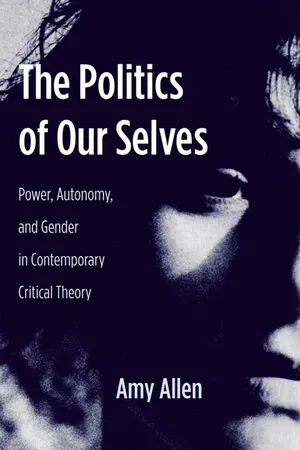
eBook - ePub
The Politics of Our Selves
Power, Autonomy, and Gender in Contemporary Critical Theory
- English
- ePUB (mobile friendly)
- Available on iOS & Android
eBook - ePub
About this book
Information
Subtopic
Feminism & Feminist TheoryIndex
Social Sciences1
Introduction
THE POLITICS OF OUR SELVES
Maybe the problem of the self is not to discover what it is in its positivity, maybe the problem is not to discover a positive self or the positive foundation of the self. Maybe our problem is now to discover that the self is nothing else than the historical correlation of the technology built in our history. Maybe the problem is to change those technologies. And in this case, one of the main political problems would be nowadays, in the strict sense of the word, the politics of ourselves.
—FOUCAULT

However, Foucault’s call for a politics of ourselves remains a bit ambiguous. It seems to entail two distinct, though related, claims. First, it suggests that the self is not a natural or given entity (which Foucault indicates by saying that we have to give up on discovering the self in its positivity) but a political one, in the sense that it is constituted by power relations. This is why Foucault indicates in his lectures “About the Beginnings of the Hermeneutics of the Self” that technologies of the self have to be studied together with technologies of domination: that is, “if one wants to analyze the genealogy of the subject in Western civilization,” one has to “take into account the points where the technologies of domination of individuals over one another have recourse to processes by which the individual acts upon himself. And conversely, he has to take into account the points where the techniques of the self are integrated into structures of coercion or domination.”1 Foucault goes on to call the “contact point” between these two technologies “government.”2 Second, implicit in the idea of technologies of the self is an appeal to some notion of the self’s autonomy in the sense of a capacity for self-transformation, as is evident in his definition of “techniques of the self”: “techniques which permit individuals to effect, by their own means, a certain number of operations on their own bodies, on their own souls, on their own thoughts, on their own conduct, and this in a manner so as to transform themselves, modify themselves, and to attain a certain state of perfection, of happiness, of purity, of supernatural power, and so on.”3 Implicit here too, though perhaps more so, is a notion of autonomy in the sense of critical reflection: the capacity to reflect critically upon the state of one’s self and, on this basis, to chart paths for future transformation. This sense of autonomy comes to the fore more explicitly in some of Foucault’s other late writings, for instance, when he refers to the “critical ontology of ourselves … conceived as an attitude, an ethos, a philosophical life in which the critique of what we are is at one and the same time the historical analysis of the limits that are imposed on us and an experiment with the possibility of going beyond them.”4 These twin notions of autonomy—understood as the capacities for critical reflection and self-transformation—underpin Foucault’s notion of the politics of ourselves.
However, this leads us to a difficulty, for these two sides of the politics of the self are often thought to be incompatible with each other. It has been assumed that thinking of the self as political in the first sense, as constituted by power, makes a politics of the self in the second sense impossible, because it reveals agency, autonomy, and critique to be nothing more than illusions, power’s clever ruses. This assumption motivates both those who claim that Foucault’s late work on practices of the self is contradictory to his archaeological and geneaological writings and those who argue that a Foucaultian account of subjection is incompatible with autonomy understood as critical reflexivity, the capacity to take up a critical perspective on the norms, practices, and institutions that structure our lives. The difficulty in getting past this issue has fueled the Foucault-Habermas debate; its feminist incarnation, the debate between Judith Butler and Seyla Benhabib; and, more generally, debates about the usefulness of postmodernism for feminism.
The central aim of this book is to develop a framework that illuminates both aspects of the politics of the self. My goal is to offer an analysis of power in all its depth and complexity, including an analysis of subjection that explicates how power works at the intrasubjective level to shape and constitute our very subjectivity, and an account of autonomy that captures the constituted subject’s capacity for critical reflection and self-transformation, its capacity to be self-constituting. Developing this sort of account is crucially important for critical theory. As Benhabib has argued, a critical social theory has two aspects: “explanatory-diagnostic” and “anticipatory-utopian.”5 Under the former aspect, critical theory offers an empirically grounded critical diagnosis of the central crisis tendencies and social pathologies of the present; under the second, it charts paths for future transformation. Without an account of subjection, critical theory cannot fulfill the first task because it cannot fully illuminate the real-world relations of power and subordination along lines of gender, race, and sexuality that it must illuminate if it is to be truly critical. But without a satisfactory account of autonomy, critical theory cannot fulfill the second task; it cannot envision possible paths of social transformation. One of the central arguments of this book is that, to date, Habermasian critical theory has done a much better job with the second task than it has with the first. In order for critical theory to offer a compelling diagnosis of the present, it would do well to take very seriously the analyses of subjection offered by Foucault and Butler.
The account I offer here also has important implications for feminist theory, which has grappled as well with this ambivalent notion of the politics of the self. But in this case the challenge tends to come from the opposite direction. Whereas there has been some controversy over this, many feminist theorists have accepted Foucault’s analysis of power and subjection and used it as a framework for their analyses of gender subordination. Although Foucault’s analysis of disciplinary and normalizing power has proven extremely fruitful for such explanatory-diagnostic purposes, it has generated a host of problems concerning subjectivity, agency, autonomy, collective social action, and normativity. As I will argue below, there are resources within Foucault’s work for responding to some of these challenges, particularly the claim that his analysis of power undermines any possible conception of subjectivity, agency, and autonomy. The remaining issues can be addressed by integrating Foucault’s insights into power and subjection with the normative-theoretical insights of Habermas.
This project is situated at the intersection of feminism and critical theory, and it seeks to develop an account of the politics of our selves that would be fruitful for both projects. My account draws on the theoretical resources offered by both Foucault and Habermas and develops these into a framework that is, I hope, useful for theorizing gender, race, and sexual subordination and the possibilities for resisting and transforming such subordination in more emancipatory directions. Given the long-standing debate between Foucault and Habermas and their intellectual progeny and the widespread assumption that these two men offer radically different, even incompatible philosophical and social-theoretical frameworks, this goal might seem quixotic. In order to show why this is not so, I devote a good deal of time in what follows to making the case that there is much more middle ground between Foucault and Habermas than either their critics or their supporters have assumed up to now. In the case of Foucault, this involves arguing that many of the standard Habermasian (and feminist) critiques of his work have been based on a misunderstanding of his oeuvre. In the case of Habermas, it involves offering a weaker, more contextualist, and pragmatic reading of his normative project, in order to make that project compatible with a Foucaultian analysis of power. But the purpose of these interpretive arguments is ultimately a systematic and constructive one: to develop a feminist critical-theoretical account of the politics of our selves that does justice to the ways in which the self is both constituted by power and simultaneously capable of being self-constituting. In the remainder of this chapter, I explore the most difficult challenges that such an account will have to meet.
The Entanglement of Power and Validity
What is at stake for feminist critical theory in this notion of the politics of our selves is revealed in a particularly vivid way in the well-known debate among Judith Butler, Seyla Benhabib, and Nancy Fraser, published as Feminist Contentions: A Philosophical Exchange. Inasmuch as this debate also stages a confrontation between Habermasian critical theory and its poststructuralist Foucaultian Other, I think it is worthwhile to start by reviewing this exchange. My focus here is limited to just one strand of this wide-ranging debate, but it is not only the strand that is most relevant to this project, but also, it seems to me, the central point of contention in the debate: the strand that concerns the problem of the subject and the possibility of critique.6
Benhabib initiates this thread of the exchange by arguing that an acceptance of what she calls, borrowing Jane Flax’s terminology, the postmodern “death of man” thesis is incompatible with feminism. Although Benhabib admits that all parties might agree to a weak version of this thesis, according to which the subject is always situated in various social and linguistic practices, the strong version, which dissolves the subject into just another position in language/discourse, is, in her view, incompatible with the feminist interest in autonomy and emancipation. This interest compels feminists to assume, according to Benhabib, that “the situated and gendered subject is heteronomously determined but still strives toward autonomy. I want to ask how in fact the very project of female emancipation would even be thinkable without such a regulative principle on agency, autonomy, and selfhood?”7
Although Butler scoffs at what she sees as Benhabib’s overly simplistic characterization of postmodernism, she does defend what she describes as a crucial insight of her (and Foucault’s) variant of poststructuralism, which, she insists, does not dissolve, undermine, or dispense with the subject at all. As Butler sees it, “the critique of the subject is not a negation or repudiation of the subject, but rather, a way of interrogating its construction as a pregiven or foundationalist premise.”8 Moreover, she claims that thinking of the subject as constructed by relations of power does not necessitate a denial of agency: “on the contrary, the constituted character of the subject is the very precondition of its agency. For what is it that enables a purposive and significant reconfiguration of cultural and political relations, if not a relation that can be turned against itself, reworked, resisted?”9
The closely related issue of how to conceptualize critique first emerges in Benhabib’s discussion of another main thesis of postmodernism—the “death of metaphysics” thesis, which asserts the death of grand metanarratives—but it quickly merges into the questions of subjectivity, agency, and critical reflexivity that are raised in her discussion of the death of man thesis. Benhabib argues that the postmodernist commitment to a strong version of the death of metaphysics thesis “would eliminate … not only metanarratives of legitimation but the practice of legitimation and criticism altogether.”10 Although postmodernists defend a conception of immanent critique, Benhabib contends that such a conception of critique does not in fact exempt such theorists from the task of philosophical and normative justification. Inasmuch as cultures and traditions are made up of, as Benhabib puts it, “competing sets of narratives and incoherent tapestries of meaning,” even the practitioner of immanent critique must engage in philosophical and normative justification of her own criteria.11 In response, Butler appears to sidestep the issue of normative justification, focusing instead on the entanglement of power and validity. As she sees it, “power pervades the very conceptual apparatus that seeks to negotiate its terms, including the subject position of the critic; and, further … this implication of the terms of criticism in the field of power is not the advent of a nihilistic relativism incapable of furnishing norms, but, rather, the very precondition of a politically engaged critique.”12 Here Butler invokes Foucault’s (in)famous claim that there is no outside to power; if one starts with this assumption, then all critique is, of necessity, immanent, whether the critic realizes or admits this or not. There is no choice between immanent and transcendent critique. Not only that, but the very positing of a critical perspective that is capable of transcending power relations—even if that perspective is “hypothetical, counterfactual, imaginary”—“is perhaps the most insidious ruse of power.”13 In a footnote to this passage, Butler makes it explicit, although it was already perfectly clear, that she considers Habermasian critical theory to be a prime example of this insidious ruse.14
Enter Fraser, who argues that the Butler-Benhabib debate is a false antithesis and, consequently, that feminists do not have to choose between Foucaultian-Butlerian poststructuralism and Habermasian-Benhabibian critical theory. Regarding the disagreement over the death of man thesis, Fraser boldly stakes out a middle ground. Fraser endorses Butler’s claim, “pace Benhabib, that it is not sufficient to view the subject as situated vis-à-vis a setting or context that is external to it. Instead, we should see the subject as constituted in and through power/discourse formations. It follows that there exists no structure of subjectivity that is not always already an effect of a power/discourse matrix; there is no ‘ontologically intact reflexivity,’ no reflexivity that is not itself culturally constructed.”15 However, given that Butler seems committed to the belief that such constituted subjects have critical capacities, Fraser “take[s] her point here to be that critical capacities are culturally constructed.”16 Although Benhabib is clearly committed to the existence and importance of critical capacities, she does not take a position on the issue of where these capacities come from; moreover, as Fraser sees it, “it is perfectly possible to give an account of the cultural construction of critical capacities. Thus, nothing in principle precludes that subjects are both culturally constructed and capable of critique.”17 However, with Benhabib, Fraser does see a problem with Butler’s view, which concerns the way that Butler equates critique with resignification. According to Fraser, this formulation sidesteps the normative dimension of critical theory and thus seems to “valorize change for its own sake and thereby to disempower feminist judgment.”18 So her summation of the debate is that “feminists need to develop an alternative conceptualization of the subject, one that integrates Butler’s poststructuralist emphasis on construction with Benhabib’s critical-theoretical stress on critique.”19
In her reply to the initial exchange, Fraser sums up the strengths and weaknesses of each of the two positions, and thus she poses the challenges for the development of such an alternative conceptualization of the subject. Whereas Benhabib’s Habermasian framework usefully captures in a nonessentializing, nonfoundationalist, proceduralist way the normative dimension that Fraser takes to be crucial to feminist theorizing, its focus on “justification and validity marginalizes questions about motivation and desire; thus, it cannot help us understand why women sometimes cling to perspectives that disadvantage them, even after the latter have been rationally demystified. More generally … Benhabib’s approach valorizes the active, constituting side of individuals’ involvement in communicative practice, to the relative neglect of the passive, constituted side.”20 Butler’s Foucaultian account, by contrast, “cogently defends the need for denaturalizing critique, critique that reveals the contingent...
Table of contents
- Cover
- Half title
- Series Page
- Title
- Copyright
- Dedication
- Contents
- Acknowledgments
- 1. Introduction: The Politics of Our Selves
- 2. Foucault, Subjectivity, and the Enlightenment: A Critical Reappraisal
- 3. The Impurity of Practical Reason: Power and Autonomy in Foucault
- 4. Dependency, Subordination, and Recognition: Butler on Subjection
- 5. Empowering the Lifeworld? Autonomy and Power in Habermas
- 6. Contextualizing Critical Theory
- 7. Engendering Critical Theory
- Concluding Reflections
- Notes
- Bibliography
- Index
Trusted by 375,005 students
Access to over 1.5 million titles for a fair monthly price.
Study more efficiently using our study tools.
Frequently asked questions
Yes, you can cancel anytime from the Subscription tab in your account settings on the Perlego website. Your subscription will stay active until the end of your current billing period. Learn how to cancel your subscription
No, books cannot be downloaded as external files, such as PDFs, for use outside of Perlego. However, you can download books within the Perlego app for offline reading on mobile or tablet. Learn how to download books offline
Perlego offers two plans: Essential and Complete
- Essential is ideal for learners and professionals who enjoy exploring a wide range of subjects. Access the Essential Library with 800,000+ trusted titles and best-sellers across business, personal growth, and the humanities. Includes unlimited reading time and Standard Read Aloud voice.
- Complete: Perfect for advanced learners and researchers needing full, unrestricted access. Unlock 1.5M+ books across hundreds of subjects, including academic and specialized titles. The Complete Plan also includes advanced features like Premium Read Aloud and Research Assistant.
We are an online textbook subscription service, where you can get access to an entire online library for less than the price of a single book per month. With over 1.5 million books across 990+ topics, we’ve got you covered! Learn about our mission
Look out for the read-aloud symbol on your next book to see if you can listen to it. The read-aloud tool reads text aloud for you, highlighting the text as it is being read. You can pause it, speed it up and slow it down. Learn more about Read Aloud
Yes! You can use the Perlego app on both iOS and Android devices to read anytime, anywhere — even offline. Perfect for commutes or when you’re on the go.
Please note we cannot support devices running on iOS 13 and Android 7 or earlier. Learn more about using the app
Please note we cannot support devices running on iOS 13 and Android 7 or earlier. Learn more about using the app
Yes, you can access The Politics of Our Selves by Amy Allen in PDF and/or ePUB format, as well as other popular books in Social Sciences & Feminism & Feminist Theory. We have over 1.5 million books available in our catalogue for you to explore.