Adrian Johnston and Catherine Malabou defy theoretical humanities' deeply-entrenched resistance to engagements with the life sciences. Rather than treat biology and its branches as hopelessly reductive and politically suspect, they view recent advances in neurobiology and its adjacent scientific fields as providing crucial catalysts to a radical rethinking of subjectivity.
Merging three distinct disciplines—European philosophy from Descartes to the present, Freudian-Lacanian psychoanalysis, and affective neuroscience—Johnston and Malabou triangulate the emotional life of affective subjects as conceptualized in philosophy and psychoanalysis with neuroscience. Their experiments yield different outcomes. Johnston finds psychoanalysis and neurobiology have the potential to enrich each other, though affective neuroscience demands a reconsideration of whether affects can be unconscious. Investigating this vexed issue has profound implications for theoretical and practical analysis, as well as philosophical understandings of the emotions.
Malabou believes scientific explorations of the brain seriously problematize established notions of affective subjectivity in Continental philosophy and Freudian-Lacanian analysis. She confronts philosophy and psychoanalysis with something neither field has seriously considered: the concept of wonder and the cold, disturbing visage of those who have been affected by disease or injury, such that they are no longer affected emotionally. At stake in this exchange are some of philosophy's most important claims concerning the relationship between the subjective mind and the objective body, the structures and dynamics of the unconscious dimensions of mental life, the role emotion plays in making us human, and the functional differences between philosophy and science.
eBook - ePub
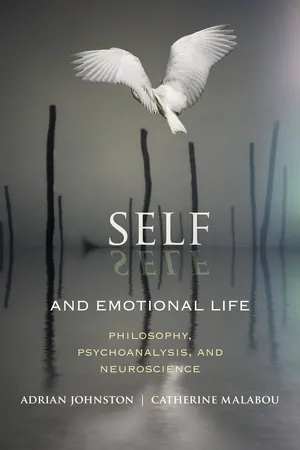
Self and Emotional Life
Philosophy, Psychoanalysis, and Neuroscience
- English
- ePUB (mobile friendly)
- Available on iOS & Android
eBook - ePub
Self and Emotional Life
Philosophy, Psychoanalysis, and Neuroscience
About this book
Information
Topic
Sciences biologiquesSubtopic
Déconstruction en philosophiePART I.
GO WONDER
SUBJECTIVITY AND AFFECTS IN NEUROBIOLOGICAL TIMES

INTRODUCTION
FROM THE PASSIONATE SOUL TO THE EMOTIONAL BRAIN
Current neurobiology is engaged in a deep redefinition of emotional life. The brain, far from being a nonsensuous organ, devoted solely to logical and cognitive processes, now appears, on the contrary, to be the center of a new libidinal economy. Such a vision is not only displacing the relationship between body, mind, and the psyche. It also disturbs disciplinary boundaries and induces secret networks between sciences (biology and neurobiology) and the humanities (philosophy and psychoanalysis). A new conception of affects is undoubtedly emerging.
Many neurobiologists today insist upon the role of the “emotional brain.” This leads them to elaborate a new theory of affects that is rooted in the traditional one, but whose conclusions transgress the frame of the philosophical analysis of passions, and even the frame of deconstruction.
The general issue I address here is the following: Does this new conception produce a genuinely different approach to emotions, passions, and feelings? Or, by contrast, does it consist in a mere reformulation of the traditional approaches to these topics? Is current neuroscience just a repetition or is it engaged in an unprecedented material and radical deconstruction of affects, feelings, and emotions—and, hence, in a new deconstruction of subjectivity? The problem is knowing whether emotions and affects are still considered rooted in an originary process of autoaffection of the subject—where the subject has to touch itself in order to be moved or touched by objects—or if the study of the emotional brain precisely challenges the vision of a self-affecting subjectivity in favor of an originary deserted subject, a subject that is definitely not present to itself.
This issue is all the more difficult if we consider that psychoanalysis, as well as contemporary Continental philosophy, has attempted precisely the production of a strong critique of autoaffection and its supposed priority. What, then, does the conception of a specifically neural libidinal economy introduce into the field of this critique? Does it just confirm this critique or does it dramatically metamorphose it?
The following intervention involves a confrontation between three approaches—philosophical, psychoanalytical and neurobiological—to the same issue: the origin of affects, an origin that is not and can no longer be determined by and as the primordial gesture of a subject meeting up with itself. We will see how, from this shared question, the responses vary to the point of producing perhaps insurmountable divergences. It is in pushing off from a reading of the theory of the passions in Descartes and Spinoza that Antonio Damasio, in his books Descartes’ Error and Looking for Spinoza, has presented his studies of the relations between the brain and emotion—with these studies also seeming to have the consequence, in his eyes, of leading to a new definition of affects. It has appeared to me pertinent to set off again from this theory in order to establish a dialogue or, perhaps, its impossibility. I will confront here Derrida’s reading of Descartes, Deleuze’s and Damasio’s readings of Spinoza, and Damasio’s work on these two major philosophers. The psychoanalytic theory of affects will be examined from a transversal point of view, appearing through the other discourses, as both a necessary benchmark and a controversial reference.
Affects and Autoaffection: Definitions
Let’s borrow the definition of the term affect from Deleuze who, in one of his lectures from 1978 on Spinoza’s Ethics (January 24, 1978), declares:
I begin with some terminological cautions. In Spinoza’s principal book, which is called the Ethics and which is written in Latin, one finds two words: affectio and affectus. Some translators, quite strangely, translate both in the same way. This is a disaster. They translate both terms, affectio and affectus, by “affection.” I call this a disaster because when a philosopher employs two words, it’s because in principle he has reason to, especially when French easily gives us two words that correspond rigorously to affectio and affectus, that is “affection” for affectio and “affect” for affectus. Some translators translate affectio as “affection” and affectus as “feeling” [sentiment], which is better than translating both by the same word, but I don’t see the necessity of having recourse to the word feeling since French offers the word affect. Thus when I use the word affect it refers to Spinoza’s affectus, and when I say the word affection, it refers to affectio.1
Deleuze refers here explicitly to book 3 of the Ethics, which is entirely devoted to the problem of affects. It is true that the English translators of Spinoza make use of “emotions” instead of “affects,” as in the title of book 3 (“Concerning the Origin and Nature of the Emotions” [De Origine et Natura Affectuum]) or in definition 3 of that book: “By emotion [affectus] I understand the affections of the body by which the body’s power of activity is increased or diminished, assisted or checked, together with the ideas of these affections.”2
Generally speaking, an affect is a modification. Being affected means to be modified—that is, altered, changed—by the impact of an encounter, be it with another subject or an object. But, what, exactly, is modified by this encounter, and why does this modification create an emotional, and not immediately cognitive, phenomenon? This is because the encounter does not trigger any faculty or sense or logical structure; it touches—and thus reveals—the very feeling of existence. Deleuze goes on: “I would say that for Spinoza there is a continuous variation—and this is what it means to exist—of the force of existing or of the power of acting.… Affectus in Spinoza is variation (he is speaking through my mouth; he didn’t say it this way because he died too young …), continuous variation of the force of existing, insofar as this variation is determined by the ideas one has.”3 The force of existing is constant, but it differs from itself all the time, varies in its continuous power. Affects circumscribe precisely this paradoxical transformability of duration and persistence. An affect is thus always related to the feeling of existence itself through the changing of objects. We may call affect every kind of modification produced by the feeling of a difference.
Let’s now move to the word autoaffection. Apparently, this term is very distant from the Spinozan context to the extent that it was coined by Heidegger in Kant and the Problem of Metaphysics. Heidegger makes use of it when he comments on section 24 of Critique of Pure Reason. Here, Kant states that the subject is both a transcendental logical form—the form of the “I think” (or transcendental apperception), with no sensuous content—and the empirical form of the subject’s intuition, the way in which the subject “sees,” “feels,” or “intuits” herself. The subject is two in one.4 The only mode of communication between the “two” subjects is a kind of affect. First, the subject can only represents itself as it appears empirically to itself.5 Second, the “I think” itself, or the apperception, as soon as it takes itself as an object, loses its formal transcendental determination to become an intuited object (i.e., an object of the inner sense that affects it). The subject can only represent itself as affected—altered—by itself. The self has access to itself through its own otherness or alterity. The self-representation of the subject is thus always an autoaffection.
The process of autoaffection is for Kant time itself. The subject receives its own forms, it perceives its own logical structure, through the way in which it apprehends itself empirically as remaining the same through change and succession. Autoaffection is thus the temporal difference between the self and itself. Heidegger declares: “Time, that is pure autoaffection, constitutes the essential structure of subjectivity.”6 This structure—autoaffection as temporality—is, according to Heidegger, the origin of all other kinds of affects: passions, emotions, and feelings. Autoaffection appears to be the basis, the condition of possibility, of the primary and primordial form of every particular affect. Feelings like love, hatred, envy, and the like are only possible because the very core of our self is primarily autoaffected. The relationship between subjectivity and itself is prior to the relationship between subjectivity and its objects.
It is easy to discover that the motif of autoaffection is closely linked with Spinoza’s definition of affects as modifications of the power of existing, or conatus. Autoaffection designates the very feeling of existence; the “I” who feels itself is the dominant structure of all affective modification. The very structure of subjectivity, within the metaphysical tradition, was one and the same with the structure of autoaffection, that is, as this kind of self-touching through which the subject is feeling its singular presence. If it is true that, according to traditional philosophers, there cannot be any affects without a primary autoaffection, then all affects might be defined as particular touches, as variations of an originary self-touching, the introduction of time within identity. If an affect is a modification produced by the feeling of a difference, the primordial form of emotional modification is produced by the feeling of the subject’s own difference from itself. Hence the precise definition of the passions of the soul: in section 27, Descartes declares: “We may define them generally as those perceptions, sensations or emotions of the soul which we refer particularly to it.”7
How are we then to understand our initial issue? Can we think of affects outside autoaffection, affects without subjects, affects that do not affect “me”? The contemporary authors that we will study all envisage a response to this question. They do so in playing Descartes and Spinoza against each other, in showing that the two philosophers both, each in his manner, already brings out this problem. In the first case (Derrida and Damasio), Descartes is the pure thinker of autoaffection, while Spinoza anticipates the vision of a subjectivity that does not preexist its affects but is, on the contrary, constituted by them. Damasio, for his part, affirms that Spinoza is the first and only philosopher of the tradition to have elaborated a materialist definition of affects that relates them to a primary activity of cerebral cartography and not to the substantial presence of a subject to itself. The Descartes-Spinoza conflict prefigures the contemporary conflict between metaphysics and neurobiology about the definition of the mind and the psyche. For Damasio, if Descartes is the great metaphysician of presence, Spinoza appears, on the other hand, as a “protoneurologist.” As for Deleuze, it’s a different case, with his recognizing in Descartes a power of surpassing the closure of the subject in on itself. Both Descartes and Spinoza bring to light a certain dimension of affects by which they exceed the pure reflexivity of the “I.”
In following the thread of these readings, we will try to situate the locus of a possible dialogue between two conflictual positions, that of philosophy and that of neurobiology. How is it possible to effectively deconstruct autoaffection? Is it by positing the existence of what Derrida identifies as originary “heteroaffection,” where the subject is primarily and profoundly alien to itself? Or, is it by affirming, as Damasio does, that a subject is constantly exposed to the potential deprivation of all affects because of brain damage? According to neurobiologists, the possibility of being detached from one’s own affects is not a pure and purely external contingency that may happen to a healthy autoaffected subject; it is virtually already inscribed in some way within the process of autoaffection itself.
Damasio, by elaborating the theory of “somatic markers,” stresses the central importance of emotions in neural regulation. Elementary mechanisms of thought or of reasoning are deeply linked with emotional processes. The principle of decision making, for example, is emotional. In the introduction to Descartes’ Error, Damasio writes: “I began writing this book to propose that reason may not be as pure as most of us think it is or wish it were, that emotions and feelings may not be intruders in the bastion of reason at all: they may be enmeshed in its networks, for worse and for better. The strategies of human reason probably did not develop, in either evolution or any single individual, without the guiding force of the mechanisms of biological regulation, of which emotion and feeling are notable expressions.”8
Paradoxically enough, it is the impairment of emotional processes—occurring after a brain lesion, for example—that reveals their importance: “the absence of emotion and feeling is no less damaging, no less capable of compromising the rationality that makes us distinctively human and allows us to decide in consonance with a sense of personal future, social convention, and moral principle.”9
I would like to advance here that the notion of an absence of emotions, which does not come from a kind of disavowal or any type of psychic strategies, marks the novelty of the current neurobiological point of view on affects. Paradoxically, it is not so much the insistence on the major role of emotion in reasoning or in cognitive processes in general that signals the revolutionary position of some cutting-edg...
Table of contents
- Cover
- Half title
- Series Page
- Title
- Copyright
- Contents
- Preface: From Nonfeeling to Misfeeling—Affects Between Trauma and the Unconscious
- Acknowledgments
- Part I. Go Wonder: Subjectivity and Affects in Neurobiological Times
- Part II. Misfelt Feelings: Unconscious Affect Between Psychoanalysis, Neuroscience, and Philosophy
- Notes
- Index
Trusted by 375,005 students
Access to over 1.5 million titles for a fair monthly price.
Study more efficiently using our study tools.
Frequently asked questions
Yes, you can cancel anytime from the Subscription tab in your account settings on the Perlego website. Your subscription will stay active until the end of your current billing period. Learn how to cancel your subscription
No, books cannot be downloaded as external files, such as PDFs, for use outside of Perlego. However, you can download books within the Perlego app for offline reading on mobile or tablet. Learn how to download books offline
Perlego offers two plans: Essential and Complete
- Essential is ideal for learners and professionals who enjoy exploring a wide range of subjects. Access the Essential Library with 800,000+ trusted titles and best-sellers across business, personal growth, and the humanities. Includes unlimited reading time and Standard Read Aloud voice.
- Complete: Perfect for advanced learners and researchers needing full, unrestricted access. Unlock 1.5M+ books across hundreds of subjects, including academic and specialized titles. The Complete Plan also includes advanced features like Premium Read Aloud and Research Assistant.
We are an online textbook subscription service, where you can get access to an entire online library for less than the price of a single book per month. With over 1.5 million books across 990+ topics, we’ve got you covered! Learn about our mission
Look out for the read-aloud symbol on your next book to see if you can listen to it. The read-aloud tool reads text aloud for you, highlighting the text as it is being read. You can pause it, speed it up and slow it down. Learn more about Read Aloud
Yes! You can use the Perlego app on both iOS and Android devices to read anytime, anywhere — even offline. Perfect for commutes or when you’re on the go.
Please note we cannot support devices running on iOS 13 and Android 7 or earlier. Learn more about using the app
Please note we cannot support devices running on iOS 13 and Android 7 or earlier. Learn more about using the app
Yes, you can access Self and Emotional Life by Adrian Johnston,Catherine Malabou in PDF and/or ePUB format, as well as other popular books in Sciences biologiques & Déconstruction en philosophie. We have over 1.5 million books available in our catalogue for you to explore.