- English
- ePUB (mobile friendly)
- Available on iOS & Android
eBook - ePub
About this book
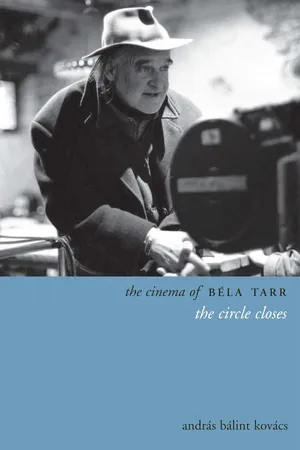
The Cinema of Béla Tarr is a critical analysis of the work of Hungary's most prominent and internationally best known film director, written by a scholar who has followed Bela Tarr's career through a close personal and professional relationship for more than twenty-five years. András Bálint Kovács traces the development of Tarr's themes, characters, and style, showing that almost all of his major stylistic and narrative innovations were already present in his early films and that through a conscious and meticulous recombination of and experimentation with these elements, Tarr arrived at his unique style. The significance of these films is that, beyond their aesthetic and historical value, they provide the most powerful vision of an entire region and its historical situation. Tarr's films express, in their universalistic language, the shared feelings of millions of Eastern Europeans.
Information
Subtopic
Film & VideoCHAPTER ONE
The Persona
Because this chapter is about Béla Tarr as a person, I will not refrain from evoking a personal memory. The first time I met with Tarr was in 1979, at a screening of Ermanno Olmi’s The Post. The screening was organised by filmmakers, Béla Tarr among them, who not much later organised their own filmmaking studio, called Társulás. Their goal was to find young film critics who were receptive to supporting their particular goals in creating documentary-style fiction films. As we left the screening room and walked toward some club in which we would discuss the film, Béla started to talk about the film, while most of us, including myself, were just trying to make some sense of what we had just seen. I was amazed by his crystal clear, strong, sharp and unambiguous comments formulated five minutes after he had finished watching a film for the first time. I was amazed how someone could have such an assured approach to the world as to be able to form so quickly an uncompromising, and accurate, opinion about anything. By the time we arrived at the club I was convinced that there was no other way of interpreting this film than the way Béla Tarr did. At least this is how I remember the story; Tarr has a different recollection of it. He says he was not present at the screening, and has never seen this film. He joined us only when we left the screening room, and made his comments only after he had listened to our conversation about the film. Whatever is the case, my impression of what he said was the same. Whether or not he saw it, he gave me a key to this film through the unambiguous, straightforward words he used.
This first impression has never changed since then. I think that the key to his character can be found in the power of his approach to the world, the uncompromising stubbornness of pursuing his goals, and the intelligence and sophistication by which he formulates his vision in both words and images.
The outsider
Béla Tarr was born in Pécs, in southern Hungary, in 1955. For his fourteenth birthday he received an 8mm camera from his father. Very soon, at the age of seventeen, this camera got him into trouble. During his high school years he got involved with some radical leftist movements ideologically not far from Maoism. These groups, although consisting of intellectuals and artists, made a cult around physical work and around being among workers. They grouped around music groups like Monszun and theatre groups such as Orfeo. Tarr, while still a high school student, also went regularly to work in a shipyard and followed these groups on their regular excursions to workers’ districts and workers’ hostels. On one of these occasions he met a group of gypsy workers who wrote a letter to János Kádár, first secretary of the Hungarian Socialist Workers Party, asking him to grant them permission to leave the country to work in Austria, because they could not find enough work at home. The whole idea seemed so absurd in 1971 in a country where even visiting a relative living abroad required obtaining special permission, which proved an ordeal to anyone who tried, and this story inspired the sixteen-year-old Tarr to ask these workers to talk about their situation and motivation for his camera. With two of his friends they formed a filmmaking group they named after Dziga Vertov (referring to Jean-Luc Godard and Jean-Pierre Gorin’s ‘Dziga Vertov Group’). Tarr’s Dziga Vertov Group made a documentary about these men, and sent this film, Guest Workers (lost since then), to an amateur film festival, where it won first prize. The success made Tarr very proud of his film, which he wanted everybody, especially workers, to see. So he took his projector and tape recorder, and several times a week he would visit workers’ hostels, where he would set up his equipment and screen the film to workers arriving home from the factory. He even made posters by hand to advertise these projections at the workers’ hostels.
The workers took this well, but the Communist Party did not. One day at school, Tarr was ordered to go to the local party office to explain what he was doing and to screen the film to the party officials. They watched the film but didn’t say anything. They let him go, and no direct retaliation was undertaken. But a year later, when, after finishing high school, he wanted to study at university, he was told not even to think about it. He was denied admission to every higher educational institution in the country. So he went to work in the shipyard. He worked there for two years, but his frail, thin build wasn’t meant for the hard physical labour. He sent an application to the department of philosophy of Budapest’s ELTE University. At the admission exam he shocked the examining professor by asserting that Marx’s Communist Manifesto was like a work of art rather than a political programme, and that communism was a movement rather than some institutionalised political formation. He was refused admittance. He took the job of doorman at a cultural centre in one of Budapest’s workers’ districts. In the meantime he continued making amateur films, one of which won another prize at a subsequent amateur film festival. Members of the jury included István Dárday and Györgyi Szalai, two prominent representatives of a group of documentary filmmakers working in a kind of semi-documentary, semi-fictional genre. They invited Tarr to work as an assistant on their next major project, Film Saga (Film-regény, 1977). At the age of twenty, Tarr had his first real contact with professional filmmaking.
In the meantime, Tarr already had a film project in the works, part of which was the film he won the prize for at the amateur film festival. This was about a young woman named Irén Szajki, whom Tarr met when he was filming in a workers’ district on the outskirts of Budapest that has been demolished since then. Irén was squatting in an apartment for a period, but eventually the city council had her evicted by force. Tarr, who was working alone at that time, decided to film the act of eviction. He found a hideout in a neighbouring building from which he could film the action quietly, and settled there half an hour before the city council agents arrived, accompanied by the police. Somehow the police found out about his being there and began the whole procedure by arresting him first and taking him to police headquarters. He was kept there half of the day, during which time the agents accomplished their mission. After that he was let go. Irén had nowhere else to go from this apartment but to his father-in-law’s place, where she was the twelfth person in residence. This was the origin of Tarr’s first full-length feature film, Family Nest (Családi tűzfészek, 1977), where Irén Szajki played the female protagonist. She also played important roles in later Tarr films, such as Satantango and Werckmeister Harmonies.
Family Nest was made by the Balázs Béla Stúdió, an independent studio for young filmmakers, and released in 1979. At the age of twenty-two not only did he become the youngest film director in Hungary with a full-length feature film officially released, but thanks to Family Nest he earned a national and international reputation, the film also winning the Grand Prize at the 1979 Mannheim International Film Festival. At the same time, the fact that Tarr did not have any professional training did not escape attention. Not only was he very young, but he was also a total outsider in a professional community that was very careful not to allow anyone near film production who did not go through official training. For Tarr to be taken seriously as a filmmaker it was strongly advised he go to an official film school. Although just a couple of years earlier he had been banned from all higher educational institutions in Hungary, after Family Nest it would have been very difficult not to admit him to film school. He was accepted into Miklós Szinetár’s class, originally a television director training programme, later changed into a film director’s programme in 1978.
Tarr was no less an outsider in film school, not bothering to attend many classes. He was making his next feature film, The Outsider (Szabadgyalog, 1980). He was allowed to do whatever he liked, and was not required to live a regular film student’s life. The Outsider was already an official professional studio production. After the release of this film he started his third project, The Prefab People (Panelkapcsolat, 1982). At the same time he made Macbeth (1982), originally a film school assignment but later reproduced for television. By the time he graduated from film school he already had three full-length feature films finished, and two international awards, the Locarno Festival special mention for The Prefab People being the second. This was quite an unusually intense beginning to a professional career for a filmmaker of his age.
In 1980 Tarr was among the founders of a newly formed studio, called Társulás Studió. It was formed by people belonging to a certain ‘cinema direct’ current, who were joined by some others who had ideas about filmmaking outside of the then-mainstream politically correct realist norm of Hungarian cinema. Officially, its mission was to create and promote the semi-documentary, semi-fictional style the founders of the studio initiated five years earlier. However, filmmakers with clearly avant-garde ambitions could also come and make films in the studio. Very quickly Társulás became Hungarian cinema’s most inventive filmmaking studio. But Társulás was short-lived. Right from the outset, filmmakers from other studios did not agree with the formation of Társulás, for the simple reason that they all had to live on the shrinking state funding of the film industry. Another studio meant distribution of the funds between five studios instead of four. After six years’ constant struggle, in 1985 Társulás, the only institutional background for the innovative spirit of Hungarian cinema, was dissolved.
Tarr made two films with Társulás, The Prefab People and Almanac of Fall (Őszi Almanach, 1985). In 1985 his next project, Satantango, was accepted by the studio, but the production could not start. With the dissolution of Társulás the chances that he could make this film fell considerably. He tried to sell the idea to several of the remaining studios with no success. He was even told by one of the studio heads, a film director colleague, that he was an amateur and he had better quit filmmaking for good. In 1986 Tarr found himself marginalised in the official Hungarian film industry, which he never really belonged to anyway, and it looked like he would not be able to continue as a filmmaker within the existing institutional structure. He started a new project less ambitious than Satantango. It was an idea he had had earlier about a small-town singer and her husband, and together with László Kransznahorkai, writer of the source novel for Satantango, he wrote the script for Damnation. He was used to the idea of being an outsider and accepted this marginalised position. He brought together several sponsors not directly involved in filmmaking, like the Hungarian Film Institute and the Hungarian Advertising Agency; Hungarian Television and MOKÉP, the state film distribution company, joined the project later. If Hungarian Television had not been involved in the production, it would have been the first Hungarian feature film after World War II to be produced entirely outside the official filmmaking system.
Thus far Tarr was not a widely known filmmaker. Each of his steps into the realm of filmmaking was irregular and kept him at the margin of the film industry. As Ágnes Hranitzky put it: ‘He wasn’t taken seriously as a filmmaker. For the studio people, he was just a wannabe.’1 He was categorised as someone belonging to the by-then extinguished documentary-style fiction film movement, and not even as the most characteristic representative of it, in that his films showed very few direct political concerns. Almanac of Fall was already atypical of Tarr’s former work and provoked more enthusiasm among critics abroad than among those in Hungary; but this film laid the foundations for his international reputation. The discrepancy between his marginal status in Hungary and his growing international fame became even more pronounced with his next film, Damnation. The film provoked harsh or mocking reviews in Hungary and a total rejection by the jury of the Hungarian Film Week of 1988, but at same time, it earned him the Foreign Critics Award on the same occasion, two other international awards (Cannes and Bergamo), a nomination for the European Film Award and a number of other international festival invitations all over the world.
The next year Tarr received a DAAD2 fellowship for artists to spend a year in West Berlin. Upon return, the Tarr-Hranitzky couple gave up their apartment in the heart of Budapest and moved to a little village about thirty kilometres from the capital city. That is where they started preparations for their gigantic enterprise, Satantango. It looked as if Tarr had settled for remaining marginal to the Hungarian professional film world. He did not often participate in professional debates and did not keep in contact with most of the leading figures of Hungary’s professional film production. However, he has since become a frequent visiting professor at the Berlin film school, where he has been spending a couple of months each year. Ironically, he has not received any invitation to teach at the Hungarian film school as yet. In 1994 Satantango featured at the Hungarian Film Week. The organisers considered this a marginal event, forecasting a weak attendance due to the film’s extreme running time (seven and a half hours), and programmed it in a small theatre. Several hundred viewers showed up, loudly expressing their discontent. This film earned Tarr a massive international reputation among cinephiles all over the world. Respected critics praised this film, and a certain cult around it was born.
Due to the fact that during the preceding fifteen years he himself had to secure the financing for his own films, and played the role not only of the director but also of the executive producer, after the release of his next film, Werckmeister Harmonies, Tarr started his own production company, T. T. Filmműhely, together with producer Gábor Téni.
By the early years of 2000 Tarr was not a marginal figure any more. He was already well-known for his international successes and was recognised as a somewhat eccentric but important figure of Hungarian cinema. Although bringing together sponsorship for Werckmeister Harmonies took a long time, he managed to secure the financing for this film too, including important government grants. In 2003 he obtained the highest national award an artist can get in Hungary. In 2009 he accepted an offer to be a candidate for the future presidency of the Hungarian Film Foundation, but it was not long before he realised that there was very little support for his radical conception of how to run the Foundation, and he stepped back. In 2010 he was elected president of the Hungarian Filmmakers Association.
The lack of success of The Man from London was rather disappointing considering the high expectations, and all of this foreshadowed the difficulties surrounding the commencement of Tarr’s next project, The Turin Horse (2011). This is when Tarr announced that this film would be his last one, after which he would quit filmmaking. He made this announcement when he was already a national and international celebrity, known and respected by many in the international art-film world: T-shirts with his name on are on sale in Los Angeles, his style is imitated by other filmmakers, and he has become a cult figure for art-film audiences all over the world. In short, when Tarr ceased to be a marginalised outsider and became one of the touchstones of the mainstream high-brow art-film culture, he decided it was time to stop.
The maverick
‘When someone makes a film that is seven and a half hours long it means that he just ignores the way the world is.’3 Being an outsider has been a conscious choice for Tarr for the most part, and provided him with the freedom of not being engag...
Table of contents
- Cover
- Half title
- Series Page
- Title
- Copyright
- Contents
- Acknowledgments
- Introduction
- 1. The Persona
- 2. Style in the Early Years
- 3. The Tarr style
- 4. The Tarr style in Evolution
- 5. Narration in the Tarr Films
- 6. The Characters
- Conclusion
- Filmography
- Select Bibliography
- Index of Names
Trusted by 375,005 students
Access to over 1.5 million titles for a fair monthly price.
Study more efficiently using our study tools.
Frequently asked questions
Yes, you can cancel anytime from the Subscription tab in your account settings on the Perlego website. Your subscription will stay active until the end of your current billing period. Learn how to cancel your subscription
No, books cannot be downloaded as external files, such as PDFs, for use outside of Perlego. However, you can download books within the Perlego app for offline reading on mobile or tablet. Learn how to download books offline
Perlego offers two plans: Essential and Complete
- Essential is ideal for learners and professionals who enjoy exploring a wide range of subjects. Access the Essential Library with 800,000+ trusted titles and best-sellers across business, personal growth, and the humanities. Includes unlimited reading time and Standard Read Aloud voice.
- Complete: Perfect for advanced learners and researchers needing full, unrestricted access. Unlock 1.5M+ books across hundreds of subjects, including academic and specialized titles. The Complete Plan also includes advanced features like Premium Read Aloud and Research Assistant.
We are an online textbook subscription service, where you can get access to an entire online library for less than the price of a single book per month. With over 1.5 million books across 990+ topics, we’ve got you covered! Learn about our mission
Look out for the read-aloud symbol on your next book to see if you can listen to it. The read-aloud tool reads text aloud for you, highlighting the text as it is being read. You can pause it, speed it up and slow it down. Learn more about Read Aloud
Yes! You can use the Perlego app on both iOS and Android devices to read anytime, anywhere — even offline. Perfect for commutes or when you’re on the go.
Please note we cannot support devices running on iOS 13 and Android 7 or earlier. Learn more about using the app
Please note we cannot support devices running on iOS 13 and Android 7 or earlier. Learn more about using the app
Yes, you can access The Cinema of Béla Tarr by András B. Kovács in PDF and/or ePUB format, as well as other popular books in Media & Performing Arts & Film & Video. We have over 1.5 million books available in our catalogue for you to explore.