eBook - ePub
The Cinema of Steven Soderbergh
Indie Sex, Corporate Lies, and Digital Videotape
- English
- ePUB (mobile friendly)
- Available on iOS & Android
eBook - ePub
The Cinema of Steven Soderbergh
Indie Sex, Corporate Lies, and Digital Videotape
About this book
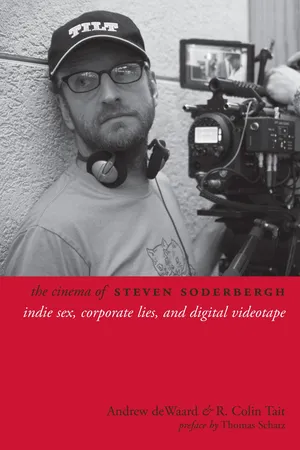
The industry's only director-cinematographer-screenwriter-producer-actor-editor, Steven Soderbergh is contemporary Hollywood's most innovative and prolific filmmaker. A Palme d'or and Academy Award-winner, Soderbergh has directed nearly thirty films, including political provocations, digital experiments, esoteric documentaries, global blockbusters, and a series of atypical genre films. This volume considers its slippery subject from several perspectives, analyzing Soderbergh as an expressive auteur of art cinema and genre fare, as a politically-motivated guerrilla filmmaker, and as a Hollywood insider. Combining a detective's approach to investigating the truth with a criminal's alternative value system, Soderbergh's films tackle social justice in a corporate world, embodying dozens of cinematic trends and forms advanced in the past twenty-five years. His career demonstrates the richness of contemporary American cinema, and this study gives his complex oeuvre the in-depth analysis it deserves.
Information
PART ONE
AUTHOR, BRAND, GUERRILLA
CHAPTER ONE
The Dialectical Signature: Soderbergh as Classical Auteur
I don’t consider myself an artist or a visionary… There are the Fellinis, the Altmans – even someone like Gus Van Sant – who push the film language, who bend and twist the medium to suit their vision. You look at their movies and you can’t imagine anyone else making them. I’m not that kind of filmmaker. I’m a chameleon.
Steven Soderbergh, 19931
Since its development more than half a century ago, auteur theory – the conceit that a film director’s personal creative vision is the predominate force in shaping the artistry of a film – has remained a contentious, heavily fragmented discourse.2 As with most other arts, film theory’s relationship with authorship has morphed and evolved through various iterations, due in large part to historical context and competing ideologies. Nevertheless, a common, if shaky, approach to cinematic authorship has coalesced in film criticism, and its formulation and application to Steven Soderbergh will be the focus of the current chapter. Subsequently, we will update auteur theory for the age of New Hollywood,3 Indiewood,4 and Conglomerate Hollywood,5 adding to it the dimensions of celebrity and fame to formulate the ‘sellebrity auteur.’ We will then follow that chapter with a decidedly non-traditional application of ‘Third Cinema,’ considering Soderbergh as a ‘guerrilla auteur,’ whose repossession of the means of production represents a significant advancement in the art form. But first, we will situate the director within the discourse of ‘classical’ auteur theory, identifying the prevailing patterns of Soderbergh’s work within this traditional view of authorship. As Soderbergh refuses to play by the rules, we will quickly see how our subject matter exceeds the increasingly limited boundaries of auteur theory, not to mention the classical paradigm. That being said, a brief rehearsal of auteur theory seems necessary, if only to analyse how well, paradoxically, the frame does in fact suit the director.
In the mid-1950s, film critics at the influential French journal Cahiers du cinéma set out to elevate the status of its most beloved film directors by championing the creative vision of luminaries like Alfred Hitchcock, Jean Renoir, and Howard Hawks. As a consequence of this central objective, these critics sought to diminish the role held by the screenwriter, who at that time was perceived to be the film’s true author. Led by François Truffaut, Jean-Luc Godard, and Eric Rohmer, the Cahiers group also sought to demonstrate how the true individual artist rose above the industrial formation of the Hollywood system to clearly relate their unique visions, particularly within set genres. Three predominant criteria of auteurism took hold, which could elevate a filmmaker to the status of auteur: a distinctive visual style, achieved through technical mastery; a continued, intentional set of thematic concerns and patterns; and finally, a struggle with the industrial process of cinema’s production, embodying the unavoidable tension between art and commerce. In short, a personal creative vision defined the auteur.
When the theory travelled to the Anglophone world in the 1960s, it was popularised by American and British critics, most notably Andrew Sarris and Peter Wollen. Sarris’s influential essay, ‘Notes on the Auteur Theory’ (1962), was the first iteration of this critical trend, followed by The American Cinema: Directors and Directions 1929– 1968 (1968). Sarris synthesised many of the French ideas and privileged the American context over all others. Sarris elaborated on Alexandre Astruc’s notion of the camérastylo (camera-pen), the instrument through which the director expresses their distinctive creative vision or ‘signature.’ As a result, Sarris created a hierarchical system, still in operation today, that isolates a ‘pantheon’ of directors, ranked in order of importance. Despite critical, scholarly, and industrial attempts to dislodge the director as the centre of all filmmaking, the canonising of important figures remains firmly in place today, just as it does in literature, despite similar attempts. Admittedly, this very book participates in the reductive capacity of canonisation, elevating Soderbergh to the status of ‘important artist.’ At the same time, however, we can use the opportunity to measure the flaws in classical auteur theory by what it excludes and why many productive filmmakers stand outside of the critical canon. As Soderbergh has been equally privileged by and dislodged from a larger canon throughout his career, it is worth mapping the moments and aspects by which he has been anointed as a bona fide auteur, as well as exploring those where he has not.6
What is often forgotten in the auteur debate is that the theory itself has been divided since its inception, and oriented in opposite directions between French and Anglophone perspectives. As Maitland McDonagh reminds us, the French critics venerated the director who worked within the system, and whose signature emerged despite the interference from the studio. The ‘new generation’ of auteurs, prompted by Sarris, privileged ‘film as art’ and a ‘medium for personal expression’ without regard to the industry that produced them.7 The irony of dealing with a figure like Soderbergh is that he neither emerges as the romantic auteur, nor the ‘studio hack.’ His status remains uncertain, despite the reality that he is actually closer to both analytic models than many other contemporary directors. This is also why he doesn’t quite fit. Soderbergh thus offers an opportunity to view his career-long trajectory amidst other trends and a larger model that does not exclusively view him as a practitioner whose works express, as Sarris would have it, the ‘élan of his soul.’8 Rather, Soderbergh is a complex figure whose intersections with many collaborators, contexts, and technologies require that we reach beyond Sarris-inspired criticism to find a new structure that accounts for the many tensions and paradoxes that the contemporary Hollywood industry provides us.
Auteurism fell out of favour when its flaws and limitations were articulated, and a multitude of alternative discourses in film theory gained prominence in its place, but there has been a reconsideration of cinematic authorship in recent years. Dudley Andrew poignantly welcomes back auteurism: ‘Breathe easily. Epuration has ended. After a dozen years of clandestine whispering we are permitted to mention, even to discuss, the auteur again.’9 ‘Auteurs are far from dead,’ in Timothy Corrigan’s view. ‘In fact, they may be more alive than at any other point in film history … within the commerce of contemporary culture, auteurism has become, as both a production and interpretive position, something quite different from what it may have been in the 1950s or 1960s.’10 Hollywood is a constantly changing and evolving industry; there is no reason why considerations of authorship in Hollywood should not evolve correspondingly. By understanding its theoretical limitations and shifting industry conditions, we may reformulate the concept of the ‘auteur’ according to these new contexts.
The primary modification of auteurism has been in terms of the reliance on Romantic and individualist notions of the author. Prompted by such grand literary revelations as Roland Barthes’ ‘The Death of the Author’11 in 1968 and Michel Foucault’s ‘What is an Author?’12 in 1969, auteur theory has been overhauled in terms of its breadth and scope. Rather than perceiving an auteur film as some sublime expression of individual genius, it is now regarded as a discursive site for the interaction of biography, institutional context, social climate, and historical moment. In this rendering, auteurism is meant to ‘emphasize the ways a director’s work can be both personal and mediated by extrapersonal elements such as genre, technology, [and] studios.’13 What began as an attempt by the French critics of Cahiers du cinéma to elevate the director to the status of an artist has since evolved into a complex theory containing various interrelated theories and positions.
Nevertheless, auteur theory continues to be a useful categorical tool for the film critic, if only for the simple reason that a distinctive authorial signature is still readily perceived in directors to this day. Authors remain an important site for critical analysis. While we have already noted the difficulties in pinning down Soderbergh to any distinct brand on account of his prolific output and his formal, thematic, and stylistic promiscuity, broad strokes of his signature are visible to varying degrees throughout his body of work. When dealing with a canon approaching thirty feature films, as well as dozens of others that have borne his name as producer, patterns are sure to reveal themselves. At first glance, cinematography would be an easily identifiable trademark: Soderbergh’s films often exhibit a colour-coded visual pattern, matching stories, characters, or settings with carefully chosen, symbolic colour palettes. On closer inspection, one might isolate editing as his tool of choice; flashbacks, temporal shifting, and non-linear editing pervade the bulk of his work. Thematically, arguments could be made for technological alienation, conflicted subjectivity, or institutional absurdity. Alternatively, armed with some meta-filmic knowledge, Soderbergh’s inventive use of his actors and stars or his deft navigation of the financial aspect of Hollywood production might well be his defining feature. Upon completion of an in-depth study of the man’s entire oeuvre, however, one comes to realise that Soderbergh is not so much painting with many cinematic brushes, but orchestrating his films with a mastery of nearly all the major roles of film production. And not just the creative ones.
In an effort to move beyond the Romantic notion of authorial genius, we might reverse the importance given to raw talent versus ‘mere’ skill. No doubt Soderbergh did appear a considerable talent when his debut film – sex, lies, and videotape – seemingly came out of nowhere to win the Audience Award at Sundance, the Palme D’Or at Cannes, the Independent Spirit Award for Best Director, and the Academy Award for Best Screenplay. More impressive than this precocious feat, however, is what he did next. Prophetically claiming that ‘it’s all downhill from here’ in his acceptance speech at Cannes, Soderbergh – determined to hone his craft – followed his debut success with two minor, middling experiments (Kafka, The Underneath), one critically acclaimed film (King of the Hill, one of the best reviewed films of 1993), and one of the most abysmal failures in contemporary American cinema history. Though Schizopolis was seen by few and enjoyed by even fewer, Soderbergh took the opportunity to experiment and develop his skill in all aspects of film creation. As director, writer, cinematographer, editor, composer, and even actor, in these multiple roles, Soderbergh assimilated all the necessary skills needed on a film set.
With this newly-minted holistic approach, Soderbergh returned to Hollywood with the one-two crime-genre punch of Out of Sight and The Limey, showcasing his new signature to much acclaim. This would be followed by Erin Brockovich and Traffic the next year, each landing him a Best Director nomination at the Academy Awards (the first dual nomination in more than sixty years). There is no defining element or characteristic that unites all of these films – nor any of the increasingly experimental works to follow – so much as there is a Soderberghian ethos or spirit that pervades his entire body of work. And work it most certainly is; Soderbergh has fulfilled his desire to rival the career of John Huston, constantly working and prolifically releasing films: almost thirty as director and another thirty or so as producer. Aggressive with his visuals and storytelling, political and antagonistic with his thematics, loose and deceptive with his performances, and ceaselessly experimental, the Soderberghian signature is not a brush stroke, but a full-on filmmaking factory.
Though a holistic approach to filmmaking defines Soderbergh’s signature, four major categories can be isolated as his most radical: cinematography, editing/narrative, performance, and production. Each of these categories can be subdivided to highlight not only their opposition to conventional Hollywood modes, but to exhibit the dynamic internal tensions within each designation. Not content with a single visual style, editing structure, or performance expectation, Soderbergh constantly experiments with different styles oscillating along a spectrum, their disjuncture forming a signature-as-dialectic. His style itself is working through the formal and aesthetic possibilities of the medium. This formal fluctuation is inherently bound to Soderbergh’s choice of material; he bounces from esoteric arthouse project, to digital experiment, to high concept blockbuster, to genre staple, to period piece, to special-effects laden project, and back again. With such a diverse range of subject matter, it is appropriate that the accompanying form and style should oscillate as well. Tracking this dialectical dynamism requires a wider view towards patterns that exhibit themselves only across many films.
Considering the wide scope of Soderbergh’s work, we might designate one end of the spectrum as ‘classical’, referring to his more traditional impulses, and the other ‘chaotic’, representing his experimental qualities. By ‘classical’, we mean the painterly compositions, glossy three-point lighting, and smooth camera movements of his cinematography and mise-en-...
Table of contents
- Cover
- Half title
- Series Page
- Title
- Copyright
- Contents
- Acknowledgments
- Dedication
- Preface
- Introduction
- Part One: Author, Brand, Guerrilla
- Part Two: History, Memory, Text
- Part Three: Crime, Capital, Globalisation
- Conclusion
- Filmography
- Bibliography
- Index
Trusted by 375,005 students
Access to over 1.5 million titles for a fair monthly price.
Study more efficiently using our study tools.
Frequently asked questions
Yes, you can cancel anytime from the Subscription tab in your account settings on the Perlego website. Your subscription will stay active until the end of your current billing period. Learn how to cancel your subscription
No, books cannot be downloaded as external files, such as PDFs, for use outside of Perlego. However, you can download books within the Perlego app for offline reading on mobile or tablet. Learn how to download books offline
Perlego offers two plans: Essential and Complete
- Essential is ideal for learners and professionals who enjoy exploring a wide range of subjects. Access the Essential Library with 800,000+ trusted titles and best-sellers across business, personal growth, and the humanities. Includes unlimited reading time and Standard Read Aloud voice.
- Complete: Perfect for advanced learners and researchers needing full, unrestricted access. Unlock 1.5M+ books across hundreds of subjects, including academic and specialized titles. The Complete Plan also includes advanced features like Premium Read Aloud and Research Assistant.
We are an online textbook subscription service, where you can get access to an entire online library for less than the price of a single book per month. With over 1.5 million books across 990+ topics, we’ve got you covered! Learn about our mission
Look out for the read-aloud symbol on your next book to see if you can listen to it. The read-aloud tool reads text aloud for you, highlighting the text as it is being read. You can pause it, speed it up and slow it down. Learn more about Read Aloud
Yes! You can use the Perlego app on both iOS and Android devices to read anytime, anywhere — even offline. Perfect for commutes or when you’re on the go.
Please note we cannot support devices running on iOS 13 and Android 7 or earlier. Learn more about using the app
Please note we cannot support devices running on iOS 13 and Android 7 or earlier. Learn more about using the app
Yes, you can access The Cinema of Steven Soderbergh by Andrew deWaard,R. Colin Tait in PDF and/or ePUB format, as well as other popular books in Medios de comunicación y artes escénicas & Películas y vídeos. We have over 1.5 million books available in our catalogue for you to explore.