
eBook - ePub
The Cinema of Terry Gilliam
It's a Mad World
- English
- ePUB (mobile friendly)
- Available on iOS & Android
eBook - ePub
The Cinema of Terry Gilliam
It's a Mad World
About this book
Terry Gilliam has been making movies for more than forty years, and this volume analyzes a selection of his thrilling directorial work, from his early films with Monty Python to The Imaginarium of Doctor Parnussus (2009). The frenetic genius, auteur, and social critic continues to create indelible images on screen--if, that is, he can get funding for his next project. Featuring eleven original essays from an international group of scholars, this collection argues that when Gilliam makes a movie, he goes to war: against Hollywood caution and convention, against American hyper-consumerism and imperial militarism, against narrative vapidity and spoon-fed mediocrity, and against the brutalizing notion and cruel vision of the "American Dream."
Information
Subtopic
Film & VideoCHAPTER ONE
Steampunked: The Animated Aesthetics of Terry Gilliam in Jabberwocky and Beyond
Anna Froula
Whatever works best is what I do. I don’t have any aesthetic thing about one or the other.
Terry Gilliam (Adams 2010)
Terry Gilliam made the transition from illustrator to movie-maker when he made his first animation for We Have Ways of Making You Laugh (1968). With a £400 budget and a two-week deadline, he volunteered to translate the potentially funny but seemingly unusable ‘tapes of terrible punning links between records made by disk jockey Jimmy Young’ into visual language (Marks 2010: 18). Inspired by the technique of avant-garde filmmaker Stan Van Der Beek, Gilliam explains, ‘I could do what I do – cut-outs. So I got pictures of Jimmy Young, cut his head out and drew other bits and pieces and started moving the mouth around’ (Monty Python and McCabe 2005: 113). Gilliam’s ability to make such visual spectacles on the cheap using found material has become one of the director’s trademarks. From his Monty Python’s Flying Circus (1969–74) animations to his live-action films and computer-generated art, he has forged his own distinct aesthetic of cinematically dense, textured worlds that are mundane yet absurd, hallucinogenic yet barren, and bursting with gadgetry and grotesquerie. His rich aesthetic sensibility reflects such influences as German Expressionism, Ray Harryhausen, Hieronymus Bosch, Alfred Hitchcock, Lewis Carroll, Mad magazine, and a Chevrolet assembly line.1 These influences and experiences coalesce in his animation and live-action production design to satirise modern dehumanisation and apocalyptic dystopia via neo-Victorian design, absurdist medievalism, intestinal ducts and anachronistic technologies. By examining his animation and his live-action film, especially his first solo-directed film, Jabberwocky (1977), this chapter traces the ways in which Gilliam’s aesthetic has influenced and incorporated the visual style and movement known as ‘steampunk’, a postmodern aesthetic and rebellious movement mixing Victorian imagery and steam-powered technology.
Gilliam’s aesthetic is immediately recognisable yet difficult to define. Peter Marks underscores the difficulty of categorising the filmmaker at all because of the hybridity that he and his films embody (2010: 2–6). This is partly geographical, for the native Minnesotan has lived in England since the late 1960s. As Marks details, Gilliam’s filmography fits within a range of ‘UK Film Categories’, some of which combine American and British finance and some US productions that incorporate British finance, ‘creative involvement’, or ‘cultural content’ (2010: 45). The director’s films also blend genre categories, such as the ‘previously undemographed medieval comedy market’ with Monty Python and the Holy Grail (1975), which he co-directed with Terry Jones, and Jabberwocky, his solo directorial debut (Marks 2010: 10; McCabe 1999: 63). Gilliam describes his work as ‘reactive’ – an ‘alternative’ to ‘the way the world sees itself, or the way the world is being portrayed’ (Adams 2010). Both reactionary and revolutionary, Gilliam’s approach to filmmaking manifests both the process and aesthetic we now describe as steampunk.
Like Terry Gilliam as filmmaker, steampunk is difficult to define because it is, as Rachel Bowser and Brian Coxall write, ‘part of this, part of that’ (2010: 1). Steampunk’s suffix denotes its status as an artistic movement distinguished by countercultural themes that focus on ‘underground movements, marginalised groups and anti-establishment tendencies’ (Remy 2007). Whereas cyberpunk is concerned with a data-powered world, steampunk focuses on the material and industrial world. By convention, steampunk deploys intertextuality, pastiche, bricolage and anachronism (see Pagliassotti 2009). Gilliam’s aesthetic – and the kind of anarchist, rebel ideology it embodies – both exemplify and inspire the slippery tenets of steampunk, in particular historical anachronism, claustrophobia, pastiche, some ‘invocation of Victorianism’ and machinery: wires, gears, cogs and ducts – lots of ducts (Bowser and Coxall 2010: 1).
Bowser and Coxall explain elsewhere: ‘steampunk is about things – especially technological – and our relationship to things’ (2009). In contrast with the slick contemporary design of surfaces that the consumer can only stroke and tap but not open and/or repair (such as the recent generation of Apple devices), steampunk exposes the innards of things and society by making them visible. Bowser and Coxall identify one defining element of steampunk as ‘the invocation of Victorianism’, for example, stories set in London or ‘in a future world that retains or reverts to the aesthetic hallmarks of the Victorian period … or a text that incorporates anachronistic versions of nineteenth-century technologies’ (2010: 1). Steampunk’s appearance is characterised by the Victorian industrial: ‘dirigibles, steam engines, and difference engines built out of brass rods and cogs, cogs, cogs’ (2010: 16). The cogs are particularly significant because steampunk’s insistence on the visibility of labour makes it more than an aesthetic. Gilliam’s development as an artist coincided with the historical period in which the elements that would become steampunk emerged. Cory Gross describes this moment in history – that is, the My Lai massacre, the Summer of Love, Woodstock, the Stonewall riots, the moon landing, the avant-garde cinema of Stan VanDerBeek and Kenneth Anger – as a time in which ‘the romance of the Victorian Era’ and other ‘threads were fermenting that would, by the late 70s, mark the rebirth and eventual solidification of what would come to be known as Steampunk’ (2008).2
As a movement, steampunk also performs ‘a kind of cultural memory work, wherein our projections of fantasies about the Victorian era meet the tropes and techniques of science fiction, to produce a genre that revels in anachronism while exposing history’s overlapping layers’ (Bowser and Coxall 2010: 1). By interweaving different time periods and by making visible the inner workings of an object or system, steampunk criticises capitalism’s historic ‘lack of mercy’ in its treatment of ‘both the haves and have nots’ (Nevins 2008: 10). In its insistence that we confront labour in visible, material forms, steampunk teaches us ‘to read all that is folded into any particular created thing – that is, learning to connect the source materials to particular cultural, technical and environmental practices, skills, histories and economies of meaning and value’ (Forlini 2010: 73). As Dru Pagliassotti suggests, ‘by recycling and rethinking history’s lost dreams and obsolete technologies within the context of contemporary historical awareness, steampunk is poised to offer the world, with an ironic wink and a shiny brass-and-wood carrying case, a vision of the future that offers cautious hope instead of dystopian despair’ (2009). However, both hope and despair characterise Gilliam’s movies, which embody the optimism of the Victorian period’s exciting possibilities and emerging technologies, as well as the dystopian result of these same technologies: the unspeakable slaughter of World War I. In particular, his narratives that are told from a child’s perspective – Time Bandits (1981), The Adventures of Baron Munchausen (1988) and Tideland (2005) – open up fantastic visions of endless possibilities and reflect his sense that children are as intelligent as adults (if not more so), albeit less experienced: ‘Their minds are just as active – more so, in fact, because they haven’t been limited and defined yet. To them, wonderful things can happen’ (Sterritt and Rhodes 2004: 17). The child’s subjective point of view, however, stands in stark contrast to Gilliam’s adult worlds of hyperconsumerism (Time Bandits), war-mongering (Baron Munchausen) and neglect (Tideland) and serves also to underscore the ‘scathing indictment of modern culture’ that characterises his films and steampunk itself (Jones 2010: 103).
Steampunk as Aesthetic and Process
Gilliam’s aesthetic also evokes the artistic influences listed above, and he has yet to describe his production design as steampunk, per se. Nevertheless, its distinctive look, ideology and themes permeate much of his production design and approach to filmmaking and have done so since before the term ‘steampunk’ was coined in 1987 in a letter written by K. W. Jeter in Locus magazine (see Di Filippo 2010). Bruce Sterling and William Gibson’s The Difference Engine (1990) is credited as the literary progenitor of modern steampunk, and Jules Verne and H. G. Wells are cited as steampunk’s aesthetic inspiration, but, as Paul Di Filippo points out, ‘the ex-Python gets too little credit as an outlier of the steampunk movement’ (ibid.). However, Gilliam’s steampunk vision has inspired a new generation of artists, such as ‘Datamancer’ (Rich Nagy), who credits Brazil as part of the inspiration for his innovative brass and wood laptop computer embellished by shiny gears and an ornate crank power switch (see Frucci 2007).
Yet Gilliamesque steampunk does more than expose labour and celebrate Neo-Victorian craftsmanship. Two of Brazil’s initial working titles, Brazil, or How I Learned to Live With the System SO FAR and 1984½, explicitly invoke, respectively, Stanley Kubrick’s critique of nationalist militarism and George Orwell’s critique of nationalist totalitarianism, thus anticipating what Pagliassotti conceives of as steampunk’s ideology. Pagliassotti argues that its Neo-Victorianism ironically challenges Victorianism’s affection for nationalism and ‘the propagation of cultural imperialism’ by not ‘adopting all of the Bad Old Ideas of Victorianism … not its sexism, racism, classism, poverty and other ills’ (2009). Similar to the Victorian images that populate Gilliam’s early animation for Monty Python’s Flying Circus, the Pythons play a squad of Tommies in Monty Python’s Meaning of Life (1983) in ‘Part III, Fighting Each Other’ and give Captain Biggs (Terry Jones) several timepieces, including an ornate Victorian clock, for his birthday.
The delicate craftsmanship of the glass-encased clock with exposed ornate gears and its absurd appearance in a desolate, muddy trench highlight its contrast with the senseless and brutal war machine of World War I, particularly when Blackitt (Eric Idle) takes a bullet in the chest before the rest of the troops are killed, one by one. This satire of oppressive totalitarianism that treats humans as utilitarian automatons frequently appears in Gilliam’s production design, from his medieval tales to his science fiction and opera, via motifs of Neo-Victorian gears and dials fused with cogs, clock faces, keyboards and the ubiquitous ducts.
Such an industrial leitmotif characterises the interrogation room in Twelve Monkeys (1995) where scientists in the future evaluate Cole (Bruce Willis) as a ‘volunteer’ for time travel. In the introductory scene, after Cole’s visit to the desolate winterscape above the underground shelter, figures in elaborate rubber suits and protective masks scrub him with mops and hoses from a distance. Clean and naked, he draws blood from his own arm with a Victorian syringe in an exam room observatory populated by machines composed of exposed sprockets and automated pistons. Next, guards lead him into the interrogation room while an announcer’s voice informs over a loudspeaker, ‘there will be socialization classes in 0700’. One guard declares him ‘clear from quarantine’, and another scans the barcode on Cole’s neck. At his captors’ direction, Cole lets himself be mechanically restrained in a chair that lifts him into the air so that the scientists can communicate with him at a remove, broadcasting their faces and conversation through multiple small screens and speakers that adorn a brass-covered globe. The flywheels, dials and other guts of the scientists’ computers are exposed in a series of glass-topped tables, onto which clutter brass instruments, a variety of clocks and multiple gauges.

Celebrating the Captain’s birthday in the trenches in Monty Python’s Meaning of Life
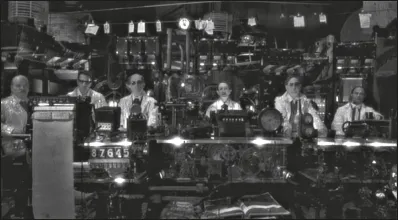
Dystopian steampunk in Twelve Monkeys
The industrialised complex of exploitation via Neo-Victorian mechanics imprisons Cole in a dystopian future run by a totalitarian regime of ‘rational’ scientists. Gilliam’s production design particularly embodies steampunk’s ‘harsh view of reality’, in which, as Bruce Sterling has observed, ‘anything that can be done to a rat can be done to a human being. And we can do most anything to rats’ (Remy 2007). In Twelve Monkeys’ future, the scientists experiment on people with dehumanising technology that is also faulty, such as when Cole and a fellow traveler are sent into the trenches of World War I.
The scientists’ dependence on scavenging together a working laboratory out of whatever materials can be salvaged and recycled after the virus devastates the global population has less dystopian roots in Gilliam’s creative process, which principally engages steampunk’s deployment of bricolage. His meshing of outdated and updated technological fashions both anticipates and reinforces steampunk’s focus on historical anachronism. As a cartoonist for Help! magazine (1960–65), which was created by Mad magazine founding editor Harvey Kurtzman, Gilliam became skilled in creating ‘fumetti – photo comic strips that essentially played like a movie storyboard with characters speaking in word bubbles, with Gilliam often writing, casting, and photographing them himself ’ with a ‘16mm Bolex camera and a tape recorder (McCabe 1999: 16, 18).3 As Gilliam remembers, ‘We were always stealing film from trash cans and drawing on it. We’d animate right on the clear film’ (McCabe 1999: 18). When he began working as an animator in London on the children’s television show Do Not Adjust Your Set (1967–69, with Michael Palin, Eric Idle and Terry Jones) and on We Have Ways of Making You Laugh (1968), he honed this approach to his innovative ‘cutanimation’ that flourished on Monty Python’s Flying Circus. To create his cut-outs, he spent time at the British Museum looking for free materials from ‘a lot of dead painters and a lot of dead engravers’ to draw and cut into moveable parts that he would place in a setting and photograph two frames at a time, making the filmmaker, in his own words, the ‘premier cut-out animator of the era’ (McCabe 1999: 24; Gilliam 2006).
The opening credit sequence of the first episode of Monty Python’s Flying Circus revels in t...
Table of contents
- Cover
- Half title
- Series Page
- Title
- Copyright
- Contents
- Acknowledgments
- Dedication
- Notes on Contributors
- Introduction: Fear and Loathing in Hollywood: Looking at Terry Gilliam through a Wide-angle Lens
- Terry Gilliam Interview: with Karen Randell – 3 May 2012
- 1. Steampunked: The Animated Aesthetics of Terry Gilliam in Jabberwocky and Beyond
- 2. Grail Tales: The Preoccupations of Terry Gilliam
- 3. ‘And Now for Something Completely Different’: Pythonic Arthuriana and the Matter of Britain
- 4. The Baron, the King and Terry Gilliam’s Approach to ‘the Fantastic’
- 5. The Subversion of Happy Endings in Terry Gilliam’s Brazil
- 6. The Fissure King: Terry Gilliam’s Psychotic Fantasy Worlds
- 7. ‘You can’t change anything’: Freedom and Control in Twelve Monkeys
- 8. ‘It shall be a nation’: Terry Gilliam’s Exploration of National Identity, Between Rationalism and Imagination
- 9. ‘Won’t somebody please think of the children?’: The Case for Terry Gilliam’s Tidelands
- 10. Divorced from Reality: Time Bandits in Search of Fulfilment
- 11. Celebrity Trauma: The Death of Heath Ledger and The Imaginarium of Doctor Parnassus
- Filmography
- Bibliography
- Index
Trusted by 375,005 students
Access to over 1.5 million titles for a fair monthly price.
Study more efficiently using our study tools.
Frequently asked questions
Yes, you can cancel anytime from the Subscription tab in your account settings on the Perlego website. Your subscription will stay active until the end of your current billing period. Learn how to cancel your subscription
No, books cannot be downloaded as external files, such as PDFs, for use outside of Perlego. However, you can download books within the Perlego app for offline reading on mobile or tablet. Learn how to download books offline
Perlego offers two plans: Essential and Complete
- Essential is ideal for learners and professionals who enjoy exploring a wide range of subjects. Access the Essential Library with 800,000+ trusted titles and best-sellers across business, personal growth, and the humanities. Includes unlimited reading time and Standard Read Aloud voice.
- Complete: Perfect for advanced learners and researchers needing full, unrestricted access. Unlock 1.5M+ books across hundreds of subjects, including academic and specialized titles. The Complete Plan also includes advanced features like Premium Read Aloud and Research Assistant.
We are an online textbook subscription service, where you can get access to an entire online library for less than the price of a single book per month. With over 1.5 million books across 990+ topics, we’ve got you covered! Learn about our mission
Look out for the read-aloud symbol on your next book to see if you can listen to it. The read-aloud tool reads text aloud for you, highlighting the text as it is being read. You can pause it, speed it up and slow it down. Learn more about Read Aloud
Yes! You can use the Perlego app on both iOS and Android devices to read anytime, anywhere — even offline. Perfect for commutes or when you’re on the go.
Please note we cannot support devices running on iOS 13 and Android 7 or earlier. Learn more about using the app
Please note we cannot support devices running on iOS 13 and Android 7 or earlier. Learn more about using the app
Yes, you can access The Cinema of Terry Gilliam by Jeff Birkenstein,Anna Froula,Karen Randell, Jeff Birkenstein, Anna Froula, Karen Randell in PDF and/or ePUB format, as well as other popular books in Media & Performing Arts & Film & Video. We have over 1.5 million books available in our catalogue for you to explore.