- English
- ePUB (mobile friendly)
- Available on iOS & Android
eBook - ePub
About this book
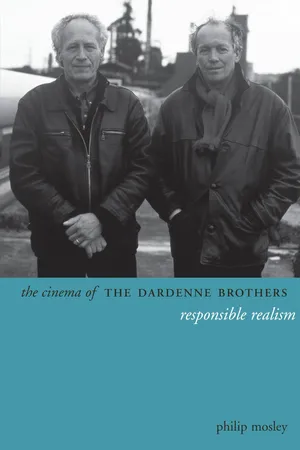
The brothers Jean-Pierre and Luc Dardenne have established an international reputation for their emotionally powerful realist cinema. Inspired by their home turf of Liège-Seraing, a former industrial hub of French-speaking southern Belgium, they have crafted a series of fiction films that blends acute observation of life on the social margins with moral fables for the postmodern age. This volume analyses the brothers' career from their leftist video documentaries of the 1970s and 1980s through their debut as directors of fiction films in the late 1980s and early 1990s to their six major achievements from The Promise (1996) to The Kid with a Bike (2011), an oeuvre that includes two Golden Palms at the Cannes film festival, for Rosetta (1999) and The Child (2005). It argues that the ethical dimension of the Dardennes' work complements rather than precludes their sustained expression of a fundamental political sensibility.
Information
CHAPTER ONE
Responsible Realists
With two Palme d’Or awards at the international film festival in Cannes, France – one for Rosetta (1999), another for L’Enfant (The Child, 2005) – the Belgian brothers Jean-Pierre and Luc Dardenne have joined an elite group (Emir Kusturica, Francis Ford Coppola, Shohei Imamura, Bille August) of two-time winners of the most prestigious prize in world cinema. Their other four major fiction films – La Promesse (The Promise, 1996), Le Fils (The Son, 2002), Le Silence de Lorna (The Silence of Lorna, 2008), and Le Gamin au vélo (The Kid with a Bike, 2011) – have also garnered many prizes at Cannes and elsewhere.1 This growing oeuvre has established their reputation as leading cinematic auteurs whose mode is a gritty social realism that we associate with practitioners of the ‘new French realism’ such as Laurent Cantet, whom the brothers admire, and particularly to its regional exponents such as Erick Zonca and Bruno Dumont in northern France or Benoît Mariage and Lucas Belvaux in the southern Belgian region of Wallonia where the Dardennes were born, raised and continue to live and work.2 We also associate this mode with, for instance, some of the work of Ken Loach, Mike Leigh and Stephen Frears in Britain.3 The films of the Dardennes share with these contemporaries and others elsewhere a preoccupation with the lives of working-class individuals struggling to survive with a measure of dignity in a new world order that for them is mainly one of poverty, unemployment, social disintegration and environmental ruin. On closer examination the Dardennes’ films represent these things and more. From their early video documentary work (1974–83) through their first forays into narrative fiction film (1986–92) to their six key films since 1996 the brothers’ vision has been of a will to empower their protagonists and so help to liberate them from economic circumstances, personal relationships and mental states that oppress, restrict and destabilise them in one way or another.
For the subtitle of this volume I chose ‘responsible realism’, as keywords to the Dardennes’ cinema. While the brothers are undoubtedly exemplary realist filmmakers, their relation to cinematic realism is as nuanced and complex as the notion itself. As for responsibility, I believe that the Dardennes’ entire filmmaking career so far has shown their acute awareness of a need for both individual and collective responsibility in human relations. I agree broadly with a dominant critical view that ethical concerns lie at the heart of their work, but I prefer not to see these concerns as detached from a fading sense of politics. In the documentaries, which are firmly grounded in particular social and political histories, these concerns emerge in their sensitivity to the documentary act, that is, to their involvement in constructing and mediating the testimonial discourse that implicates the subjects of their films. Especially from The Promise onward they dramatise these concerns in uncompromising portrayals of individual lives that play out against a visibly bleak socio-economic backdrop.
In all but one of the documentaries and in their first fiction film Falsch (1986), the Dardennes explore a dynamic relation between history and memory, between public and private narratives. They question how individuals deal with personal experiences that invariably burden them as much as define and inspire them. In their third fiction film Je pense à vous (You’re on My Mind, 1992) – preceded by Il court, il court le monde (They’re Running … Everyone’s Running, 1988), a short film set in the present – the brothers begin to turn their attention away from the relation of the past to the present via diverse commemorative acts to dramas of the more recent past and of the present day. The story of a family threatened by the effects of industrial collapse, You’re on My Mind is set in 1980. The Promise and subsequent films are set in the present. Shaped by the evolution of a post-industrial society already seen in its formative stages in You’re on My Mind, the later dramas focus on crises of conscience and action that indirectly form an individual response to socio-economic conditions. We may thus see the developing cinema of the Dardennes as an ethical body of work within a politically informed social realist mode, one that engages with questions of honesty to ourselves and others, and of how we assume and exercise a sense of human responsibility.
Film Practice
A good director tries to eliminate [the] distance between audience and action, to destroy the screen as a picture frame, and to drag the audience through it into the reality of the scene. (Roemer 1966: 265)
Making all their films together as Jean-Pierre and Luc Dardenne and not seeking solo careers independently of each other puts us in mind of the uncommon and fascinating phenomenon of brotherly (or sibling) directorial pairs: Auguste and Louis Lumière, Vittorio and Paolo Taviani, Ethan and Joel Coen, Stephen and Timothy Quay, Andy and Larry (now Lana) Wachowski, Peter and Bobby Farrelly. Unlike, for instance, the Tavianis, who alternate leadership on the set, the Dardennes have a highly symbiotic relationship in all phases of the filmmaking process: casting, location, rehearsal, shooting, postproduction, promotion and publicity. In Jean-Pierre’s words, ‘we are the same: one person, four eyes’ (see Brooks 2006). During shooting, however, one stays on set with the actors and technicians, while the other watches the video monitor for an overall sense of rhythm. In choosing this method they obey a single rule: whoever is behind the monitor must not speak to actors or crew members. Once they complete a take, they discuss it in front of the monitor, then with their cinematographer.
Luc writes the screenplays but does so in continuous dialogue with Jean-Pierre, who often takes a greater responsibility for the more technical aspects of their projects. As Luc puts it, ‘I hold the pen, but it writes with two hands’ (2005: 24). He adds that when he writes his diary entries in the first person singular, he is effectively also using the first person plural. In interviews the brothers have been known to finish each other’s sentences, but they display a refreshing tendency not to sound too earnest about their mutual understanding and close working relationship.
In creating their films the Dardennes’ major reference points are as much in literature and philosophy as in cinema or the visual arts in general. Their cinema of responsible realism, one that acknowledges the humanity of others and sustains a dream of the future, draws them to the French philosopher Emmanuel Levinas; to neo-Marxist and liberal humanist thinkers such as Hannah Arendt, Theodor Adorno and especially Ernst Bloch; and to lesser known figures such as Catherine Chalier, author of a treatise on tears subtitled ‘Fragility of God, Fragility of the Soul’ (2003). Among their wide-ranging literary touchstones are the Bible – which teaches how to stay with the literal, says Luc (2005: 82) – Shakespeare, Dostoyevsky,4 Camus, Faulkner and Toni Morrison. Luc admits a need for literature and music to inspire his screenwriting activity. As a prelude to writing a script he enters an intensive reading phase and listens particularly to Beethoven’s piano sonatas and concertos. He likens the rhythm of a film to that which he hears in Schumann. Yet the moment he enters the screenwriting phase, all ideas must be subsumed by a quest for concrete images and dialogue that will embody them in audiovisual terms. This rationale recalls André Bazin’s faith in the power of images and, as Ivone Margulies (2003) points out, in the French theorist’s fascination with the incidental and contingent elements of the visual field. The Dardennes’ work exemplifies realist cinema of this kind, in which the material world offers up images and moments of everyday life that both drive and exceed the narrative in whose service they have been photographed.
Their film practice hinges on steadfastly refusing to be lured by the formulaic, the glamourous or the visually excessive, which they find to be endemic to most commercial cinema, a ‘cinema without style’, says Luc (2005: 26), whose ‘technical comfort’ (2005: 61) they decline. They seek to remain as independent as possible of that dominant cinema given the financial and administrative exigencies of production, distribution and exhibition of fiction films. While they accept that filmmaking in Belgium necessarily involves them in the mechanics of a dirigiste system, that is, one predicated on state support and promotion of a quasi-national film industry, they are careful to relate themselves tangentially to that system. They resist identifying with the conventions of a national film culture and its assumptions of taste and acceptable product, while readily acknowledging the practical impossibility of doing as they wish outside that culture.
In the late 1970s when the Dardennes were establishing their presence as video documentarians, few film companies existed in Wallonia. The brothers soon realised a need to establish their own company in order to maintain their independence and artistic control. Dérives, which they founded in 1975, has the status of a non-profit collective committed to documentary filmmaking; in 1994 they founded Les Films du Fleuve, a for-profit company committed to the making of fiction films. Given the limited infrastructure of Belgian film production, in which an artisanal mode continues to prevail in the absence of a national film industry, the brothers have always been aware of the need for partnerships with other private and with public bodies. In 2000 they decided to appoint an executive producer, Olivier Bronckart, so that they could concentrate on the filmmaking side, and in 2002 they entered into partnership with the French producer Denis Freyd and his company Archipel 35. Other regular private partners include the European cultural television channel Arte and the French channel Canal Plus, which have both shown a sustained willingness to invest in feature films. From the earliest days they have regularly sought grants in aid from public partners, notably the European Union which supports film initiatives via schemes like the Council of Europe’s production fund Eurimages, as well as RTBF (Belgian French-language public television), the Belgian Ministry of the French Community and the regional government of Wallonia, all of which share a commitment to the promotion of audiovisual culture. The Belgian and French advance on box-office receipt system (avance sur recettes) has also proven to be an important part of their fundraising; without it The Promise would not have been such a breakthrough success. More recently they have also taken advantage of a federal tax shelter in Belgium for the production of films. And if we look, for instance, at the sources of financial support for The Silence of Lorna (see Filmography), though still modest compared to many commercial productions, it has grown commensurately with the Dardennes’ high reputation to include five major and numerous minor bodies from both private and public sectors.
From the beginnings of Dérives and Les Films du Fleuve the Dardennes have sought to establish a collective artistic identity not only for the production of their own films but also for those of others; by 2008 Les Films du Fleuve had made ten such fiction films. As well as committing to independent production, the brothers believe that an independent distribution network for European films is a worthy undertaking. Thus in 2008–9 they served as presidents of such a network: Europa Distribution.
The Dardennes’ relative autonomy as filmmakers does not imply either a dictatorial or a complacent attitude to the business of making films. They are respected for a lack of egotism in their approach to their profession. Indeed, as perfectionists, they are highly self-critical and rarely pleased with what they achieve. Typical of this accountability was their refusal to place the blame for the failure of You’re on My Mind on anyone but themselves. They acknowledge that while the story was admirably suited to their interests, they failed to find the right way to tell it. And while they always set up as far as possible in advance of shooting and reserve the right to call the final shot, they listen carefully to the questions and suggestions of their close-knit team of actors and technicians. Equally they encourage executive producer Bronckart and production partner Freyd to offer their artistic inputs.
The economy of scale that marks the Dardennes’ production of fiction films matches the relative lowness of their budgets. The Promise, their first film after creating Les Films du Fleuve, was made for €1.6 million, a figure little short of one million less than for the commercially coproduced You’re on My Mind four years earlier. Alongside a growing reputation and rising costs have come steadily increasing budgets: Rosetta, €1.9 million; The Son, €2.6 million; The Child, €3.6 million; The Silence of Lorna, €4 million; The Kid with a Bike, €5.8 million. Nonetheless it is noteworthy that in 2002 The Son cost only slightly more than You’re on My Mind a decade earlier. Luc tells Pascal Edelmann that ‘we normally find €1.2 or €1.3 million in our country, one million in France and the rest … from Eurimages’ (2007: 221).
For relatively low-budget productions the duration of their principal photography is quite long reflecting the Dardennes’ perfectionism and attention to detail. Shooting time in days remains fairly consistent: The Promise, 40 days; Rosetta, 56; The Son, 64; The Child, 61; The Silence of Lorna, 60; The Kid with a Bike, 55. It rose a little for The Son only because of technical problems, so for the other films after The Promise its variation has remained within a basic seven-day range.
The Dardennes take a long time over a film – three years as a rule – typically sending themselves up as ‘cows’ who need to ruminate a lot. They prepare meticulously to shoot a film by devoting much time to scriptwriting, discussion, location scouting and casting. They spend three to four months on location scouting equipped with a video camera to seek out the right visual and aural settings. The only time they have delegated location scouting was for The Silence of Lorna and then only because they needed additional time to travel in the Balkans to cast the leading role. Though they work out a script carefully before shooting, everything including the ending depends on the mise-en-scène to which changes may be made on the spur of the moment. They use no storyboards and are extremely wary of conventional strategies such as the explanatory establishing shot, the shot/reverse shot and the use of music. Rare instances of music are brief and diegetic, while nondiegetic music occurs only in a single instance at the end of The Silence of Lorna and in a short repeated passage in The Kid with a Bike. They use direct sound and do not overdub. Dialogue is sparse; they drive their films more by sound and image than by word. Since everything is so well worked out beforehand, they engage in limited editing that is, according to their editor Marie-Hélène Dozo, interviewed by Jacqueline Aubenas, dictated by the rhythm of the narrative, by the characters and by the mise-en-scène (2008: 180). They admit that editing is always a difficult stage for them, while staying open to necessary changes in both production and postproduction.
Choosing equally carefully whom they work with, the Dardennes gather around them on each occasion more or less the same small team of actors and technicians. Outsiders are unwelcome to enter the process at any stage, as the brothers prefer privacy during filmmaking to protect an air of mutual confidence and understanding that they strive to engender among their collaborators. They take a long time over casting decisions until they are sure of their choices for parts. They do not base these choices on an actor’s professional visibility or technical competence but rather on being convinced that a certain body or face may incarnate a particular character. This fit is so tight that actors’ and characters’ names occasionally remain the same: Assita Ouedraogo/Assita in The Promise, Olivier Gourmet/Olivier in The Son. They prefer to work with a mixture of seasoned actors and young nonprofessionals usually drawn from their own region (the Albanian actress Arta Dobroshi in the title role of The Silence of Lorna is an exception). There is in any case a dearth of teenage professionals in Belgium. They appreciate the willingness of these young actors to throw themselves into a role with a lack of physical self-consciousness. Most of their actors had never appeared in film before, including the highly experienced Gourmet whom they plucked from theatre in Liège. No film by the Dardennes had been planned around an individual actor until The Son, in which they developed the character of Olivier around Gourmet. Yet his performance does not call attention to his identity as a professional actor, which is one of the highest compliments it may be paid.
The brothers rehearse their actors exhaustively both in preproduction and during principal photography. These rehearsals include one month on costume tryouts alone. They do not rehearse dialogue, nor do they permit their actors to improvise. On ...
Table of contents
- Cover
- Half title
- Series Page
- Title
- Copyright
- Contents
- Acknowledgments
- 1. Responsible Realists
- 2. Cinematic Reference Points
- 3. The Video Documentaries, 1974–83
- 4. Foraying into Fiction, 1986–92
- 5. Breakthrough: The Promise, 1996
- 6. First Palme d’Or: Rosetta, 1999
- 7. Pushing the Envelope: The Son, 2002
- 8. Second Palme d’Or: The Child, 2005
- 9. A Minor Shift: The Silence of Lorna, 2008
- Afterword: The Kid with a Bike, 2011
- Filmography
- Bibliography
- Index
Trusted by 375,005 students
Access to over 1.5 million titles for a fair monthly price.
Study more efficiently using our study tools.
Frequently asked questions
Yes, you can cancel anytime from the Subscription tab in your account settings on the Perlego website. Your subscription will stay active until the end of your current billing period. Learn how to cancel your subscription
No, books cannot be downloaded as external files, such as PDFs, for use outside of Perlego. However, you can download books within the Perlego app for offline reading on mobile or tablet. Learn how to download books offline
Perlego offers two plans: Essential and Complete
- Essential is ideal for learners and professionals who enjoy exploring a wide range of subjects. Access the Essential Library with 800,000+ trusted titles and best-sellers across business, personal growth, and the humanities. Includes unlimited reading time and Standard Read Aloud voice.
- Complete: Perfect for advanced learners and researchers needing full, unrestricted access. Unlock 1.5M+ books across hundreds of subjects, including academic and specialized titles. The Complete Plan also includes advanced features like Premium Read Aloud and Research Assistant.
We are an online textbook subscription service, where you can get access to an entire online library for less than the price of a single book per month. With over 1.5 million books across 990+ topics, we’ve got you covered! Learn about our mission
Look out for the read-aloud symbol on your next book to see if you can listen to it. The read-aloud tool reads text aloud for you, highlighting the text as it is being read. You can pause it, speed it up and slow it down. Learn more about Read Aloud
Yes! You can use the Perlego app on both iOS and Android devices to read anytime, anywhere — even offline. Perfect for commutes or when you’re on the go.
Please note we cannot support devices running on iOS 13 and Android 7 or earlier. Learn more about using the app
Please note we cannot support devices running on iOS 13 and Android 7 or earlier. Learn more about using the app
Yes, you can access The Cinema of the Dardenne Brothers by Philip Mosley in PDF and/or ePUB format, as well as other popular books in Medios de comunicación y artes escénicas & Películas y vídeos. We have over 1.5 million books available in our catalogue for you to explore.