The essays in this collection deploy biological and social scientific perspectives to evaluate the transformative experience of parenthood for today's women and men. They map the similar and distinct roles mothers and fathers play in their children's lives and measure the effect of gendered parenting on child well-being, work and family arrangements, and the quality of couples' relationships.
Contributors describe what happens to brains and bodies when women become mothers and men become fathers; whether the stakes are the same or different for each sex; why, across history and cultures, women are typically more involved in childcare than men; why some fathers are strongly present in their children's lives while others are not; and how the various commitments men and women make to parenting shape their approaches to paid work and romantic relationships. Considering recent changes in men's and women's familial duties, the growing number of single-parent families, and the impassioned tenor of same-sex marriage debates, this book adds sound scientific and theoretical insight to these issues, constituting a standout resource for those interested in the causes and consequences of contemporary gendered parenthood.

eBook - ePub
Gender and Parenthood
Biological and Social Scientific Perspectives
- English
- ePUB (mobile friendly)
- Available on iOS & Android
eBook - ePub
Gender and Parenthood
Biological and Social Scientific Perspectives
About this book
Information
Subtopic
History & Theory in PsychologyIndex
PsychologyPART ONE
HOW AND WHY IS PARENTHOOD GENDERED?
1
THE DYNAMIC NATURE OF THE PARENTAL BRAIN
Kelly G. Lambert and Catherine L. Franssen
DURING THE BUILDUP to the 2008 presidential election, Beau Biden, son of Democratic vice-presidential candidate Joe Biden, gave a heartfelt introductory speech at the Democratic National Convention. He relayed how after the tragic death of his mother and sister in an automobile accident in 1972, his father, a newly elected senator, had refrained from his duties, stating, “Delaware can get another senator, but my boys can’t get another father.” Once Biden had resumed his work, he commuted to Washington every day (four hours round-trip) so that he could see his children every night.1 The GOP similarly touted their vice presidential candidate’s parental qualities; Sarah Palin was repeatedly introduced as a “mother of five.” Soon after the announcement of Palin’s being chosen to join the McCain ticket, she wrote the following brief note to her Alaskan constituents: “It is the honor of my life to represent you as your Governor, and over the next two months I will continue to do so. As the mother of five, I know how to multitask, and I will continue to promote the path of reform that we set out on together in the state of Alaska.”2
These scenarios provide interesting observations about our nation’s perceptions of parenting roles and their benefits to personal development. Palin’s case reinforces the perception that being a mother enhances cognitive abilities such as multitasking. On the other hand, fatherhood is rarely touted as relevant experience for executive leadership roles; indeed, Biden’s choice of paternal connection over career aspirations is powerful specifically because it is perceived as rather unique.
Of course, political and cultural perceptions of parenting change with the times. So let us consider more empirical evidence here. Are our national perceptions of gender-dependent styles of parenting (as discussed in other chapters in this book) accurate biologically? How does the experience of parenting influence the brains of mothers and fathers?
The complexity of our culture presents challenges in determining the fundamental similarities and differences in parental males and females, especially when investigating specific neurobiological effects. In response to these challenges, our lab has utilized rodent models to explore the neurobiological alterations that accompany parental responses. These models have provided fascinating clues about how pregnancy, lactation, and parental nurturing drastically alter the female brain and behavior. To understand more about the paternal response, we have studied a unique rodent that is monogamous and biparental, the California deer mouse (Peromyscus californicus). And this research program has revealed interesting data related to the potential impact of paternal experience on mammalian neurobiological responses. Before turning to our findings, however, let us set an appropriate evolutionary context as we consider the impact of parental responses on the subsequent emergence of the mammalian brain.
EVOLUTIONARY SIGNIFICANCE OF PARENTAL RESPONSES
According to Paul MacLean, one of the most accomplished neuroscientists of the twentieth century, parental responses—specifically, maternal responses—significantly guided the evolution of the mammalian brain. In fact, he suggests that the three behaviors that separated mammals from nonmammalian vertebrates all centered around maternal care, characterized by nursing, audiovocal communications (important for maintaining contact between mother and offspring), and play behavior (MacLean 1998). His book The Triune Brain in Evolution includes an entire chapter on a brain circuit (the thalamocingulate circuit) that he identifies as maintaining family-related functions (MacLean 1990). Further, he notes that the separation of the mother from her offspring could have fatal consequences and that the separation cry of the offspring, possibly representing the first case of mammalian vocalization, enabled the mother to locate the young mammal before it came to harm. According to MacLean, vocalizations provided a valuable dimension to social contact and led to the development of the complex social brain now observed in mammals, especially humans (MacLean 1990, 1998; Lambert 2003).
In an article entitled “Women: A More Balanced Brain,” MacLean emphasizes the role of maternal responses in the evolution of the mammalian brain: “For more than 180 million years, the female has played the central role in mammalian evolution” (MacLean 1996:422). He argues that mothers directed the human species toward right-hand dominance as they held their offspring near their hearts so that the rhythmic beating would calm the baby. This response required the mothers to rely on their right hands to manipulate their environmental surroundings. Thus, holding or carrying the infant on the left side likely influenced the functional and anatomical expansion of the right hemisphere in women. This neuroanatomical expansion may have further contributed to a more balanced brain in the female. In fact, neuroimaging research has indicated increased interhemispheric activity in women compared to men, who exhibited enhanced intrahemispheric activity (Azare et al. 1995). As observed in figure 1.1, as vertebrates evolved from reptiles, which exhibited few maternal responses beyond laying eggs, to mammals such as squirrel monkeys, which engage in the metabolically expensive behavior of carrying their offspring almost continuously for months, the brain changed accordingly (MacLean 1990, 1998). Having another animal to care for likely required the brain to evolve from the reflexive responses of reptiles to the more complex emotional responses of ancient mammals and finally to the focused attention, enhanced vigilance, multitasking, and enhanced problem-solving skills observed in mammalian mothers today. Consequently, it appears that the maternal hand (or paw) has indeed rocked the evolutionary cradle, leading to the emergence of the most advanced brains, those of mammals. It has been suggested, however, that prior to the evolution of the mammalian brain, post-hatching parental responses were present in certain dinosaur species. And today, such parental responses are observed in some reptiles, such as crocodiles, as well as in avian species (Tullberg, Ah-King, and Temrin 2002; Meng et al. 2004). Noted anthropologist Sarah Hrdy describes several aspects of the maternal response that have been conserved throughout the process of evolution:
A mother’s body merges into synchrony with her baby’s needs, and the baby’s well-being becomes her pressing concern. Parts of these responses are incredibly old. Prolactin, the same hormone that coordinates maternal responses to infant demands for milk, was already orchestrating metamorphoses in amphibians and controlling water balance in the tissues of bony freshwater fish millions of years before any mammal existed. Every aspect of our neurochemistry and emotions has a rich and convoluted history, bearing witness to multiple long-running legacies that we share with earthworms, amphibians, small mammals, and other primates.… Many of the emotions we feel today, many of our autonomic responses, first evolved in environments inhabited by ancient ancestors. Many of these conditions no longer pertain or have long since disappeared, yet … their legacy remains relevant to what we are(Hrdy 2000:10)
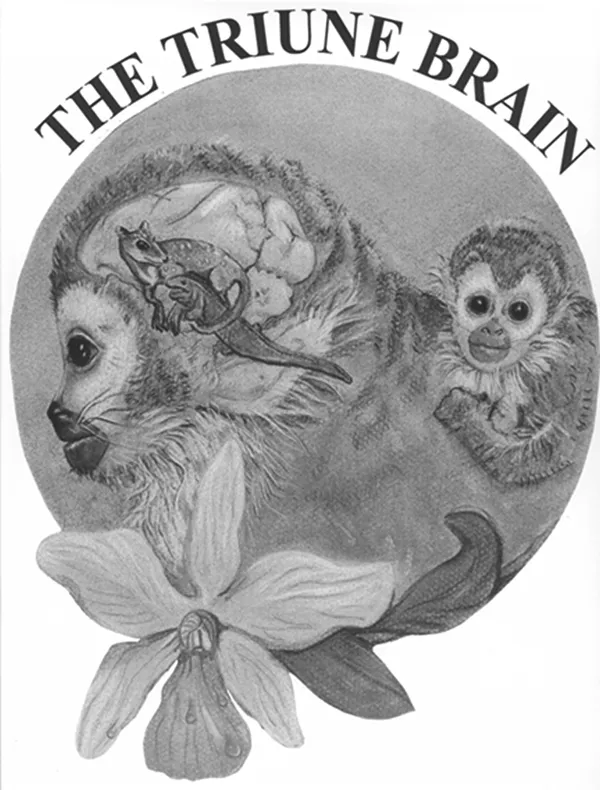
FIGURE 1.1 An interpretation of MacLean’s “triune brain,” emphasizing the reptilian brain (hindbrain), the paleomammalian brain (limbic system), and the more recently evolved neomammalian brain (neocortex). Because Paul MacLean wrote extensively about the maternal-infant relationship, the brain is depicted in a maternal squirrel monkey, a species frequently used in his neuroethological research.
Source: Artwork by Jacqueline Berry; design by Kelly Lambert.
THE MATERNAL MAMMALIAN BRAIN
About fifteen years ago, Craig Kinsley (of the University of Richmond) and I (KGL) became intrigued by the potential effect of pregnancy and motherhood on the female brain. Studies had reported that even short-term exposure to estrogen in rodents augmented a part of the brain known for its involvement in learning and memory, especially spatial memory (Woolley and McEwen 1992, 1993).3 Past research had focused on the roles of brain areas known to be involved in traditional maternal responses4 (Numan and Stolzenberg 2008), but new indications that a brain area not typically associated with maternal behavior was influenced by alterations in reproductive hormones were intriguing. Soon we began to realize that the area of the brain involved in spatial memory, the hippocampus, could indeed be central to a female’s success as a mother. Spatial memory appears to be especially important for maternal success when we consider the metabolically expensive lactation response, which is maintained in maternal rodents by up to three times more food-caching responses than nonmaternal rodents exhibit (Calhoun 1963). Accordingly, we hypothesized that, in addition to the traditional maternal responses of crouching, nursing, retrieving, and licking/grooming (see figure 1.2), other responses such as heightened vigilance/boldness and enhanced foraging responses were necessary to successfully raise the female’s offspring, a significant genetic investment.
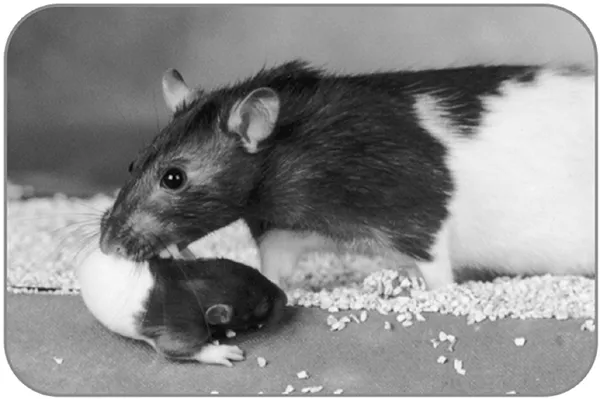
FIGURE 1.2 A rat grooms her offspring, a behavior critical for the health of the young pup.
Source: Photo by Doug Berlin – Randolph-Macon College Behavioral Neuroscience Laboratory.
Initially, we investigated the effect of maternal experience on foraging ability by conducting a spatial-memory task in a dry-land maze. A dry-land maze consists of a circular arena with eight little cups (wells) equally spaced along the perimeter. The floor of the arena is covered with the rats’ usual bedding, so nothing novel is present to distract the rat from its task of discovering—and subsequently remembering—which one well contains the food (bait). We tested three groups of Long Evans rats: first-time (primiparous) moms about two weeks postpartum, never-pregnant (nulliparous) females that had had no exposure to another female’s pups, and nulliparous females that had been exposed to pups for the equivalent of two weeks (and so were pup-sensitized). In a second experiment, we tested two groups of Sprague Dawley rats—moms that had had two pregnancies (multiparous) and nulliparous females—in a radial-arm maze. A radial-arm maze is shaped somewhat like an asterisk, with eight dead-ended tunnels radiating out from the center starting point. One path ends in the desired food, and a rat must use spatial cues in order to remember which path has already been checked and found empty before discovering the baited one.
In both experiments, the maternal animals exhibited enhanced spatial memory; interestingly, in the dry-land maze, even the pup-sensitized nonmothers (that is, the foster moms) demonstrated increased spatial ability (Kinsley et al. 1999).
Because lactating females have altered metabolic rates and energy demands—and this could potentially affect their behavioral responses—we focused subsequent studies on the more long-term effects of reproductive experience. Nulliparous, primiparous, and multiparous Sprague Dawley females were tested in the dry-land maze at the ages of six, twelve, eighteen, and twenty-four months. Results suggested that primiparous and multiparous females learned the tasks more efficiently, showing less decline than the virgin rats as they got older. The brains of the rats were then assessed for deposits of a protein associated with Alzheimer’s disease in humans (amyloid precursor protein). The multiparous animals had fewer deposits of the protein in their hippocampus than did their virgin and primiparous counterparts (Gatewood et al. 2005).
In a similar study, nulliparous, primiparous, and multiparous Long Evans rats were assessed in the dry-land maze at four-month intervals from the ages of five to twenty-two months. No learning-acquisition differences were observed in this study; the probe trials, however, told a different story. In these probe trials, conducted one week after the final test trials, no food is placed in the previously baited food well. In this way, we assess the animal’s longer-term memory by removing any sensory cues that may have been influential in earlier phases of training and testing. At five and thirteen months of age, the parous (primiparous and multiparous) animals exhibited an advantage in these longer-term memory tests.
In a final adaptation of the dry-land-maze assessment, triads of thirteen-month-old weight-matched females from each of the reproductive groups were placed in the maze at one time to compete for the foo...
Table of contents
- Cover
- Half title
- Title
- Copyright
- Contents
- Acknowledgments
- Introduction
- Part I. How and Why Is Parenthood Gendered?
- Part II. Implications for Children, Couples, and Families
- List of Contributors
- Index
Trusted by 375,005 students
Access to over 1.5 million titles for a fair monthly price.
Study more efficiently using our study tools.
Frequently asked questions
Yes, you can cancel anytime from the Subscription tab in your account settings on the Perlego website. Your subscription will stay active until the end of your current billing period. Learn how to cancel your subscription
No, books cannot be downloaded as external files, such as PDFs, for use outside of Perlego. However, you can download books within the Perlego app for offline reading on mobile or tablet. Learn how to download books offline
Perlego offers two plans: Essential and Complete
- Essential is ideal for learners and professionals who enjoy exploring a wide range of subjects. Access the Essential Library with 800,000+ trusted titles and best-sellers across business, personal growth, and the humanities. Includes unlimited reading time and Standard Read Aloud voice.
- Complete: Perfect for advanced learners and researchers needing full, unrestricted access. Unlock 1.5M+ books across hundreds of subjects, including academic and specialized titles. The Complete Plan also includes advanced features like Premium Read Aloud and Research Assistant.
We are an online textbook subscription service, where you can get access to an entire online library for less than the price of a single book per month. With over 1.5 million books across 990+ topics, we’ve got you covered! Learn about our mission
Look out for the read-aloud symbol on your next book to see if you can listen to it. The read-aloud tool reads text aloud for you, highlighting the text as it is being read. You can pause it, speed it up and slow it down. Learn more about Read Aloud
Yes! You can use the Perlego app on both iOS and Android devices to read anytime, anywhere — even offline. Perfect for commutes or when you’re on the go.
Please note we cannot support devices running on iOS 13 and Android 7 or earlier. Learn more about using the app
Please note we cannot support devices running on iOS 13 and Android 7 or earlier. Learn more about using the app
Yes, you can access Gender and Parenthood by W. Bradford Wilcox,Kathleen Kovner Kline, W. Wilcox, Kathleen Kline in PDF and/or ePUB format, as well as other popular books in Psychology & History & Theory in Psychology. We have over 1.5 million books available in our catalogue for you to explore.