Are there parallels between the "moment of insight" in science and the emergence of the "unknowable" in religious faith? Where does scientific insight come from? Award-winning biologist Robert Pollack argues that an alliance between religious faith and science is not necessarily an argument in favor of irrationality: the two can inform each other's visions of the world.
Pollack begins by reflecting on the large questions of meaning and purpose—and the difficulty of finding either in the orderly world described by the data of science. He considers the obligation to find meaning and purpose despite natural selection's claim to be a complete explanation of our presence as a species—a claim that calls upon neither natural intention, nor design, nor Designer. Next, the book focuses on matters of free will, from the choice of a scientist to accept evidence, to the choice of a religious person to accept a revelation, to a patient's loss of free will in medical treatment. Here Pollack addresses questions of ethics and offers a provocative comparison of two difficult texts whose contents remain incompletely understood: the DNA "text" of the human genome and the Hebrew record of Jewish written and oral law. In closing, Pollack considers the promise of genetic medicine in enabling us to glimpse our own future and offers a reconsideration of the possible utility of the so-called placebo effect in curing illness.
Whether refuting a DNA-based biological model of Judaism or discussing the Darwinian concept of the species, Pollack, under the banner of free inquiry, presents a genuine, vital, and well-argued assay of the intersection of science and religion.
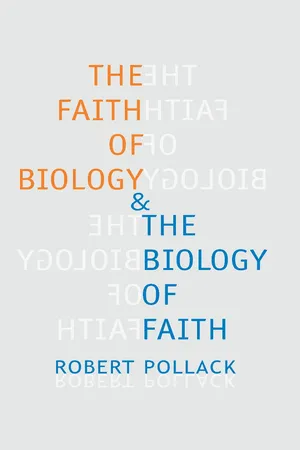
eBook - ePub
The Faith of Biology and the Biology of Faith
Order, Meaning, and Free Will in Modern Medical Science
- English
- ePUB (mobile friendly)
- Available on iOS & Android
eBook - ePub
The Faith of Biology and the Biology of Faith
Order, Meaning, and Free Will in Modern Medical Science
About this book
Information
chapter one | Order Versus Meaning: Science and Religion | |
| Science is meaningless because it gives no answer to our question, the only question important for us: what shall we do and how shall we do it? —Leo Tolstoy, quoted in Lewis Wolpert, The Unnatural Nature of Science |
THE SEAL OF Columbia College—subsequently Columbia University—is almost a quarter of a millennium old. It personifies all of us, faculty and students alike, as naked babies. Seated before us is the ideal Teacher, the spiritual mother of us all, Alma Mater, arms out, scepter of wisdom in her hand. Below her is a reference to chapter 2 of the first Epistle of Peter: “Wherefore laying aside all malice, and all guile, and hypocrisies, and envies and all evil speakings / As new born babes, desire the sincere milk of the word, that ye may grow thereby.” Around her shoulders is a fragment of a line in Latin from the Hebrew Scriptures, psalm 36, line 10: “By Your light do we see light.” Together these Biblical references are a brilliant and poetic evocation of the acts of teaching and learning.
I have been saying the words of the psalm in Hebrew every day for a few years, since I found myself convinced of the need to accept the Jewish obligation—kept by my ancestors for thousands of years—to say traditional prayers every morning. I had become accustomed enough to the Hebrew some time ago to think about what I was saying as I said it. One morning it came to me with great force that the Latin of the seal’s psalm was an edited version of the psalmist’s intention. From the prayer I saw that the full line is “With You is the fountain of life; by Your light do we see light.” And when I went back to look at the seal embedded at the threshold of Low Memorial Library, there indeed was the Hebrew for “Light of God” on a scroll in the Teacher’s hand.
I wish I knew who designed our seal, and when, and why we leave out the first premise—that there is an unknowable Deity at the source of everything to be taught and everything to be learned, that everything known to be, and everything yet to be known, is surrounded by the Unknowable.
The Known, the Unknown, and the Unknowable
This book is about the boundary of the knowable and the unknowable. Science works at the boundary of the known and the unknown, a different place entirely. The unknowable as a notion does not come easily to the scientifically minded. Dealing with it is a project full of paradox, requiring that one talk about the unutterable and anatomize the unmeasurable. I chose to work at this new boundary, nevertheless, because I have the habits of thought of a scientist. As soon as the notion of the unknowable as distinct from the unknown placed itself before me, the shock changed both my career and the way I see the world. The unknown was the raw material of my career, and the notion that it might be bounded in this way seemed to me deeply subversive of the entire enterprise.
My first reaction was as a scientist: I kept this idea to myself and went on about my business as a laboratory director while I thought about how it might be put to a test of some sort. But then, like the spotted Dalmatian who leaps to run after any truck that sounds like a fire engine, my training—begun as a physics major in Columbia College—eventually obliged me to grab onto what was most interesting rather than what was expedient, to try to understand the notion of the unknowable in all its untestability, and to make what I could understand about the unknowable understandable to others in turn. That is what I have wished to do in this book, as I would have done for the data of my laboratory if that is where my curiosity had led me instead.
Science proceeds by the testing of hypotheses, but because a hypothesis that can stand up to testing expands the territory of the known, scientific hypotheses about the unknowable are not meaningful. Put another way, it is not worth a moment of anyone’s time to seek the proof through science of any religious belief. And as this book is about the consequences of potential unknowability—a notion as foreign to many reasonable nonscientists as it is to the scientific method—I needed first to provide some working terminology for the unknowable, without calling upon the tools of scientific hypothesis testing.
Insight, Revelation, and the Unknowable
Ask any scientist what lies at the core of her work, you will learn that it is not the experimental test of the hypothesis—although that is where most of the time and money in science go. It is the idea, the mechanism, the insight that justifies all the rest of the work of science. The moment of insight that reveals the new idea, where an instant before there was just fog, is the moment when the unknown first retreats before the creativity of the scientist. Here, then, is the first door into the unknowable: where does scientific insight come from? Surely from someplace currently unknown. Let us consider the possibility that scientific insight, like religious revelation, comes from an intrinsically unknowable place.
It is a safe bet that working scientists would agree to the notion that there is a lot we don’t know yet, and that the boundary between the known and unknown that science pushes back is the shoreline of a small island floating in a vast sea of the unknown. Let us say—make the further hypotheses—that the sea of the unknown is not the edge of everything, and that the unknown itself is wholly bounded, blurring into an intrinsically inaccessible and immeasurable unknowability. Then science would still be increasing the territory available to the world of the understood. As the length and complexity of the shoreline with the unknown grew in step with every discovery, there would still be no edge to the unknown except the unknowable. The enterprise of science would be assured of a limitless future of successes, none of them ever bringing the unknowable any closer.
Can these hypotheses—that the unknowable exists, and that it will remain unknowable—be tested through the methods of science? Probably not, as they posit notions that resist testability. But they are nevertheless a fair representation of worldwide human experience outside science. It will be my first task to make the case that they are, as well, consistent with the actual experience of scientists, if not the institutional ideology of organized science. I hope then to demonstrate that, at least for the life sciences I am most familiar with, there is a way to practice the enterprise while also acknowledging that the shoreline may be remodeled but that in the end the sea is not drainable.
I can anticipate the response of many to what I have said so far: to beg the question. The unknowable is not a category that gives itself easily to demonstration of its existence. If it were a mental quirk only, a fantasy not worth worrying about, an idea of something that cannot be, then that would be a sufficient answer: No unknowable, no problem. The problem with that glib answer is that science itself depends on the periodic emergence of the unknowable for its own progress.
There is no way to think through a good idea in advance; insight is not a phenomenon subject to prior scientific analysis. At every instant of insight, every moment of Aha! what had not been conceivable becomes clear. Where was the idea before it was thought? Only afterward, once it was thought, can science begin the determination of the known from the unknown, using the idea as a guide. But before it was thought there were no tasks, there was no path, no idea that a question even existed to be asked.
The unknowable is worth a scientist’s attention if for no other reason than that it is the source of insight, the irrational part of science that has no chance of being brought under rational control. Moments of insight in science are not reproducible, neither is their occurrence modeled by any hypothesis of its own. As scientific insight cannot be harnessed to the engine of experimental testing, each occurrence may as well be a gift from an unknowable source. Good ideas emerge in the mind of a scientist as gifts of the unknowable. They are not, as data are, simply trophies of a struggle with the unknown.
Insight Is No More Reproducible Than Revelation
The essence of the measurable is reproducibility; insight is by definition not a reproducible thing. Recall how few such ideas have come to any of us in the hundreds of years we have been trying to understand the world and ourselves through science. Yet without moments of insight that emerge from nowhere, science bogs down in mindless repetition of acts that look serious but cannot be in the service of anything except confirmation of what is already known.
Scientific insight is not the only example of such a gift from the unknowable. Other events—also occurring rarely, inexplicably, unpredictably—can give meaning to our lives, just as scientific insights can explain the world outside ourselves. By meaning, in this context, I mean a new understanding drawn from the internal emotional content of the experience, not the intellectual understanding that may follow as it does when experimentation proves a scientific insight to be useful. Meaning, purpose, teleology, the end of things: these are not notions that we naturally associate with science. Such experiences are commonly called religious.
Yet the central event in science—the sudden insight through which we see clearly to a corner of what had been unknown—is so similar to these religious experiences that I see only a semantic difference between scientific insight and what is called, in religious terms, revelation. That difference remains small, whether one says that insight or revelation both come from nowhere interesting, or that they come from the unknowable that surrounds all that can be known, or that they come from God.
The differences between science and religion that have crystallized and reified into a wall separating the two do not lie in the semantic difference between insight and revelation. Whether prepared for or not, prophetic experiences and scientific insights will occur with similar rarity, irrationality, and unpredictability. The real differences grow from the different uses made of scientific and revelatory insight. In both insight takes the form of a vision of an invisible and hidden mechanism. In science such insights are made into guides for learning how nature works, thereby reducing our ignorance of the world around us. Guiding the formation of religious obligation, revelatory insights are prerequisite to the rituals and observances of a religion, which ease the burden of living by lifting a felt ignorance of the purpose and meaning of our mortal lives.
In all organized religions I am aware of, revelation takes the form of a sense of being overwhelmed by sheer feeling arising within without reason nor cause. Just as a scientist prepares for insight by deep immersion in the study of what has been dragged out of the unknown by her predecessors, a person adept at religious insight—a holy person, a prophetic person—may prepare by study of earlier revelation and prophecy, and by trying to be alert to the moral or lesson taught through what might be—to an unfeeling observer—just a coincidence.
Although both science and religion presume that the territory of the unknown is vast, most religions are far more comfortable with the notion of a residue of unknowability than are most sciences. Many practicing scientists instead believe—they would say they know—that what is not known today must and will be known tomorrow, or the next day, and that this will go on until everything is known.
The notion that nothing exists except what is knowable is wholly unprovable. Holding on to this belief in the absence of any way to test it through experimentation, and despite the counterevidence of scientific insight itself, puts science at the risk of being trapped in dogma. Like the worst of religious dogmas, the insistence that everything is knowable is an unprovable position assumed in the face of the evidence of the natural world. In this case the evidence includes the fact of uncontrollable insight as the wellspring of scientific discovery.
Scientists will argue that the reproducibility of scientific experiments assures that science as an enterprise can always be brought to internal consistency, while religions, free to call upon individual revelation and unreproducible miraculous events, necessarily fall into contradiction with one another and thereby cancel any reason for a sensible person to take any of them as seriously. In a negative template of this position many people of faith will argue that science is a fragmented enterprise unable to paint a coherent picture of the natural world, limited by conflicting and inconsistent models and the finite limits of a mortal mind.
Whereas many scientists cannot really accept that anyone could believe in a way around mortality, and though many religious persons cannot really believe that any serious person could fail to experience those feelings, some people—I am one of them—choose to carry both sets of thoughts at once. From the point of view of a scientist who is also a religious person—or of anyone else willing to allow the irrational portion of his life to be admitted to the discourse—religions respond to a small number of universally felt human experiences, the most easily recognized across all cultural boundaries being the obsessive need to somehow come to terms with the rational vacuity of one’s own mortality and the recurring need to vest one’s life with a meaning that transcends it.
Accepting the Irrational in Science and Religion
In my book The Missing Moment I concluded that current scientific studies of the brain and the mind require us to acknowledge that science has an irrational component, and that scientists are likely to experience this irrationality as the same waves of awe, joy, fear, or wonder that can overtake a religious person or even the “oceanic experience” of a shared, external, unknowable presence that Freud protested too much he could not feel.
The barrier erected by scientists who push aside, deny, or ignore these irrational states of mind is an artificial unnecessary one, built on denial of the reality that their own work depends upon uncontrollable and unpredictable moments of insight. The same artificial barrier is maintained from the other side with equal futility each time the resultant discoveries of science are denied, ignored, or pushed aside by people anxious to protect the same irrational states of mind so precious to them in their religious faith.
To dismantle the wall from both sides, both camps will have to admit what they must already know: the reality of irrational inward experience. They will have to acknowledge it as the source of the unexpected and unpredictable insight upon which both organized science and organized religion depend. Such admissions will not come easily. Characters like me are not at all used to putting religious feelings in the foreground and, rather, have the habit of pushing our feelings away, repressing them into unconscious reservoirs from which they may emerge but where they do not interfere with the dream of lucid rationality.
This makes speaking about religious feelings in an academic setting particularly tricky. Scientists and others who use their powers of repression to avoid accepting the reality of religious feeling, or even its origin the natural world, tend to have great difficulty accounting for such feelings even in themselves. Not just moments of insight and revelation but other feelings as well—emotional states that overtake one, unbidden and unplanned by conscious rational anticipation—seem to be a different order of phenomena than those easily studied under reproducible conditions. It is extremely difficult to do a controlled experiment on feelings.
In terms of the expected behavior of scientists, strong feelings as such are also in bad taste. Data have to be examined in terms of the model they test, and models as well as data have to be able to stand on their own in the eyes of other scientists. This situation too has its mirror image in organized religion, where a spontaneous feeling of disbelief or doubt in the face of incomprehensible evil or simple bad luck may not be easily squared with the presumption that we are moral beings in a moral universe. Neither can all the unwanted strong feelings associated with love, aggression, or, of course, death be fitted into most religious frameworks of expected right conduct. Too much doubt is as much in bad taste from a religious person as too much enthusiasm from an overeager experimenter.
The Avoidable Risk of Dogma
While insight and prophecy may both visit a single person, neither organized science nor organized religion expect each of their members to share in the prophetic experience. Rather, each transmits the gifts of its most insightful leaders. As those of us in a university know better than most, teaching is a human interaction rich in emotion, and therefore subject to abuse. The abuse of the teaching function takes the same form in both organized science and organized religion: what begins as the fully engaged experience of meaning can be compressed, through unfeeling teach...
Table of contents
- Cover
- Half title
- Title
- Copyright
- Series Page
- Dedication
- Contents
- Preface to the 2013 Paperback Edition
- Preface
- Acknowledgments
- Introduction
- Chapter 1. Order Versus Meaning: Science and Religion
- Chapter 2. The Meaning Is in the Order: DNA-Based Medicine
- Chapter 3. Meaning Beyond Order: The Science of One Life at a Time
- Postscript
- Bibliography
- Index
Trusted by 375,005 students
Access to over 1.5 million titles for a fair monthly price.
Study more efficiently using our study tools.
Frequently asked questions
Yes, you can cancel anytime from the Subscription tab in your account settings on the Perlego website. Your subscription will stay active until the end of your current billing period. Learn how to cancel your subscription
No, books cannot be downloaded as external files, such as PDFs, for use outside of Perlego. However, you can download books within the Perlego app for offline reading on mobile or tablet. Learn how to download books offline
Perlego offers two plans: Essential and Complete
- Essential is ideal for learners and professionals who enjoy exploring a wide range of subjects. Access the Essential Library with 800,000+ trusted titles and best-sellers across business, personal growth, and the humanities. Includes unlimited reading time and Standard Read Aloud voice.
- Complete: Perfect for advanced learners and researchers needing full, unrestricted access. Unlock 1.5M+ books across hundreds of subjects, including academic and specialized titles. The Complete Plan also includes advanced features like Premium Read Aloud and Research Assistant.
We are an online textbook subscription service, where you can get access to an entire online library for less than the price of a single book per month. With over 1.5 million books across 990+ topics, we’ve got you covered! Learn about our mission
Look out for the read-aloud symbol on your next book to see if you can listen to it. The read-aloud tool reads text aloud for you, highlighting the text as it is being read. You can pause it, speed it up and slow it down. Learn more about Read Aloud
Yes! You can use the Perlego app on both iOS and Android devices to read anytime, anywhere — even offline. Perfect for commutes or when you’re on the go.
Please note we cannot support devices running on iOS 13 and Android 7 or earlier. Learn more about using the app
Please note we cannot support devices running on iOS 13 and Android 7 or earlier. Learn more about using the app
Yes, you can access The Faith of Biology and the Biology of Faith by Robert E. Pollack in PDF and/or ePUB format, as well as other popular books in Théologie et religion & Théorie, pratique et référence de la médecine. We have over 1.5 million books available in our catalogue for you to explore.