From the first publication of Pride and Prejudice to recent film versions of her life and work, Jane Austen has continued to provoke controversy and inspire fantasies of peculiar intimacy. Whether celebrated for her realism, proto-feminism, or patrician gentility, imagined as a subversive or a political conservative, Austen generates passions shaped by the ideologies and trends of her readers' time—and by her own memorable stories, characters, and elusive narrative cool.
In this book, Rachel M. Brownstein considers constructions of Jane Austen as a heroine, moralist, satirist, romantic, woman, and author and the changing notions of these categories. She finds echoes of Austen's insights and techniques in contemporary Jane-o-mania, the commercially driven, erotically charged popular vogue that aims paradoxically to preserve and liberate, to correct and collaborate with old Jane. Brownstein's brilliant discussion of the distinctiveness and distinction of Austen's genius clarifies the reasons why we read the novelist-or why we should read her-and reorients the prevailing view of her work. Reclaiming the rich comedy of Austen while constructing a new narrative of authorship, Brownstein unpacks the author's fascinating entanglement with readers and other admirers.
- English
- ePUB (mobile friendly)
- Available on iOS & Android
eBook - ePub
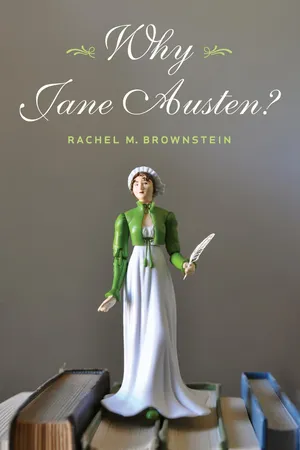
Why Jane Austen?
About this book
Information
Subtopic
European Literary CriticismIndex
LiteratureCHAPTER 1
Why We Read Jane Austen
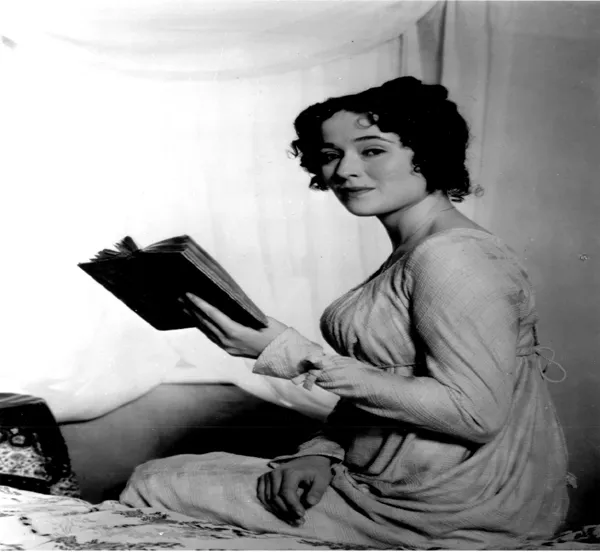
FIGURE 2. Jennifer Ehle as Elizabeth Bennet in Pride and Prejudice, directed by Simon Langton (BBC, 1995).
Questions of Truth
We remember that Jane Austen wrote novels. It might be worthwhile for her critics to read them.
—Virginia Woolf, “Jane Austen and the Geese” (1920)
Nowadays the teaching of literature inclines to a considerable technicality, but when the teacher has said all that can be said about formal matters, about verse-patterns, metrics, prose conventions, irony, tension, etc., he must confront the necessity of bearing personal testimony. He must use whatever authority he may possess to say whether or not a work is true; and if not, why not; and if so, why so. He can do this only at considerable cost to his privacy.
—Lionel Trilling, “On the Teaching of Modern Literature” (1955)
“A single man in possession of a good fortune must be in want of a wife”: I would be happy to read a novel that starts like that. Charmed by the sound of the sentence, I would settle for a second one that backed up the generalization, for example like this: “As Sir Eustace Beauregard [or Sir Solomon Goldberg] approached the Bennet establishment, his cousin Francis Peake was galloping across the adjacent fields toward Longbourn.” But I’d be just as pleased to find it going in a different direction, e.g., “Rich Mr. Bingley blushed as he recalled his sister’s voice mockingly repeating the maxim,” which underscores the ambiguity of Jane Austen’s modal “must” (well, if he must, he must).1 The tantalizing tautology of Austen’s opening statement—the hint that what most people say or acknowledge is not worth saying—remains intact in the part of the sentence I’ve severed from the one she actually wrote.
But the “real” sentence offers many more delights than the abbreviated knock-off I’ve fabricated. How pleasantly and perversely disorienting of Jane Austen to begin a novel—which by definition presumes a reader prepared to suspend disbelief—with a declaration about the truth: “It is a truth universally acknowledged, that a single man in possession,” etc. How provocative is it for a writer to begin a work of fiction by stipulating what is—or perhaps is not—true, being merely, if universally, acknowledged to be true, which is to say only said or taken to be true? And what is the point, what the effect, of specifying “a truth,” that is, a single one, as opposed to “the truth”? (Reviewing a recent book about memoir, Daniel Mendelsohn reflects that “novels, you might say, represent ‘a truth’ about life, whereas memoirs and nonfiction accounts represent ‘the truth’ about specific things that have happened.”2) Can a “universally acknowledged” truth—as opposed to a truth that most people don’t or can’t see or talk about, a truth more subtle and hard to come by—in fact be true? Whatever else it may do, for openers this sentence raises the question of truth and fiction’s relation to it. As Katherine Mansfield’s comment regarding “the truth” about “every true admirer of the novels” also suggests, it is the right place to begin thinking about Jane Austen.3
When the word “truth” occurs in Pride and Prejudice—twenty-four times after “a truth” is introduced (twice) on the first page—the definite article usually precedes it, sometimes modified (“the real truth,” “the unhappy truth”). When it stands alone (“too much truth,” “civility and truth,” “truth in his looks,” “in truth,” “some truth”) there is the same implication that truth is absolute and more-or-less unitary, and that we know what it is or might be. To specify a truth is to suggest it is one truth among several, while to characterize it as “universally acknowledged” (very different from “universally recognized”) is to begin to suggest it is no truth at all. That “this truth” (as the word is immediately repeated) is that “a single man . . . must be in want of a wife”—that is, that a single man is obliged to be or must be a single man, i.e., a man who lacks a wife—is not worth saying, being as they say too true. Is the meaning of the sentence merely that most people tend to talk nonsense? What exactly is the universe in question—who is “everybody,” here? Is this work of fiction mocking or pretending to be like a philosophical treatise or argument, the kind of book that pursues the matter of truth? Arguably, that first sentence is meant to draw attention to the fictiveness of fiction and the differences among discourses (e.g., what most people have to say). What is this novel’s relation to the pursuit and the telling of truth(s)? Is fiction to fact as lies are to truth, or is the equation different? Broaching these questions at the beginning of the book sets the reader up to see the single man in question, and the people talking about him, in a particular way. Does the sentence prepare us to sympathize with his plight—in want of a wife, he will be pursued by women—or to see him as a familiar figure in gossip and fiction, or even as a trope? The reader begins to decide whether this will be an old story or a new one, a comedy or a satire—and if the latter, on what and whom.
Much of the discussion of truth in and around fiction has focused on the relation of the novel to news, facts, and history, on the one hand, and on the other hand to the fantasies and formulas and tropes of romance (often, “mere romance”). Don Quixote and Northanger Abbey are stories about overly credulous readers who believe fictions are true. Defining the “formal realism” of the novel that “rose,” as he saw it, along with the middle classes in England in the eighteenth century, Ian Watt emphasized the plausibility and credibility of this new form of story, which reflected (and inflected) ordinary people’s actual domestic lives. In contrast to earlier stories, the novel, according to Watt, describes actions middle-class readers could imagine performing themselves (galloping across fields toward houses, not descending into the underworld) undertaken by characters with first names and surnames like modern people’s names (Robinson Crusoe or Sir Eustace Beauregard, not Aeneas) whose motives and relationships are believable. The conventions of mimetic realism that the realistic novelists developed, according to Watt, convey time and space as ordinary people apprehend them; novels are about issues in ordinary (if slightly exaggerated or elevated) domestic lives concerned with the making of families, communities, profit, and love. At the center of such stories are credible characters like Pamela Andrews the virtuous servant, Tom Jones the raffish foundling, and Clarissa Harlowe the daughter of a scheming middle-class family that seeks to rise into the gentry. In his chapter on Richardson, Watt praised that novelist (as Diderot had done before him) for truth to his characters’ inner lives and to motives of which they themselves are unaware—psychological truth.4
There are different kinds of truths, and reasonable novelists and readers disagree about whether the “truths” that different novels tell are acknowledged or universal, or plausible or too pleasant, and/or about whether they are worth telling. Matthew Arnold deplored Charlotte Bronte’s novels for expressing the “hunger, rebellion, and rage” he took to be the writer’s own, and Virginia Woolf agreed with him to some extent, writing that one passionate feminist speech by the ideologically driven rebellious heroine spoiled Jane Eyre. Charlotte Bronte, for her part, had criticized Jane Austen’s novels for being about “ladies and gentlemen, in their elegant but confined houses,” instead of the throbbing men and women who peopled her own more natural and authentic fictions.5 Reading Austen critically contributed to Bronte’s view—and her representations—of the truths about people that are worth writing about. There’s no accounting for tastes, which vary and change; and writers inflect, and readers interpret, the tropes of fiction very differently.
Both historical novels and novels of manners promise or pretend to some kind of truth to life. In the first group, imaginary characters sometimes encounter “real” ones, as the protagonists of Waverley and War and Peace and Norman Mailer’s An American Dream do. In the second, motives and customs, ceremonies, and domestic details we recognize make imagined and sometimes fantastic worlds seem plausible: being convinced of a fiction’s truth involves comparing and contrasting it to the lives we know. The appetite for narrative fiction is related to the appetite for gossip. As Patricia Spacks has argued, the domestic novel is related to gossip (consider the last sentence of the first chapter of Pride and Prejudice, about Mrs. Bennet: “The business of her life was to get her daughters married; its solace was visiting and news”).6 Stories about imaginary people, like stories about our neighbors or news of local weddings in the papers, satisfy the hunger to consider our lives in relation to other people’s, and the related desire to plug new and different names and details into the narratives we know and expect. News about the neighbors or people like them is intrinsically interesting. Gossip is familiar and predictable and also full of coincidences, as novels are: some you’re prepared to marvel at, others are hard to swallow, and some you don’t even notice are coincidences. Reading Pride and Prejudice, comfortably suspending disbelief, we don’t bother to wonder how plausible it is that Darcy and Wickham, who grew up on the same estate in the north of England, should find themselves—annoyingly, embarrassingly—interested in the same girl in a country village in the south. At their first encounter, when one of the men turns white and the other turns red, this dramatic sudden contrast between their countenances—otherwise not described—pleasingly persuades us that these rivals are moral opposites. They (and other characters: Darcy and Elizabeth, but also Elizabeth and Jane, Elizabeth and Charlotte, and Elizabeth’s different aunts Phillips and Gardiner) are paired to please us with the promises of balance, coherence, and some kind of truth.
In the famous first paragraphs of Austen’s most-read and best-loved novel, which raise questions of truth and universality and what kind of truth gets acknowledged and what kind remains unsaid, her irony is palpable, thick. But it is not clear what it is directed at. Are we meant to read the first sentence of Pride and Prejudice as calling attention to the opposite of what it seems to be saying, that society is concerned about the fate of unmarried women, not men? Critics have suggested that the tautological statement that a single man with a good fortune (i.e., money and/or luck) is “in want of” a wife (i.e., that he doesn’t have one) implies that a single woman without a fortune is on the other hand obliged to find a husband to support her—and that most novels (but possibly not this ironic one) are about that predicament. Can anyone but a habitual reader of romantic novels—and critical articles about such novels—be relied on to get this point? What about a habitual reader of wedding notices in the newspapers? Or is the irony also directed more generally—more universally—at the relation between what respectable people profess to believe (acknowledge) and what they really think and do and even sometimes say? The tone of this magisterial, mocking narrative voice enchants and challenges.
The narrator’s initial philosophical generalization is immediately undercut by the first scene of the story, in which an ill-matched long-married couple banters at cross purposes about the new man in town, who might be a good catch for one of their grown daughters. The curtain falls on this scene of dialogue—and on the chapter—with a summation of Mr. and Mrs. Bennet’s characters that matches the curtain-raising first paragraphs in its authority, but takes a slightly different tack and tone. The narrative voice at the end of the chapter is as direct and to the point in dispatching the Bennets (as if for good) as it was philosophical and ironic at the beginning. “Mr. Bennet was so odd a mixture of quick parts, sarcastic humour, reserve, and caprice, that the experience of three and twenty years had been insufficient to make his wife understand his character. Her mind was less difficult to develop. She was a woman of mean understanding, little information, and uncertain temper” (PP, 5). (Dickens observes by the way, in Barnaby Rudge, that what’s called an uncertain temper is certain to be a bad one.) In other words, the narrator points out to us what the couple’s conversation has already demonstrated—and also that understanding character or human nature will be the project and the subject of a book that will devote itself to these home truths. To finish the first chapter is to know what it expects of its reader.
There is a sly echo, in the famous first sentence of Pride and Prejudice (1813), of a rhetorical question Edmund Burke asks in Reflections on the Revolution in France (1790): “Is it then a truth so universally acknowledged, that a pure democracy is the only tolerable form in which human society can be thrown, that a man is not permitted to hesitate about its merits, without the suspicion of being a friend to tyranny, that is, of being a foe to mankind?” Arguing against what he sees as an undiscriminating fashion for democracy that doesn’t allow for finer distinctions, Burke seems to be glancing back at Thomas Jefferson (“We hold these truths to be self-evident, that all men are created equal” (Declaration of Independence, 1776; my italics). Where Jefferson argued for putting into effect (i.e., making true) “truths” that are not yet universally accepted and acknowledged, Burke and Austen are criticizing what most people think of as truths—and, it would seem, criticizing most people. Although he is no friend to tyranny, Burke has reservations about the pure democracy being cried up by people in favor of the French Revolution: did Jane Austen, who drafted her novel during the revolutionary 1790s, have similar reservations about the rights and freedoms of individuals? She certainly seems to have had reservations about the courtship plot, although it turns out she’s writing a novel based on it; since (as everyone knows) she herself never married, and since most of the marriages she portrays are less than good, she perhaps had reservations about the universally acknowledged obligation to marry. Was she, then, a social conservative—a Tory, if, as Marilyn Butler has argued, a Tory feminist?7 From a conservative point of view, on the other hand, marriage is central to the social fabric, which requires that a single man of good fortune marry, so that the race (and the class) will continue and the nation remain in the same—the right—hands. (But in this case the single man at issue has merely rented Netherfield Park: he does not own real property, and his fortune derives from trade, that is, speculation and luck.) Is this narrator’s tongue so firmly in her cheek that we cannot know her meaning? Does she mean to communicate or to conceal what she thinks is true?
Class discussions of the first chapter of Austen’s most oft-assigned novel tend to be lively. American college students are struck first of all by the oddity of Mrs. Bennet’s calling her husband “Mr. Bennet”: it puts them off. Did husbands and wives really talk to one another that way in England at that time, they ask, even at home—even (mischievously) in bed? Or did only the rich ones take this peculiar formal little distance from one another? Someone notices that in the first scene Mr. Bennet calls his wife “my dear,” not “Mrs. Bennet”: does that mean she is looking up to him, while he is condescending to her? Is that Jane Austen’s feminist satire? Or is the novelist taking an equal distance from both characters? Is the book a satire on middle-class people who are pretentious and stuffy and polite instead of casual and intimate the way people are today? If someone remarks that this married couple is just like the married couples in sitcoms today—the distant husband, the ditzy wife—we remain on the subject: what’s true to life—and what kind of people’s life—and what’s merely conventional. Talking about how sitcoms reflect the influence of Austen’s novels can be as fruitful as talking about the novels that influenced hers—more fruitful in a beginning class, when the students have read very little. The question on the table is how this book is different from the usual run of domestic comedies and love stories, why it is considered a classic, why they should have to read it in school. As they argue about whether Mr. or Mrs. Bennet is the better parent—she’s too involved in managing the girls’ lives, he’s too aloof and detached—I try to get them to notice and take pleasure in the play of differences and similarities among the characters, the subtle distinctions in the way they express themselves—the words they use. To compare and contrast first this husband and wife and then the Bennet and the Lucas families, and Mr. Bennet and his brothers-in-law, and Mrs. Bennet and the much grander but quite as gauche and manipulative matron, Lady Catherine de Bourgh. To teach them to read.
Was everyone really so witty back then, they ask, and did they all have such large vocabularies? Or is the book trying to make them sound better than people actually sounded, even then? We talk a little about different kinds (I might even say, tentatively and as if casually, “classes”) of people, and I tell them a few facts about the landed gentry and the land-based economy, and how things were beginning to change, economically and socially, at the time Jane Austen wrote. Perversely hungry for facts in this course in fiction, the students are especially interested in the entail on Mr. Bennet’s estate, which makes it impossible for him to pass it on to his daughters, enjoining him instead to leave it, in defiance of feeling and reason, to Mr. Collins, the distant relative who according to law is the male heir. They see this as a sign of how undemocratic things were then. I observe that the documents that entitle people to property are still operative in our world, and that just like novels they are made up of mere words, and that civil society continues to depend on what we sometimes call legal fictions.
In other words, to begin to talk about the novel is inevitably to engage with the question the narrative points toward from the start, the question of language and its power to tell truths of one kind or another. What truth does this or any novel actually tell? And (this is school, after all) what can and should you learn from the work of reading and studying this book? In what sense might this story about chaste and virtuous English virgins and their suitors, none of w...
Table of contents
- Cover
- Half title
- Title
- Copyright
- Epigraph
- Contents
- Acknowledgments
- Abbreviations
- Introduction
- 1: Why We Read Jane Austen
- 2: Looking for Jane
- 3: Neighbors
- 4: Authors
- 5: Why We Reread Jane Austen
- Afterwords
- Notes
- Index
Trusted by 375,005 students
Access to over 1.5 million titles for a fair monthly price.
Study more efficiently using our study tools.
Frequently asked questions
Yes, you can cancel anytime from the Subscription tab in your account settings on the Perlego website. Your subscription will stay active until the end of your current billing period. Learn how to cancel your subscription
No, books cannot be downloaded as external files, such as PDFs, for use outside of Perlego. However, you can download books within the Perlego app for offline reading on mobile or tablet. Learn how to download books offline
Perlego offers two plans: Essential and Complete
- Essential is ideal for learners and professionals who enjoy exploring a wide range of subjects. Access the Essential Library with 800,000+ trusted titles and best-sellers across business, personal growth, and the humanities. Includes unlimited reading time and Standard Read Aloud voice.
- Complete: Perfect for advanced learners and researchers needing full, unrestricted access. Unlock 1.5M+ books across hundreds of subjects, including academic and specialized titles. The Complete Plan also includes advanced features like Premium Read Aloud and Research Assistant.
We are an online textbook subscription service, where you can get access to an entire online library for less than the price of a single book per month. With over 1.5 million books across 990+ topics, we’ve got you covered! Learn about our mission
Look out for the read-aloud symbol on your next book to see if you can listen to it. The read-aloud tool reads text aloud for you, highlighting the text as it is being read. You can pause it, speed it up and slow it down. Learn more about Read Aloud
Yes! You can use the Perlego app on both iOS and Android devices to read anytime, anywhere — even offline. Perfect for commutes or when you’re on the go.
Please note we cannot support devices running on iOS 13 and Android 7 or earlier. Learn more about using the app
Please note we cannot support devices running on iOS 13 and Android 7 or earlier. Learn more about using the app
Yes, you can access Why Jane Austen? by Rachel M. Brownstein in PDF and/or ePUB format, as well as other popular books in Literature & European Literary Criticism. We have over 1.5 million books available in our catalogue for you to explore.