- English
- ePUB (mobile friendly)
- Available on iOS & Android
eBook - ePub
Tolerance, Democracy, and Sufis in Senegal
About this book
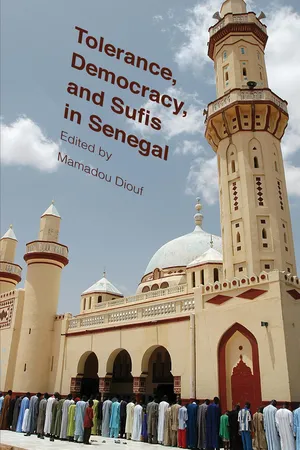
This collection critically examines "tolerance," "secularism," and respect for religious "diversity" within a social and political system dominated by Sufi brotherhoods. Through a detailed analysis of Senegal's political economy, essays trace the genealogy and dynamic exchange among these concepts while investigating public spaces and political processes and their reciprocal engagement with the state, Sunni reformist and radical groups, and non-religious organizations. The anthology provides a rich and nuanced historical ethnography of the formation of Senegalese democracy, illuminating the complex trajectory of the Senegalese state and reflecting on similar postcolonial societies. Offering rare perspectives on the country's "successes" since liberation, the volume identifies the role of religion, gender, culture, ethnicity, globalization, politics, and migration in the reconfiguration of the state and society, and it makes an important contribution to democratization theory, Islamic studies, and African studies.
Information
[ 1 ]
Introduction
The Public Role of “Good Islam”: Sufi Islam and the Administration of Pluralism1
The prevailing predictions of the nineteenth century and the beginning of the twentieth century incorrectly announced that religions would suffer a continuous and irreversible decline due to democracy, tolerance, dialogue, and pluralism. Secularism, in particular, will be one of the key drivers of the process of economic and social development. On the contrary, as averred by Ashis Nandy, with a genuine irony:
Many wrote obituaries of religions as early as the middle of the nineteenth century. Since then, it has been the triumph of one secular ideology after another, though steep decline or ignominious fall has usually followed the triumph. Religion has re-emerged at the end of what could only be called an age of ideologies, not in its pristine form but bearing the imprint, and, sometimes, even the garb of the age of secular ideologies. At the beginning of the twenty-first century, religion has turned into a phoenix that has risen from its own ashes as a sign of its new triumph.2
Sufism as an Antidote to Political Islam
The visual expressions, infrastructures, and sacred places of Sufism are currently called upon to oppose the rise of political Islam in this new environment, which is strongly characterized by the presence of religions in the public space, Islam in particular. This detour marks a paradox, very acutely anchored in the idea that the strengthening of the presence of a certain form of religiosity in the public sphere could ensure respect for pluralism, favor the development of an open society,3 and establish democracy in the political and social landscape. In the case of Senegal, it is important to understand the political and religious dynamics as well as the meshing of and exchanges between the Western-educated elite and the various traditional leaders, the two groups that have strongly contributed to the Senegalese success story. The Senegalese case study is a historical construction in which a social contract has brought religious and political authorities together since colonial times. Why have brotherhood marabouts been able to offer formulas and forms of vernacularization of discourses and political practices to the state and to the political elites? Why is the return to Sufism an answer to the mobilization, inspired by political Islam (equated to fundamentalism, conservatism, traditionalism, and terrorism)? What lessons can we learn by strengthening or restoring Sufi organizations, practices, and spirituality, all of which are conceived as antidotes or responses to the rise of religious fundamentalism in a society in which Muslims form a majority?4
Dismantled during the process of building modern nation-states in Pakistan, Egypt, and Tunisia, Sufi associations are being reestablished as critical elements in strategies aimed at containing the advance of political Islam.5 In chapter 9, Alfred Stepan illustrates the return to Sufi Islam in the case of Senegal because that “particular form of Islam […] fosters ‘rituals of respect’ by emphasizing those parts of the Qur'an’s multivocality that urge tolerance as a response to diversity.” No one he interviewed during his fieldwork felt comfortable with the concept of an “apostate,” and all felt comfortable with the famous Catholic Cardinal Thiandoum’s Muslim roots. Additionally, he notes that in the city of Popenguine, he found Catholics and Sufi disciples who helped build one another’s mosques and churches.
Zidane Meriboute, one of the most vocal advocates of the restoration of Sufism as a modernizing Islamic force6 able to contain the expansion of political Islam, provides an analytical framework that powerfully contrasts the “liberal, rational, enlightened and tolerant” Sufi tradition with fundamentalist Islam. He makes a strong case that Sufism can be viewed as “an antidote” because it has a prose, a grammar, and modern practices that circumscribe and support a space of pluralism and tolerance. It represents the safest way to facilitate the admission of Muslim societies into today’s world, considering its doctrinaire track record, “from the work of some of the most brilliant Muslim thinkers of the Middle Ages and from the Sufis. Such men included Ibn Rusch (Averros), Ibn Sina (Avicenna), sal Khawarizwi, Al-Hallaj, Ibn Al-Arabi, and Rumi. Centuries later, Jamal Ad-Din Al Afghani and Muhammad Abduh followed on from their work. Contemporary thinkers, such as Egypt’s Abdullah Badawi and Mohammed Al-Jabri in Morocco, continue to play their part. It continues to be the only way Islam will be able to coexist with the West. Neither orthodox theologians nor Muslim politicians, however, have yet come to terms with these reformers and unconventional mystics whose activities tend to destabilize dogmatic Islam.”7 On the contrary, Meriboute continues, analyzing the current situation, “[I]n much of North Africa, Eurasia, and Africa proper, religious fundamentalism and Sufi coexist, either in uneasy cohabitation or outright conflict. In some countries, such as Algeria, Tunisia, and Turkey, for historical reasons, that have never been fully examined, there has been hostility to Sufi orders. The results were soon to be seen. The vacuum left by the withdrawal of the Sufis was swiftly filled by other expressions of Islam, often of the most hard-line Islamist variety.”8 Thus, the prevailing turn to “Western-style nationalism, based on modernizing liberalism,”9 legitimized the destructive head-on attacks upon Sufi organizations and provided grounds to the expansion of “radical Islam.”
In contrast to the dismantling of the Sufi brotherhoods, which benefited radical Islam, Meriboute discerns three events as key moments in the political trajectory of Sufi Islam: the reestablishment of Sufi associations in Egypt by Nasser, at the beginning of the 1950s;10 the active participation of Algerian president Abdel Aziz Bouteflika in the revitalization of the Zawiyas social and charitable activities to serve as “bulwarks against fundamentalism … calling upon them to correct false ideas about Islam and to inform public opinion, particularly among young people;”11 and, finally, the position of African nationalist regimes “that emerged from the process of decolonization [that] have refrained from allowing themselves to be persuaded by the traditionalist ulema to try to stamp out the brotherhoods, as was the case under President Bourguiba in Tunisia, and Boumédienne in Algeria. The unintended consequences of Boumédienne’s policies were to complete the work begun by Sheikh Ben Badis who had persecuted bastions of liberal Sufism in Algeria, which could have been rampart against religious extremism.”12
Regarding the Senegalese case study examined in this volume, an African country sandwiched between “Islam and the West”—referring to the title of Sheldon Gellar’s book13—the challenge posed by the rise of “Islamist religious fundamentalism” is addressed by turning to a specific type of Islamic religious formation, Sufi Islam. The cooperation between the political power and the Sufi leadership is considered to be the foundation that ensured political stability in an African environment, stricken by military coups, civil wars, and ethnic conflicts. This singularity in Africa and the Senegalese exception has been qualified as a “quite remarkable success story,”14 a “construction of a liberal democracy” by Robert Fatton,15 a “quasi-democracy,”16 or “an unfinished democracy.”17
However, the combination of the hard blows to Sufism in the Middle East and Asia, combined with the assaults from the partisans of secularism and the rise of political Islam, seemed to announce the unquestionable decline of the Sufi tradition, according to the social science scholarship and the opinions of the observers of the political scene in sub-Saharan Africa. It is, for example, the argument of the British historian J. S. Trimingham who concludes his study of the influence of Islam in Africa insisting upon “the weakening of the Sufi spirit,” attacked by both political Islam and secularism, whose irresistible progression and hegemony characterize modern times.18 E. E. Rosander, who draws a clear distinction between “African Islam” and “Islam in Africa,” espouses this conclusion.19 She suggests that African Islam reappropriated local forms and resources, thus retaining an African quality. Open to local cultures, it accommodates other spiritualities. Islam in Africa, which launched an attack against the increasingly retreating African Islam, according to Rosander, has set two goals for itself: the purification of Islam and the removal of any Western or local impurities.20 Even if they do not believe political Islam will adversely affect the Senegalese political arena and society, C. Coulon and D. Cruise O’Brien observe that despite President Abdou Diouf’s denial of the existence of an Islamic threat in Senegal, “to stay just a few days in Dakar is to realize that the tranquil and moderate Islam which has long prevailed in this country is now in question. One finds in Senegal the atmosphere of Islamic agitation that marked the early years of colonial rule, a period when the economic, social, and political upheavals introduced by the European presence produced large scale religious movements and gave birth, for example, to the Muridiyya of Amadu Bamba.”21
Further examining the long-term changes undergone by the relationships between the state and the brotherhoods, from the improvement of their relationship during the colonial period with the establishment of a form of indirect administration of the rural population by the clerics to the postcolonial era, and their increasing role in political parties’ access to voters and recruitment of militants, Coulon and Cruise O’Brien conclude by observing the closure of the harmonious sequence, during which “everything seemed to be for the best in the Islamic and patrimonial world.” They stressed that “for the last ten years or so, and since the accession of Abdou Diouf as head of state, Islam seems to be a more and more autonomous force. The Islamic awakening is apparent in all social strata and manifests itself in a variety of ways. The increase in number of Islamic associations of all kinds is one sign of this renewal, whether they are traditional da’iras grouping the disciples of a single marabout or modernist groups with social and political goals influenced by reformist ideas.”22 Less than ten years after the publication of Coulon and Cruise O’Brien’s article, L. Villalón argues that despite the threat, “the system has proven durable,”23 even though he also notes a new wave of Muslim religious demonstrations within the Senegalese public sphere, as well as the rise in destabilizing risks, while recognizing that Islamic groups tend to exclusively reach the urban segment of the population.
Islam and National Culture: Revisiting the Social Contract
The long Senegalese history, which started with the establishment of the French colonial administration, is precisely the subject of this volume. It began as a conference hosted by the Institute of African Studies; the Institute for Religion, Culture, and Public Life; the Center for Democracy, Toleration, and Religion; and the Committee on Global Thought on the theme of Tolerance, Democracy, and Sufis in Senegal at Columbia University in 2008. The volume examines the different turns, twists, and facets of the complex trajectory of the Senegalese state and society; these contours are continuously reconstituted by the circumstances, social segments, and fragments through their confrontations, and cooperation within and between the various brotherhoods, as well as between the aforementioned state.
The different chapters aim to identify and analyze the effects of Sufism on the Senegalese society, the public sphere, upon democratic procedures, and on the respect of pluralism, including religious pluralism. The numerous social, cultural, and religious arrangements highlighted by the authors attest to the existence of what is identified by many scholars as the “Senegalese exceptionalism.” Building on his previous work on the Murid brotherhood, Donal Cruise O’Brien treats this exceptionalism using the simple, but nonetheless very revealing, concept of the “success story,”24 achieved by a social contract binding the taalibe, the marabouts, the colonial administration (before independence), and the postcolonial political elite. Such a “success story,” according to Coulon and Cruise O'Brien,
was attributed to the emergence of an authentic national culture, to relatively viable linkages between the communities (local, religious, or ethnic) and the state. The success was manifest in the capacity of the governmental party as an effective political machine. The quality of the political leadership made the Senegalese state a uniquely effective apparatus, and an instrument of stability although still unable to initiate an effective development policy. The state in Senegal at least was not a political artifact, working in a void, without effective links with society at large.25
Cruise O’Brien’s theoretical and methodological approaches as well as his main conclusions are now subjected to an intense questioning and revision. The new scholarship on the Murid in particular suggests specific revisions, as shown, for example, by Cheikh Babou in chapter 6. He investigates the “underlying assumption [that] the social contract theory relates to the willingness of the state, colonial and postcolonial, to share power or at least to recognize an autonomous domain of authority to the leadership of the Muslim orders of Senegal.”
This volume juxtaposes different disciplines and various methods and theories to shed light on the different forms of vernacularization of democracy, tolerance, and pluralism, to participate in an effort to trace in detail the contours of the debate. The end result is a longue durée perspective, focusing on the changes and adjustments made to the social contract between the taalibe and marabouts, as well as between the marabouts and the state. Its ambition is to reexamine the Senegalese experience, a particular political enterprise, by revisiting its history, possibilities, mutations, and limitations and whose very unique Senegalese chara...
Table of contents
- Cover
- Half title
- Series Page
- Title
- Copyright
- Contents
- Acknowledgments
- List of Abbreviations
- 1. Introduction: The Public Role of the “Good Islam”: Sufi Islam and the Administration of Pluralism
- 2. A Secular Age and the World of Islam
- 3. Islam’s New Visibility and the Secular Public in Senegal
- 4. Dakar’s Sunnite Women: The Dialectic of Submission and Defiance in a Globalizing City
- 5. Sovereign Islam in a Secular State: Hidden Knowledge and Sufi Governance Among “Taalibe Baay”
- 6. The Senegalese “Social Contract” Revisited: The Muridiyya Muslim Order and State Politics in Postcolonial Senegal
- 7. Religious and Cultural Pluralism in Senegal: Accommodation Through “Proportional Equidistance”?
- 8. Islam, the “Originaires,” and the Making of Public Space in a Colonial City: Saint-Louis of Senegal
- 9. Stateness, Democracy, and Respect: Senegal in Comparative Perspective
- 10. Negotiating Islam in the Era of Democracy: Senegal in Comparative Regional Perspective
- Glossary
- List of Contributors
- Index
Trusted by 375,005 students
Access to over 1.5 million titles for a fair monthly price.
Study more efficiently using our study tools.
Frequently asked questions
Yes, you can cancel anytime from the Subscription tab in your account settings on the Perlego website. Your subscription will stay active until the end of your current billing period. Learn how to cancel your subscription
No, books cannot be downloaded as external files, such as PDFs, for use outside of Perlego. However, you can download books within the Perlego app for offline reading on mobile or tablet. Learn how to download books offline
Perlego offers two plans: Essential and Complete
- Essential is ideal for learners and professionals who enjoy exploring a wide range of subjects. Access the Essential Library with 800,000+ trusted titles and best-sellers across business, personal growth, and the humanities. Includes unlimited reading time and Standard Read Aloud voice.
- Complete: Perfect for advanced learners and researchers needing full, unrestricted access. Unlock 1.5M+ books across hundreds of subjects, including academic and specialized titles. The Complete Plan also includes advanced features like Premium Read Aloud and Research Assistant.
We are an online textbook subscription service, where you can get access to an entire online library for less than the price of a single book per month. With over 1.5 million books across 990+ topics, we’ve got you covered! Learn about our mission
Look out for the read-aloud symbol on your next book to see if you can listen to it. The read-aloud tool reads text aloud for you, highlighting the text as it is being read. You can pause it, speed it up and slow it down. Learn more about Read Aloud
Yes! You can use the Perlego app on both iOS and Android devices to read anytime, anywhere — even offline. Perfect for commutes or when you’re on the go.
Please note we cannot support devices running on iOS 13 and Android 7 or earlier. Learn more about using the app
Please note we cannot support devices running on iOS 13 and Android 7 or earlier. Learn more about using the app
Yes, you can access Tolerance, Democracy, and Sufis in Senegal by Mamadou Diouf in PDF and/or ePUB format, as well as other popular books in Política y relaciones internacionales & Historia africana. We have over 1.5 million books available in our catalogue for you to explore.