Cinema has long shaped not only how mass violence is perceived but also how it is performed. Today, when media coverage is central to the execution of terror campaigns and news anchormen serve as embedded journalists, a critical understanding of how the moving image is implicated in the imaginations and actions of perpetrators and survivors of violence is all the more urgent. If the cinematic image and mass violence are among the defining features of modernity, the former is significantly implicated in the latter, and the nature of this implication is the book's central focus.
This book brings together a range of newly commissioned essays and interviews from the world's leading academics and documentary filmmakers, including Ben Anderson, Errol Morris, Harun Farocki, Rithy Phan, Avi Mograbi, Brian Winston, and Michael Chanan. Contributors explore such topics as the tension between remembrance and performance, the function of moving images in the execution of political violence, and nonfiction filmmaking methods that facilitate communities of survivors to respond to, recover, and redeem a history that sought to physically and symbolically annihilate them
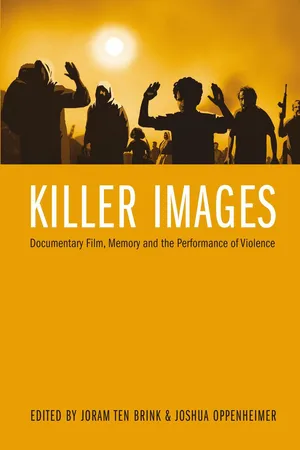
eBook - ePub
Killer Images
Documentary Film, Memory, and the Performance of Violence
- English
- ePUB (mobile friendly)
- Available on iOS & Android
eBook - ePub
Killer Images
Documentary Film, Memory, and the Performance of Violence
About this book
Information
Subtopic
Film & VideoBATTLE FOR HISTORY:
APPROPRIATING THE PAST IN THE PRESENT
APPROPRIATING THE PAST IN THE PRESENT
SUBVERTING DOMINANT HISTORICAL NARRATIVES:
AVENGE BUT ONE OF MY TWO EYES, AVI MOGRABI
Joram ten Brink
Avi Mograbi, a documentary film director, lives and works in Tel Aviv, Israel. Avenge But One of My Two Eyes (Nekom Achat Meshtai Einai) was produced in 2005 as a French/Israeli co-production.
Joram ten Brink: One of things that strike me is your work at the checkpoints full of images of the violence, humiliation, frustration and pain in these places. You developed that style over the years, with you as the provocateur, as the man with the film camera.
Avi Mograbi: It wasn’t my intention to provoke or intervene in the situation. There are lots of situations in the film where I don’t intervene. Actually, I prefer to remain an observer, and let the viewer see the reality in, let’s say, in a ‘direct cinema’ mode. Of course it’s very strange to talk about my work and mention ‘direct cinema’, but I prefer to just look at things and let the viewer appreciate it, or understand what’s happening. But what happens in the occupied territories is that, first of all, sometimes the situations immediately put you in a position of intervention. I am travelling often in the company of activists who have come to do work. They are not just observers. Often you want to be a silent observer but one of the parties that is being observed, the soldiers, are reluctant to become subjects of observation. And of course what you see in the film is only a small selection of situations but there were so many situations where you would go to a checkpoint and stand even from afar, and then one of the soldiers would come up and say: ‘if you don’t put away the camera we’ll close the checkpoint and then it’s not us who are not letting the Palestinians go across, it’s you!’ You ‘become’ the person with the key to the checkpoint with his camera! Of course because you come there with a political intention, you say to yourself: of course it’s a distorted way to describe the situation, but the people are waiting to cross through the checkpoint. The soldiers don’t mind, they often say to the Palestinians, pointing at me: ‘He is blocking your way.’ And sometimes even the Palestinians say: ‘Go, don’t film now, you are creating a disruption.’ And of course in Avenge… there is one scene where they actually try to block me from filming. It’s so strange, because there was nothing to film. We’d just arrived there, me and the B’Tselem guys, and this was a checkpoint where nothing was happening, you know, really there was nothing to film. And if it wasn’t for them [the soldiers], there wasn’t a scene. But they were making a scene. And of course the scene of trying to block the ‘eye’ is a very strong one, and very important. Of course, there was supposedly no physical violence, but it was a very violent situation. It’s hard to see in the film, because the camera has a very limited lens width, but four soldiers were actually touching my body with their jackets, and this is why, when I move the camera, I move from one place to another. Because they were in front, they were blocking me with their bodies. So, of course, when you are in such a situation, whatever you do, you react. Either you say – okay, I’ll put down, I’ll turn off the camera; or you say, as I did – you have no right to do that. But whatever you do is a reaction. I don’t think I provoked anything. I think I was provoked. But the fact is, you are right, that in the occupied territories a lot of times, the presence of the camera is a provocation. Not because you do anything, or not because anything happens or that you create something that happens, but the fact that you pull out a camera means that you have ‘intentions’. And those ‘intentions’, as the soldiers see them, unless they know that you are on their side, are seen as a provocation, and they try to block filming. In the last scene of the film where I do ‘explode’ violently and aggressively, not with physical violence, but definitely with foul language, you can say – here was a situation that I created, but never intentionally. I never planned to do that. Lately, my activism has been shifted from demonstrating and working with activist groups to doing something useful. Like today I drove a woman from the town of Tulkarem to Tel HaShomer hospital and back. She needed treatment for her eye. She has a permit to cross but for her to get from the checkpoint of Tulkarem to Tel HaShomer hospital would take a whole day if she had to do it alone. But, back to the last scene in Avenge… I was with Physicians for Human Rights at a certain checkpoint where they had an ongoing problem with children returning from school at two different times, namely, at twelve noon and at one-thirty. The younger kids who arrive to the checkpoint at twelve always have to wait until one-thirty for the gates to open. This has been going on every day for months. And you know, the ridiculous thing, of course, is that the soldier told me: ‘I don’t need to tell you the reason.’ If he said ‘there is a security problem … there’s a suicide bomber on the loose, we have to close the gates’, okay. But he just said: ‘I don’t have to tell you.’ And this sentence put me on fire. What do you mean you don’t have to tell me? And of course it’s the hottest day of the year and I lost my temper, which happens from time to time. And the most irritating thing of all was that, come one-thirty, the soldiers opened the gate wide open, people from both sides – adults with bags, cars – everybody crossed at once; no body checked, as if there were no checkpoint there.
JtB: You also see it in this scene – there’s a kind of little ritual, a kind of ‘dance’ between the activists and the soldiers; the activists, always with a camera and you’re not the only camera in many of the shots, and there are also B’Tselem’s camera people walking around. We witness those moments of violence, of humiliation, so much integrated with the image of cinema and with the need to document everything.
AM: The activists have learned that the Israeli juridical system, the police, the press and the public, don’t believe the word of the activists, of the leftist activists, because they are biased. But the public cannot resist an image, and this is why it has become very common that activists travel with cameras in order to create proof for the authorities or for the press or the public. My son was once arrested near the village of Bil’in. He was not arrested during one of the big demonstrations there, but there was a period when they [my son and his friends] were doing mid-week activities to try to interfere with the building of the fence near the village. One of the things they did was that they created a big cylinder made out of barrels that were welded into a big pipe, and they made holes for the head and the legs. Six or seven activists were seated inside this pipe, only heads and legs protruding and they were all chained, etc. They placed it on the road where the tractors were working. And my son was arrested afterwards, and was brought to Jerusalem, to the Russian Compound Police Station, and then later brought in front of a judge. His friends who were not arrested came back and told me that there is a video showing everything that happened there. I took the video and ran up to Jerusalem and arrived on time for the hearing in front of the judge. The police accused my son of interfering with the building work etc, but also they accused him of attacking a policeman. I showed the video to the judge, and after he saw it, he said – I see only violence on the part of the police, the activists didn’t ‘do’ any violence. Because they [the protestors] were locked inside [the barrels], the police started beating them with clubs. And the judge said – excuse me, they can go home, because there is only police violence here, there is no activist violence. And so forth. B’Tselem eventually gave dozens of cameras to locals [Palestinians] and this is how you got to see lately the incident where a soldier shot the leg of one of the people arrested in the village of Nil’in. A twelve-year-old girl filmed it on video. So the camera has become, I wouldn’t say a weapon but … I mean of course, when you are confronted with the soldiers this is not your weapon, this doesn’t win the confrontation, but it’s a weapon for later times to clarify what has really happened. The army do the same – whenever there are demonstrations in the occupied territories, they always use at least one soldier whose job is to shoot a video.
JtB: But the presence of your camera at those checkpoints actually changes the dynamics of the events in the checkpoints.
AM: Yes, it does. There are two possibilities. It depends on who the soldiers are. On one hand it makes them softer, because they are aware of the presence of the camera and maybe they are not so happy about what they are doing or even a little bit ashamed of what they are doing, maybe there is a bit of fear…
JtB: So the camera stirs their conscience…
AM: Yes, or maybe the camera makes them think that perhaps their mother will see them and so sometimes they become softer, like in the situation in Avenge… when a person was made by the soldiers to stand on the stone. We were three cameramen there. Normally, this ‘event’ lasts for hours but because of our presence an hour after we arrived nobody was there any more. They let everybody go. Because they suddenly realised that … maybe the camera didn’t raise their conscience but it raised their awareness of the situation.
JtB: That shot made me think of Abu Ghraib photographs. It’s the image of humiliation. But [your soldiers] didn’t see it as an image until you came with a camera. Then it became an image of humiliation for them.
AM: Yes. And in other situations, like you see in the film, where the soldiers decide that the camera is an interruption, they may either attack the camera, or block the checkpoint until you go. So the presence of the camera or the presence of human rights activists affects the situation. Nowadays people are so aware of the power of the image that you cannot place a camera anywhere without people knowing it. I mean, in the back of their mind, even if they don’t feel that they need to modify their behaviour, they are aware of the presence of the camera. And I think this is very interesting – the camera is very powerful. But also the soldiers themselves use the camera not only for documentary, for an ‘official’ documentary activity, but also for fun. You mentioned Abu Ghraib? People here have been taking photos of themselves with corpses of fighters they have killed from the other side and have been spreading them in internal net[work]s.
JtB: You’ve seen it?
AM: Yes.
JtB: So they’re taking trophies?
AM: Yes. Sometimes holding the dead person standing up, sometimes… I should have a picture of them – they look sometimes like hunters, with their leg on the body of the dead person. Abu Ghraib…
JtB: Is not an American invention…
AM: No. Of course, it’s different when, in Abu Ghraib the camera came only after a series of humiliations in the prison. The soldiers were trying to brag about their abilities to be ‘strong fighters’.
JtB: Back to your film, what struck me also were the ambulance scenes – the use of long shots and the attention to detail. Those scenes are played out almost in real time. As part of the image of violence and humiliation they contain a huge number of small details – the hand gestures, the soldiers’ orders: ‘Come! Go! Come! Go!’ the repetitive nature of the event. It looks almost like a ritual that happens every day.
AM: Yes, I believe in an image that tells you a story and not in a person that tells you the story from his memory, including his interpretation of what has happened before. Although you may say that the ‘information’ may be the same, but when you see it, when you just see the image, although the basic ‘information’ is no different, the impact of the real image is so much stronger.
JtB: But it’s the attention to the little details, which ‘delivers’ the horror.
AM: I think this technique also brings out the irony and points to how crazy everything is. It was very important for me to zoom in, as you said, to the guy at the top of the observation point, because when you stand down there you don’t understand how it works. The people are showing the soldiers on the top of the observation point, from a distance, their ID, or their travel permits. Tell me, how can a soldier sitting twelve meters high up tell anything? He is sitting there with his binoculars and it is so absurd. Because what are these documents? If you look at them from twelve meters away with binoculars, how can you at all know tell if they’re authentic or not? It could be lousy photocopy, and how can you read the names with binoculars … I think that the absurdity is part of the horror, but also it is an idea within itself.
JtB: If there were no cameras around the checkpoints, would the world of the checkpoints be different?
AM: Of course the world of the checkpoints would be different, I’m not sure I know how, but it’s like anything … if there were no reporters, not only cameras, and nobody to tell you what’s happening perhaps the situation would be different. Not necessarily for the good. Like some two or three years ago a woman in the Hawara checkpoint witnessed a person trying to cross with a violin. He was asked to play in order to cross. She caught it with her cell-phone camera. This image speaks not about the humiliation only but about the historical context – the image of the violin player in Jewish history is very loaded – the orchestras in death camps and in concentration camps etc. So again, the information is not so significant or important but more important and significant is the context, which corresponds to your own historical reference.
JtB: We are always aware of the way you are ma...
Table of contents
- Cover
- Series Page
- Title Page
- Copyright
- Contents
- Acknowledgments
- Notes on Contributors
- Introduction
- (De)activating Empathy
- Memory of Violence: Visualising Trauma
- Battle for History: Appropriating the Past in the Present
- Performing Violence
- Index
Trusted by 375,005 students
Access to over 1.5 million titles for a fair monthly price.
Study more efficiently using our study tools.
Frequently asked questions
Yes, you can cancel anytime from the Subscription tab in your account settings on the Perlego website. Your subscription will stay active until the end of your current billing period. Learn how to cancel your subscription
No, books cannot be downloaded as external files, such as PDFs, for use outside of Perlego. However, you can download books within the Perlego app for offline reading on mobile or tablet. Learn how to download books offline
Perlego offers two plans: Essential and Complete
- Essential is ideal for learners and professionals who enjoy exploring a wide range of subjects. Access the Essential Library with 800,000+ trusted titles and best-sellers across business, personal growth, and the humanities. Includes unlimited reading time and Standard Read Aloud voice.
- Complete: Perfect for advanced learners and researchers needing full, unrestricted access. Unlock 1.5M+ books across hundreds of subjects, including academic and specialized titles. The Complete Plan also includes advanced features like Premium Read Aloud and Research Assistant.
We are an online textbook subscription service, where you can get access to an entire online library for less than the price of a single book per month. With over 1.5 million books across 990+ topics, we’ve got you covered! Learn about our mission
Look out for the read-aloud symbol on your next book to see if you can listen to it. The read-aloud tool reads text aloud for you, highlighting the text as it is being read. You can pause it, speed it up and slow it down. Learn more about Read Aloud
Yes! You can use the Perlego app on both iOS and Android devices to read anytime, anywhere — even offline. Perfect for commutes or when you’re on the go.
Please note we cannot support devices running on iOS 13 and Android 7 or earlier. Learn more about using the app
Please note we cannot support devices running on iOS 13 and Android 7 or earlier. Learn more about using the app
Yes, you can access Killer Images by Joram ten Brink,Joshua Oppenheimer, Joram ten Brink, Joshua Oppenheimer in PDF and/or ePUB format, as well as other popular books in Media & Performing Arts & Film & Video. We have over 1.5 million books available in our catalogue for you to explore.