- English
- ePUB (mobile friendly)
- Available on iOS & Android
eBook - ePub
About this book
Action Movies: The Cinema of Striking Back is a study of action cinema, exploring the ethics and aesthetics of the genre with reference to its relatively short history. It moves from seminal classics like Bullitt (1968) and Dirty Harry (1971) through epoch-defining films like Rambo: First Blood Part II (1985) and Die Hard (1988) to revisions, reboots, and renewals in films like Kill Bill Vol. 1 (2003), Taken (2008), and The Expendables (2010). The action genre is a fusion of form and content: a cinema of action about action. It is a cinema of the will, configured as a decisive reaction to untenable circumstances. Action heroes take up arms against the sea of troubles that beset them, safe in the knowledge that if they don't do it, nobody will. Though this makes the action movie profoundly disturbing as an embodiment of moral ideology, its enduring appeal proves the appetite for assurance remains undiminished, even in the wake of 9/11.
Information
Subtopic
Film & Video1 THE WAR AT HOME
The Urban Western: Rogue Cops and Vigilante Avengers
In Death Wish Paul Kersey (Charles Bronson), an architect whose wife has been murdered and daughter raped, becomes a vigilante. Though an educated pacifist, Kersey has snapped in the face of his sense of powerlessness. During a business trip to Arizona he discovers an aptitude for firearms after he attends a Wild West show with a client, who makes him a gift of a .32 revolver. Kersey’s sense of morality, honour and even heroism is framed by a delusion, referencing received images of strength, will and ‘frontier justice’, driven by trauma and psychosis. At the film’s climax, a wounded Kersey pursues a mugger to an abandoned train yard. Bleeding, tiring, delirium overtaking him, Kersey draws a bead on his target and says ‘Fill your hand.’ The mugger has no idea what he means.
The command to ‘fill your hand’ is an invitation to battle: a reference to True Grit (1969) in which an aging John Wayne plays Rooster Cogburn, a US Marshall who faces down four gunmen in a bravura climax where the line is spoken in response to an agist insult leveled against him. In Cogburn’s case this battle requires significant strength – four young men against a single ‘one-eyed fat man’. In Kersey’s case, it is an ironic line as the mugger is unarmed and Kersey has spent the entire film summarily executing similar street punks in an act of universal vengeance (these are not even the perpetrators of the crimes against his family). It is also, in the event, an impotent line, as he falls unconscious and his quarry escapes.
Reviewing Death Wish in Newsweek in 1974 Maureen Orth described the film as ‘an urban western’ (see Talbot 2006: 21). Though Will Wright wrote confidently of the mythic function of the American western, concluding it ‘contains a conceptual analysis of society that provides a model of social action’ (1975: 185) there were few new films to write about. The western was dying as a genre, arguably facing total erasure after The Wild Bunch (1969) eviscerated its mythology with a cautionary tale of anachronism and extinction.
By the late 1960s American cinema had begun to reflect the uneasy sensibility of the post-Kennedy years. It was a cinema of doubt, framed by a society seemingly on the brink of revolution. These were the years of the ‘war at home’ where political unrest resulting from counter-cultural resistance to the Vietnam War led to a series of intense confrontations with governmental authority, leading often to social unrest and even violence. Many of the films of this period demonstrate a sense of social tension between heroic ideals and social values, sometimes to the detriment of established genres whose tenets had been evolved in a completely different social paradigm, particularly war films and westerns.
Wright identifies four plot structures, all revolving around the status of the hero relative to individual and social values: in the ‘classical’ plot the hero aids society by joining with it; in ‘the vengeance variation’ he begins within society but steps outside because it is too weak to permit his pursuit of vengeance; in ‘the transitional theme’ he leaves society because it is too strong and too much at odds with his (heroic) worldview; in ‘the professional plot’ he protects society simply because he has been paid (1975: 29–123). All four of these structures recur in non-western films throughout the 1970s. The fact is that the change in historical framework and iconography is not incidental, and produces subtle variations on the relatively clear-cut moral parameters of the western genre, not least of all because the postmodern geographies (physical and psychic) involved cannot but shift the mythic paradigm from classical models.
Wright’s ‘model of social action’ was still applicable to these and subsequent films as the historical and iconographical frames of reference shifted towards modernity and urban space. The underlying themes of social action and social order in the light of an evolving civilisation are consistent, but there is a change in perspective with the shift to the urban that resonated with contemporary audiences. An ‘urban western’ is ‘urban’ first, representing the physical landscape of present experience as a marker of ‘civilisation’ instead of using nineteenth-century frontier imagery as a cipher for the same thing. As Ed Buscombe puts it ‘the city became the frontier, and the savages – the muggers and rapists – were already inside the gates’ (1993: 53). The capacity to navigate this dangerous space is one of the markers of the action hero, as is the (post-)modernistic fascination with urban imagery (helicopter shots of cityscapes, alienating juxtapositions between actors and surrounding buildings). Even the visual palette of Death Wish evokes not so much a documentary image of New York in the early 1970s commensurate with crime dramas, but more an expressionistic labyrinth of twisting alleyways filled with lurking dangers reflecting Kersey’s paranoid fantasy. It is significant that Kersey is an architect (an accountant in the original novel), reinforcing the western’s concern with the literal building of civilisation. Kersey designs spaces to be lived in, only to find that those who dwell in architectural spaces may not conform to social design.
Coogan’s Bluff may be the exemplary urban western in its deployment of a dual architecture of contemporary crime drama and classic western. Clint Eastwood plays Arizona Deputy Sheriff Walt Coogan, sent to New York to extradite a criminal, but finding himself baffled by the social and physical environment. Eastwood’s unapologetically classical westerner is pitted against the sins of the ‘civilised’ East, thoroughly overrun by criminality, immorality and hedonism, but also against the bureaucratic authorities that insist on deference to the procedures of modern law enforcement. Eventually Coogan is able to navigate through the urban jungle and escape from it – a literal flight back to his ‘civilisation’ which is clearly (and nostalgically) encoded as a social, sexual and cinematic past.
The opening scene enacts the drama of confrontation between classic and contemporary iconography as Coogan brings in a Navajo fugitive. There is conscious deference to the classic western in the desert landscape and the Native American lurking in the brush. The paraphernalia of modernity is then brought to bear, firstly in the semi-automatic rifle with a telescopic sight carried by the Navajo, then in the form of Coogan’s jeep, which is seen tearing across the landscape and used to stir up dust and prevent the Navajo from getting a clear shot.
This scenario is replayed in reverse throughout the film as Coogan becomes disenfranchised from the environment. In New York Coogan is overwhelmed by the new urban architecture and its culture and is literally attacked by the contemporary counter-culture. When he enters a club called ‘Pidgeon-Toed Orange Peel’ he is confronted by psychedelic lights and music illustrating scenes of sexual deviance including nudity and homosexuality. There he meets Linny Raven (Tisha Sterling), his quarry’s hippy girlfriend who has sex with him, but then arranges for Coogan to be beaten up. He later attacks her, throwing her around her beaded, mural-decorated apartment before throttling her in front of a huge painting of the word ‘love’, and driving his fist through the wall beside her head.
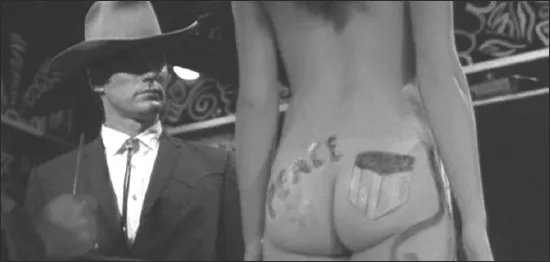
Eastern decadence under the western gaze: Clint Eastwood confronts the counter-culture in Coogan’s Bluff (1968)
In Linny we have, as Alan Lovell remarks, one of director Don Siegel’s ‘women who convert their unbalanced sexual desires and envies into violence’ (1975: 37) and a doubling of the film’s skepticism with modernity and sexual identity. Her refusal of the dominant orthodoxy of desire, where she should fall in love with the manly hero and share his values, is represented as criminal impulse. This becomes a register of the trauma of the sexual revolution, here clearly being reacted against by a hero who takes direct action – crushing the liberal sensibility. In doing so, he is seen also to re-ignite the traditional domesticated desire of the heroine, initially liberal and progressive probation officer Julie Roth (Susan Clark), who waves a teary goodbye to the gunfighter at the film’s conclusion as he rides off into the proverbial sunset, albeit in a helicopter.
Dirty Harry, also directed by Don Siegel, would cement Eastwood as the defining urban cowboy, and would provide the template for the ‘rogue cop’ movie that would become one of the foundations of the action genre. In it San Francisco Detective Inspector Harry Callahan (Eastwood) pursues a killer called Scorpio (Andy Robinson) in defiance of the rules of due process. Callahan’s confrontations with his superiors are as much the focus of the film as the battle with Scorpio. They represent a consistent and repeated punctuation of the narrative – a restraint of action that merely makes the audience anticipate the film’s cathartic explosions of violence when Harry is unleashed (this was precisely what the film’s tagline promised – ‘You don’t assign Harry to murder cases, you turn him loose.’) When Harry disobeys orders, confronts and kills Scorpio and then throws away his badge at the end of the film, he has taken action, but abandoned the civilisation he has upheld. Unlike Coogan though, he has nowhere to return to where he is socially legitimate.
That Harry represented the new breed of urban enforcer stepping almost unreconstructed out of western myth is barely debatable, certainly when you compare the film with The French Connection, released the same year. The French Connection loosely follows the true story of New York’s biggest ever drugs bust as Detective Jimmy ‘Popeye’ Doyle (Gene Hackman) pursues a complex chain of evidence through thugs and street dealers to mastermind Alan Charnier (Fernando Rey). The French Connection took the crime film towards the more realistic ‘New Hollywood’ aesthetic in its depiction of New York; Dirty Harry remained in the figurative and literal West. The French Connection is about solving a complex crime through dogged determination and investigative police work; Dirty Harry is about solving all crime, as represented by a single murderer, through decisive action and the application of extreme force, including harassment and torture. Two very different visions of civilisation are being upheld here. Though aspects of the same configurations of tensions between heroism, civilisation and landscape as outlined in Dirty Harry are present in The French Connection, its ‘rogue cop’ is also, in spite of himself, more integrated with the system, and this is precisely what gives the film its frisson in the final scene where Doyle’s sanity and perhaps criminal culpability in seeking vengeance is left unresolved.
Dirty Harry triggered critical and cultural debate around the politics of this emergent cinematic sensibility. Writing in The New Yorker, perennially acerbic critic Pauline Kael described it as both fascist and immoral, making the film a hot button for public discourse. In fact Kael remarked that the action film on the whole had always had ‘fascist potential’ (1985: 148), but that Dirty Harry had brought it to the surface. This remark encapsulates the situation of this emergent cinematic sensibility at this juncture in history. The action film marks an explicit emergence of a reactionary panic to a perceived threat to social order; one, ironically, hereby symbolically contained by violence wielded in the name of that same order but in opposition to its ‘civilised’ tenets. This would endure throughout the following years, across numerous direct Dirty Harry sequels, and various re-iterations of the formula with varying degrees of subtlety. Certainly there was little but blunt rhetoric in the advertising for the Sylvester Stallone vehicle Cobra (1986): ‘Crime is a disease. Meet the Cure.’
Films in which ordinary citizens take the law into their own hands are quite different than the ‘rogue cop’ variety, although examples of the vigilante film still fall within the same framework – arguably shifting focus from the cowboys to the outlaws. In fact, the difference cuts to the heart of discourses of law and order in American history. David Johnson reports that in the 1860s San Francisco, where Dirty Harry is set, was one of the most active centres of vigilante activity in the United States. At that time ‘vigilance committees’ and frontier justice operated quasi-legitimately in a legal and judicial system attempting to regulate an evolving society (1981: 561). Johnson points out that the struggle to establish a system of judicial law throughout the nineteenth century hinged on a shift between what was perceived as natural justice and the actual rule of law from an integrated legislative authority. What is therefore at stake in the vigilante film is the rule of man versus the rule of law and the sense of self-determination and the capacity for action that comes with it.
This is in play in Death Wish where, not unlike its ‘rogue cop’ forebears, a bureaucratic police force and a seemingly immobile but frustrated populace needs an agent of action to respond to the threat of urban crime. The loose cannon here is a free agent, but one that operates with the tacit approval of professional authority. Throughout the film street crime decreases as Kersey’s rampage progresses, and the police debate whether or not to allow the vigilante to continue his activities. This culminates in a scene where, as Kersey lies in hospital recovering from his wounds, wizened police detective Frank Ochoa (Vincent Gardenia) advises him to get out of town. In response Kersey quips ‘by sundown?’ In using this particular line and in emphasising Kersey’s reaction to the reconstructed western street fight he sees in Tuscon the legacy of the western as the locus of ‘frontier justice’ as text, as trope and as social construction is made eminently clear.
While urban westerns may have adopted the tropes and devices of the classic western, rural (or at least non-urban) American imagery did not completely disappear. In fact, a ‘new western’ strain of a type developed alongside these sharing many of the same concerns. Vigilante films like Billy Jack and Walking Tall can also be located at least partly within a so-called ‘Southern exploitation’ mould. Scott Von Doviak argues that this sub-genre can be read as a modern rural American folkloric cinema. He suggests the success of these films may be seen relative to the continued success of blaxploitation films and urban westerns ‘providing heroes and myths for those trapped in the inner cities’ (2005: 9). The Southern exploitation film, by contrast, serviced drive-ins and scattered rural venues where they spoke to their audience by ‘tapping into a recent past all but obliterated by Wal-Marts and strip malls’ (ibid.) with a prevalence of rural or backwoods imagery and stories involving renegades, outsiders and miscreants who prove heroic in their defiance of ‘civilised’ (Northern) values. In this way the acts of vigilante justice and social cleansing carried out by the protagonists of these films form an even stronger link between the anti-hero and social agency. These characters earn their social mandate by dint of the unwelcome domination of a modernising urban culture, which these films unfailingly portray as corrupt and destructive.
This is the focus of the Billy Jack series, mostly written, produced, directed by and starring Tom Laughlin. The films are quixotic tales of a peaceful liberal cowboy (and, it is eventually revealed, a Vietnam veteran) pushed beyond his limits by the intrusions of state authorities. Only The Born Losers (1967) deploys traditional outlaw villains – a biker gang (the contemporary cinema’s analogue for the raiding Indian bands of the classic western). In Billy Jack the opposition is the wealthy landowner who pressures a local ‘freedom school’ with the collusion of local authorities. In The Trial of Billy Jack (1974), Laughlin broadens the palette to include fictive dramatisations of the real-life Kent State Shootings as governmental authorities move to repress liberal education, and Billy Jack Goes to Washington (1977) more or less speaks for itself. Throughout all of these films, it is social institutions that represent systematised violence and repression, in an illustration of what Slavoj Žižek describes as ‘the often catastrophic consequences of the smooth functioning of our economic and political systems’ (2008: 1). In these terms Billy Jack’s assumption of agency represents a reaction against centrist social consensus. Significantly in genre terms, this reaction is realised not only as politicised action, but actual combat.
The most exciting sequences in each of the Billy Jack films are the martial arts battles. These demonstrate both the tutelage of Hapkido master Bong Soo Han, who trained Laughlin, and a comparatively early adoption of some of the cinematic architecture of Hong Kong martial arts films. This is particularly pointed in Billy Jack when Billy and his students are taunted in an ice cream parlour, causing Billy to call out the local thugs to the nearby park. A series of establishing shots from above establish the geographical boundaries of the combat, showing Billy at the centre of a circle of antagonists, before the film intercuts to images of individual blows and kicks as he fights. The editing is not as fluid, nor are Laughlin’s movements as quick or graceful, as his Asian counterparts, but the very ‘heaviness’ of the blows is more visually resonant with John Wayne than Bruce Lee, and this may be the point, as it was later in the films of Chuck Norris.
Walking Tall also spawn...
Table of contents
- Cover
- Half title
- Series Page
- Title
- Copyright
- Contents
- Acknowledgments
- Dedication
- Preface
- Introduction
- 1. The War at Home
- 2. The Hyperbolic Body
- 3. The End of Ideology
- 4. The Return
- Filmography
- Bibliography
- Index
Trusted by 375,005 students
Access to over 1.5 million titles for a fair monthly price.
Study more efficiently using our study tools.
Frequently asked questions
Yes, you can cancel anytime from the Subscription tab in your account settings on the Perlego website. Your subscription will stay active until the end of your current billing period. Learn how to cancel your subscription
No, books cannot be downloaded as external files, such as PDFs, for use outside of Perlego. However, you can download books within the Perlego app for offline reading on mobile or tablet. Learn how to download books offline
Perlego offers two plans: Essential and Complete
- Essential is ideal for learners and professionals who enjoy exploring a wide range of subjects. Access the Essential Library with 800,000+ trusted titles and best-sellers across business, personal growth, and the humanities. Includes unlimited reading time and Standard Read Aloud voice.
- Complete: Perfect for advanced learners and researchers needing full, unrestricted access. Unlock 1.5M+ books across hundreds of subjects, including academic and specialized titles. The Complete Plan also includes advanced features like Premium Read Aloud and Research Assistant.
We are an online textbook subscription service, where you can get access to an entire online library for less than the price of a single book per month. With over 1.5 million books across 990+ topics, we’ve got you covered! Learn about our mission
Look out for the read-aloud symbol on your next book to see if you can listen to it. The read-aloud tool reads text aloud for you, highlighting the text as it is being read. You can pause it, speed it up and slow it down. Learn more about Read Aloud
Yes! You can use the Perlego app on both iOS and Android devices to read anytime, anywhere — even offline. Perfect for commutes or when you’re on the go.
Please note we cannot support devices running on iOS 13 and Android 7 or earlier. Learn more about using the app
Please note we cannot support devices running on iOS 13 and Android 7 or earlier. Learn more about using the app
Yes, you can access Action Movies by Harvey O'Brien in PDF and/or ePUB format, as well as other popular books in Media & Performing Arts & Film & Video. We have over 1.5 million books available in our catalogue for you to explore.