Official Chinese narratives recounting the rise of the Chinese Communist Party (CCP) tend to minimize the movement's international associations. Conducting careful readings and translations of recently released documents in Russian, Japanese, and Chinese, Ishikawa Yoshihiro builds a portrait of the party's multifaceted character, revealing the provocative influences that shaped the movement and the ideologies of its competitors.
Making use of public and private documents and research, Ishikawa begins the story in 1919 with Chinese intellectuals who wrote extensively under pen names and, in fact, plagiarized or translated many iconic texts of early Chinese Marxism. Chinese Marxists initially drew intellectual sustenance from their Japanese counterparts, until Japan clamped down on leftist activities. The Chinese then turned to American and British sources.
Ishikawa traces these networks through an exhaustive survey of journals, newspapers, and other intellectual and popular publications. He reports on numerous early meetings involving a range of groups, only some of which were later funneled into CCP membership, and he follows the developments at Soviet Russian gatherings attended by a number of Chinese representatives who claimed to speak for a nascent CCP. Concluding his narrative in 1922, one year after the party's official founding, Ishikawa clarifies a traditionally opaque period in Chinese history and sheds new light on the subsequent behavior and attitude of the party.
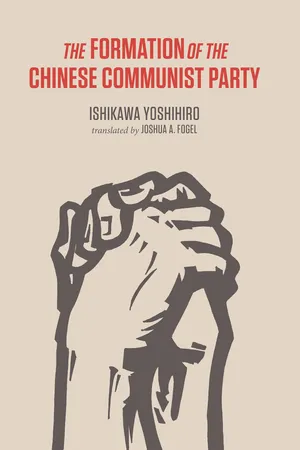
eBook - ePub
The Formation of the Chinese Communist Party
- English
- ePUB (mobile friendly)
- Available on iOS & Android
eBook - ePub
The Formation of the Chinese Communist Party
About this book
Information
Subtopic
Chinese HistoryIndex
History1
The Reception of Marxism in China
NEW THOUGHT TRENDS IN CHINA AT THE TIME OF THE MAY FOURTH MOVEMENT
Knowledge and Revolution
The May Fourth Movement erupted in 1919, as is well known, but that is the year that genuine study of Marxism began in China as well. Western socialism, Karl Marx (1818–1883), and Marxism had been introduced to China in the late-Qing period, and while all of them exerted a certain influence on a group of Chinese revolutionary refugees overseas at that earlier point in time, they did not begin to spread throughout China until 1919.1 The precipitous flow of socialist documents into China from 1919 forward is simply astonishing, as the main newspapers and magazines throughout the country devoted large amounts of space to introducing socialist ideas. Spreading Marxism at that time, Zhou Fohai (1897–1948) wrote about the rise of the “socialist” tide: “This year a huge number of magazines have been discussing socialism. Some have been short-lived, but there is a strong sense that if they do not discuss socialism at all, they cannot be considered publications of the New Culture Movement.”2
The Marxism that spread through the major cities of China gained the strong support of Soviet Russia and the Comintern, culminating in the formation of the Chinese Communist Party. For Chinese intellectuals who were learning about and accepting Marxism, however, it was something they acquired first from reading books, as was the case with many other new ideas of Western origin at that time, a topic that requires thorough study of its own. For example, in research on Mao Zedong’s thought, when and what sort of socialist documents he read that led ultimately to his conversion to Marxism are topics of concern,3 for they suggest, in the context of the Communist movement, an inseparable relationship between the acquisition of knowledge and the revolutionary movement.
In this sense, it was not simply the case that the reception of Marxism in China resulted in a revolutionary movement linked by the Communist movement to the birth of a Communist Party; Marxism indeed brought to twentieth-century China a wave that might be dubbed the “knowledge revolution” in two senses.
First, in the confused intellectual realm of China in the May Fourth era, Marxism appeared as an all-inclusive ideology. To the various issues arising from the New Culture Movement—such as traditional Chinese thought as represented by “cannibalistic Confucianism” (in the words of Lu Xun), women’s liberation, a scientific view of the world, literary revolution, comparison of Eastern and Western civilizations, industrial promotion, and all manner of other complex questions—the prognostications of the materialistic view of history, the theory of class struggle, and the emergence of Communist society after the completion of the revolution gave rise to a “knowledge revolution” offering assurance of an age to come in the aftermath of a radical settlement. Like the gushing waters after a dam is broken, all manner of modern Western systems of thought came flooding into China all at once in the May Fourth era. Amid them, the distinctive comprehensive system of Marxism demonstrated extraordinary influence. In its way, Marxism promised a “fundamental guide” to those who understood it and to those who believed in it. While everything of past value had been laid open to criticism, until then no new yardstick to replace the old had appeared. This intellectual scene in the May Fourth era of extreme confusion somehow or other acquired a coordinate axis with the entrance of Marxism on the scene, and then all became crystal clear. For example, we see that, after his acceptance of Marxism in the 1919–1920 period, the writings of Li Dazhao (1888–1927), often called the father of Chinese Marxism, escaped from the conceptual speculative thinking that is often now difficult to comprehend and gained clarity in one fell swoop. His writing changed from a literary to a vernacular style, and his thinking developed into a Marxist mode of thought, as he began to use and speak in a Marxist vocabulary.
Another reason for calling the acceptance of Marxism a “knowledge revolution” is that its acceptance brought about in China a revolutionary movement of a new form guided by the system of “knowledge” known as Marxism. In other words, it marked the emergence of a revolution that complied with theory. Some time ago, E. H. Carr (1892–1982) dubbed the characteristic of the Communist movement and socialist revolution following the Russian Revolution “self-consciousness” and pointed out the important differences between these and the earlier bourgeois revolution.4 As Carr’s words indicate, “the Russian Revolution was the first great revolution in history to be deliberately planned and made”; the “socialist revolutionary movement” from the latter half of the nineteenth century was initially studied before being carried out, and on the basis of that research, a program was decided upon, and on this basis, plans were implemented. This marks a major difference from earlier revolutionary movements. Having some knowledge about these ideologies and principles before carrying out a revolution meant that it would be impossible to understand the revolutionary movement after the Russian Revolution if one ignored the weight of this “knowledge.” And China was certainly no exception. The Communist movement in China was actively begun by “intellectuals who not only repeated the past but planned the future, who sought not only to make a revolution but to analyze and prepare the conditions in which it could be made.”5
Marxist study in China did not blossom as a result of a sufficient accumulation of socialist research, nor was it attained as a consequence of the development of economic theories, and it was not realized by virtue of the labor movement. It was, in a word, a Marxism that was “learned.” The history of its acceptance in China was not only the stimulation of interest in accepting a foreign culture that emerged in the process of “study”; insofar as one can aver that having “studied” Marxism gave rise to a distinctive attribute of the Communist Party, “knowledge and guidance,” the subsequent Communist movement under Comintern influence also deserves full consideration.6 (Remember that leaders of the Communist movement in many countries had their theoretical systems of revolution published in the form of collected writings or collected works.) In this sense, in Japan as well from the 1920s, after the rapid influx of Marxism, “socialists who emerged from an ideology rooted in knowledge”7 took shape as new, left-wing intellectuals centered on the young, something highly suggestive for China at the same time.
Print Media and “New Ideas” During the May Fourth Movement
The extensive diffusion of Marxism cannot be explained without the temporal background of the flood-like influx of new currents of thought in the May Fourth era. In considering the spread and acceptance of Marxism as a foreign system of thought, we must first examine the situation surrounding the culture at the time that made this possible and, in particular, the operations going on in print media, the primary avenue for the spread of ideas. No matter how concerned Chinese intellectuals involved in the May Fourth Movement were with foreign trends of thought and, as a result of the May Fourth Movement, no matter how keen their desire for reforming society so new currents of thought (including Marxism at this time) could be broadly introduced into China, the existence to a certain degree of print media outlets to materially convey these intellectual currents was assumed. In other words, Marxism and the influx of foreign intellectual currents en masse in the May Fourth era moved in tandem with the growth of print media in the May Fourth period.
Reading through the history of publishing in modern and contemporary China, one can say that the May Fourth era exhibited unprecedented activity in the publication of journals. Shimizu Yasuzō (1891–1988), who was sent to Beijing at the time by the Japan Congregational Church, noted that journals and demonstrations had dramatically increased since the start of the May Fourth Movement.8 Similarly, Luo Jialun (1897–1969), who was an early student activist in 1919, remarked in a comment about journals in China that “there have been too many journals in recent years for me to be able to look them all over.”9 One aspect of the dramatic rise, like floodwaters rising, in the number of journals can be seen even today by perusing Wusi shiqi qikan jieshao (Introduction to Periodicals in the May Fourth Period).10
Needless to say, the efflorescence in publication of all these journals was a product of the preceding “New Culture Movement.” The influence of the New Culture Movement, which attacked the difficult to understand literary language and advocated a new literature based on the vernacular language, led to a spread of the vernacular during the May Fourth era, and newly issued journals more often than not used the vernacular. Despite the stark fact that the great majority of Chinese living in the countryside were illiterate,11 the propagation of the vernacular style led to an expansion in the stratum of subscribers to books, and this must be seen as paving the way for the influx of journals.
While the publication of magazines and books in the May Fourth era spread rapidly, the growth of commercial publishing clearly lay behind this. To be sure, such representative publishing houses of the period, such as the Commercial Press (Shangwu yinshuguan) and Zhonghua shuju, had been producing works since before the May Fourth era, but the kinds of books they handled were largely limited to textbooks, the Chinese classics, and dictionaries—basic reference or research works. Through the New Culture Movement, the introduction of literary works from overseas, as well as the publication of works of literary theory, social science writings, and magazines aimed at young people and women, began. The number of published books alone rose dramatically. Even such publishers as Yadong tushuguan (The East Asian Library) and Taidong tushuguan (The Great Eastern Library), which had already been publishing works related to socialism, especially Marxism, in the May Fourth period, advanced the modernization of publishing, as can be seen in their establishment of an editorial structure in journalism during the May Fourth period.12 On the whole, one may say that the world of commercial publishing became established in China during the period surrounding the May Fourth Movement.
In the expanding flow of books and magazines, the distributors and agents set up by the organs of higher education in many places played a prominent part in linking publishers with readers. During the May Fourth era, when the structure of the flow of books nationwide had not yet been reorganized, many students purchased books from distributors that operated out of schools. Using book distributors this way made it possible to order and buy newspapers, magazines, and individual volumes that were published in Beijing or Shanghai from any regional city. These agencies not only distributed books, but those who worked for them (often activist students) gained a grasp on the intellectual scene among students from the books ordered and purchased, and they also offered a site at which like-minded students could meet. One reform-minded teacher at the Zhejiang Number One Normal School in Hangzhou at the time left the following memory of a book distributing agency:
After “May Fourth,” the propaganda movement continued through newspapers and magazines. The influence of newspapers and magazines was enormous, and they functioned to enlighten and educate young people. We wrote essays and organized book distributors at many sites, as we continued steadily to buy progressive periodicals. By selling books and magazines, we struck up conversations with buyers, and then advanced our organizational work. The way these book distributors worked was extremely popular at schools, and the buyers were all rather progressive young men and women. . . . If you were to say, when introducing someone to a friend, that this person supports the New Culture [Movement], that would be enough to gain his trust.13
As this citation indicates, students in the May Fourth era connected with one another through the activities of book distributors. And, needless to say, book distributors further expanded their operations after the May Fourth Movement. Even at Beijing University, the highest educational institution in the country (which would later turn out many Communists), the agency for the university press itself placed advertisements in books and magazines in Beijing daxue rikan (Beijing University Daily).
The spatial expansion of print media is especially significant not just for the magazines these book distributors used, but they worked with newspapers in other cities as well. For example, with the objective of spreading the new culture, in July 1920, Mao Zedong (1893–1976) and his colleagues opened the book agency Wenhua shushe (Culture Books) in Changsha, the capital of his native Hunan Province, and distributed numerous books and magazines. Noteworthy here are the large number of sales of Xin qingnian (New Youth, roughly 320 subscriptions for September–October 1920 and a total of 2,000 through March 1921); in addition, for October 1920, there were sixty-five daily subscriptions to the Shanghai newspaper Shishi xinbao (News of the Times) and forty-two for the Beijing newspaper Chenbao (Morning News).14 At the time, no national newspapers existed in the journalistic world, since Shishi xinbao and Chenbao were local papers in Shanghai and Beijing, respectively. With the intermediacy of distributors, however, it became possible to subscribe to Shanghai and Beijing newspapers even in Changsha. With the increasing popularity of magazines and newspapers at the time, their influence extended to several times the number of issues actually in circulation. In a short period of time, Marxism spread not only to the large cities of Beijing and...
Table of contents
- Cover
- Title Page
- Copyright
- Contents
- List of Figures and Tables
- Introduction to the English Edition
- Introduction (2001)
- 1. The Reception of Marxism in China
- 2. Soviet Russia, the Comintern, and the Chinese Communist Movement
- 3. Toward the Formation of the Chinese Communist Party
- 4. The First National Congress of the Chinese Communist Party
- Afterword
- Appendix 1: Chinese Translations from Japanese of Works on Socialism, 1919–1922
- Appendix 2: Explanation of Chinese Books Concerning Socialism, 1919–1923
- Appendix 3: Shi Cuntong’s Deposition
- Abbreviations
- Notes
- Bibliography
- Index
Trusted by 375,005 students
Access to over 1.5 million titles for a fair monthly price.
Study more efficiently using our study tools.
Frequently asked questions
Yes, you can cancel anytime from the Subscription tab in your account settings on the Perlego website. Your subscription will stay active until the end of your current billing period. Learn how to cancel your subscription
No, books cannot be downloaded as external files, such as PDFs, for use outside of Perlego. However, you can download books within the Perlego app for offline reading on mobile or tablet. Learn how to download books offline
Perlego offers two plans: Essential and Complete
- Essential is ideal for learners and professionals who enjoy exploring a wide range of subjects. Access the Essential Library with 800,000+ trusted titles and best-sellers across business, personal growth, and the humanities. Includes unlimited reading time and Standard Read Aloud voice.
- Complete: Perfect for advanced learners and researchers needing full, unrestricted access. Unlock 1.5M+ books across hundreds of subjects, including academic and specialized titles. The Complete Plan also includes advanced features like Premium Read Aloud and Research Assistant.
We are an online textbook subscription service, where you can get access to an entire online library for less than the price of a single book per month. With over 1.5 million books across 990+ topics, we’ve got you covered! Learn about our mission
Look out for the read-aloud symbol on your next book to see if you can listen to it. The read-aloud tool reads text aloud for you, highlighting the text as it is being read. You can pause it, speed it up and slow it down. Learn more about Read Aloud
Yes! You can use the Perlego app on both iOS and Android devices to read anytime, anywhere — even offline. Perfect for commutes or when you’re on the go.
Please note we cannot support devices running on iOS 13 and Android 7 or earlier. Learn more about using the app
Please note we cannot support devices running on iOS 13 and Android 7 or earlier. Learn more about using the app
Yes, you can access The Formation of the Chinese Communist Party by Yoshihiro Ishikawa, Joshua Fogel,Joshua A. Fogel in PDF and/or ePUB format, as well as other popular books in History & Chinese History. We have over 1.5 million books available in our catalogue for you to explore.