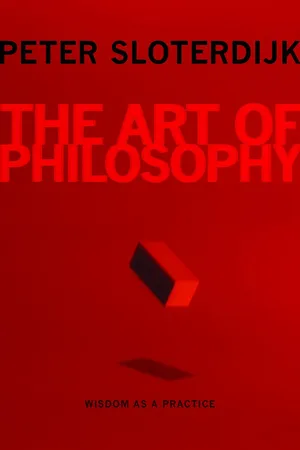
In his best-selling book You Must Change Your Life, Peter Sloterdijk argued exercise and practice were crucial to the human condition. In The Art of Philosophy, he extends this critique to academic science and scholarship, casting the training processes of academic study as key to the production of sophisticated thought. Infused with humor and provocative insight, The Art of Philosophy further integrates philosophy and human existence, richly detailing the foundations of this relationship and its transformative role in making the postmodern self.
Sloterdijk begins with Plato's description of Socrates, whose internal monologues were so absorbing they often rooted the philosopher in place. The original academy, Sloterdijk argues, taught scholars to lose themselves in thought, and today's universities continue this tradition by offering scope for Plato's "accommodations for absences." By training scholars to practice thinking as an occupation transcending daily time and space, universities create the environment in which thought makes wisdom possible. Traversing the history of asceticism, the concept of suspended animation, and the theory of the neutral observer, Sloterdijk traces the evolution of philosophical practice from ancient times to today, showing how scholars can remain true to the tradition of "the examined life" even when the temporal dimension no longer corresponds to the eternal. Building on the work of Husserl, Heidegger, Nietzsche, Arendt, and other practitioners of the life of theory, Sloterdijk launches a posthumanist defense of philosophical inquiry and its everyday, therapeutic value.
- English
- ePUB (mobile friendly)
- Available on iOS & Android
eBook - ePub
About this book
Information
Topic
FilosofíaSubtopic
Deconstrucción en filosofía1
THEORY AND ASCETICISM, MODERN AND ANCIENT
The discussion this evening will not tackle the complexities of the life of practice in the arts of the modern era nor in the athletic and religious asceticism of antiquity and the Middle Ages. Our topic is science as practice, or alternatively, science as anthropotechnology, although the latter term only features here to the extent that it means people using practice to develop themselves. I will leave aside speculation about possible eugenic and genetic manipulation as elucidated from Plato to Trotsky with varying degrees of seriousness.1 In giving the topic this specific title, we are already expressing the idea that practicing a profession dedicated to theory has to be seen somehow as asceticism and, moreover, as a process that helps the agents of scholarship as such to get fit. In this context, scholarship means more than the sum of its results; it is also the embodiment of the mental or logical procedures that help its pupils to make the transition from everyday to theoretical behavior. Incidentally, in what follows I shall proceed by minimizing the difference between science and philosophy and treating the two offshoots of the ancient European culture of rationality side by side as characteristics of the bios theoretikós, without discussing their specific qualities and increasing mutual estrangement.
As far as I know, the history of the processes that remodeled the profane person, who invariably began as a worshiper of his tribe’s idols, into a person doing theory has never been written. At most, it can be found between the lines of the prevailing history of ideas. Depending on the topic, we come across it in talking about the conditions for the incorporation of scientific processes, that is, mostly in pedagogical and anthropological asides on methodologies. The close relationship between practice and method is shown in the long series of preparatory studies that ranges from present-day beginner courses to the Greek and pre-Greek paths to the initial foundations of theory.
Admittedly, we tend to overlook such phenomena as long as we continue to believe in the history of ideas oriented to “basic problems” or “results.” We fail to see its significance as long as we ignore the fact that all “ideas,” theorems, and discourses would dissolve like writing on water if they were not embedded in the ongoing processes of repetitive life that guarantee, among other things, epistemic characteristics and discursive routines. These include, first of all, prior to any science yet closely influencing it, the reading and writing practiced by persons who do theory, which is why high culture and the culture of writing are almost synonymous expressions.
To give an idea of the breadth of the historical time span in which we can observe the phenomena under consideration in our cultural context, I would like to present two testimonies here, a relatively recent one from the beginning of the twentieth century that indicates the height of development until very recently, and a time-honored one that takes us back to the moment when Plato established the Athenian academy, accomplishing the foundation of philosophy and the philosophical sciences.
Let me begin our excursion today with a little-known document that offers the opportunity to present our problem in almost crystalline clarity. I shall cite some excerpts from a letter Edmund Husserl drafted to the poet Hugo von Hofmannsthal, who lived in Rodaun near Vienna. The letter is dated January 12, 1907. At this time, Husserl had been tenured public professor of philosophy at Göttingen University since 1906 and was a key figure of the phenomenological movement that had existed since 1900. As we shall see shortly, he wrote this philosophical epistle in the hope of involving Hofmannsthal, who was fifteen years younger, in his theoretical project. To put it more cautiously, Husserl wanted to associate Hofmannsthal with his project from a distance, not in concrete collaboration but to demonstrate an ethereal complicity between contemporaries who shared the rather unusual preference for a strictly contemplative attitude to the world.
In approaching Hofmannsthal, Husserl took what seemed like a tempting opportunity to make common intellectual cause with the celebrated poet of late Habsburg modernism and, amid the general surroundings of triumphant cohorts of pragmatists and naturalists, to champion the idea of relating to life’s events as “pure observers.” The philosopher’s letter was preceded by his meeting in person with the addressee a month earlier. On a reading tour of Germany, Hofmannsthal had given a lecture, “The Poet and Our Time,” in Göttingen and had visited Husserl. The poet, then age thirty-two, treated his Göttingen audience to a kind of creative confession, stylizing the poet’s self as a universal witness, indeed, as a living archive of being and as the focal point of collection for the world.
Dec. 12, 1907
He is here, and it is nobody’s business to bother about his presence. He is here and changes position silently and is all eyes and ears…. He is the onlooker—no, the hidden comrade, the silent brother of all things…. He suffers from everything and in suffering he enjoys everything…. For people and things and thoughts and dreams are all the same to him…. He can’t ignore anything…. It is as if his eyes were lidless…. Everything must and will congregate within him…. It is he who connects the elements of time within himself. The present is within him, or nowhere.2
These words on the existence of the poetic observer were sufficiently evocative to resonate in the philosopher’s mind even a month later, demonstrating his agreement. The tone and content of Husserl’s letter leave no room for doubt. He felt stimulated to equate the poet’s apparently selfless passivity in collecting impressions around him with the transpersonal activity of his own philosophy in observing and explaining. He had been convinced for some time of the possibility that contemplative behavior could be liberated from the position of being a once-weekly, second-class, indolent activity to which it had lapsed due to the triumphal progress of psychologisms, sociologisms, and naturalisms. What Husserl developed in the following years under the banner of “phenomenological method” is an aggregation of arguments for the thesis that the time was ripe for a philosophy that would rise to become a strict science. Or one could even say, for a defense of exact contemplation that developed into a counterattack thanks to its methodological modernization. Husserl’s vision was nothing less than the transformation of intuition into precision work and the dissolution of the distinction between the working days and holidays of reason. Let me quote at some length from this moving record of an attempt at professional communication:
Most esteemed Herr von Hofmannsthal!
You told me how a steadily growing flood of correspondence has complicated your life. But I feel the urge to thank you because you have made me very happy with a precious gift. Now you have to take the consequences of that foul deed and put up with this letter as well. Please be kind enough to excuse me for not having thanked you right away. Out of the blue I had a sudden inspiration about thought syntheses that I had been chasing for a long time. I was kept busy trying to write them down. Your “Short Plays” were close at hand all the time and greatly inspired me, although I didn’t have time to read continuously at length.3
The “inner meanings” that define your art as a pure aesthetic art, or actually not define but raise it to the ideal sphere of pure aesthetic beauty, are particularly interesting for me in terms of aesthetic objectification: that is, not just for my feeling as an art lover but also as a philosopher and “phenomenologist.” The years I spent trying to get a clear sense of fundamental philosophical problems and then finding methods of solving them have brought me the lasting reward of the “phenomenological” method. It requires taking a position to all forms of objectivity that seriously deviates from the natural standpoint, a position closely related to the attitude and behavior to which your art as pure aesthetic art transports us in relation to the depicted objects and the whole world of art.
Perception of a purely aesthetic work of art is achieved by strictly preventing the intellect from taking any existential position and preventing any reaction of feeling and will that presupposes such an existential response. To put it more clearly, the work of art transfers us (and forces us) to the state of pure aesthetic intuition that excludes taking any position. The more of the existential world that echoes here, or is actively introduced, the greater the existential response demanded by the work of art as such (for example, even as a naturalistic sensory illusion: the natural truth of photography), the less aesthetically pure the work is. (This also applies to any kind of “trend.”) The natural mental attitude, that of real life, is totally “existential.” The things that stand before us in the flesh, the things that are the subject of topical and scholarly talk, are what we posit as realities, and acts of the mind and of will are based on this positing of existence: joy, that this is; sadness, that something is not; wish, that it could be; and so on. (= existential mood response). This is the antithesis of the attitude of pure aesthetic perception and its corresponding state of mind. But it applies no less to the purely phenomenological frame of mind, the only attitude for solving philosophical problems, because the phenomenological method also demands strictly cutting off all existential responses…. In this way, all science and all reality (including that of one’s own ego) become mere “phenomenon.”
Only one thing remains: … to clarify the meaning that is immanent … by pure looking (in pure contemplative analysis and abstraction) … never and nowhere transgressing the simple phenomenon….
[For the artist], the world becomes a phenomenon by his observation of it; its existence is a matter of indifference to him, just as it is to the philosopher [in the critique of reason].4
It suffices to highlight certain phrases in this significant but bizarre document. Even after a time gap of over a hundred years, the convoluted naivety of Husserl’s proposal for an alliance still gives it a tragi-comic tone. Hans Blumenberg, despite his admiration for the philosopher, could not resist the passing jibe that in Husserl’s case radicalism was often close to ridiculousness.5 In the factual part of the letter, we are immediately struck by the entirely Platonic idea that life and reflection fall into two strictly separate camps. The two dimensions relate to each other like involvement and abstinence or defilement and cleansing.
It is no coincidence that the word “pure” constitutes the word for pathos in Husserl’s vocabulary: it occurs ten times alone in the excerpts cited here, whether as an adjective in phrases such as “purely aesthetic” or an adverb as in “purely aesthetically” or “purely phenomenologically.” Striving toward purity is linked to the attempt to create a totally “intuitive” relationship to the conditions of consciousness. Husserl worked all his life to recreate a contemplative modus vivendi that he intended to base on an appropriate modus cogitandi. His summing up at the age of seventy in 1929 has a touch of pathos: he wrote that he had to do philosophy otherwise he would have been unable to live in this world.
Since Husserl always considered the “natural attitude” to everything in real life to mean “taking a position,” which implies being involved in life’s problems and being fettered to the galleys of everyday life, the decision on the possibility of intuitive, even “purely intuitive,” behavior depends solely on proving that the curse of having-to-take-a-position can be successfully avoided. This means that to be pure, theory should be able at least temporarily to suspend its agent’s fixation on real existence, even if it does not completely dissolve it. Husserl typically appends the word “existential” to the phrase “taking up position.” Not long afterward, Heidegger’s approach from a diametrically opposed perspective would bring that same word, “existential,” into the center of a philosophy that was no longer contemplative. The new “existential” philosophy would not only emphasize the primacy of “concern” but would also show its determination to be swept along by the imperatives of the historical moment, as if existential “thrownness” must inevitably lead to being carried away by the great “event.” Exactly at this point, however, when the revolutionary Sturm-und-Drang author Heidegger pinned the “existentials” to his shield to join the Nazi storm, Husserl focused all his concern once again—one would like to say, for the last time—on “existential positioning.” What he envisaged was securing a windless zone in which thinking, free from the unreasonable demands of existence, could enjoy its interminable work on phenomena.
These points provide an initial approach to the set of problems that leads our investigation. If there were ever a happy occasion to observe theory being done, whether as philosophy or science, from the aspect of its practicing character, we have it here in relation to Husserl’s endeavor to attain a sphere of theoretical purity and pure theory. As we have indicated, this struggle resembled an attempt at complete purification. It was meant to put a stop to life’s tendency toward primal dirt, the inclination to get involved in and take positions on everything to do with life itself. Husserl called this act of stopping at the white line of theory “bracketing” or “switching off” the “natural position.” His endeavors could be described as a struggle for the possibility of the absence of struggle, a struggle fought to achieve a para-existential or extra-existential neutrality. Thanks to this, consciousness should withdraw from its “own” affairs and acquire the initially unlikely habit of circumventing the “things themselves” in a disinterested way.
If science—or, to put it more cautiously, the theoretical “attitude” as such, which can engender a specific science—is to be a matter of practice, then the cardinal exercise (from the Latin cardo, the door hinge) would have to be a withdrawal exercise. It would be an exercise in not-taking-up-a-position, an exercise in de-existentialization, an attempt at the art of suspending participation in life in the midst of life. Only through this narrow door could thought enter a sphere of pure observation in which the things of life cease to affect us directly. The observing ego should take the place previously occupied by the position-taking ego. The following applies to this curious onlooker ego: it does not go to the theater to emerge refined; it goes to the theater refined in advance (we do not know how) to transmit something of its purity to everything it sets eyes on there. If this kind of watching can be achieved by patient exercising, one’s personal existence would appear as a graphic illustration in a textbook on possible life forms. In fact, “pure” thought should be nothing but investigation of the illustrations we find if we look at an open page in the book of consciousness, and act all the while as if we have forgotten that the only consciousness one has direct access to is one’s own. This peculiarity, however, should no longer play a role; even the existence that belongs to me should be regarded merely as an individual case of a general connection of essence. My life has become nothing more than an accidental information source, a point on a curve that would interest me only for the functional equation. We should be wary of seeing this attempt to purify as an anachronism. Its modernity glares out from the fact that it entered the scene more or less as the logical sister of photography, even if Husserl, in his letter, condescendingly defines photography as the accomplice of vulgar naturalism. In fact, he is a “photographer” himself in another medium. Phenomenology is the philosophical counterpart to the process of “drawing with light” on sensitive material in the late nineteenth century that ushered the production of images into the technological age. It translates the first modern media art into the mental sphere by practicing a process of transforming sights seen in the surrounding environment and random visible and palpable life substances into fixed inner images devoid of context. In time, this process also appropriates moving pictures, which is obvious because anybody who focuses on the inner worlds of imagination will soon become aware of the permanent filmmaking of consciousness and will conclude that this deserves a special film analysis. It appears as the theory of inner consciousness of time.
The images under discussion here are recorded with a noetic camera. If the films are exposed to light and retrieved from the fixing bath of inner contemplation, the pictures achieve a philosophical status that is meaningful for archives or museums as well. The point of the best of all exercises is to develop the images captured from existence as phenomena. They are archived in the phenomenological collection. It is hardly surprising that the most philosophically interesting archive theories of the past decades, whether those of Jacques Derrida or Boris Groys, are more or less explicitly inspired by phenomenology. The archive is the collection whose content consists entirely of objects that have been released from the burden of being bound to life. Since more and more “things” can be liberated, decontextualized, and de-animated over time, the archive is in a process of incessant growth. What is expanding here is the zone of “things” released from the imposition of being real. Just as Hegel envisaged the schema of the classical museum, Husserl imagined that of the museum of the modern age.6
If life has always meant involvement, phenomenological thinking means practicing noninvolvement: nota bene, not the lack of involvement in the external activity that chronically overworked professors have no time for anyway, but in one’s own life where one takes a position. In other words, noninvolvement with one’s own self. The demonstrable results of this, the still life depictions of factors of consciousness, are to be conserved in the permanent exhibition. The best phenomenologist would be the most rigorous archivist. He would be the thinker who had learned most of all that he never really took part in existing. He would demonstrate how to behave so as to displace oneself in the permanent collection.
A few years later, Husserl invented the expression epoché for the gesture of distancing oneself from life, or the parts of life governed by direct affiliation to the ...
Table of contents
- Cover
- Half title
- Title
- Copyright
- Epigraph
- Contents
- Translator’s Note
- Introduction Theory as a Form of the Life of Practice
- 1. Theory and Asceticism, Modern and Ancient
- 2. “The Observer has Come”: The Creation of Persons Fit for Epoché
- 3. Theory and Suspended Animation and its Metamorphoses
- 4. Cognitive Modernism: The Assassination Attempts on the Neutral Observer
- Notes
- Name Index
Trusted by 375,005 students
Access to over 1.5 million titles for a fair monthly price.
Study more efficiently using our study tools.
Frequently asked questions
Yes, you can cancel anytime from the Subscription tab in your account settings on the Perlego website. Your subscription will stay active until the end of your current billing period. Learn how to cancel your subscription
No, books cannot be downloaded as external files, such as PDFs, for use outside of Perlego. However, you can download books within the Perlego app for offline reading on mobile or tablet. Learn how to download books offline
Perlego offers two plans: Essential and Complete
- Essential is ideal for learners and professionals who enjoy exploring a wide range of subjects. Access the Essential Library with 800,000+ trusted titles and best-sellers across business, personal growth, and the humanities. Includes unlimited reading time and Standard Read Aloud voice.
- Complete: Perfect for advanced learners and researchers needing full, unrestricted access. Unlock 1.5M+ books across hundreds of subjects, including academic and specialized titles. The Complete Plan also includes advanced features like Premium Read Aloud and Research Assistant.
We are an online textbook subscription service, where you can get access to an entire online library for less than the price of a single book per month. With over 1.5 million books across 990+ topics, we’ve got you covered! Learn about our mission
Look out for the read-aloud symbol on your next book to see if you can listen to it. The read-aloud tool reads text aloud for you, highlighting the text as it is being read. You can pause it, speed it up and slow it down. Learn more about Read Aloud
Yes! You can use the Perlego app on both iOS and Android devices to read anytime, anywhere — even offline. Perfect for commutes or when you’re on the go.
Please note we cannot support devices running on iOS 13 and Android 7 or earlier. Learn more about using the app
Please note we cannot support devices running on iOS 13 and Android 7 or earlier. Learn more about using the app
Yes, you can access The Art of Philosophy by Peter Sloterdijk, Karen Margolis in PDF and/or ePUB format, as well as other popular books in Filosofía & Deconstrucción en filosofía. We have over 1.5 million books available in our catalogue for you to explore.