The act of remaking one's history into a heritage, a conscientiously crafted narrative placed over the past, is a thriving industry in almost every postcolonial culture. This is surprising, given the tainted role of heritage in so much of colonialism's history. Yet the postcolonial state, like its European predecessor of the eighteenth and nineteenth centuries, deploys heritage institutions and instruments, museums, courts of law, and universities to empower itself with unity, longevity, exaltation of value, origin, and destiny.
Bringing the eye of a philosopher, the pen of an essayist, and the experience of a public intellectual to the study of heritage, Daniel Herwitz reveals the febrile pitch at which heritage is staked. In this absorbing book, he travels to South Africa and unpacks its controversial and robust confrontations with the colonial and apartheid past. He visits India and reads in its modern art the gesture of a newly minted heritage idealizing the precolonial world as the source of Indian modernity. He traverses the United States and finds in its heritage of incessant invention, small town exceptionalism, and settler destiny a key to contemporary American media-driven politics. Showing how destabilizing, ambivalent, and potentially dangerous heritage is as a producer of contemporary social, aesthetic, and political realities, Herwitz captures its perfect embodiment of the struggle to seize culture and society at moments of profound social change.
- English
- ePUB (mobile friendly)
- Available on iOS & Android
eBook - ePub
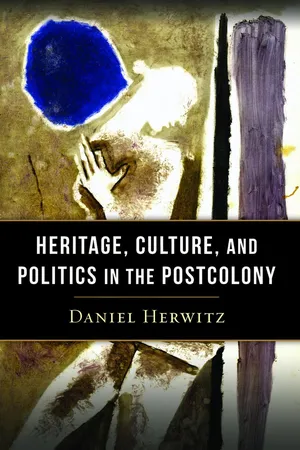
Heritage, Culture, and Politics in the Postcolony
About this book
Information
Topic
PhilosophySubtopic
Social HistoryChapter One

The Heritage of Heritage
I
Heritage entered and remade in an action-packed way and right now, or in the twentieth century anyway, with all the energy and all the fault lines associated. That is the topic of this book. Heritage at the moment of agency, poised between heritage practices of the past and the desire, need, or inevitability of breaking away from them to make something new. My father remade an old farm into his own personal piece of American heritage by preserving vintage barn boards, purchasing green fields, and turning old antiques into Americana; he made old clothing into a heritage brand item for fun and profit. His entry into the book of heritage also changed it. He bought into it, collected and acquired it as if he were a Vanderbilt, Carnegie, or Rockefeller. But he also branded it with his own insignia by turning it into a brand. This is an immigrant’s heritage, that of the newly rich who buy their ancient titles and their places on the boards of venerable institutions which one generation past would have had none of them. It is how they find their way inside: through wearing the past, collecting and marketing it. It is the case of an individual wanting in to the American dream and wanting it in a way that declares his own independence, his own access point, his own drummer. In this way the immigrant latches onto the values of America the first settler society, the first postcolonial state. He (if it is my father) acts as if he is the settler writ large, driving his car around the college towns of New England and New York as if slogging westward ho by wagon train or canoe or arriving at Plymouth Rock by sailing ship. Thus does he magnify his own sense of self through some unique combination of history, movie, and maternal blessing, thinking of himself as Davy Crocket, Randolph Scott, some American explorer.
Across the world young nations, groups of men and women, sects, provinces, conflagrations of people of all kinds have been engaged in the project of rewriting their pasts into heritages, and in particular in that vast part of the world that can be called postcolonial or the postcolony. I lived a decade in South Africa during the moment of political transition, the 1990s. At that miraculous moment of political negotiation, Truth and Reconciliation, and the writing of perhaps the most forward-looking constitution of any nation, old heritages went into tailspins and new ones hurtled into being. Decolonization had placed its European/settler heritages in question, leaving their role in everything from museum practice to university curriculum reeling. Traditional objects (artifacts of “indigenous” culture) and the institutions with which they are associated were being pulled from the “anthropology section” of the museum, recontextualized, and given new meaning within contemporary heritage discourses. Proclaiming one’s past and codifying it in museums and through tourist sites is a virtual obsession through which people aim for acknowledgment (in some social or national or transnational context) and also, as often as not, branding and marketing, profiling and cash. And yet heritage is also the object of the most profound social, national, transnational controversies. It is a headache as well as obsession. Museums, uncertain of how to stake art, retreated to the default position of one size fits all: exhibiting one of everything so as not to leave anything out, nor provide any possibly unjust emphasis on anything. The result: a smorgasbord of art, a department store of incomprehensible items. The most famous painting in the Johannesburg Art Gallery was stolen because the museum, afraid of unduly emphasizing its Eurocentric past, had stashed it in an unlocked closet with old video machines. University debated the role of classics, Romance languages, European philosophy for the new Africa, not always aware that their terms of debate were themselves a product of the philosophical heritages they were sometimes too ready to jettison. Heritage fell into question at this moment of creative inauguration. But, on the other hand, new kinds of performance and exhibition began playing roles in the preservation of community and identity values, but also the remaking of those values in the urban/contemporary vibrancies of new lives being lived, new aspirations being formulated by the young. Performance, always deep in African village and town, quickly morphed into a central vehicle for the remaking of identity, which itself, in the newly inaugurated dispensation, was caught between inherited social practice and new identities tried on in the excitement of a vast social theater called the new country. At the same time, the continuities of heritage became critical to identity and group belonging, placing a conservative angle on heritage (preservation of tradition). Between conservation and free appropriation the past was played out in—and for—the present. The past became heritage done and undone.
Political history is itself an object of heritage making. What was an apartheid struggle is now a story to be told, a set of artifacts to be put on exhibition, a collection of memoirs and history books, a legacy, the stuff of heritage making. How to rescript the story of apartheid as a heritage for the newly evolving postcolonial state: whether to tell it as a vast act of mourning and suffering or March to freedom, within the media of book or digital apartheid museum and Web site, where, when, and featuring whom, for whose jockeying to power and whose benefit and whose readership and for what national purpose? Justice becomes, in the realm of heritage making, a new kind of contest between storytelling, medium, and power. Heritage is a window into the relation of aesthetics to politics as it emerges in the postcolony. By a bizarre act of Parliament, any group that builds a new casino in the country must build an apartheid museum at the site. And so the casino just to the south of Johannesburg, at Gold Reef City, which celebrates the heritage of white mining that was the birth of Johannesburg as a major metropolis and global commercial center, fronts a highly effective apartheid museum designed by an Israeli architect (see chapter 4). No adequate history book has been written for use in the schools that would teach this difficulty and traumatic legacy of South Africa’s in a way congruent with the new democratic dispensation. The country, desperately in need of a national narrative, finds itself unable to reach agreement in and on its telling. Heritage remains at the official level only partly inaugurated even twenty years into the new democracy.
South Africans of every color, creed, linguistic affiliation, and geographical location are meanwhile hard at work turning their sometimes formerly dispossessed or devalued pasts into “heritages,” and this for purposes of acknowledgment, identity politics, and/or commercialization and tourism. Every nook and cranny of every city, hamlet, or rural area has some kind of heritage museum or library/archive or tourist theme park in the hope that Danish, Dutch, and British high moral tourism will stop in, look, listen, and buy. While official state heritage making and related national consciousness is highly contested, decentralized heritage, heritage from “below,” local heritage making, and market-driven heritage practices prosper. In that country (and elsewhere) heritage making is a lens into the problems and prospects of national unity, state-driven narration, and nation building, the diversities of social acknowledgment and the global market forces into which the heritage game enters and sometimes wins big bucks. And also of groups, provinces, and families who seek acknowledgment, voice, power, profiling, and also, as often as not, capital gains through heritage. It is a gesture of voice, an act of empowerment and solidarity, a piece of venture capital.
II
The heritage turn was part of the logic of construction by which many late colonial societies were able to formulate their terms of identity and origin and found their national beginnings. These people at the late colonial moment are likely to see their past as a broken legacy, one that has been castigated, robbed by those in power over them. The recovery of this kind of past, a past which appears to them only in downgraded form, an otherwise lost or inaccessible past, is also a worldwide phenomenon. A past perceived to be alienated, even broken, is one that a people congregate around fixing, and the reconstruction (whether for identity and/or marketplace) is often one of fierce, implacable energy, perhaps violent nationalism.
This dynamic of break, perceived fracture, inaccessibility has been central to the postcolony, where the (precolonial) past is often perceived to have gone through what Frantz Fanon called a process of “devaluation.”1 Mortified as monstrous, primitive, incapable of modernization, colonialism turned the precolonial past into a mark of inferiority, then stuck it in the museum to be gazed at like a nude alabaster Venus missing an arm and a leg. This mortification of a people was compounded by their reeducation as colonial subjects, trained in forms of art, language, philosophy, and writing which gradually supplant the other, and which are learned from a position of subordination. They are usually seen by the colonial master as wearing this education like an ill-fitting suit of clothes, which confirms to the colonial eye their buffoonery. The motto is You too can become a second-rate version of us, so go for it! After all, you have no choice. And so the great game of mimicry begins, further displacing people from past.
The remaking of a dispossessed past into a “heritage” today is important in driving not only nationalism but self-respect. It is also important in the neoliberal game of profiling, branding, and marketing. How this remaking intersects with market forces is one of the most interesting questions one can ask, since it is about the relation between human aspiration, group affiliation, creative innovation, and global self-branding for the marketplace. “Heritage,” John and Jean Comaroff remark in Ethnicity INC: “is culture named and projected into the past, and simultaneously, the past congealed into culture. … It is identity in tractable, alienable form, identity whose found objects and objectifications may be consumed by others and, therefore, be delivered to the market.”2
It is a central theme of that fine book that across the postcolonies the resurgence of identity takes the form of reconstructing heritage as marketable commodity (intellectual property or corporate project). To their idea one may add that of archeologist Nick Shepherd, who points out that the very discourse of heritage is a way of globalizing the local, packaging it in a common and neutral language with immediate status and recognition value on the global stage.3 Redescribed as “heritage,” local rituals, projects, and beliefs suddenly make global sense. Heritage discourse allows local culture potential entry into the circuit of global foundations, nonprofit and humanitarian organizations, world markets by profiling and branding local culture for that globalized, neoliberal consumer system. The paradox is that, like human rights language (with which heritage-speak overlaps), global comprehensibility and recognition are purchased at the price of thinning content into a language of buzzwords.
There is a great deal of truth to Shepherd’s idea, which can be confirmed by the circuitry of international conferences, foundation grants, public goods organizations from UNESCO, all using these same buzzwords, “heritage” being the most obvious, “intellectual property” a close second, with “human capital” coming in third for the bronze. The language of heritage turns local culture into a particular twist on a common tongue, just as a sweater, automobile, news program, or canned food from Peru, Malaysia, Nepal, or Italy often is. This common language makes identity a globally comprehensible, consumable item and provides local populations with relevant profile. Having (suddenly) a heritage makes you (potentially) an international player just as having a Web site in English does. You may even get your fifteen minutes of Andy Warhol glory, jacking up the sales of your land, property, motorbike, flora, fauna, books, or artifacts. The Comaroffs put it thus: empowerment is a term increasingly “connoting privileged access to markets, money, and material enrichment.”4 The very use of heritage-speak empowers by lending the speaker a sense of internationalized “profile,” a belief that by talking the talk and walking the walk they are now international players. Which may well be the case, whether for the heritage ecotourism market or for the world of foundations and grants.
This happens at the expense of the thinning of content, the profiling of content through buzzwords. Heritage making finds itself under pressure to conform to global profiling stereotypes, and all heritage products begin to look alike. The world’s differences thin in the global department store of heritages. But heritage making must also thicken and deepen content if the scripting of a group or nation’s past and traditions, the performance of these, the ritualized presentation of them is a way of achieving depth of voice, is part of the project of self-recognition, of return from alienation. The tension between the profiling game (which thins content) and the aim of deepening the texture of the heritage voice is often very real. This is especially so because the one demands the other. Part of what constitutes recognition or acknowledgment of a group through its heritage making is the circulation of their heritage to some broad class of participants and consumers. Otherwise that heritage, however thick and complex in content, speaks only to a small number of special initiates in a tiny heritage church. Sometimes this is what is perhaps wanted (cult formation, human exclusivity and exclusion), but as often as not a group or nation scripts its past with the aim of empowerment within a wide circle of participants, within an identity politics or nation or global consumer class. And so the simultaneous need to thicken and to thin the content of one’s heritage script/instruments is an ongoing condition or conundrum.
I think every act of heritage gesture today faces something of this double-edged sword: to profile for a nation and/or global consumer population while also thickening the complexity of voice for purposes of self-recognition and what the philosopher Friedrich Nietzsche would call self-becoming (self-creation through new self-narration). This is clearly a matter of trade-off. Sometimes it pushes heritage creation in the direction of a distributed array of products, some of which are quite complicated and deep, others thinner, more globally comprehensible. It is a double-edged sword which extends to the heritage icon, that special event, ritual, story, and/or place which encrypts so much of a group or nation’s past, carries the weight of deep historical signification, but is also a global profiling instrument by which the group or nation gains immediate recognition as well as tourist value. The South African example is of course Robben Island. Robben Island is a tiny salt deposit off the coast of Cape Town where anti-apartheid political prisoners lived in tiny cells and worked digging salt during decades of isolation, connected to the wider world only through their endless gaze at the city of Cape Town and its crystal rock mountain suspended under a cerulean sky and through samizdat documents smuggled onto the island. It is an indelible site of memory, also increasingly a pit stop on the itinerary of the tourist who takes in the island along with a township between photographing the wild game at designer game parks and shopping for wire sculptures of animals, mohair shawls, and printed tablecloths—heritage items all—at the Cape Waterfront. The silence of this liminal island haunts, its aura of incarceration is too powerful to disappear into ecotourism yet, especially when the guided tour is given by a former prisoner whose recitation is a ritualized act of testimony. But the ability of this island to suspend the consumer stance and produce an experience of shock (which stops the traveler in their tracks, inviting complex reflection) may not prove indelible if/when time passes and the immediacy of the memory, its eloquent caesura, fades. As it eventually will over time. If this island is in danger of reducing to another pit stop on the moral tourist’s day planner, then everything is. I will return to this in chapter 4.
A moral pit stop is not always a bad thing: Money is to be made by impoverished peoples through heritage tourism, especially if the tourist will buy the book, eat at the restaurant, purchase the heritage costume, and stay at the B and B. But a moral pit stop is inevitably the victory of thin over thick content; profiling wins out over complexity of voice. It remains within the fast-paced one-dimensional aesthetics of experience rather than in the ambit of deeper human absorption and reflection. Heritage making is therefore an aesthetic issue: about quality and kind of experience afforded in late capitalist society, not simply a moral and political issue about recognition, reparation, and social power. This is why heritage is such a prescient window onto human societies today.
But here one arrives at a prior question, perhaps the basic question. Why heritage of all things? Why should an emerging postcolonial society want entry into this particular way of framing the past, this heritage game? I mean, given how tainted the colonial practice of heritage was, how much damage it did to them? To answer because that’s where the money is is not enough of an answer. More than money is at stake here: the use of a practice, of an instrument, heritage, which was a lynchpin in colonial culture and preached to the native with missionary zeal in the missionary position. Heritage practice was an act of power over those peoples who now want to adopt that very game. Heritage practice was a “gift” in the double-edged sense of offering and poison.5 Why should the postcolony be so obsessed with gaining access to this particular test match? Why should the postcolony be so keen to establish national, museums and acts of modernism, bringing the texture of the past now understood as heritage into the whirl of the present? Why not be done with the heritage game once and for all and treat the past in some other way? After all, the past is infinitely rewritable, from a loose set of traditions to a distant memory to the thing that one opposes to that which one ignores on principle, etc. … Of all the ways in which the past has been and might be rewritten, why restage it as heritage? Why not break with the colonial construction of it altogether?
Is this the case of my father writ large: that there is no stimulus for entry into the heritage game more powerful than being an immigrant or outsider, formerly excluded from the New England Yacht Club and/or the playing fields of Eton? So you determine to create your own access points. Or you become a first-class mimic, changing your name, upgrading your accent, imitating King Charles spaniels for pure breeding?
There is no single answer to this question.
Here is one answer: Heritage has always been perceived in two ways: as the club you can’t enter but also the gift you are offered from the pulpit. Colonial elites have been offered European education, Sunday roast beef, and three-piece tailored suits; they have righteously admired Dickens and company as among the best parts of themselves. Nelson Mandela often spoke this way of the importance of the literacy, literature, respect for law and morality, disciplines of thought he acquired in mission school in the Eastern Cape as a child. He is not alone. Without the positive side of heritage learned in colonial times there could be no impetus for elites to reestablish heritage as a basis of a p...
Table of contents
- Cover
- Half title
- Title
- Copyright
- Dedication
- Epigraph
- Contents
- Preface
- Acknowledgments
- Chapter 1. The Heritage of Heritage
- Chapter 2. Recovering and Inventing the Past: M. F. Husain’s Live Action Heritage
- Chapter 3. Sustaining Heritage Off the Road to Kruger Park
- Chapter 4. Monument, Ruin, and Redress in South African Heritage
- Chapter 5. Renaissance and Pandemic
- Chapter 6. Tocqueville on the Bridge to Nowhere
- Epilogue
- Notes
- Index
Trusted by 375,005 students
Access to over 1.5 million titles for a fair monthly price.
Study more efficiently using our study tools.
Frequently asked questions
Yes, you can cancel anytime from the Subscription tab in your account settings on the Perlego website. Your subscription will stay active until the end of your current billing period. Learn how to cancel your subscription
No, books cannot be downloaded as external files, such as PDFs, for use outside of Perlego. However, you can download books within the Perlego app for offline reading on mobile or tablet. Learn how to download books offline
Perlego offers two plans: Essential and Complete
- Essential is ideal for learners and professionals who enjoy exploring a wide range of subjects. Access the Essential Library with 800,000+ trusted titles and best-sellers across business, personal growth, and the humanities. Includes unlimited reading time and Standard Read Aloud voice.
- Complete: Perfect for advanced learners and researchers needing full, unrestricted access. Unlock 1.5M+ books across hundreds of subjects, including academic and specialized titles. The Complete Plan also includes advanced features like Premium Read Aloud and Research Assistant.
We are an online textbook subscription service, where you can get access to an entire online library for less than the price of a single book per month. With over 1.5 million books across 990+ topics, we’ve got you covered! Learn about our mission
Look out for the read-aloud symbol on your next book to see if you can listen to it. The read-aloud tool reads text aloud for you, highlighting the text as it is being read. You can pause it, speed it up and slow it down. Learn more about Read Aloud
Yes! You can use the Perlego app on both iOS and Android devices to read anytime, anywhere — even offline. Perfect for commutes or when you’re on the go.
Please note we cannot support devices running on iOS 13 and Android 7 or earlier. Learn more about using the app
Please note we cannot support devices running on iOS 13 and Android 7 or earlier. Learn more about using the app
Yes, you can access Heritage, Culture, and Politics in the Postcolony by Daniel Herwitz in PDF and/or ePUB format, as well as other popular books in Philosophy & Social History. We have over 1.5 million books available in our catalogue for you to explore.