Before 9/11, films addressing torture outside of the horror/slasher genre depicted the practice in a variety of forms. In most cases, torture was cast as the act of a desperate and depraved individual, and the viewer was more likely to identify with the victim rather than the torturer. Since the terrorist attacks of September 11, 2001, scenes of brutality and torture in mainstream comedies, dramatic narratives, and action films appear for little other reason than to titillate and delight. In these films, torture is devoid of any redeeming qualities, represented as an exercise in brutal senselessness carried out by authoritarian regimes and institutions.
This volume follows the shift in the representation of torture over the past decade, specifically in documentary, action, and political films. It traces and compares the development of this trend in films from the United States, Europe, China, Latin America, South Africa, and the Middle East. Featuring essays by sociologists, psychologists, historians, journalists, and specialists in film and cultural studies, the collection approaches the representation of torture in film and television from multiple angles and disciplines, connecting its aesthetics and practices to the dynamic of state terror and political domination.
eBook - ePub
Screening Torture
Media Representations of State Terror and Political Domination
- English
- ePUB (mobile friendly)
- Available on iOS & Android
eBook - ePub
Screening Torture
Media Representations of State Terror and Political Domination
About this book
Information
Subtopic
Film History & CriticismIndex
Social SciencesPART I
Torture and the Implications of Masculinity
1
Countering the Jack Bauer Effect
AN EXAMINATION OF HOW TO LIMIT THE INFLUENCE OF TV’S MOST POPULAR, AND MOST BRUTAL, HERO
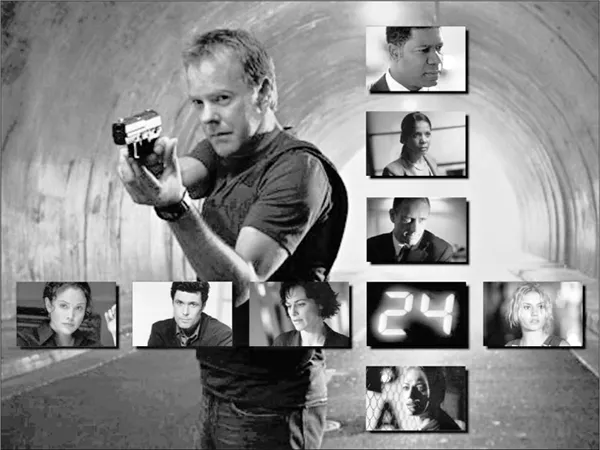
24 – FOX television series (2010–2011)
“You say that nuclear devices have gone off in the United States, more are planned, and we’re wondering about whether waterboarding would be a bad thing to do? I’m looking for Jack Bauer at that time!” [Sustained applause.]
—Tom Tancredo, Republican presidential debate, May 15, 2007, University of South Carolina
To some, Jack Bauer, the hero of the FOX television program 24, is just the sort of guy the U.S. needs to counter the threat from extremist groups like al-Qaeda. Bauer never flinches when confronting a terrorist. In its first six seasons 24 broadcast eighty-nine scenes that feature torture.1 Bauer has used nearly every torture technique imaginable over the lifetime of the series. He has stabbed, shot, kicked, choked, electrocuted, drugged, blackmailed, threatened family members of terrorists with death, and used other exotic forms of torture in his abusive quest for information. Terrorists who are willing to die for their cause routinely reveal critical secrets seconds after Bauer turns on the pain. 24 is at the leading edge of a new trend in television. Since September 11 there has been a lot more torture on TV—an average of more than 120 scenes a year on prime time.2
The torturers have changed too. The heroes on programs like LOST, The Shield, and even Star Trek: Enterprise turn to torture regularly to gain information. When “the good guys” use torture, it almost always works. All this torture has had an impact. Junior U.S. soldiers—and even interrogators at the detention facility in Guantánamo Bay—have copied abusive interrogation techniques they have seen portrayed on TV.3 And military educators say that 24 is one of the biggest problems they have in their classrooms, because young people preparing for a career in the armed services routinely point to the program as evidence that it is necessary to use torture at times to save lives.
A number of public figures have also turned to 24 in explaining their own views on torture. In doing so they have perpetuated the myth that Bauer, or at least men like him, exist. At a jurists’ conference in Canada, for example, Justice Antonin Scalia reportedly said, “Jack Bauer saved Los Angeles. . . . He saved hundreds of thousands of lives.”4 He went on to explain that no jury would convict Bauer of a crime for his use of abusive interrogation techniques. President Bill Clinton, in explaining his position on torture during the run-up to the 2008 Presidential elections, told NBC’s Meet the Press, that any law that approved torture would soon become abused. But, he said, there are security agents like Bauer who might decide to use torture even though it is illegal. “If you’re the Jack Bauer person, you’ll do whatever you do and you should be prepared to take the consequences,” Clinton explained.5 “When Bauer goes out there on his own and is prepared to live with the consequences, it always seems to work better,” the former president added. In December 2006 the Intelligence Science Board, which serves as an expert advisory panel to the U.S. intelligence community, released a report stating, “Most observers, even those within professional circles, have unfortunately been influenced by the media’s colorful (and artificial) view of interrogation as almost always involving hostility and the employment of force—be it physical or psychological—by the interrogator.”6
Copying Bauer
The story of how the Bush administration pulled back from the United States’ long-standing commitment to the Geneva Conventions is well known. As Tony Lagouranis, an interrogator who served at Abu Ghraib, explains in his book Fear Up Harsh: An Army Interrogator’s Dark Journey Through Iraq, interrogators who served in Iraq in 2002 and 2003 were told “to take the gloves off” and encouraged to develop their own interrogation techniques.
“We were told explicitly that the interrogator needed the freedom to get creative,” Lagouranis writes. “So basically there were no limits.”7 In more than one case interrogators turned to television and the movies for inspiration. Lagouranis said that his unit, based in Iraq in 2003, would watch TV programs together and then discuss using the torture techniques they had just viewed on the Iraqis in their custody.
Lagouranis’s unit was not the only one that was inspired by on-screen fictional accounts of interrogation. Lieutenant General Paul Mikolashek, who served as inspector general of the army, was sent into the field in 2004 with a team of investigators to conduct a systemic review of interrogation methods in an effort to determine how widespread the use of torture had become.
Mikolashek’s final report identified “no evidence of a pattern of abuse.” 8 But the field, or “scoping,” notes recorded by one investigator are troubling. A platoon leader said that “at the point of capture, non-commissioned officers were using interrogation techniques they literally remembered from the movies.” 9
Diane Beaver, the highest-ranking uniformed military lawyer at Guantánamo, told Philippe Sands, a lawyer and journalist, that the second season of 24 directly influenced the way that interrogations were conducted at the facility. Sands recounts the conversation in his book, Torture Team: Rumsfeld’s Memo and the Betrayal of American Values. “We saw it on cable,” Beaver told Sands.10 “People had already seen the first series. It was hugely popular.” “He gave people lots of ideas,” Beaver continued, saying that interrogators directly copied Bauer. “You could almost see their dicks getting hard as they got new ideas.”
Torture on 24
24 is set up to knock down whatever hesitations you might have about Bauer’s methods. It is, in a perverse way, an advertisement for torture that ran for eight seasons, every Monday night, from when it first aired on November 6, 2001, to its last episode on May 24, 2010. Bauer is a hero who not only fights terrorists but also all of us who believe that his methods won’t work.
Just about the only assistance that Bauer needs comes from technology (and a squeaky-voiced tech who runs the computers named Chloe). Virtually everyone else—especially those easy-to-hate government bureaucrats—tries to keep Bauer from “taking the gloves off.”
Bauer was often restrained—and sometimes even arrested or otherwise detained—by superiors at the White House and the Counter-Terrorism Unit (CTU, the fictional agency where Bauer is employed), who fear he will use abusive interrogation tactics inappropriately. However, he repeatedly manages to escape, torture the bad guys, gain necessary information, and convince his superiors to continue letting him do his job. In season 4, for example, when Bauer apprehends a suspected terrorist, his superiors prevent him from participating in the interrogation, preferring instead to use more humane questioning tactics. They get nowhere, and the clock is ticking. The terrorist is known to be a part of a cell planning a high-level political assassination. The program heightens the tension by placing a small clock at the bottom of the screen. It counts down as Bauer paces outside the interrogation room.
One of the innovations of the program is the introduction of this clock, which purports to be tracking real time in Bauer’s life. A season, made up of twenty-four episodes, recounts one day of Bauer’s life. After less than ten seconds Bauer decides to take action. He boldly strides toward the interrogation room, knocks out the armed guard on duty, breaks into the room, and shoots the detainee in the knee. “What is your target?” Bauer screams, as he points the gun at the detainee’s other leg. “Secretary of defense,” shouts back the prisoner. While all of this takes place, the CTU director and a colleague are watching (and listening) from behind a one-way mirror connected to the interrogation room. When Bauer first enters they scream at him to stop. When the information is blurted out, they immediately call the White House to warn of the attack. Seconds later Bauer’s boss sends him out to protect the secretary.
Every character who questions the use of torture on the program is ultimately proved to be wrong. Even Bauer’s commitment to abusive interrogations wavers at one point, before he quickly realizes that he has to keep doing “whatever it takes.” In season 6 Bauer actually opposes the torture of a suspect for the first time, only to watch slack jawed as an associate jams a knife into the suspect’s knee, causing him to immediately reveal secrets. Indeed, torture is presented as such a perfect tool when it comes to countering terrorism that just about the only person that it does not compel to talk is Bauer himself. Bauer actually (briefly) dies during a torture scene in season 2 rather than talk. But he quickly comes back to life, and can be seen effectively torturing terrorists later that episode.
Bauer’s Appeal
Interrogators and soldiers in the field were not the only ones who were influenced by Bauer’s tactics. In the summer of 2004, one year after Diane Beaver and her colleagues watched the second season of 24, I began renting DVDs of the program and quickly became hooked on the adrenaline rush that 24 provided. I was an unlikely fan. Days after the revelations of abuse at Abu Ghraib, I was tapped to serve as the manager of Human Rights First’s campaign to end torture. I would spend my days talking to government officials, reporters, and activists about the damage the use of torture had done to the United States.
But at night, as I watched more and more 24, I found that Bauer was chipping away at my ironclad resolve that torture should not ever be employed. I found myself wondering what a U.S. agent should do if he faced the ticking time-bomb situations Bauer faced every Monday night on 24. The experience was unsettling. After all, if this program could have this impact on me—a person who spends his days working to stop torture—I wondered what impact the program might have on the broader viewing public. And I wondered what, if anything, Human Rights First might do about it.
In the fall of 2005 I called Lieutenant Colonel Gary Solis, a retired Marine Corps officer and an attorney who had developed a course on torture and the laws of war that he was teaching at the U.S. Military Academy at West Point. Solis told me, “24 is one of the biggest problems I have in my classroom.”11 He explained that some professors at West Point felt compelled to watch the program in order to argue with their students about why what Bauer had done on the program the night before would never work in the field. During its first four seasons the program boasted more than 15 million regular viewers, and was especially popular among seventeen- to thirty-five-year-old men, according to Nielsen ratings. (After that peak, the program’s ratings ebbed, but ratings show that it continues to be one of the top ten most-viewed programs on TV, with a steady viewership of more than 12 million people.)
On the phone Solis, a combat-decorated veteran of the Vietnam War, asked me, “Have you ever been in a position where you shot someone in combat? Because I can tell you that in real life, it doesn’t sound the same or even smell the same as it does on TV.” Solis said his students were particularly swayed by the scene during the fourth season where Bauer breaks into the interrogation room, shoots the suspect, and finds out about plans to target the secretary of defense. Solis told Jane Mayer of the New Yorker, “I tried to impress on them that this technique would open the wrong doors, but it was like trying to stomp out an anthill.”12
Nudging Hollywood
For the next year I corresponded with Colonel Stuart Herrington, a legendary intelligence officer who...
Table of contents
- Cover
- Half title
- Title
- Copyright
- Dedication
- Contents
- Screening Torture: An Introduction
- Part I: Torture and the Implications of Masculinity
- Part II: Torture and the Sadomasochistic Impulse
- Part III: Confronting the Legacies of Torture and State Terror
- Part IV: Torture and the Shortcomings of Film
- List of Contributors
- Index
Trusted by 375,005 students
Access to over 1.5 million titles for a fair monthly price.
Study more efficiently using our study tools.
Frequently asked questions
Yes, you can cancel anytime from the Subscription tab in your account settings on the Perlego website. Your subscription will stay active until the end of your current billing period. Learn how to cancel your subscription
No, books cannot be downloaded as external files, such as PDFs, for use outside of Perlego. However, you can download books within the Perlego app for offline reading on mobile or tablet. Learn how to download books offline
Perlego offers two plans: Essential and Complete
- Essential is ideal for learners and professionals who enjoy exploring a wide range of subjects. Access the Essential Library with 800,000+ trusted titles and best-sellers across business, personal growth, and the humanities. Includes unlimited reading time and Standard Read Aloud voice.
- Complete: Perfect for advanced learners and researchers needing full, unrestricted access. Unlock 1.5M+ books across hundreds of subjects, including academic and specialized titles. The Complete Plan also includes advanced features like Premium Read Aloud and Research Assistant.
We are an online textbook subscription service, where you can get access to an entire online library for less than the price of a single book per month. With over 1.5 million books across 990+ topics, we’ve got you covered! Learn about our mission
Look out for the read-aloud symbol on your next book to see if you can listen to it. The read-aloud tool reads text aloud for you, highlighting the text as it is being read. You can pause it, speed it up and slow it down. Learn more about Read Aloud
Yes! You can use the Perlego app on both iOS and Android devices to read anytime, anywhere — even offline. Perfect for commutes or when you’re on the go.
Please note we cannot support devices running on iOS 13 and Android 7 or earlier. Learn more about using the app
Please note we cannot support devices running on iOS 13 and Android 7 or earlier. Learn more about using the app
Yes, you can access Screening Torture by Michael Flynn,Fabiola Fernandez Salek in PDF and/or ePUB format, as well as other popular books in Social Sciences & Film History & Criticism. We have over 1.5 million books available in our catalogue for you to explore.