Over the past half century in America, Buddhism has grown from a transplanted philosophy to a full-fledged religious movement, rich in its own practices, leaders, adherents, and institutions. Long favored as an essential guide to this history, Buddhism in America covers the three major groups that shape the tradition—an emerging Asian immigrant population, native-born converts, and old-line Asian American Buddhists—and their distinct, yet spiritually connected efforts to remake Buddhism in a Western context.
This edition updates existing text and adds three new essays on contemporary developments in American Buddhism, particularly the aging of the baby boom population and its effect on American Buddhism's modern character. New material includes revised information on the full range of communities profiled in the first edition; an added study of a second generation of young, Euro-American leaders and teachers; an accessible look at the increasing importance of meditation and neurobiological research; and a provocative consideration of the mindfulness movement in American culture. The volume maintains its detailed account of South and East Asian influences on American Buddhist practices, as well as instances of interreligious dialogue, socially activist Buddhism, and complex gender roles within the community. Introductory chapters describe Buddhism's arrival in America with the nineteenth-century transcendentalists and rapid spread with the Beat poets of the 1950s. The volume now concludes with a frank assessment of the challenges and prospects of American Buddhism in the twenty-first century.
- English
- ePUB (mobile friendly)
- Available on iOS & Android
eBook - ePub
Buddhism in America
About this book
Information
Topic
Theology & ReligionSubtopic
North American HistoryPart One
BACKGROUND
Introduction
A long line of mourners wound its way up the hill behind Zen Mountain Monastery (ZMM) in New York’s Catskill Mountains on a stark November morning. We gathered to inter the ashes of John Daido Loori, one of the native-born, Euro-American dharma teachers who emerged in the 1980s as leaders of a new American Buddhism. Born in 1931, Loori was a part of the so-called Beat generation. In his late thirties, he began to study photography under Minor White and to practice Buddhism with a number of teachers, most importantly Taizan Maezumi, who founded the Zen Center of Los Angeles, an important practice center that emerged in the midst of the cultural revolutions of the Sixties. Loori once described himself to me as a Buddhist “radical conservative,” which was shorthand for saying he admired aspects of the monastic traditions of Japan even as he thoroughly reinterpreted them to suit the needs of Zen-minded Americans.
Daido’s life spanned the Beat and Hip generations, which together have placed an indelible mark on Buddhism in the United States. Attending his funeral became a natural opportunity for me to reflect on how the American Buddhist scene had evolved since around 1990, when I first began to immerse myself in research for the original edition of this book.
At that time, one major story was how, in a few short decades, Buddhism had been transformed from a diffuse spiritual interest pursued primarily through books into a mass movement grounded in face-to-face encounters between Asian teachers and American students. At least since the nineteenth century, Buddhism had been trickling into American culture in a kind of free-floating dharma discourse by way of texts such as Paul Carus’s Gospel of the Buddha and Dwight Goddard’s Buddhist Bible. Americans also became familiar with Buddhism, particularly Zen, through literary expressions like the haiku, practices such as martial arts and the tea ceremony, and architecture and the fine arts. A major leap forward occurred in the 1950s with the publications of works by D. T. Suzuki, Jack Kerouac, Alan Watts, and others now associated with the Beat fascination with Buddhism. Before historians had unearthed Victorian Buddhism, the Buddhist contingent at the World’s Parliament of Religions, and the work of a few very early pioneering teachers, many observers considered the Beat poets to be the quintessential expression of American Buddhism.
Then, quite suddenly, beginning in the late 1960s, Americans became intensely interested in the practice of Buddhism, whether chanting in the Nichiren style or seated meditation as taught in the Zen, Theravada, and Tibetan traditions. Seemingly overnight, something new appeared on the American spiritual landscape—a large number and wide range of vibrant Buddhist institutions. They gave a concrete, social foundation to an emergent, hybrid spiritual movement that was part dharma traditions of Asia and part American enthusiasm, idealism, and innovation.
Light snow fell as the line of a hundred or so mourners made its way into a pine grove near the crest of the hill, where there is a burial ground for the ZMM community, an image of Shakyamuni teaching, and a stupa dedicated to Taizan Maezumi, the monastery’s first abbot. The somber mood of the crowd was cross-cut by a sense that this was also a homecoming for many of Daido’s students, members and affiliates of the Mountains and Rivers Order, one of the many U.S.-born lineages that now comprise the growing ranks of America’s serious Buddhists.
After having studied and practiced for years, many new Buddhists like Loori became authorized to teach—Loori himself in 1986 by Taizan Maezumi. As they established their own teaching centers, American Buddhism grew exponentially, giving rise to a “convert community.” One characteristic institution of this new community was the “dharma center,” a practice hall more than social center, where people could meditate in styles derived from Asian monastic traditions that were being substantively altered to suit the needs of the baby boom generation, who had begun to take conventional jobs and raise middle-class families. After weathering a series of leadership crises in the 1980s, the convert community began to promote what was seen to be a uniquely American dharma in the 1990s. At that time, Buddhism in the United States was hailed as something new—more egalitarian and democratic than Asian Buddhism, more oriented to social activism and open to the interests and aspirations of women. It was seen to be free of the reified ritualism of Asia, unhampered by Asian clericalism, and thoroughly open to the social and emotional needs of American laity.
Today Buddhist rhetoric has shifted in subtle but significant ways. There is less talk of American Buddhism’s unique character and more about deep currents of Westernization and globalization that drive near-universal processes of change and transformation. Many modernist aspects of contemporary Buddhism are now understood to have arisen first in Asia in response to Western incursions during the nineteenth and early twentieth centuries. This modernizing Buddhism was then exported to the West by Asian teachers, where it was further transformed as it was repackaged for Western consumption. Doubly modernized, Western Buddhism is now bouncing back east to drive further transformations of Buddhism in Asia and around the globe.
This shift in rhetoric marks both a shedding of American parochialism and a maturing of convert Buddhists’ self-understanding. The Buddhist movement in the United States is larger, deeper, and more stable than it was twenty years ago, and more confident about its direction and goals. There is less self-celebratory astonishment at its accomplishments and less anxious need expressed about asserting its independence from Asian sources. There is also a more seasoned conviction that Buddhists have a salutary role to play in the crises facing the contemporary world in terms of both sustainable social values and religious practice that can ameliorate human suffering. Having dedicated well over thirty years to the assiduous practice of Buddhism, founding and funding institutions, and establishing national and international networks of colleagues, disciples, and friends, the convert community seems to have hit its stride. With Buddhist children and grandchildren now being born into the dharma, it is technically no longer a convert community but a naturalized feature on the spiritual landscape of America and the West.
But questions that emerged several decades ago about there being “two Buddhisms” in the United States—convert and immigrant—persist as a prominent, apparently perennial feature of the community. Like Euro-American converts, most Asian American Buddhist communities have their roots in the pivotal decade of the 1960s. As a result of a change in immigration law in 1965, Asian immigration soared and by the 1980s substantial Buddhist communities grounded in many national and regional traditions thrived in states from New York to California, Texas, and Illinois.
As was the case two decades ago, there remains today a lack of substantive communication between Euro-American and immigrant communities. It appears that religious sensibilities function so differently in the two groups that both have accepted the fact that there is little common ground between them. Euro-Americans embraced the dharma as a revolutionary spiritual alternative with the convert’s classic zeal, and they continue to conceive of their engagement with it in world-transforming terms. Immigrant religion, however, tends to be infused with the more intimate concerns of memory, solace, and spiritual practice grounded in ethnic, linguistic, and ancestral identity, which profoundly shapes these communities’ approach to the American mainstream. In them, ongoing institutional links to Asia remain influential, even as second and third generations emerge who are, technically speaking, no longer immigrants.
There is evidence that these two very different Buddhist communities are moving toward each other, fitfully. Observers note that lay immigrants are taking up elements typical of Westernized Buddhism and that some converts display an appreciation for liturgical activities once dismissed as too Asian and ritualistic. But the public voice of American Buddhism remains overwhelmingly that of Euro-Americans, who often proceed as if oblivious to immigrants as an intrinsic part of America’s emerging Buddhism. How these two communities will interact in the future production of a Westernized and Americanized dharma, which eventually they must, remains an imponderable question that will require more decades to puzzle out.
I traveled to Zen Mountain Monastery from Santa Fe to pay my respects to Loori because he was one of my major informants on the Zen Buddhist scene. But as I mingled with the many people who converged on ZMM that bitterly cold morning, I realized that I had also come to regard him as a friend. Over the course of several years, Daido and I talked often, not only about his own development but also about his hopes for the American dharma in the twenty-first century. We discussed our shared Roman Catholic formation, an element of his style that contributed to his elegant presence as liturgist when he led public sittings for Woodstock tourists who frequented ZMM’s zendo on summer Sunday mornings. I valued Loori’s view that the crucified Christ so prominent on the impressive craftsman-style stone zendo—once the Catholic church for a camp serving New York City youth—must surely be a bodhisattva. Loori also became a confidant of sorts at the passing of my wife, Ann, and I still fondly recall his gentle counsels to me about life, death, and impermanence inspired by Dogen’s Genjo Koan during a dinner we shared just a week after her shockingly sudden death.
After graveside ceremonies for Loori, the assembled visitors retreated to a nearby inn for a meal and postmortem, but I absented myself, instead driving to Woodstock to make a brief visit to KTD, Karma Triyana Dharmachakra, where I’d also conducted hours of research. Like Zen Mountain Monastery, KTD has grown substantially and is now a formidable U.S. Buddhist institution, the North American seat of the Gyalwa Karmapa, the head of the Kagyu school of Tibetan Buddhism. When I first visited KTD, the question of succession to the office of the Gyalwa Karmapa was in dispute following the death of the Sixteenth Karmapa, Rangjung Rigpe Dorje, in 1981 in a Chicago suburb. The simultaneous recognition and enthronement of two young candidates threatened a schism in the worldwide Kagyu community. KTD backed Ogyen Trinley Dorje, who in 2008 was finally able to travel from Nepal, where he lives in the Tibetan community in exile, to his Woodstock seat, an event that marked for that community a pivotal, ceremonial moment in the history of Buddhism coming West.
As I wandered the grounds of KTD’s mountaintop compound viewing the results of their building campaigns, I was struck again by how American Buddhism has grown with such rapidity and gained such institutional complexity. During the enthusiasm of the Nineties, it was often said that the movement of Buddhism to the United States marked another “turning of the wheel of dharma,” a metaphor used to designate a few major turning points in the religion’s long Asian past. Scholars of that ancient history have long studied the adaptation of the dharma to cultures across Asia through texts, literature, art, and archaeological excavations. For them it was an exciting opportunity to witness a wholly new, New World expression of that process firsthand. For historians of American religion, Buddhism coming West was a culmination of a century and a half of American seekers pursuing alternative spiritual inspiration in the East, a process that began with the New England Transcendentalists. For scholars in either camp who followed developments—the arrival of dozens of regional and national Buddhist traditions on American ground almost simultaneously, the impact of Asian politics on the process of transmission, the arcane doctrinal disputes and institutional adaptations—the spectacle was breathtaking.
In the first edition of Buddhism in America, I wrote that the variety and richness of the Buddhist traditions taking root in the United States militated against a definitive statement about what American Buddhism is and what it will become in the future. Despite important developments over the last two decades, this still appears to be largely the case, so I intend to argue only a modestly revisionist thesis. Several decades ago, the major story in American Buddhism was the way a free-floating dharma discourse—the book and arts-oriented Buddhism noted above—was becoming grounded in a wide range of new dharma institutions. For that reason, I emphasized the differences among selected traditions, some of their distinctive traits, practices, and vocabularies, and how these were beginning to take on institutional shape. Today this institutionalization process continues apace, but so too does the dissemination of powerful, free-floating dharma discourses. The two new essays at the beginning of parts 2 and 3 are a selective update of the American Buddhist scene today, with attention both to progress within institutional Buddhism and to the ongoing role of dharma discourses in the culture at large.
CHAPTER ONE

The American Buddhist Landscape
Mid-Sunday morning in Los Angeles, drumbeats and the ringing of a bell open a service in a temple of the Buddhist Churches of America (BCA), the oldest institutional form of Buddhism in the United States. Despite the drum and bell, commentators have often observed that BCA services, with their hymn singing and sermons, resemble those of American Protestantism, which is taken to be evidence of the assimilation of the BCA into mainstream American society. To a great degree this is true. After more than a century in the United States, the Japanese Americans who compose the bulk of the BCA membership have wrestled in many ways with the Americanization issues faced by racial and religious minorities. But even the most casual observer will note substantial differences between the temple and a Protestant church, the most conspicuous being the altar, with its centrally located, burnished image of Amida Buddha.
Close attention to elements of the service that are familiar—readings from scripture, remembrances for deceased members of the congregation, and birthday congratulations for children—reveals some further, more important differences of a philosophical or, as a Christian might say, theological nature. Most conspicuously, the first of three congregational chants, which are led by the priest and followed by the people sitting in the pews in soft, monotone chant, is called the Three Respectful Invitations:
We respectfully call upon Tathagatha Amida to enter this dojo.
We respectfully call upon Shakyamuni to enter this dojo.
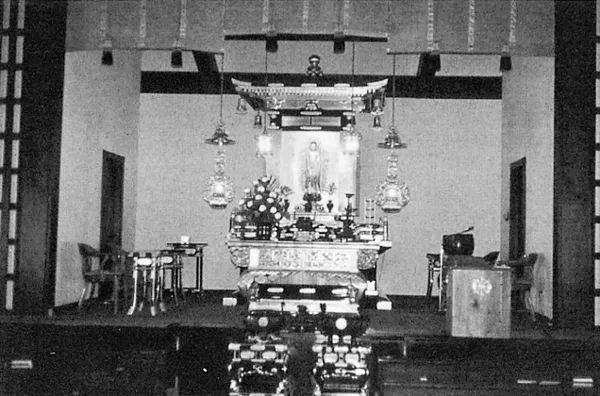
Among the most venerable of the buddhas and bodhisattvas, Amida Buddha is central to the Pure Land tradition of which the Buddhist Churches of America is a part. This Amida image and altar are found in the Midwest Buddhist Temple in Chicago, Illinois, one of a network of temples established by Japanese Americans since the end of the nineteenth century.
PAUL NUMRICH
PAUL NUMRICH
We respectfully call upon the Tathagathas of the ten directions to enter this dojo.1
This is followed by additional recitations, including the phrase Namo Amida Butsu, a key element in BCA practice, referred to as the Nembutsu.
Rituals are seen by scholars of religion as windows ...
Table of contents
- Cover
- Half title
- Series Page
- Title
- Copyright
- Dedication
- Contents
- Introduction
- Part One: Background
- Part Two: Major Traditions
- Part Three: Selected Issues
- Profiles
- Chronology
- Notes
- Glossary
- Resources for the Study of American Buddhism
- Index
Trusted by 375,005 students
Access to over 1.5 million titles for a fair monthly price.
Study more efficiently using our study tools.
Frequently asked questions
Yes, you can cancel anytime from the Subscription tab in your account settings on the Perlego website. Your subscription will stay active until the end of your current billing period. Learn how to cancel your subscription
No, books cannot be downloaded as external files, such as PDFs, for use outside of Perlego. However, you can download books within the Perlego app for offline reading on mobile or tablet. Learn how to download books offline
Perlego offers two plans: Essential and Complete
- Essential is ideal for learners and professionals who enjoy exploring a wide range of subjects. Access the Essential Library with 800,000+ trusted titles and best-sellers across business, personal growth, and the humanities. Includes unlimited reading time and Standard Read Aloud voice.
- Complete: Perfect for advanced learners and researchers needing full, unrestricted access. Unlock 1.5M+ books across hundreds of subjects, including academic and specialized titles. The Complete Plan also includes advanced features like Premium Read Aloud and Research Assistant.
We are an online textbook subscription service, where you can get access to an entire online library for less than the price of a single book per month. With over 1.5 million books across 990+ topics, we’ve got you covered! Learn about our mission
Look out for the read-aloud symbol on your next book to see if you can listen to it. The read-aloud tool reads text aloud for you, highlighting the text as it is being read. You can pause it, speed it up and slow it down. Learn more about Read Aloud
Yes! You can use the Perlego app on both iOS and Android devices to read anytime, anywhere — even offline. Perfect for commutes or when you’re on the go.
Please note we cannot support devices running on iOS 13 and Android 7 or earlier. Learn more about using the app
Please note we cannot support devices running on iOS 13 and Android 7 or earlier. Learn more about using the app
Yes, you can access Buddhism in America by Richard Hughes Seager in PDF and/or ePUB format, as well as other popular books in Theology & Religion & North American History. We have over 1.5 million books available in our catalogue for you to explore.