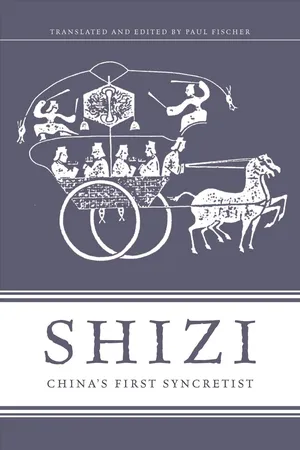
By blending multiple strands of thought into one ideology, Chinese Syncretists of the pre-imperial period created an essential guide to contemporary ideas about self, society, and government. Merging traditions such as Ruism, Mohism, Daoism, Legalism, and Yin-Yang naturalism into their work, Syncretists created an integrated intellectual approach that contrasts with other, more specific philosophies. Presenting the first full English translation of the earliest example of a Syncretist text, this volume introduces Western scholars to both the brilliance of the syncretic method and a critical work of Chinese leadership.
Written by Shi Jiao, China's first syncretic thinker, during the Warring States Period of 481 to 221 BCE, Shizi is similar to Machiavelli's The Prince in that it dispenses wisdom to would-be rulers. It stresses the need for leaders to be detached and objective. It further encourages self-cultivation and effective government, recommending that rulers maintain self-discipline, hire reliable people, delegate power transparently, and promote others in an orderly fashion. The people, it is argued, will emulate their leader's wisdom and virtue, and a just and peaceful state will result. Paul Fischer provides an extensive introduction and a chapter-by-chapter summary and analysis of the text—outlining the importance of syncretism in Chinese culture—and explores the text's particular features, authorship, transmission, loss, and reconstruction over time. The Shizi set the stage for a long history of syncretic endeavor in China, and its study provides insight into the vital traditions of early Chinese philosophy. It is also a template for interpreting other well-known works, such as the Confucian Analects, the Daoist Laozi, the Mohist Mozi, and the Legalist Shang jun shu.
Trusted by 375,005 students
Access to over 1 million titles for a fair monthly price.
THIS CHAPTER, as its name suggests, is about education. The method of education, whether from a particular set of books, from models ancient or modern, or from within a particular school of thought, is not specified. A worthy teacher is suggested once, but elsewhere the implication is that self-study is expected. One major theme is that education is necessary to find worthwhile employment, while another is that such employment itself is worthless if one does not possess the real goal of education: virtue. Finally, the effects of learning are said to be implicated in both theory and practice, for it is only through education that the cosmic Way is reflected and the human person glorified.
This chapter is in four sections. The first defines “learning” as working on oneself, like an artisan on his craft. The second asserts that opportunities for self-improvement can be found in all kinds of circumstances, both supportive and adverse. It also declares that virtue makes adversity easier to bear. The third explains that virtue is superior to rank and status, even though the world at large may appear more concerned with the latter. The last section encourages persistence in learning, but assures the reader that the effects of learning are cumulative: the more one studies, the brighter one will shine.
1.1 Learning is self-cultivation
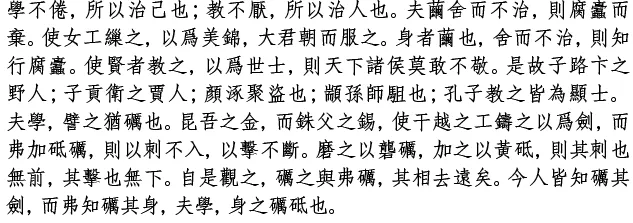
To learn without tiring is that by which one cultivates the self; to teach without becoming bored is that by which one cultivates the people. (If) a cocoon is abandoned and not cultivated, then it will rot away and be discarded. (But if) a female artisan extracts the silk, then this can be used to make beautiful brocade, (fit even for) a great ruler to wear to court. (Your) person is (like) a cocoon: (if) it is abandoned and not cultivated, then (your capacity to) think and act will rot away.1
(But) have a worthy teach you, and (you may) be made into an outstanding official. Then the state sovereigns of the world will all respect (you). This is how Zilu (a rural man from Bian), Zigong (a merchant from Wei), Yan Zhuoju (a thief), and Zhuansun Shi (a horse-broker)—all (men of lowly backgrounds)—became eminent officials after Kong Zi taught them.2
Learning is like sharpening. (Suppose fine) copper from Mount Kunwu and (excellent) tin from Zhufu are worked by the (famous) blacksmiths of Gan and Yue and forged into a sword. Yet (if they) do not use (both) fine and course whetstones (on it), then (when) using (it) to stab, (it) will not enter; and (when) using (it) to slash, (it) will not cut. (But if they) sharpen it with a course whetstone, and add to this with a fine whetstone, then its jabbing will have nothing (that can) withstand (it), and its slashing will have nothing (that will not) fall before (it). (If you) consider it this way, the diference between sharpening and not sharpening (clearly) is great. Nowadays, people all know to sharpen swords, but no one knows to sharpen themselves. Learning is the sharpening of the self.3
Note:The first sentence is a common trope in early Chinese texts. It nicely sets the stage for the entire text of the Shizi. It is likely that we owe to Kong Zi the precedent of educating people from nonnoble backgrounds, as long as they proved to be willing and able. Thus it is fitting that he should be introduced first in this encomium on learning. Mount Kunwu and Zhufu were famous, respectively, for their excellent copper and tin, while swords from Gan and Yue are well-attested in the ancient literature. But even as swords of the best materials are of no use if they are not properly sharpened, so ministers of the noblest backgrounds are of no use if they are not educated.
1.2 Both good and bad circumstances help to complete virtue; virtue makes bad circumstances easier
The Master said: “(People in) carriages only fear ground that is not firm; (those in) boats only fear water that is not deep. (Yet) having these vehicles makes people’s problems easier. (Likewise,) the Way makes people’s problems easier.”
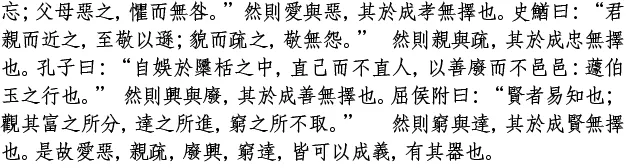
This is why Zeng Zi said: “(If your) parents love you, (then you should be) happy but not neglectful; (if your) parents hate you, (then you should be) fearful but without reproach.” Thus, (a parent’s) love or hate can equally help (us) perfect (our) filiality.4
Shi Qiu said: “(If) the ruler is intimate and close to you, (then you should be) extremely respectful and deferential; (if he) ignores and is distant to you, (then you should be) respectful without resentfulness.” Thus, (a ruler’s) intimacy or distance can equally (help us) perfect (our) devotion.5
Kong Zi said: “Delighting in having his warped traits straightened; straightening himself without (trying) to straighten others; being dismissed (from office) with gracefulness and without despondency: (these) were the actions of Qu Boyu.” Thus, renown or dismissal can equally (help us) perfect (our) excellence.6
Quhou Fu said: “Worthies are easily recognized. (Simply) observe what they distribute (when they are) wealthy, whom they promote (when they are) successful, and what they will not accept (when they are poor).”7 Thus, extremity or success can equally (help us) perfect (our) worthiness.
For this reason, love or hate, intimacy or distance, dismissal or renown, extremity or success: all can be taken to perfect propriety, (if you) have a vehicle.
Note: Education will make your life easier, particularly if it has a firm foundation and sufficient depth. The “Way” used in the third sentence has two possible referents. The first is a contextual “way of learning that sharpens the self and makes problems easier.” The second is the “Way” from a Daoist context. The latter is plausible because the term “way” (
) is only used twice in this chapter, here and in the final sentence, where a more cosmic “Way” is mentioned.
Shi Qiu
, also known as Shi Yu
, was a minister for the state of Wei
. He is known for his unbending commitment to bettering his lord. Qu Boyu
, also known as Qu Yuan
, was also a minister of Wei
and a student of Kong Zi.8 Unlike Shi Qiu, he was known for his flexibility, as well as his modesty and openness to change, even later in life.
Shizi makes three points with these historical figures. The first is “by their fruits ye shall know them”: worthy ministers are recognizable by their actions, not by their pedigrees or their physical attributes. Thus, they share their wealth when rich, promote competent staff when successful, and do not accept bribes even when poor. Second, learning is not just from books; learning also comes from critically examining one’s circumstances. This practical aspect of learning is emphasized in several chapters of the Shizi. Third, educational situations need not always be pleasant, as the Western trope regarding children learning about hot stoves themselves will testify. This is not a matter of trial and error, however, but rather one of making all experiences learning experiences.
The “vehicle” (
) in the last sentence refers us back to the carriages and ships mentioned at the beginning of this section, which can now be seen as metaphors for the virtues of filiality, loyalty, excellence, and worthiness. As carriages need solid roads and ships need deep water, so education needs a firm foundation and depth of learning. Then, with the help of such vehicles or virtues, navigating difficult areas is made easier.9
1.3 Virtue is greater than rank and status
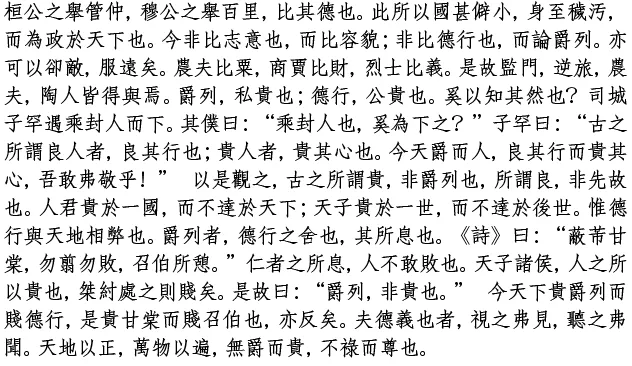
Duke Huan promoted Guan Zhong and Duke Mu promoted Boli (after) evaluating their virtue. Their (virtue) is the reason why such small and remote states, (governed by) such “worthless” people, nevertheless came to rule the world.10 Nowadays no one (seems to) evaluate intentions and ideas, but (only) manners and appearance, and no one evaluates virtue and behavior, but (they only) discuss rank and status. Meanwhile, (it is only virtue) that can make enemies retreat and distant (vassals) submit.
Farmers evaluate grain, merchants evaluate commodities, heroes evaluate proper behavior. This is why (even) gatekeepers, innkeepers, farmers, and potters all will succeed with (correct evaluation).
Rank and status are honored by the selfish, (while) virtuous action is honored by the public-minded. How do (we) know this is so? (Once there was) a Director of City Walls (named) Zihan (who) went to the city of Cheng. (When) he met the sentry (he politely) descended (from his carriage). His attendant said: “(This is only) a sentry from Cheng; why have you descended (from your carriage)?” Zihan replie...
Table of contents
Cover
Title Page
Copyright
Dedication
Contents
Introduction
Content
Transmission
Key Terms
Annotated Translation
1. Exhortation to Learn (Quan xue)
2. Honoring Words [of Good Advice] (Gui yan)
3. Four Kinds of Proper Conduct (Si yi)
4. The Enlightenment Hall (Ming tang)
5. Allocation (Fen)
6. Emerging from Delusion (Fa meng)
7. Considerateness (Shu)
8. Governing the World (Zhi tianxia)
9. Good Intentions (Ren yi)
10. Broad-mindedness (Guang)
11. Generous Fellows (Chuo zi)
12. Dwelling in the Way (Chu dao)
13. Spiritous Enlightenment (Shen ming)
14. Stopping the Chu Army (Zhi Chu shi)
15. The Ruler’s Governance (Jun zhi)
Fragments (Yi wen)
Notes
Bibliography
Index
Frequently asked questions
Yes, you can cancel anytime from the Subscription tab in your account settings on the Perlego website. Your subscription will stay active until the end of your current billing period. Learn how to cancel your subscription
No, books cannot be downloaded as external files, such as PDFs, for use outside of Perlego. However, you can download books within the Perlego app for offline reading on mobile or tablet. Learn how to download books offline
Perlego offers two plans: Essential and Complete
Essential is ideal for learners and professionals who enjoy exploring a wide range of subjects. Access the Essential Library with 800,000+ trusted titles and best-sellers across business, personal growth, and the humanities. Includes unlimited reading time and Standard Read Aloud voice.
Complete: Perfect for advanced learners and researchers needing full, unrestricted access. Unlock 1.4M+ books across hundreds of subjects, including academic and specialized titles. The Complete Plan also includes advanced features like Premium Read Aloud and Research Assistant.
Both plans are available with monthly, semester, or annual billing cycles.
We are an online textbook subscription service, where you can get access to an entire online library for less than the price of a single book per month. With over 1 million books across 990+ topics, we’ve got you covered! Learn about our mission
Look out for the read-aloud symbol on your next book to see if you can listen to it. The read-aloud tool reads text aloud for you, highlighting the text as it is being read. You can pause it, speed it up and slow it down. Learn more about Read Aloud
Yes! You can use the Perlego app on both iOS and Android devices to read anytime, anywhere — even offline. Perfect for commutes or when you’re on the go. Please note we cannot support devices running on iOS 13 and Android 7 or earlier. Learn more about using the app
Yes, you can access Shizi by Paul Fischer in PDF and/or ePUB format, as well as other popular books in Filosofia & Storia dell'Asia. We have over one million books available in our catalogue for you to explore.