- English
- ePUB (mobile friendly)
- Available on iOS & Android
eBook - ePub
About this book
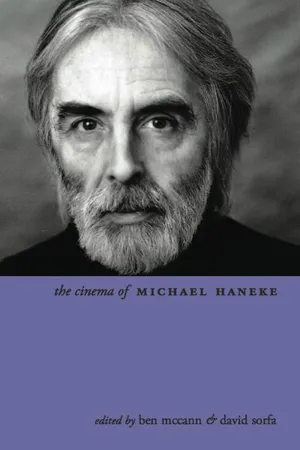
Michael Haneke is one of the most important directors working in Europe today, with films such as Funny Games (1997), Code Unknown (2000), and Hidden (2005) interrogating modern ethical dilemmas with forensic clarity and merciless insight. Haneke's films frequently implicate both the protagonists and the audience in the making of their misfortunes, yet even in the barren nihilism of The Seventh Continent (1989) and Time of the Wolf (2003) a dark strain of optimism emerges, releasing each from its terrible and inescapable guilt. It is this contingent and unlikely possibility that we find in Haneke's cinema: a utopian Europe. This collection celebrates, explicates, and sometimes challenges the worldview of Haneke's films. It examines the director's central themes and preoccupations—bourgeois alienation, modes and critiques of spectatorship, the role of the media—and analyzes otherwise marginalized aspects of his work, such as the function of performance and stardom, early Austrian television productions, the romanticism of The Piano Teacher (2001), and the 2007 shot-for-shot remake of Funny Games.
Information
CHAPTER ONE
Domestic Invasion:
Michael Haneke and Home Audiences
Michael Haneke and Home Audiences
Catherine Wheatley
From the outset of his feature-making career, Michael Haneke has defined his work against the dominant conventions of mainstream (Hollywood) movies. He describes the trilogy of Der siebente Kontinent (The Seventh Continent, 1989), Benny’s Video (1992) and 71 Fragmente einer Chronologie des Zufalls (71 Fragments of a Chronology of Chance, 1994) as ‘a polemic against the American cinema of distraction’ (1992: 89) and in his notes to 71 Fragments of a Chronology of Chance he writes:
I attempt to provide an alternative to the totalising productions that are typical of the entertainment cinema of American provenance. My approach provides an alternative to the hermetically sealed-off illusion which in effect pretends at an intact reality and thereby deprives the spectator of the possibility of participation. In the mainstream scenario spectators are right off herded into mere consumerism. (2000: 172)
In my own book on Haneke, and again in a number of articles, I have posited that both the content and the form of the director’s work are shaped by a concern with the ethics of dominant film-viewing practices.1 My argument throughout is that the director deliberately draws on Hollywood convention (most prominently genre forms) in order to encourage emotional engagement with narrative, only to rupture this engagement by deploying self-reflexive devices which stall the pleasure-drive and give rise to a position of rational awareness that centres around two points of knowledge. At once, the spectator becomes aware of the film as a construct – the product of a director. But at the same time, he becomes aware of himself, sitting in the cinema, as a consumer of the film. In this way, I have argued, the films are able to make their spectators aware of certain desires and motivations that may be less than admirable.
Haneke’s Funny Games (1997) provides the most pronounced illustration of my thesis. The film was promoted as a ‘thriller’, right down to the fact that when it premiered at the 1997 Cannes Film Festival tickets to the screening were issued with a red warning sticker (a measure previously only taken with one film – Quentin Tarantino’s Reservoir Dogs (1992)). Even before entering the cinema, audiences were primed to expect, as Jonathan Romney puts it, ‘a blood-soaked nail-biter’ (1999). And indeed, in the opening thirty minutes of the film, Haneke deliberately heightens these expectations: cutting is moderately paced, speeding up at points of high tension; shot/ reverse-shots, point-of-view shots and lingering close-ups of various objects (a knife left on a boat, a set of golf clubs, the family dog, all of which will play an important role later in the narrative) function as generic signposts. As the director states:
Elements from the history of the suspense thriller appear as quotes – the classical opening, the scene when the boy escapes to the villa – very classical, like Hitchcock. And the audience only engages with the film when they don’t know what’s going to happen, when they allow themselves hope. (In Falcon 1998: 12)
Once the spectator of Funny Games is engaged with the narrative, once they ‘allow themselves hope’, the film draws on a repertoire of self-reflexive techniques, ranging from long, drawn-out shots in which little happens, to direct audience address, to the film’s now infamous diegetic rewind in order to break any sense of intactness, and force the spectator to acknowledge his participation in (ostensibly) violent spectacle.
In my understanding, then, cinematic viewings of Funny Games are characterised by a tension between a pleasurable absorption in the film’s narrative and unpleasurable awareness of the film’s constructedness. At this point of tension, the spectator is invited to enter a thought space, in which he or she engages with the ethical implications of mainstream film consumption. While I stand by this argument, I must nonetheless concede here that it is based upon a rather problematic premise: that the spectator of Funny Games – or indeed, any of Haneke’s other works – is viewing the film in a cinema. And yet with the growing popularity of DVDs and downloads and the concomitant decline of theatrical attendances, such an assumption can at best be rather presumptuous. At worst, it may fail to account for the vast majority of spectators of Haneke’s films: according to the distributors of Funny Games, roughly five thousand viewers saw the film in US cinemas and even fewer in the UK, yet the film has seen steady video sales in both countries.2
Since the experience of home viewing is widely recognised to be significantly different from that of watching a film in a cinema, some consideration of this viewing context is pivotal to a full understanding of how Haneke’s films relate to their spectators. In what follows, I would like to examine the transition which the films undergo when viewed on the small screen rather than in the cinema, and in particular to suggest some ways in which the shift in viewing context might reframe the self-reflexive devices which Haneke employs.
Mediated Reality
In an interview with Michel Cieutat for the journal Positif, Haneke explains that he has been witness to the television’s invasion of the domestic sphere and its hijacking of the cinema’s unique pleasures:
I am part of a generation which was able to grow up without the continual presence of television. So I was therefore able to learn about the world directly, without any intermediary. Today, by contrast, children learn how to perceive reality through television screens, and reality on television is shown in one of two ways: on the one hand there are documentary shows, and on the other fiction. I think that the media has played a significant role in this loss of any sense of reality. (In Cieutat 2000: 28)
Over the course of his lifetime, Haneke has seen television supplant cinema - and eventually transform it. Much has been made in scholarly literature of Haneke’s allegiance to modernist filmmaking traditions, and yet he is working in a postmodern period (or perhaps even a ‘post-postmodern period’): a time when the joys of the cinema, as celebrated by François Truffaut and the young Jean-Luc Godard are passed; when the ideologically pernicious potential of the cinema has been discovered, dismantled and discussed; when critics such as Jean Baudrillard and Slavoj Žižek can write of the disruption between the ‘Virtual’ and the ‘real’. The very etymology of media suggests something of the mediation of perception that has now become a norm. Cine-televisual representation is no longer a new and exciting phenomenon, but something quotidian: we take for granted its presence in homes, hotels, aeroplanes and arenas, public houses and public spaces.
Of course, cinema and television are not the same thing, but they influence each other, ape each other. The brute power of the impression created by the larger-than-life dimensions of the screen upon a one-off visit to the cinema has been matched and indeed overtaken by the mass of impressions and their permanent presence in which both television and DVD play a role. The rapid editing and jump cuts that were so innovative when Godard first introduced them, when Arthur Penn and Sam Peckinpah developed them into their cinema of ‘ultraviolence’ (Prince 1998), are now the hallmarks of MTV and television shows such as ER (1994–2009). Likewise, Peckinpah’s slow-motion montages are now a standard means of stylising gunplay in film and television alike. Little matter that when Peckinpah first introduced this aesthetic of violence into cinema it was intended to shock audiences into a realisation of violence’s true horror; it has now become the norm. Television can take what is most strange, captivating and unique from the cinema and turn it into something domesticated, ordinary, even boring, simply through its ubiquity.
Within Haneke’s oeuvre, Benny’s Video offers the most extended treatment of this perceived mediatisation of reality. Based on a real-life incident, in which a young man videotaped his murder of another teenager, the film provides us with a wealth of incidental detail to suggest how, for Benny (Arno Frisch), perception comes to be mediated by the technology with which he is surrounded. As Brigitte Peucker points out, visual discernment takes place chiefly through a video camera, and the sounds of television and rock CDs form an aural space that envelops him (see 2000: 180). Benny spends his time watching the choreographed violence of action movies and the restrained, ‘normalising’ television reportage of scenes of death in Bosnia (Peucker 2000: 181). In these news programmes, images of carnage are accompanied by voices of commentators carefully trained to exclude all emotion, thus rendering a sanitised version of the real precisely where the spectator has come to believe he has access to its immediacy (see ibid.).
If the realism of film is conceptualised in spatial terms, Mary Ann Doane has argued, the realness of television lies in its relation to temporality, to its sense of ‘liveness’.3 The temporal dimension of television would seem to be ‘an insistent “presentness” – a “This-is-going-on” rather than a “That-has-been”’ (Doane 1990: 222). Television, Doane claims, deals ‘not with the weight of the dead past but with the potential trauma and explosiveness of the present’ (1990: 225). But while Doane connects the liveness of television to trauma, to Haneke’s mind, the medium works hard to keep the shock of catastrophe at bay. Perhaps what is more important than the liveness of the instant of filming is the way in which the very fact of filming automatically consigns its subject matter to the past, packaging it up neatly and sealing it away. For as Doane continues:
Insofar as a commercial precedes news coverage of a disaster which in its own turn is interrupted by a preview of tonight’s made-for-TV movie, television is the pre-eminent machine of decontextualisation. (Ibid.)
The very sense of liveness that characterises televisual information as part of the present means that it effaces the past. Television, as Doane puts it, inhabits a moment in time and then is lost to memory: it ‘thrives on its own forgettability’ (1990: 226). Urgency, enslavement to the instant and hence forgettability are the attributes of televised information and catastrophe; Benny’s demeanour in the face of his crime reflects the calm detachment of a news commentator.
If television is characterised by its liveness, Laura Mulvey (2006) has suggested that video may be characterised by its deadness. In Death 24x a Second, Mulvey argues that the digital frees the viewer from the dictates of narrative continuity and cinema time. For Mulvey, in the cinema of moments or, as she refers to it, ‘delayed cinema’, where the pause button stills movement at will, ‘a film’s original moment of registration can suddenly burst through its narrative time … the now-ness of story time gives way to the then-ness of the time when the movie was made’ (2006: 30–1). Moreover she posits that the modes of nonlinear viewing permitted by video – rewinds, fast forwards and so forth – reveal to the viewer the inherent stillness behind the moving image in the form of the single frame. Mulvey connects the tension between the individual frame and the moving image to cinema’s capacity to capture the appearance of life and preserve it after death. The constant flow of images vomited forward by television is countered by the film still, itself highlighted by the pause button: an image of death. In Benny’s case, this equation of the video image with death is literal. By filming his murder of the young girl, Benny captures it in a constant present, a present without history or consequence – as demonstrated by his replaying and rewinding of the video cassette, reducing and deflating through its overpresence, the murder’s shock value.
At a narrative level we might say that Benny’s Video functions as a critique of how the cinematic conventions of mainstream film and television can contribute to the Debordian ‘Society of the Spectacle’,4 a point echoed formally through Haneke’s use of varying levels of cine-televisual ‘reality’, which render the film extremely self-reflexive. As the film’s title and opening scenes suggest, the boundary between the ongoing diegetic video and the so-called ‘reality’ of the film narrative is repeatedly called into question, and at various junctures the spectator is only retrospectively made aware that the footage he or she has been watching is actually part of Benny’s video (as opposed to Haneke’s film). One of the most effective of such moments within the film occurs at its end, when we see footage shot from the darkness of Benny’s bed into the brightly lit room beyond. The spectator does not recognise the image, but the soundtrack is familiar: it is a conversation in which his parents discuss how best to dispose of the body of the young girl (Ingrid Stassner) that Benny has killed. This sequence, out of temporal order, is momentarily confusing: although the image is unfamiliar, the viewer has heard the dialogue before, and gradually realises that Benny had asked his parents on that occasion to leave the door of his room open because he had meant to videotape (or rather, as it is dark, to record) their conversation. It is not long before the spectator becomes aware that Benny’s video is once again being viewed within the diegesis of Haneke’s film: this time the soundtrack consists in a voice-over conversation about the footage, a conversation that Benny holds with the policeman with whom he is viewing it. As Brigitte Peucker points out, we are well aware that, deprived of a context and without the image of his parents’ suffering to which he had initially been privy, their dialogue on tape will, in all likelihood, serve to indict Benny’s parents for the murder that their son has committed. Hence the videotape functions not only as a document of violence, but as its instrument as well (see 2000: 184).
Reflexivity in the Home
The trope of the threatening tape resurfaces within Haneke’s work – in Caché (Hidden, 2005...
Table of contents
- Cover
- Half title
- Series Page
- Title
- Copyright
- Contents
- Acknowledgments
- List of Contributors
- Introduction
- 1. Domestic Invasion: Michael Haneke and Home Audiences
- 2. Acting, Performance and the Bressonian Impulse in Haneke's Films
- 3. Ethical Violence: Suicide as Authentic Act in the Films of Michael Haneke
- 4. Thinking the Event: The Virtual in Michael Haneke's Films
- 5. Michael Haneke and the Politics of Film Form
- Space
- Unseen Haneke
- Glaciation
- Funny Games
- The Piano Teacher
- Hidden
- The White Ribbon
- Filmography
- Sources and Bibliography
- Index
Trusted by 375,005 students
Access to over 1.5 million titles for a fair monthly price.
Study more efficiently using our study tools.
Frequently asked questions
Yes, you can cancel anytime from the Subscription tab in your account settings on the Perlego website. Your subscription will stay active until the end of your current billing period. Learn how to cancel your subscription
No, books cannot be downloaded as external files, such as PDFs, for use outside of Perlego. However, you can download books within the Perlego app for offline reading on mobile or tablet. Learn how to download books offline
Perlego offers two plans: Essential and Complete
- Essential is ideal for learners and professionals who enjoy exploring a wide range of subjects. Access the Essential Library with 800,000+ trusted titles and best-sellers across business, personal growth, and the humanities. Includes unlimited reading time and Standard Read Aloud voice.
- Complete: Perfect for advanced learners and researchers needing full, unrestricted access. Unlock 1.5M+ books across hundreds of subjects, including academic and specialized titles. The Complete Plan also includes advanced features like Premium Read Aloud and Research Assistant.
We are an online textbook subscription service, where you can get access to an entire online library for less than the price of a single book per month. With over 1.5 million books across 990+ topics, we’ve got you covered! Learn about our mission
Look out for the read-aloud symbol on your next book to see if you can listen to it. The read-aloud tool reads text aloud for you, highlighting the text as it is being read. You can pause it, speed it up and slow it down. Learn more about Read Aloud
Yes! You can use the Perlego app on both iOS and Android devices to read anytime, anywhere — even offline. Perfect for commutes or when you’re on the go.
Please note we cannot support devices running on iOS 13 and Android 7 or earlier. Learn more about using the app
Please note we cannot support devices running on iOS 13 and Android 7 or earlier. Learn more about using the app
Yes, you can access The Cinema of Michael Haneke by Ben McCann,David Sorfa, Ben McCann, David Sorfa in PDF and/or ePUB format, as well as other popular books in Mezzi di comunicazione e arti performative & Film e video. We have over 1.5 million books available in our catalogue for you to explore.