- English
- ePUB (mobile friendly)
- Available on iOS & Android
eBook - ePub
About this book
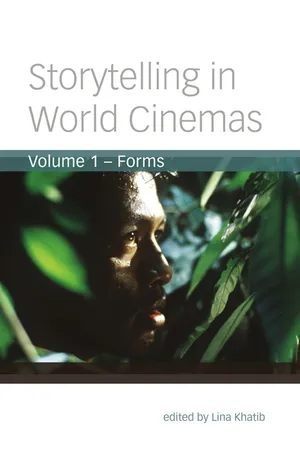
Storytelling in World Cinemas, Vol. 1: Forms is an innovative collection of essays that discuss how different cinemas of the world tell stories. The book locates European, Asian, African, and Latin American films within their wider cultural and artistic frameworks, showing how storytelling forms in cinema are infused with influences from other artistic, literary, and oral traditions. This volume also reconsiders cinematic storytelling in general, highlighting the hybridity of 'national' forms of storytelling, calling for a rethinking of African cinematic storytelling that goes beyond oral traditions, and addressing films characterised by 'non-narration'. This study is the first in a two-volume project, with the second focusing on the contexts of cinematic storytelling.
Information
Subtopic
Film & VideoIntroduction to Volume One
In how many ways can cinema tell a story? Where does this storytelling come from? And what purpose does this storytelling serve? The aim of this two-part project is to locate cinema within a wider cultural and artistic framework: this volume focuses on the theme of storytelling form, on how different cinemas in the world tell stories; the second volume, forthcoming, focuses on what stories are told, and why.
‘World cinemas’ is used in this collection not to refer to a particular category of film, but to emphasise the global scope of the collection, beyond the classical Hollywood narrative. That is not to say that the classical Hollywood narrative, based on Aristotle’s model, is completely unrelated to storytelling forms in other cinemas. On the contrary: as shown in the first three chapters of this volume that discuss ‘national’ cinematic forms in India, Turkey and Hungary, the classical Hollywood narrative as well as other Hollywood influences form a key component of the (nevertheless distinct) identity of those ‘national’ cinemas. This synergy destabilises the dichotomy of national versus Hollywood cinemas. It also shows that national cinematic storytelling is a hybrid form, attesting to the inherent global identity of film as a medium.
This idea is demonstrated in David Murphy’s chapter on storytelling in West African cinema. Murphy challenges the notion that for films to be popular in West Africa, their storytelling form must emanate from a ‘local’ source. Instead, he shows that popular West African films have narrative structures that – in addition to sometimes utilising ‘local’ oral traditions – are influenced not only by Hollywood but also by Bollywood and Hong Kong cinematic storytelling forms. West African cinema sometimes also uses ‘Western’ forms of storytelling as a form of critique (as demonstrated in Matthias De Groof’s chapter on Jean-Pierre Bekolo). Playing with form becomes a method of negotiating between African and Western storytelling techniques, calling for a rethinking of storytelling in African cinemas that frees African films from the clichéd binary of Africa versus the West. But this does not mean that the notion of a storytelling form rooted in local cultures should be completely abandoned. As Claus Tieber shows in his chapter on Indian cinema, and Lindiwe Dovey in her chapter on African cinemas, local influences do exist and create a link between different cinemas from the same locality or region.
The way cinemas use Western narrative forms can also have the aim of producing a distinct identity beyond the ‘national’. The films of Aboriginal filmmaker Tracey Moffatt do exactly that, alluding to Hollywood conventions only to challenge them. Moffatt’s films also reference (and again destabilise) artistic elements of national Australian cinema, such as featuring the expansive Australian landscape in long and wide shots that showcase the breathtaking nature of this land. Moffatt uses landscape and mise-en-scène to send the message that this is a confiscated land, reminding us of the traumatic history of Aboriginals in Australia. Thus, the stories that her films tell as well as the way they are told call for a rethinking of what a ‘national’ cinema in Australia is, or could be, about. This call for the inclusion of ‘others’ when considering ‘national’ cinema is also reflected in Anna Manchin’s chapter on Hungarian cinema which focuses on the use of Jewish humour in Hungarian cinema in the 1930s to show that it is an integral part of this cinema, despite the characterisation of Jewish Hungarians at the time as outside the national imagination.
One of the classical ways of examining influences on cinematic storytelling form is to address the role of literary and oral traditions. This volume addresses this issue through three chapters that unearth the complexities of those influences. Often, thinking about cinematic adaptations of literary texts focuses on the canonical nature of texts or on the relationship between written and cinematic content. Chris Wood goes further in his chapter on the adaptation of Haruki Murakami’s short story Tony Takitani to show that it is not just the text that is being adapted to the screen, it is also the style of the text that is being adapted. Stefanie Van de Peer also writes on the adaptation of style in her chapter on the way oral storytelling techniques and forms in the 1001 Nights are found in the Tunisian film Halfaouine. Adam Ganz wraps up the discussion by taking it to a different level: through taking British ballads, an oral storytelling form, as a case study, he shows how ballads are in fact visual mediums of storytelling that mirror screenplays in their structure and storytelling techniques. This unearthing of the visual component of oral narration, which relies on the audience to fill in the gaps and construct the images for themselves, parallels Savaş Arslan’s discussion of Turkish cinema’s lack of reliance on ‘realistic’ sets as the audience is expected to approach the films from a similar perspective to that of watching theatre, and Jennifer L. Gauthier’s discussion of the films of Tracey Moffatt that are composed of ‘open’ cinematic texts.
But film is a visual medium of course. Gesine Drews-Sylla and Erik Tängerstad pay attention in their chapters to storytelling reliant on visual forms. While DrewsSylla’s chapter examines the way paintings are used as metaphors in Georgian film in the Soviet era, Tängerstad’s shows how visualisation in film can do the opposite, and how film can subvert visual narrative conventions to deceive the audience and force a rethinking of the way in which we approach images on the screen. This effort to engage the audience actively is shared by several filmmakers, and the final three chapters in this collection deal with the work of filmmakers whose work asks the audience to fill in the gaps, whether through inaction, as in the case of the storytelling forms of the films of Apichatpong Weerasethakul, presenting partial information, as in the case of those of Tracey Moffatt, or through directly challenging the audience’s narrative expectations of a ‘national’ cinema language, as in the case of Elia Suleiman.
Part one of this book deals with the question of whether a ‘national’ form of story-telling exists. In chapter one, Claus Tieber poses two key questions: what are the frameworks influencing the way popular Indian films tell their stories? And can the specific narrative structure of these films be explained by Indian traditions and specifics? Tieber argues that the way film production is organised, the target audiences of the film industry and Western traditions such the melodrama are the most influential elements of storytelling in Hindi cinema. These factors are discussed in the context of the changes within the production process in India, which have been taking place since the late 1990s. Nevertheless, he argues that even in the ‘Westernised’ films that were produced during this period, some Indian peculiarities still remain, making Hindi storytelling a hybrid form.
Yeşilçam, the popular film industry of Turkey which persisted from the 1950s to the 1980s, is another hybrid form that presents a variety of visual and oral storytelling conventions. Enmeshed with a melodramatic narration that has a specific history in the West, Yeşilçam’s melodramatic modality is inscribed not only with traditional forms of oral narration but also with a combination of a two-dimensional way of seeing with a perspectival one. While production quality was often low, Yeşilçam included many types of film, ranging from mainstream star productions to auteur films, as well as many genres, ranging from family melodrama and action to horror and sex comedies. Though many of these films rely upon the ‘Turkification’ (i.e. remakes or free adaptations) of Western films, they also present a melodramatic modality that enmeshes elements of a melodramatic narration with an authentic practice of realism. A poor mise-en-scène or poor quality shooting and editing did not present a direct problem because the traditional performing arts in Turkey, such as theatre-in-the-round, did not rely upon the sets but on the explanation of the situation and the start of the play through a series of descriptive instructions. Similarly, Yeşilçam’s presentation of its stories was based on oral more than visual narration. Savaş Arslan’s chapter on Turkish cinema in the 1960s and 1970s shows how such a homegrown melodramatic narration and visual vocabulary is articulated in relation to and as different from Hollywood, which served as the prime and unreachable example for Yeşilçam.
In Hungarian cinema of the 1930s, the classical Hollywood narrative style was also referenced, but this time constantly challenged and undermined by another style of storytelling: the urban central-European Jewish joke. The tradition of the urban Jewish joke – self-deprecating, pessimistic, self-ironic – appears in comedies to question and parody the main narrative, augmenting its message of optimistic wish-fulfillment with self-reflexive commentary on the realities of everyday life. Jewish minor characters representing the ‘unheroic’ in everyone question and mock the easy happy ending and fate of the glamourous protagonist(s). Although this alternative storytelling appears as a sideline, it is ultimately central to the message and world-view of the films, leading to a hybrid storytelling form. Anna Manchin argues here that this is a result of the peculiar historical (cultural and political) context in which these films were created. The films were made by and for a modern urban middle class and mainly Jewish segment of the Hungarian public (and public culture) that was increasingly coming under attack from exclusionist, Christian-Hungarian nationalism in the 1930s. The films’ narratives, punctured by a Jewish tradition of ‘distrustful’ humour, represent the tension between the two coexisting cultural worlds – conservative Christian nationalism and modern urban Jewish cosmopolitanism.
Part two of the book deals with the link between cinematic storytelling and literary and oral forms. One key element under this umbrella is adaptation, and Chris Wood offers an examination of Haruki Murakami’s short story Tony Takitani as adapted for the screen by Jun Ichikawa. The process of adaptation is considered to be mutually constructive, altering the means by which both the short story and film of Tony Takitani are approached and understood. In film, the mode of telling is key and pre-empts what is told. In this way a variety of apparatuses come into play and can be deployed to create an impression which complements the literary original. Through a textual analysis of the film, the chapter argues that disruption of the narrative voice in the film conveys a sense of unreality associated with Murakami’s writing style. Indeed it is argued that it is Murakami’s style which is being adapted to screen as much as it is a particular text.
The influence of oral storytelling traditions is explored in Stefanie Van de Peer’s study of the Tunisian film Halfaouine. Van de Peer offers a complex understanding of the film that focuses on its structure and form while taking into consideration the cultural context in which the film was produced. She shows how the film’s storytelling devices such as fragmentation, narrative interruptions and embedded cycles, assisted by visualisations, parallel those in the 1001 Nights.
Adam Ganz takes a different angle when approaching the influence of oral storytelling traditions on film. His chapter on British preliterate ballads, particularly Lamkin (Child 93), looks at how storytelling techniques in time-based oral narratives foreshadow techniques used in screenwriting, in particular the use of editing techniques, crosscutting, contractions and extensions of time, multiple points of view and implicit camera positions. This leads to comparisons between oral and film storytelling, where in both mediums the story is retold in collaboration with the audience, and the aim of both storyteller and filmmaker is not to tell a story but to give the audience the tools to tell themselves a story.
Part three of the book calls for rethinking storytelling forms in African cinemas. The section begins with a chapter by Lindiwe Dovey that responds to the impasse in African film criticism over the imagined ‘incommensurability’ of celluloid film production (primarily in ‘Francophone’ West African contexts) and video/digital film production (in ‘Anglophone’ West African countries such as Nigeria and Ghana). Dovey argues that, on closer analysis, West African films and videos are not as conflicting in their forms and functions as it would initially appear. Indeed, Nollywood is an integral part of ‘African Cinema’ whose storytelling strategies are a hybrid of ‘traditional’ and Western forms.
Although it is a critical commonplace that African filmmaking is deeply influenced by the oral narrative tradition, there is no consensus on the precise nature of the (supposed) influence of the oral tradition, for example, whether it results in linear or non-linear storytelling structures. At the heart of these conflicting arguments about narrative structure lie (often unspoken) assumptions about the popularity of African cinema: the argument runs that, for an African film to reach, make sense to, and for some critics, ‘teach’, a wide African audience, it must utilise narrative structures with which its local audience is familiar. However, in this process, what significance, if any, should be accorded to African audiences’ familiarity with the narrative codes of Bollywood musicals or Kung-Fu movies? For well over fifty years, there has existed a vibrant cinema-going culture in Africa, which has shaped popular African expectations and understanding of how film narratives operate. Consequently, David Murphy argues that a more productive critical approach to African cinematic narratives must attempt to explore the confluence between Western (modernist) artistic practices and ‘popular’, African oral narrative devices.
An example of this confluence is exemplified in the work of Cameroonian filmmaker Jean-Pierre Bekolo. Matthias De Groof takes Bekolo’s film Aristotle’s Plot as a case study to show how Bekolo fundamentally questions the classical (Aristotelian) scenario structure. This illustrates how he embraces, examines and explores Aristotle’s ideal scenario formula to redefine what cinema is, and to create a subversive way of storytelling. Bekolo is shown to operate within a universal cinematic language while managing to show that cinematic codes are relative. As such, Bekolo emancipates himself from the African storytelling in cinema which expresses itself in particular languages, but at the same time he stands closer to African storytelling strategies to deal with the continent’s history and contemporary reality. Bekolo, as a representative of the new African storytelling, positions his ‘countercinema’ vis-à-vis Western as well as African traditions of storytelling, creating a storytelling form that is based on negotiation of those two traditions.
Part four looks at the use of visuals as a storytelling form. Gesine Drews-Sylla examines the use of paintings in Georgian films about Niko Pirosmanashvili, a painter whose work is considered one of the primary national symbols in Georgia. Focusing on Giorgi Shengelaya’s film Pirosmani, she shows how the film’s language closely follows the visual elements of Pirosmanashvili’s paintings which, form the main elements of a quasi-biography based on myths about the artist’s fate. Drews-Sylla argues that Pirosmanashvili’s life, his works and film narration in Pirosmani form an inseparable unit that must be contextualised within Soviet-Georgian (film) history. As the Soviet-Georgian cinema developed a unique narrative film language which was told in parables and myths – partially in order to avoid Soviet censorship when dealing with contemporary problems – Pirosmani is approached as part of this tradition. In the style of the so-called ‘archaic’ or ‘poetic’ school of Soviet cinema, the film uses the mythological layers of Pirosmanashvili’s biography in order to rephrase it as an allegorical Christian passion. Using this allegory, at the threshold of the Soviet thaw and stagnation periods, the film deals with questions of Georgian nationalism, an artist’s individual moral integrity and the legacy of the historic Russian avantgarde.
Erik Tängerstad’s chapter that follows illustrates a radically different way of using visuals in filmic storytelling. It takes as a case study Milcho Manchevski’s second feature film Dust and analyses its narrative principles as an example of what Manchevski calls ‘Cubist storytelling’. Tängerstad argues that instead of being a film that tells a story conventionally, Dust sets out to provoke spectators to critically reflect on established film conventions. The narrative of Dust circles around a narrative told in the film. But instead of being a narrative within a narrative, Manchevski has placed the story told in the film on the same narrative level as the film’s story, thereby shortcircuiting established film conventions. Images, particularly photographs, form a key part in which the film challenges conventions. Instead of using images in a ‘what you see is what you get’ way, what we ‘see’ in the film is certainly not what we get, allowing the film to raise questions about how to narrate traumatic events (in this case, the atrocities that took place during the 1903 Ilinden Uprising in Macedonia) that never have been recorded in history, and of which no visual evidence exists.
The final part of this book deals with the works of filmmakers who refuse to conform to conventional narrative forms. One of the most renowned filmmakers in this context is Apichatpong Weerasethakul. Through examining his two films Tropical Malady and Blissfully Yours, Matthew P. Ferrari illustrates how the films’ non-narration privileges characters and the symbolic environments they exist in over an unfolding story. In this sense, their storytelling creates a sensual cinema of inaction.
Jennifer L. Gauthier examines another example of refusal to conform through the work of Tracey Moffatt. She shows how non-conforming to film narrative conventions allows Moffatt to speak back to the dominant language of Australian national cinema, and in turn, the notion of national identity in Australia that has historically excluded Aboriginal people. At the same time, Moffatt appropriates dominant film discourses of otherness to subvert them. Her use of soundtracks, mise-en-scène, Aborginal cultural icons, mixed genres and avant-garde aesthetics make her films an exercise in audience participation, where the viewers have to work through the many layers of the films not just to find out what the story is, but also to engage in a dialogue about the cultural politics underlying the films’ messages about Aboriginal people, historically and in the present. As such, storytelling form becomes a political statement speaking against colonial discourse.
A similar strategy is taken by Elia Suleiman in his two feature films Chronicle of a Disappearance and Divine Intervention. In those films, the director’s work strategically moves away from the conventions and techniques of Palestinian film narrative. Sul...
Table of contents
- Cover
- Half title
- Title
- Copyright
- Contents
- Acknowledgments
- Notes on Contributors
- Introduction to Volume One
- ‘National’ Forms of Storytelling
- Storytelling and Literary and Oral Forms
- Rethinking Storytelling Forms in African Cinemas
- Storytelling and Visual Forms
- Refusing to Conform: Forms of Non-narration
- Index
Trusted by 375,005 students
Access to over 1.5 million titles for a fair monthly price.
Study more efficiently using our study tools.
Frequently asked questions
Yes, you can cancel anytime from the Subscription tab in your account settings on the Perlego website. Your subscription will stay active until the end of your current billing period. Learn how to cancel your subscription
No, books cannot be downloaded as external files, such as PDFs, for use outside of Perlego. However, you can download books within the Perlego app for offline reading on mobile or tablet. Learn how to download books offline
Perlego offers two plans: Essential and Complete
- Essential is ideal for learners and professionals who enjoy exploring a wide range of subjects. Access the Essential Library with 800,000+ trusted titles and best-sellers across business, personal growth, and the humanities. Includes unlimited reading time and Standard Read Aloud voice.
- Complete: Perfect for advanced learners and researchers needing full, unrestricted access. Unlock 1.5M+ books across hundreds of subjects, including academic and specialized titles. The Complete Plan also includes advanced features like Premium Read Aloud and Research Assistant.
We are an online textbook subscription service, where you can get access to an entire online library for less than the price of a single book per month. With over 1.5 million books across 990+ topics, we’ve got you covered! Learn about our mission
Look out for the read-aloud symbol on your next book to see if you can listen to it. The read-aloud tool reads text aloud for you, highlighting the text as it is being read. You can pause it, speed it up and slow it down. Learn more about Read Aloud
Yes! You can use the Perlego app on both iOS and Android devices to read anytime, anywhere — even offline. Perfect for commutes or when you’re on the go.
Please note we cannot support devices running on iOS 13 and Android 7 or earlier. Learn more about using the app
Please note we cannot support devices running on iOS 13 and Android 7 or earlier. Learn more about using the app
Yes, you can access Storytelling in World Cinemas by Lina Khatib in PDF and/or ePUB format, as well as other popular books in Media & Performing Arts & Film & Video. We have over 1.5 million books available in our catalogue for you to explore.